
Spiritual growth scriptures are Bible passages that instruct, encourage and shape progress in faith, character and union with Christ; this guide curates essential Old and New Testament verses, explains theological meaning, and gives practical, step-by-step ways to apply them for ongoing spiritual formation and discipleship.
Introduction to Spiritual Growth Scriptures
Answer: Spiritual growth scriptures are specific Bible passages used to foster faith development, moral transformation and deeper relationship with God; they supply theological orientation, ethical correction and encouragement for a believer’s ongoing faith journey.
Term: Spiritual growth refers to the progressive development of a person’s faith, character and relationship with God, shaped by Scripture, prayer, community and practice.

Scripture is the primary lens for Christian spiritual development because it combines doctrinal truth, narrative formation and practical commands. This article focuses on curated passages that explicitly encourage growth in faith, perseverance, wisdom and Christlikeness, rather than general wellness or secular self-help.
Spiritual growth intersects with other needs and resources.
- importance of spirituality and purpose — foundational pillar connecting growth scriptures to wellbeing.
- spiritual needs — growth often meets deep existential and relational needs.
- clarity and purpose in spirituality — scriptures orient moral and vocational purpose.
- meaning of life, point of living, human life’s meaning — scripture helps frame all three.
- living with intention and discovering meaning are supported by verse-based reflection.
- God’s word on spirituality and benefits of spiritual growth provide theological and practical grounding.
- understanding spiritual wellness and spiritual health aspects show how scripture intersects with wellbeing.
Transition: The next section lists core verses that practitioners and leaders repeatedly use to encourage faith increase and steady growth.
Key Bible Verses About Growing Spiritually and in Faith
Answer: Key verses for growing spiritually and in faith include passages that call believers to trust, persevere, learn, obey and bear fruit; the list below groups these passages with concise interpretation and practical relevance.

-
Matthew 5:6 (ESV) — “Blessed are those who hunger and thirst for righteousness, for they shall be satisfied.”
Interpretation: Growth begins with desire for God’s ways; spiritual hunger motivates discipline. Theologians note this beatitude ties desire to future sanctification (see Blue Letter Bible commentary).
-
Philippians 1:6 (NIV) — “He who began a good work in you will carry it on to completion.”
Interpretation: Growth is both divine initiative and human cooperation; faith matures through perseverance and confidence in God’s work (refer to NIV Study Bible notes at NIV Study Bible).
-
2 Peter 3:18 (ESV) — “Grow in the grace and knowledge of our Lord and Savior Jesus Christ.”
Interpretation: Spiritual growth includes doctrinal (knowledge) and relational (grace) dimensions; this verse frames theological learning and character growth as inseparable.
-
Colossians 2:6–7 (NIV) — “As you received Christ Jesus the Lord, so walk in him, rooted and built up in him, strengthened in the faith.”
Interpretation: Metaphors (rooted, built up) imply gradual, stable growth—spiritual habits and community strengthen roots and allow endurance.
-
Hebrews 5:12–14 (ESV) — “By constant practice you have trained yourself to distinguish good from evil.”
Interpretation: Mature believers practice discernment; spiritual growth is apprenticed through regular training and application of Scripture.
-
James 1:2–4 (NIV) — “Consider it pure joy… whenever you face trials… perseverance must finish its work so you may be mature.”
Interpretation: Trials refine faith—perseverance produces maturity. Multiple commentaries discuss cultural context of trial language (see seminary resources at BibleProject).
-
Romans 12:2 (ESV) — “Be transformed by the renewing of your mind.”
Interpretation: Cognitive renewal is central—spiritual growth involves new patterns of thinking informed by Scripture.
-
Galatians 5:22–23 (NIV) — “The fruit of the Spirit is love, joy, peace…”
Interpretation: Character markers measure growth; scripture-guided disciplines produce observable fruit.
-
1 Peter 2:2 (ESV) — “Like newborn infants, long for the pure spiritual milk, that by it you may grow up into salvation.”
Interpretation: Nourishment metaphor highlights dependence on Scripture and spiritual feeding for growth.
-
John 15:4–5 (NIV) — “Abide in me… apart from me you can do nothing.”
Interpretation: Union with Christ is the root; abiding (prayer, Word, sacraments) sustains growth. Commentators emphasize the vine imagery as organic and relational.
-
Ephesians 4:11–15 (ESV) — “Equipping the saints for works of service, so that the body may grow up… into Christ.”
Interpretation: Discipleship and ministry training are instruments of maturity; growth is communal.
-
Proverbs 3:5–6 (NIV) — “Trust in the Lord with all your heart…”
Interpretation: Wisdom literature connects trust and guiding decisions—growth in faith includes practical reliance on God’s guidance.
-
Psalm 119:105 (ESV) — “Your word is a lamp to my feet and a light to my path.”
Interpretation: Scripture provides ongoing direction; meditative engagement with specific verses produces incremental transformation.
-
Acts 2:42–47 (NIV) — Early church practices: teaching, fellowship, breaking of bread, prayer.
Interpretation: Growth occurs where teaching, community, worship and care are consistent; these practices model integrated formation.
-
2 Timothy 3:16–17 (ESV) — “All Scripture is God-breathed and useful for teaching, rebuking, correcting and training in righteousness.”
Interpretation: Foundational verse for Bible study methodology—Scripture equips for every aspect of growth.
-
Matthew 28:19–20 (NIV) — The Great Commission: make disciples, teach obedience.
Interpretation: Growth is missional—discipleship includes instruction and obedience, not private improvement alone.
Transition: The next section groups scriptures that emphasize maturity and the distinctive phrase “growth in Christ,” explaining themes and pastoral implications.
Scriptures Emphasizing Spiritual Maturity and Growth in Christ
Answer: Scriptures emphasizing spiritual maturity and growth in Christ teach progressive sanctification, formation of Christian character, and union with Jesus, using motifs of building, fruit-bearing and training.
Term: Spiritual maturity is the measurable increase in Christlike character, doctrinal stability and fruit-bearing in a believer’s life, often evident in ethical choices and community service.
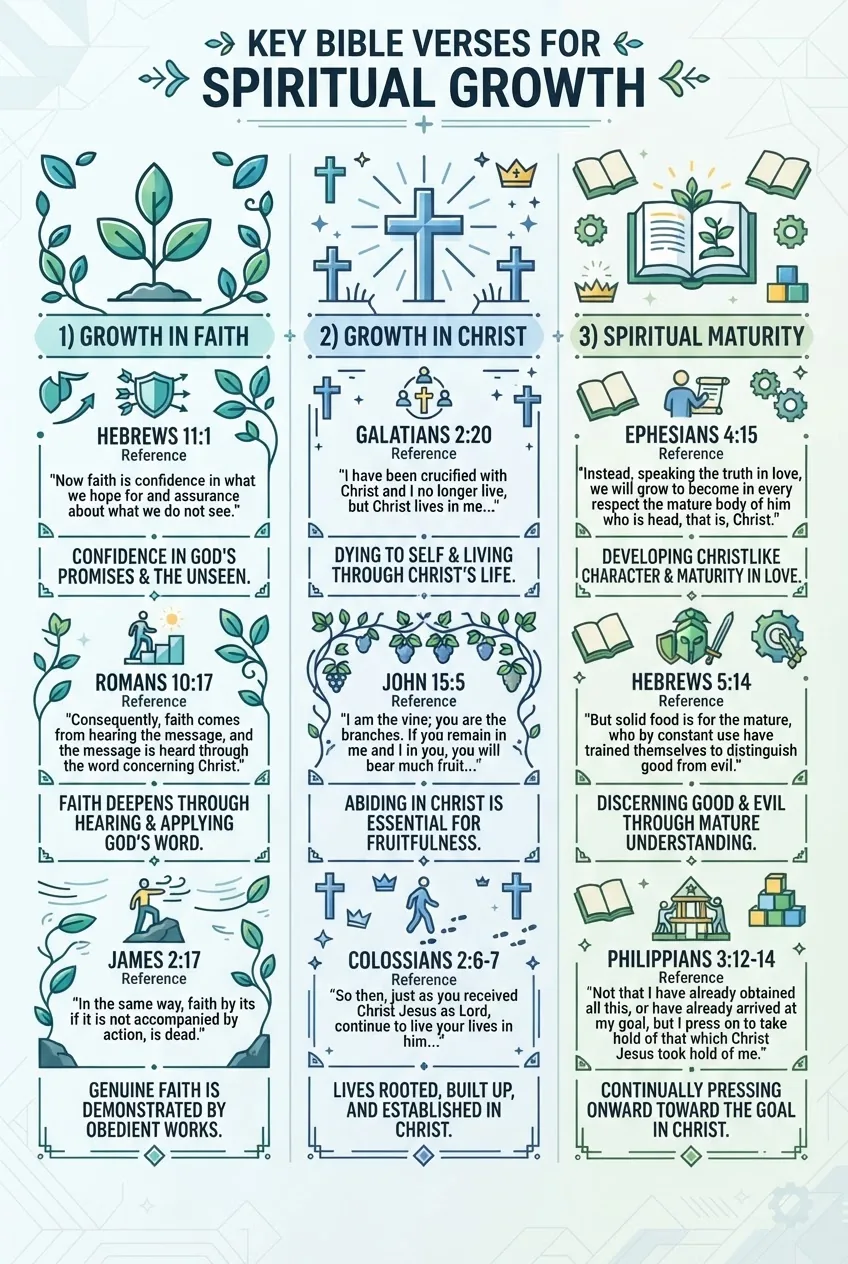
This section groups maturity passages into thematic clusters so you can study by focus.
Growth in Faith (Trust and Perseverance)
- Hebrews 11 — Examples of trust; faith-tested growth through action.
- James 1:2–4 — Trials produce perseverance and maturity.
- Romans 5:3–5 — Suffering produces endurance, character and hope.
Explanation: These verses focus on growth through testing and trust, teaching that faith grows when believers hold to God under pressure rather than withdraw—practical implications include reframing hardship as a context for formation.
Growth in Christ (Union, Abiding, Conformity)
- Colossians 2:6–7 — Rootedness and built-up life in Christ.
- Galatians 2:20 — Living by faith in the Son of God.
- John 15:1–8 — Abiding produces fruit.
Explanation: Verses in this cluster emphasize relational union—growth is not merely moral effort but participation in Christ’s life. For deeper collections, see the dedicated spiritual maturity scriptures.
Christian Character and Love
- 1 Corinthians 13 — Love as maturity’s hallmark.
- Ephesians 4:1–3 — Humility and unity as marks of mature believers.
- Philippians 2:1–11 — Christlike humility and service.
Explanation: Christian love transforms relationships and signals maturity; for a theological treatment of love and growth see biblical love and growth.
Scholarly note: Seminary-level commentaries identify trade-offs when interpreting maturity metaphors—some images (e.g., infant-to-adult) stress dependence then autonomy; others (vine imagery) stress ongoing dependence. Consult seminary resources like Blue Letter Bible for textual notes and BibleProject for narrative context.
Transition: Next we examine Old Testament passages that lay the wisdom and prophetic groundwork for growth motifs found in the New Testament.
Old Testament Verses Relating to Spiritual Growth
Answer: The Old Testament contributes wisdom, covenantal faithfulness and prophetic encouragement that shape spiritual growth—key passages teach trust, obedience, repentance and wisdom as means of formation.
-
Psalm 1 — “Blessed is the one… whose delight is in the law of the Lord.”
Thematic commentary: Contrasts the flourishing of a life rooted in Scripture with the way of the wicked; presents meditation on God’s law as growth practice.
-
Psalms 23, 42, 63 — Personal trust and longing for God.
Commentary: These psalms model prayerful hunger and pastoral comfort; they show emotional and spiritual dimensions of maturity.
-
Proverbs (select) — Proverbs 3:5–6; 4:7; 9:10.
Commentary: Wisdom literature links right thinking and right living; spiritual growth includes learning discernment and wise choices.
-
Isaiah 40:31 — “Those who hope in the Lord will renew their strength.”
Commentary: Prophetic encouragement reframes waiting and hope as sources of renewed endurance for spiritual growth.
-
Jeremiah 29:11–13 — Promise of seeking and finding God.
Commentary: Contextual reading warns against facile application, but the passage offers covenantal assurance that seeking God is met by revelation—this catalyzes growth in trust and purpose.
-
Hosea and Micah — Repentance and returning to covenant faith.
Commentary: Prophets call for ethical reformation; spiritual maturity includes corporate and personal repentance.
-
Job — Suffering, questions and mature faith.
Commentary: Job models how theological struggle and lament can produce deeper reliance on God when processed carefully.
Practical note: Old Testament growth texts often require attention to covenant context and wisdom genre—study methods that include genre identification and historical background prevent misapplication.
Transition: The New Testament develops these themes into discipleship practices, Christ-centered union and communal formation—see the next section for apostolic teachings.
New Testament Teachings on Spiritual Growth and Maturity
Answer: The New Testament teaches growth through union with Christ, the Spirit’s work, discipleship practices, doctrinal formation and church life; apostles present growth as both individual transformation and communal equipping.
Term: Discipleship is the process of being taught and formed to follow Jesus—encompassing doctrine, practice, ethical formation and mission.
Apostolic teaching emphasizes several complementary mechanisms for growth:
-
Union with Christ — Passages: John 15; Colossians 3:1–4; Galatians 2:20.
Explanation: Theological consensus says union is ontological (a believer’s identity) and practical (abiding produces fruit). Interpreters differ on how mystically to read union language; many seminary resources stress both identity and practice aspects for balanced application (Blue Letter Bible).
-
Spirit-empowered Formation — Passages: Galatians 5:16–25; Romans 8.
Explanation: Growth is not solely willpower; the Spirit produces characteristic fruit and empowers mortification of sin. Theological nuance: debates exist over instantaneous vs progressive sanctification; present both perspectives where contested.
-
Instruction and Correction — Passages: 2 Timothy 3:16–17; Hebrews 5:12–14; Titus 2.
Explanation: Scriptural instruction trains believers; apostolic letters often pair doctrinal teaching with ethical correction—maturity stems from both truth and repentance.
-
Community and Ministry — Passages: Acts 2:42–47; Ephesians 4:11–16.
Explanation: The New Testament presents the church as the primary context for growth—leaders equip, and members practice gifts in love.
-
Mission-shaped Growth — Passages: Matthew 28:18–20; Acts missionary narratives.
Explanation: Teaching, baptism and obedience to Jesus’ commands frame growth as outward-facing—making disciples fosters maturity in both teacher and learner.
| Feature | Old Testament Emphasis | New Testament Emphasis |
|---|---|---|
| Primary Motif | Wisdom, covenant faithfulness, prophetic repentance | Union with Christ, Spirit-empowerment, discipleship |
| Practice | Meditation on law, devotional lament, obedience | Community worship, teaching, sacraments/ordinances |
| Goal | Flourishing under covenant | Conformity to Christ and mission |
Interpretive caution: New Testament writers reinterpret Old Testament motifs in light of Christ—readers should use a canonical approach and consult reputable commentaries for nuanced exegesis (see external seminary and commentary sites linked earlier).
Transition: The next section converts these scriptural insights into daily, actionable practices.
Practical Application: How to Use Spiritual Growth Scriptures Daily
Answer: Use spiritual growth scriptures daily by selecting targeted verses, applying a simple study method, integrating them into spiritual disciplines and pairing them with concrete goals to measure observed growth.
Term: Spiritual disciplines are practices (e.g., prayer, Scripture reading, silence, service) intentionally used to cultivate spiritual formation and Christlikeness.
- Choose a focused verse or short passage. Start with verses listed earlier (e.g., John 15:4–5; Philippians 1:6). Keep a rolling list of 2–4 verses to cycle through for a month.
-
Use a simple study method (S.O.A.P. adapted):
- Scripture: Read the verse slowly aloud.
- Observation: Note genre, verbs, commands, promises.
- Application: Ask: “What does this invite me to do today?”
- Prayer: Respond by asking God to shape thought and action.
Step-by-step example: To study Colossians 2:6–7—(1) read; (2) observe images (rooted, built up); (3) apply by planning two weekly practices that “root” you (scripture meditation, community); (4) pray for perseverance. This concrete method shows study-borne application.
- Integrate verses into daily spiritual disciplines. Put short verses into prayer, memorize one phrase weekly, or use a verse as a reflective journal prompt each evening. For complementary routines see daily spiritual practices and spirituality and practices.
- Align scripture with values, goals and life direction. Use verses as litmus tests for decisions and daily priorities; pairing Scripture with intentional goals keeps growth measurable. See guides on core life values, values and goals identification, and finding your path in life.
- Combine Scripture with formation habits for balance and calm. Pair verses with breath prayer, sabbath rest, or service. Resources: building meaning and balance, spiritual growth and connection, and spiritual health and wellness.
- Use Scripture to orient peace and decision-making. Short verses can quiet anxiety and guide choices; see secular and faith resources on achieving inner peace, peace of mind, and personal peace benefits.
- Measure and reflect. Weekly reflection questions, journaling the ways a verse shaped choices, and accountability conversations help track growth—see reflective spiritual questions and finding meaning.
- Apply Scripture to vocational and life-purpose decisions. Use verses for discernment and goal alignment with your calling; resources include finding your path in life, finding direction, and finding your purpose.
- Combine Scripture with community formation. Encourage shared verse study, mentoring, and accountability—Ephesians 4 shows ministry-based growth; church settings multiply formation effects.
Practical tools and complementary resources: a monthly verse plan, a prayer/scripture journal, and a simple accountability rhythm (weekly check-ins) accelerate formation—see guide to growing spiritually for a fuller plan and spirituality and practices.
Real-life example (hypothetical case study): Angela, a church staff worker, used Philippians 1:6 as a monthly focus. Step 1: memorized the verse; Step 2: paired it with weekly mentoring conversations; Step 3: applied it to stress about ministry results. Over six months she reported increased perseverance, less performance anxiety, and deeper reliance on prayer—illustrating how a single verse, studied and practised, shaped character and vocational resilience.
Transition: The following section addresses common questions and interpretive challenges encountered when applying these scriptures.
Common Questions About Spiritual Growth in the Bible
Answer: Frequently asked questions about spiritual growth concern definitions, timelines, application methods, interpretive challenges and denominational differences; concise answers follow to guide study and reflection.
What are spiritual growth scriptures in the Bible?
Spiritual growth scriptures are passages that instruct, encourage or model progress in faith, repentance and Christlike character—examples include John 15:4–5, Philippians 1:6 and Hebrews 5:12–14; they function as doctrinal, practical and devotional anchors for formation.
How do spiritual growth verses differ from spiritual maturity verses?
Growth verses (e.g., 1 Peter 2:2) emphasize process and nourishment; maturity verses (e.g., Ephesians 4:11–15) emphasize completed traits like doctrinal stability and service capacity; together they form a continuum from infancy to maturity in Christ.
How can I use Bible verses to grow spiritually every day?
Choose targeted verses, apply a repeatable study method (Scripture, Observation, Application, Prayer), integrate lines into prayer and habits, track changes weekly, and practice in community for accountability and correction.
What does the Bible say about the timeline for spiritual growth?
The Bible portrays growth as variable—some changes are gradual (Philippians 1:6), others rapid (conversion experiences); Scripture gives principles, not fixed timetables, and cautions against comparing individual journeys.
What are some common challenges in understanding spiritual growth in scripture?
Challenges include ignoring genre, decontextualising promises, theological bias, and denominational lenses; using commentaries and seminary resources helps address historical and literary contexts for accurate interpretation.
How do verses about growing in Christ apply to modern believers?
They apply as calls to union with Christ through prayer, Scripture, community and service; modern application translates ancient practices into present rhythms—abiding, learning, and mission-shaped living.
Is there a difference between spiritual growth and faith growth in the Bible?
Faith growth is a subset of spiritual growth focused on trust and belief; spiritual growth includes faith plus character development, wisdom, love and service—both are interdependent in biblical teaching.
How can I ensure the quality and authenticity of Bible verses about spiritual maturity?
Cross-check passages with context, consult reputable commentaries and Bible dictionaries, examine original language resources, and compare multiple translations to avoid misapplication.
Transition: The conclusion summarises how to continue growth with Scripture and points to resources for deeper reflection and connections.
Conclusion: Embracing Growth Through Scripture
Answer: Embrace a scripture-centered approach—select verses, apply disciplined study and habits, engage community and measure change to experience lasting spiritual transformation and purpose-driven living.
If you’re exploring deeper relational dimensions and signs of spiritual connection, consider spiritual connection insights and spiritual draw and growth. For personal fulfilment through faith see finding meaning through faith.
Final CTA: Begin with one verse this week—study it, apply one practice, and share your experience with a trusted friend or mentor to start measurable spiritual growth today.