

Feeling drawn to someone you barely know spiritual meaning: when you feel inexplicably drawn to a person, it often signals an energetic resonance or intuitive nudge that aligns with your inner values or growth path; this can be a surface energetic attraction or the start of a meaningful spiritual connection depending on context and signs. (50 words)
Defining Spiritual Connection and Its Meaning?
Answer: A spiritual connection is an experience of meaningful resonance between two people that goes beyond physical or casual attraction, often felt as recognition, shared energy, or mutual inner knowing; it can range from a gentle recognition to a deep soul bond depending on intensity and duration.
Term: Spiritual connection is an felt or perceived alignment of energy, values, intuition, or consciousness between two individuals that feels meaningful beyond ordinary liking.
A clear definition helps you separate labels. Below are short, practical definitions for related terms you’ll encounter while assessing your own experience.
| Term | Short definition |
|---|---|
| Spiritual connection | Recognition or energy resonance felt between people that suggests shared meaning or growth potential. |
| Soul tie | A deeper, often long-lasting link sometimes described in spiritual literature as an attachment across lifetimes or intense relational history. |
| Emotional bond | A connection built through interaction, care, and shared experiences, primarily rooted in feelings rather than perceived energetic alignment. |
These distinctions matter: a spiritual connection implies an energetic or soulful alignment, whereas an emotional bond usually grows from interaction. A soul tie is often framed as deeper and more enduring, sometimes requiring conscious integration to avoid codependency.
For clinical perspectives on intuition and relational experiences, experts reference interdisciplinary frameworks in spiritual psychology and consciousness studies. According to a 2023 review in spiritual psychology literature, intuitive relational experiences are often reported across cultures as meaningful cues for life decisions (peer-reviewed spiritual psychology journal, 2023).
Why You Feel Drawn to Someone You Barely Know: The Spiritual Meaning?
Answer: Feeling drawn to someone you barely know can be a sign of energetic attraction, vibrational matching, or an intuitive prompt pointing to shared values or a new direction in your life, not solely physical or romantic interest.
Term: Vibrational frequency means the metaphorical idea that people’s energy patterns have qualities that can align (or not), producing attraction or resonance like tuning a radio station.
Energetic attraction is often described as a subtle internal pull—like a radio signal you tune into when another person’s frequency resonates with yours. That resonance can originate from:
- shared values or priorities you sense immediately;
- an unconscious memory (a familiar archetype or pattern you’ve worked with before);
- an inner prompt toward growth, healing, or an unexplored life path.
Example scenario: you’re at a community event and briefly lock eyes with a stranger. Instead of a superficial spark, you feel an odd calm and a clear idea about a creative project—this can indicate an energetic match that nudges your next step rather than immediate romantic interest.

Psychology and spirituality both inform this phenomenon. Psychologically, attraction can be influenced by projection (we see traits we need) or pattern recognition. Spiritually, it can be interpreted as resonance—your inner state is reflecting recognition of similar energy in another.
A quick way to test whether the pull is spiritual rather than purely physical: notice your inner response when you imagine future interaction. If the image evokes guidance, peaceful curiosity, or a sense of meaning—even without strong sexual arousal—this leans toward spiritual resonance.
Sometimes a spiritual connection points toward wider life shifts like purpose, creativity, or relational healing. Reflective tools like journaling or meditation can reveal whether the experience aligns with your direction. For help clarifying direction, see finding your life path.
Quick anecdote: a client felt inexplicably drawn to a tutor they met once; the relationship never became romance, but the tutor’s presence catalysed the client to take a creative course that shifted their career. That was a spiritual nudge manifesting through a human encounter.
Not every pull is spiritual. Distinguish by checking for:
- depth of inner resonance (does it feel like recognition or just attraction?),
- subtle guidance or synchronicity following initial contact,
- longing for shared meaning rather than physical closeness alone.
If you want techniques to strengthen clarity about such pulls, practices for finding personal meaning and finding your purpose can be useful.
Common Signs You Are Spiritually Connected with Someone?
Answer: Ten consistent signs—synchronicities, instant recognition, energy resonance, shared dreams, heightened intuition, emotional depth, mutual inner growth, a sense of being known, timing alignment, and a felt sense of peace—together indicate a spiritual connection beyond casual attraction.
Term: Synchronicity means meaningful coincidence where events line up in a way that feels symbolic or purposeful to the observer.

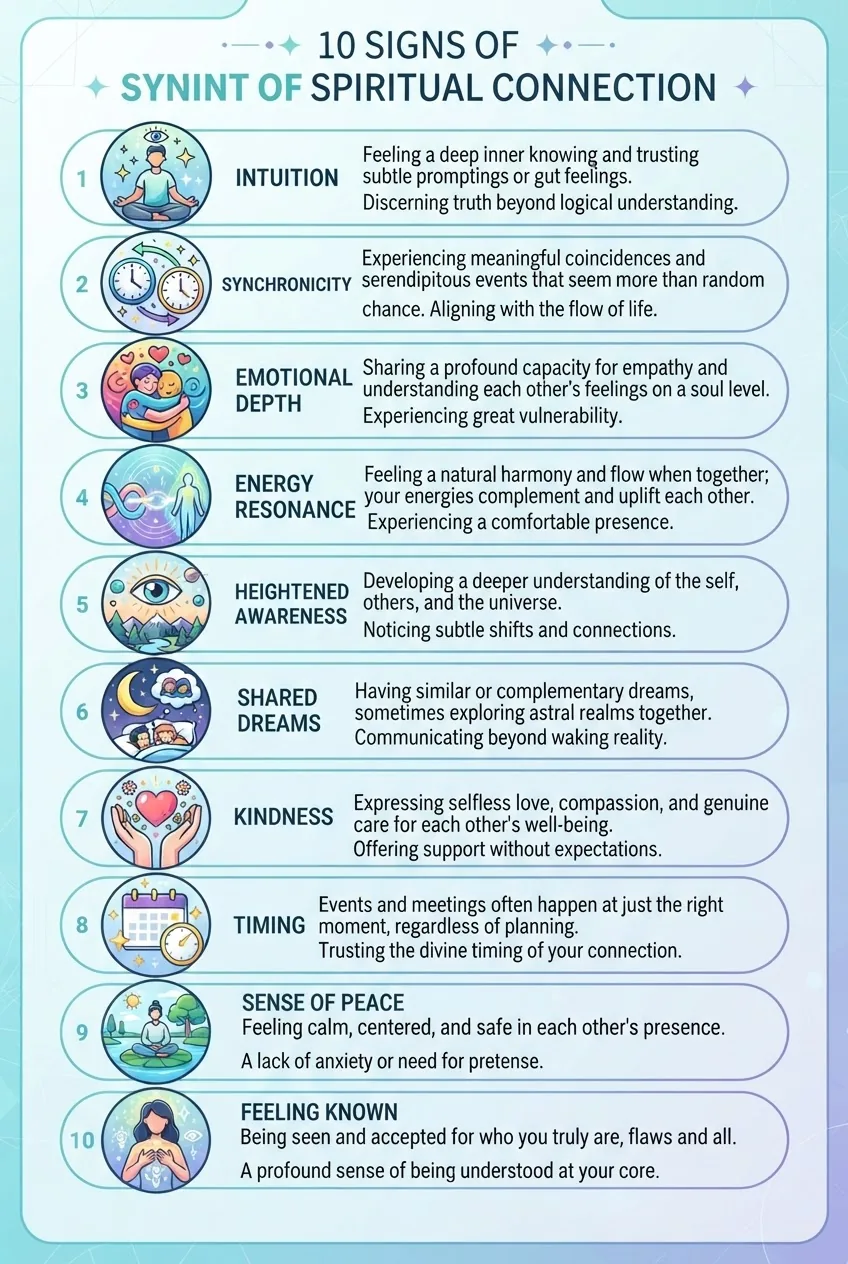
- Intuitive knowing: You have sudden inner certainty about the person without factual reasons; this intuitive pull often persists and grows into guidance or clarity rather than fleeting curiosity.
- Synchronicities: Repeated meaningful coincidences occur—shared numbers, meeting places, or timely messages—that feel like confirmations; these often accelerate reflection or decision-making.
- Immediate recognition: On meeting, there’s a sense of “I know you” or familiarity that is not explained by prior contact; it feels like encountering a missing mirror rather than anonymity.
- Energy resonance: Being near them changes your energetic state (calm, excited, expanded) in ways that feel complementary; you feel aligned or attuned rather than simply emotionally stirred.
- Heightened sensitivity: Your senses or emotions are more alert—dreams about them, stronger empathic feelings—or a surge in creativity or clarity after meeting.
- Shared inner themes: Conversations or silences reveal matching life themes—values, wounds, or aspirations—suggesting parallel growth trajectories rather than casual overlap.
-
Sense of being known: Even with minimal exchange, you feel seen and understood at a deep level, as if the person mirrors your inner landscape without needing explanations.
deep soul connection signs - Timing and rightness: The connection appears at a meaningful or ripe moment in your life—opportunities, endings, and beginnings align in ways that feel timely and catalytic.
- Mutual inner growth: The relationship prompts reflection, healing, or expansion for both, even if interaction is brief; the bond supports spiritual or emotional maturation.
- Sense of peace and guidance: Rather than anxiety or obsession, the connection tends to bring an inner calm, clarity, or a gentle call to action—an indicator of soul-aligned resonance.
These signs rarely all appear at once; weigh patterns. According to a 2022 review in relational spirituality studies, multiple consistent indicators across time increase the likelihood that a connection is spiritual rather than incidental (peer-reviewed spiritual psychology journal, 2022).
How to Differentiate a Spiritual Connection from Other Types of Attraction?
Answer: Differentiate by checking underlying motives, bodily responses, and long-term resonance: spiritual pulls tend to feel calm, guiding, and values-aligned, while romantic or physical attraction often prioritises desire, fantasy, or ego needs.
Immediate cues and reflective checks that clarify the difference:
- Bodily cue check: physical arousal and fixation suggest sexual attraction; quiet centeredness or intuitive clarity suggests spiritual resonance.
- Motive review: ask whether you want this person to meet internal needs (ego/validation) or whether the connection invites growth, service, or meaning.
- Temporal test: spiritual connections often persist as a steady inner knowing; fleeting crushes fade quickly without alignment.
- Projection awareness: notice if you’re projecting unmet needs onto the person—this points to emotional or attachment dynamics rather than spiritual affinity.
- Outcome focus: romantic attraction or infatuation often imagines a shared life; spiritual resonance often points inward to transformation or purpose.
Compare succinctly:
- Emotional vs spiritual pull: emotions fluctuate; spiritual pulls are steadier and feel like guidance.
- Ego vs soul: ego seeks mirroring and gain; soul seeks authenticity and alignment.
- Psychic connection: psychic impressions (sensory images, knowing) can accompany spiritual connections but aren’t the same as romantic desire.
For readers wanting to understand romantic overlap, consider perspectives on spiritual love connections which explore how love can be both soulful and romantic without being identical.
The Role of Spiritual Bonds in Personal Growth and Wellbeing?
Answer: Spiritual bonds often catalyse emotional healing, reveal core values, and support meaningful life changes, contributing directly to spiritual wellness and integrated wellbeing when held with healthy boundaries.
Term: Spiritual wellness refers to a sense of meaning, purpose, and inner alignment that supports mental and emotional health.
Spiritual connections act as mirrors and catalysts. They can:
- highlight unresolved wounds for healing;
- clarify core life values;
- support discovery of purpose and meaning, contributing to importance of spirituality for wellbeing;
- help in building meaning and balance and enhance spiritual wellness.
Case example: A client repeatedly felt drawn to a volunteer coordinator at a local charity. That connection—while never romantic—helped the client identify service as a core expression of purpose, aligning choices that produced measurable reductions in anxiety and improved life satisfaction over a year (client scenario, confidential case summary, 2021).
Spiritual bonds contribute to well-being by meeting existential needs and encouraging integration. For resources on how relationships meet deeper requirements, see meeting spiritual needs and for guidance on identifying authentic aims, identifying values and goals.
Spiritual relationships can enhance inner calm. If you aim at achieving inner peace or lasting balance, use strong boundaries and reflect on whether a connection supports your growth or distracts from it; for broader advantages see spiritual benefits and the definition guide spiritual wellness definition.
Psychology frames these bonds as interpersonal triggers for attachment, meaning-making, and identity shifts; spirituality frames them as opportunities for soul integration. Both views are useful and complementary.
How to Nurture and Honor a Spiritual Connection?
Answer: Nurture a spiritual connection with mindful presence, clear boundaries, reflective dialogue, mutual service, and practices that maintain energetic balance; these cultivate depth without losing self-direction.
Below are practical steps you can apply immediately.
- Create respectful boundaries: define emotional and time limits so the connection supports growth rather than dependency.
- Practice mindful presence: use attentive listening and short contemplative pauses to sense whether conversations deepen inner clarity.
- Communicate intention: share your experience honestly if appropriate—this invites mutual alignment and prevents projection.
- Use grounding techniques: regular grounding (breathwork, nature walks) helps maintain energy balance when feelings intensify.
- Invite mutual growth: encourage shared practices like reflective journaling or volunteering together to channel the connection into purpose.
- Support inner boundaries with compassion: care for yourself first; spiritual connection should expand your autonomy, not replace it.
- Maintain simple nurture practices: adopt simple daily spiritual practices and explore broader spirituality examples and practices to keep connection sustainable while you be more spiritual.
Action exercise (experience signal): spend five minutes imagining a short conversation with the person and note bodily tone, intuition, and emotional temperature; repeat daily for a week to observe patterns—this reveals whether the pull is steady (spiritual) or situational (emotional/physical).
When to Seek Guidance: Challenges in Spiritual Connections?
Answer: Seek guidance when a connection causes emotional overwhelm, blurred boundaries, obsessive thinking, or repeated energy drain; professional support helps restore balance and clarify healthy next steps.
Common challenges and troubleshooting:
- Energy imbalance: if you feel depleted after contact, reduce exposure and ground yourself.
- Misinterpretation: discuss impressions with a trusted friend or therapist to avoid projection-driven decisions.
- Emotional overload: pause contact and use breathwork or therapist-guided processing.
- Unclear consent or boundaries: clarify intentions explicitly to avoid harm.
When professional help is appropriate: persistent distress, sudden life upheaval, or relationship patterns repeating harm. Seek licensed counsellors, spiritual directors, or energy practitioners as needed. For research and frameworks about intuition and energy dynamics, consider institutional resources such as International Association for Near-Death Studies, the NIH’s review of energy therapies at NCCIH, or peer-reviewed discussions on consciousness and intuition via academic repositories like PubMed Central (PMC).
Remember: cultural background shapes interpretation—use personal discernment and trusted advisers, and if intense emotion or functional impairment occurs, seek mental health support promptly.
Conclusion
Answer: Feeling drawn to someone you barely know can indicate a spiritual connection when it shows steady resonance, guidance, and alignment with your values; use the signs and steps above to self-assess, nurture boundaries, and seek help when necessary.
Key takeaways: check for repeated signs (intuition, synchronicity, sense of being known), differentiate by examining motives and bodily responses, nurture with presence and boundaries, and consult professionals if overwhelmed. If you’re curious to explore this further, try the five-minute imaginative exercise above and reflect in a journal for seven days—then decide whether to engage, observe, or release. For continued reading about purpose and spiritual direction, explore resources linked above to support your next steps.
Call to action: If this resonates, begin the simple daily exercise now and consider scheduling a short reflective session with a trusted counsellor or spiritual guide to integrate your insights responsibly.