
Spiritual growth — by the end of this guide you will have a clear, biblically-rooted plan to deepen your faith, measurable short-term goals you can follow for 3–12 months, and practical disciplines to sustain lifelong growth. Estimated time: 30–90 minutes to read and immediately actionable; skill level: beginner to committed practitioner.
This hands-on guide gives step-by-step instructions, scripture-based interpretation, anonymised real-life examples and the exact practices to help you experience meaningful spiritual increase and growth in the spirit.
Before you start
- Prerequisites: personal desire to grow, openness to scripture, and commitment to regular time (start with 15–30 minutes/day).
- Tools and materials: a reliable Bible (ESV or NIV recommended), notebook or journal, a quiet place, and access to a trusted faith community or mentor.
- Baseline measures: record current prayer frequency, Bible reading days/week, and recent examples of spiritual fruit (e.g., patience, service).
Understanding Spiritual Growth
Spiritual growth meaning is the process by which a person matures in their relationship with God, develops Christlike character, and increases observable spiritual fruit in thought, word and deed. Think of growth like a tree: roots (doctrine and prayer), trunk (character and habit), branches and fruit (actions and influence). Growth in the spirit is both inward—renewal of the mind—and outward—love and service.
Define spiritual growth practically: measurable change in knowledge of God, sustained obedience, resilience under trial and increased love for others (see Galatians 5:22–23). Spiritual increase refers to cumulative progress—small, consistent steps that compound over months and years. True growth is non-linear: seasons of rapid insight often follow quiet, slow periods of formation.
The relationship between faith and spirituality: faith provides the foundation (trust in God and Christ’s work), while spirituality is the lived expression of that faith—prayer, worship, study, and moral transformation. As faith deepens, spirituality becomes integrated into daily decisions, relationships and purpose.
If you want to discover alignment between inner convictions and outward life, clarifying values helps. discover your core life values and reflect on how they shape spiritual priorities.
Spiritual growth intersects with meaning and purpose. To further explore what drives growth and purpose, you can find meaning in life and find your purpose through spiritually informed reflection. Growth often surfaces clear values and goals—if you need exercises to identify your values and goals, start there.
Spiritual wellness and the advantages of spirituality are documented across faith and health literature: spiritual practices correlate with meaning, resilience and community support. For an overview of how spirituality supports wellbeing, see our resource on advantages of spirituality and the definition in spiritual wellness definition.
Bridge to the biblical foundation below: a robust theology of growth prevents common errors (performance-based faith, quick-fix spirituality) and anchors progress in grace and truth.
The Biblical Foundation of Spiritual Growth
Biblical spiritual growth begins with regeneration (new birth) and continues as sanctification—God’s ongoing work to make believers more like Christ. The New Testament frames growth in relational and communal terms: we grow “in Christ” and “together” (Ephesians 4:15–16).
“But grow in the grace and knowledge of our Lord and Savior Jesus Christ.” — 2 Peter 3:18 (ESV)
Walk-through: 2 Peter 1:5–8 lays out a practical sequence—faith, virtue, knowledge, self-control, perseverance, godliness, mutual affection, love—each building on the last. Read 2 Peter 1:5–8 slowly in a journal; ask: where am I weakest? Which quality do I need to intentionally cultivate this quarter?
Ephesians 4:15 directs believers to “speak the truth in love” while growing up into Christ. This verse anchors growth in both doctrinal truth (right belief) and relational practice (love). A practical application: align a weekly study focus with a relational application—study patience in Scripture, then practice patience in a single identified relationship for one week.
Key Bible verses on spiritual maturity are compiled in our resource on key Bible verses on spiritual maturity. Use those passages with a trusted commentary (ESV Study Bible notes, NIV Application Commentary) to avoid proof-texting and to understand historical context and pastoral application.
Theological frameworks: classical Protestant sanctification sees growth as cooperative—God initiates and empowers; the believer responds with obedience. Recent theological consensus stresses both divine initiative and human responsibility—grace does not remove effort. For careful doctrinal work, consult seminary resources such as Fuller Seminary for teaching on sanctification and discipleship.
Application example (anonymised case study): “A pastor I worked with reported that after 12 months of coaching they moved from weekly guilt-driven Bible reading to reading focused on one passage with prayer and application, resulting in measurable relational changes and less spiritual burnout.” This illustrates growth as both knowledge and transformed behaviour.
Scripture engagement is central: regular, reflective reading converts information into formation. Choose a translation (ESV or NIV recommended) and a commentary; read definitionally and devotionally: observe, interpret, apply. For dependable contemporary spiritual practice guidance, consult trusted Christian publications like Christianity Today for articles linking doctrine and practice.
Caveat: biblical spiritual growth is a long obedience — expect seasons of apparent stagnation; normalise patience and dependence. The Bible models both sudden revelations and slow, steady formation (consider the disciples’ decades-long growth after Pentecost).
Practical Steps to Grow Spiritually and Faithfully
This section is the hands-on core: follow these numbered steps as a practical plan for spiritual increase. Each step begins with a bolded action and includes biblical references, specific timings, and measurable tasks you can implement immediately.

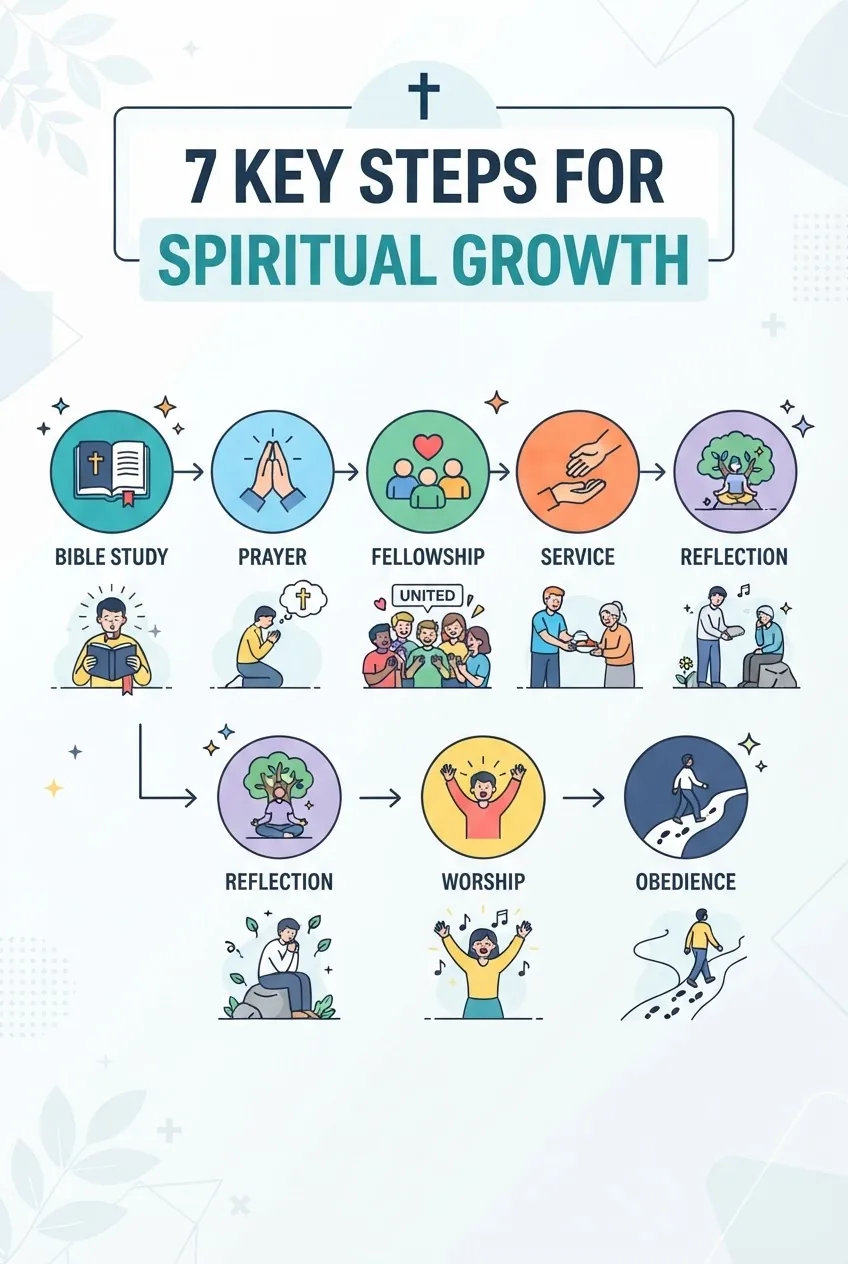
- Establish a Scripture rhythm. Set a realistic schedule: start with 15 minutes daily for 30 days, then increase to 30 minutes. Use the plan: 3 days expository reading, 2 days topical study, 2 days memoir/devotional. Read slowly—one passage, three observations, one application. Anchor: Psalm 119 and 2 Timothy 3:16–17.
- Prioritise focused prayer. Begin each day with a focused 10-minute prayer block and a 20-minute evening reflection on one spiritual goal. Use a simple pattern: Adoration (2 min), Confession (2 min), Thanksgiving (2 min), Supplication (4 min). For longer sessions, practice listening prayer—sit quietly for 5–10 minutes and note impressions in a journal (Hebrews 4:16).
- Practice Scripture meditation (muzzling hurried reading). Pick short passages (e.g., Ephesians 4:15, Philippians 2:5–11), read 3 times, meditate for 5 minutes, write one sentence application. Repeat twice weekly. This slow approach builds knowledge and heart-change (Psalm 1:2).
- Engage consistent worship and sacraments. Attend corporate worship weekly and prepare a 10-minute pre-service time of Scripture and prayer. If applicable, regularly participate in communion as a formative means of grace. Corporate worship reinforces communal spiritual formation (Hebrews 10:24–25).
- Join a small group or accountability pair. Commit to one 90-minute group meeting monthly and 30-minute accountability calls weekly (or biweekly). Share one spiritual victory and one struggle each meeting. Groups provide correction, encouragement, and practical accountability, vital for long-term sanctification (Galatians 6:1–2).
- Serve intentionally in one area for six months. Choose a ministry or local service role and commit 2–4 hours weekly for six months. Serving integrates faith with action and exposes pride, reliance on God, and compassion—key areas for spiritual increase (James 2:14–26).
- Practice fasting and focused denial for discernment. Begin with a 12–16 hour food fast once a month, or a 24-hour fast quarterly, paired with prayer and Scripture. Use fasting to seek clarity on a decision or to deepen dependence on God (Matthew 6:16–18; Acts 13:2–3).
- Develop spiritual disciplines of the heart. Keep a 5-minute gratitude list nightly for 30 days to rewire attention toward God’s faithfulness. Track results: after 30 days, note changes in mood, patience, and prayer content. Spiritual disciplines (solitude, confession, celebration) change neural pathways when repeated consistently.
- Practice spiritual reflection and journaling. Each week, spend 30 minutes reviewing spiritual goals, answered prayer, and areas needing confession. Use the 3-question template: What did I learn about God? Where did I obey/disobey? Who do I serve this week? This promotes intentional growth and prevents drift.
- Obey intentionally in one tested area for 90 days. Identify an area of known weakness (anger, gossip, impatience). Create a 90-day plan with daily micro-actions (e.g., pause and breathe for 10 seconds when triggered). Record incidents and prayer responses. Romans 12:1–2 frames obedience as transformation.
- Learn theology with disciplined study. Commit to one book per quarter on Christian doctrine or spiritual formation (choose a reputable author). Pair reading with a 12-week study plan: read one chapter weekly, summarise, and discuss with a mentor to cement knowledge into life.
- Practice regular sabbath rest. Choose one 24-hour period monthly to refrain from work, technology and obligation; spend time in prayer, nature, and relationships. Rest sustains long-term growth and models trust in God’s provision (Exodus 20:8–11).
- Measure progress with simple metrics. Track weekly: Bible reading days, prayer minutes, service hours, and one observed fruit (patience/joy). Review quarterly with a mentor to adjust practices. Measurements keep formation intentional and visible.
- Seek mentorship and pastoral oversight. Identify a mentor and schedule monthly 60-minute sessions for a minimum of 12 months. Prepare one spiritual question and one accountability report per session. Mentorship accelerates growth and provides corrective wisdom (Titus 2:3–5).
- Integrate learning into relationships. Intentionally practise one learned discipline in relationship settings—e.g., practice listening prayer with spouse or friend, or serve together in a ministry team. Relationship practice translates private devotion into public discipleship.
- Reassess and re-commit each season. Every 3 months review the above steps, celebrate progress, and adjust the plan for the next season. Spiritual growth is cyclical: plan, do, reflect, revise.
For expanded practical examples and exercises, see our overview of examples of spirituality and practices, and to learn how to how to be more spiritual in daily life. If you need help to find your path in life, integrate that discovery into your spiritual plan.
To enhance your spiritual health and integrate these steps with wellbeing practices, see enhance spiritual health and wellness.
Common mistakes and how to avoid them
I have often seen people rush into routines and then burn out. I once recommended a 60-minute daily Bible plan to a busy leader; they quit after two weeks. The correction: start with 15 minutes daily for 30 days, then scale up by 5–10 minute increments. Consistency beats intensity.
Another frequent error I observed is measuring spirituality by emotional highs. I advised a friend to track obedience and relational fruit rather than feelings; over three months their growth was clearer and more sustainable.
Checklist — verify your growth plan
| Item | Status |
|---|---|
| Daily Scripture time scheduled (15–30 min) | Yes / No |
| Weekly worship and community engagement | Yes / No |
| Service role committed for 6 months | Yes / No |
| Mentor identified and monthly meetings set | Yes / No |
| 90-day obedience target defined | Yes / No |
When to call in a professional: if you experience prolonged spiritual dryness accompanied by depression, suicidal thoughts, or severe relational breakdown, seek pastoral counselling and licensed mental health professionals. Faith-based therapists combine spiritual sensitivity with clinical skills.
Common Obstacles to Spiritual Growth and How to Overcome Them
Spiritual stagnation and dryness are normal phases. Identify barriers quickly and apply targeted remedies.
- Distractions and time scarcity: Solution — time-block 15–30 minutes daily; remove devices during that time; treat it like a non-negotiable appointment.
- Doubts in faith: Solution — journal questions, study related passages, and discuss with a mentor. Doubt can be a pathway to deeper conviction when handled honestly (see Acts 17:11 model).
- Performance-driven spirituality: Solution — reframe growth around grace; adopt one practice of confession and thanksgiving each day to counter legalism (Romans 8:1–4).
- Loneliness or lack of community: Solution — join a small group, volunteer, or seek a local congregation; community provides correction and encouragement.
- Unmet spiritual needs: Solution — address these by reading our resource on spiritual needs and their importance and integrate practical steps to meet them.
Overcoming obstacles often requires combining spiritual practices with pastoral care or faith-based therapy when issues relate to trauma or mental health. When obstacles persist after deliberate effort, consult a trained counsellor within your faith tradition.
Signs You Are Experiencing True Spiritual Growth
Growth rarely just feels good; it produces distinct indicators in character, relationships and perspective.
Common signs include increased love and patience, measurable changes in speech and action, greater alignment of life with Biblical convictions, and the fruit of the Spirit evidenced in daily choices (Galatians 5:22–23). For deeper relational cues, see our piece on deep soul connection signs and consider how connection grows with spiritual maturity.
Specific examples: when conflict arises you respond with listening and humility rather than instant defensiveness; your prayers shift from requests to alignment with God’s will; serving becomes joyful rather than burdensome. These are practical, observable shifts.
Recognising inner peace and sustained hope are credible signs. To investigate this, compare personal experience with our inner peace guide, lasting peace of mind, and articles explaining peace of mind meaning or personal peace explained.
Spiritual love—prioritising others’ good over self-interest—is a hallmark of maturity. For a focused look at love’s role in growth, consult our spiritual love exploration.
Integrating Spiritual Growth Into Daily Life Without Repeating Daily Practices Guide
Integration means living the disciplines so they shape decisions, not only devotions. This section gives high-level strategies (not a daily-practice repeat) to embed growth into your routines.
Make one weekly decision that expresses your faith: choose an ethic for the week (hospitality, patience, generosity) and set two specific acts to perform before Sunday. Track accountability in your journal.
Align life roles with purpose: if your work is stressful, choose one faith-informed habit (a 5-minute mid-day prayer pause) that recalibrates. If you want help building meaning and balance in life, map your week and allocate 25% of discretionary time to relationship and service.
Live your purpose by selecting one verse or mission statement for the quarter and placing it on your desk, phone lock-screen, or family board. For practical inspiration on daily application, see our piece on live your purpose. For more detailed daily routines, consult our daily spiritual practices guide.
Resources for Deepening Your Spiritual Growth Journey
- Bible study tools: Commit to one translation (ESV or NIV) and use the ESV Study Bible or NIV Application Commentary for historical and pastoral notes. These help prevent misinterpretation.
- Seminary and theological resources: Read introductory material from reputable institutions such as Fuller Seminary for balanced teaching on sanctification, or explore lecture series from established biblical studies institutes for depth.
- Trusted Christian authors: Consider classics like Richard Foster (Celebration of Discipline), Dallas Willard (The Spirit of the Disciplines), and contemporary writers who marry doctrine with practice. These authors model disciplined spiritual formation without legalism.
- Faith communities and mentors: Join a small group in a local church or online congregation and identify a mentor; practical growth is communal. Many churches provide one-to-one discipleship programs lasting 6–12 months.
- Academic studies on spirituality and wellbeing: Research shows correlations between spiritual practice and psychological resilience; for summaries of peer-reviewed work, consult university repositories and comprehensive overviews such as resources on Pew Research—religion.
- Recommended books (non-promotional): Foster’s Celebration of Discipline (12-week read plan), Dallas Willard’s The Spirit of the Disciplines (theology and practice), and a recent pastoral formation guidebook for mentoring frameworks.
- Prayer and devotional apps: Use apps for accountability (set daily reminders), but avoid letting tech become a substitute for embodied community.
For curated scripture collections that support growth, see our guide to Bible verses for spiritual growth and our overview of what what God says about spirituality as a foundation for practice.
Transition to wrap-up
These steps and resources form a cohesive plan: theological grounding leads to disciplined practice, communal formation and measurable growth. The next section summarises key takeaways and invites a practical first action.
Key takeaways: spiritual growth is a lifelong, grace-filled process requiring scripture engagement, prayer, community, service, and intentional measurement. Start small, scale with consistency, and rely on mentors and the local church for accountability.
Natural next step: choose one step from the numbered list and commit to a 30-day trial—document progress and review after 30 days. If you want guided help, consider contacting your local pastoral team or a certified Christian counsellor.