
What you’ll achieve: By the end you will have a practical, day-by-day plan to consistently live your purpose—including a morning and evening routine, a weekly review, a journaling tracker, and decision rules to align choices with meaning. Time required: start in 30–45 minutes and implement routines over 8–12 weeks. Skill level: beginner to practiced seeker; no prior spiritual training required.
Before you start
- A notebook or journaling app and a pen (one dedicated journal is best).
- 10–30 minutes daily allowance for first 12 weeks (split into two 10–15 minute sessions).
- Willingness to test habits for a minimum of 4 weeks before adjustment.
- Optional: a simple habit tracker (spreadsheet or app) and a timer.
- Openness to read or revisit core values exercises once every 6 months.
Understanding What It Means to Live Your Purpose
Purpose-driven life is not only a label — it is a consistent practice of aligning daily actions with a sustained sense of meaning. At its core, living your purpose means your routine choices, work, relationships and commitments answer the question: “Does this move me toward what matters most?” That alignment becomes the engine of meaningful living rather than episodic moments of inspiration.
Think of purpose as a personal mission that orients behavior the way a compass guides travel. Your authenticity shows up when you act from values rather than obligation; personal values integration means values become active filters you use when deciding how to spend time, energy, and money.
Often, external signals—like strong resonance with a cause or repeated pull toward certain activities—are practical indicators that your inner north aligns with a larger aim; see deep soul connection signs for more on those signals.
Some people report unmistakable markers of congruence: deeper clarity after quiet reflection or feeling “called” toward service. These are covered in spiritual connection meaning and signs, which explain how spiritual alignment can confirm a path.
Living purposefully also overlaps with the search for finding meaning in life — but remember: meaning is durable when it’s embodied through daily habits and choices, not just discovered as an idea.
Concrete examples:
- A teacher whose purpose is to cultivate curiosity builds weekly open-ended exploration sessions into lesson plans, not just occasional inspired lessons.
- An entrepreneur whose mission is sustainable living chooses suppliers by ecological impact metrics and blocks two hours weekly for community education.
- A parent whose aim is emotional presence sets phone-free family dinners and a five-minute mindful-breath check-in every evening.
In practice, a purpose-driven life is the steady translation of inner orientation into outer structure: calendars, rituals, words you use, and the boundaries you set. The rest of this guide teaches how to create those structures so authenticity and clarity direct your days.
Transition: With a working definition now clear, next we examine the measurable and lived benefits that purposeful living reliably produces.
The Benefits of Living a Meaningful and Intentional Life
Choosing intentional living brings both subjective wellbeing and measurable health benefits. Below are the primary gains and the research or institutional signals supporting them.
- Greater psychological resilience: People who report higher purpose show stronger recovery after stressors. According to a 2021 peer-reviewed study in a psychology journal, individuals with clear sense of purpose had smaller cortisol spikes after acute stress tasks (peer-reviewed study, 2021).
- Improved mental health and reduced depression risk: Research reviews link purpose and lower depression scores across age groups; according to a 2018 systematic review in a peer-reviewed journal, strong life meaning correlates with decreased depressive symptoms (peer-reviewed review, 2018).
- Longer-term physical health benefits: Several longitudinal studies associate purpose with reduced risk of cardiovascular events and lower all-cause mortality over decades (peer-reviewed cohort studies, various years).
- Enhanced life satisfaction and fulfillment: Distinct from momentary happiness, fulfillment vs. happiness is about sustained satisfaction; surveys show people orienting to purpose report higher life satisfaction even when daily mood fluctuates (national survey data, 2020).
- Better work meaning and productivity:Employees who connect daily tasks to broader purpose take fewer sick days and demonstrate higher engagement metrics (industry report, 2022).
- Stronger social bonds and community engagement: Purpose often orients people toward service or contribution, increasing social capital and supportive relationships (social science research, 2019).
For a deep dive on the spiritual and wellbeing framework underpinning these effects, see the importance and wellbeing benefits of living your purpose.
Selected external authority citations:
- Mindfulness and stress reduction frameworks: NIH review on mindfulness-based interventions (peer-reviewed review, 2016).
- Mental health baseline and public health context: WHO mental health fact sheet (public health agency, 2022).
- Purpose and health literature review: peer-reviewed review on purpose and well-being (peer-reviewed review, 2018).
Transition: If the benefits motivate you, the next section is a practical primer on discovering purpose, followed by daily embodiment strategies.
How to Discover Your Purpose (Brief Overview with Internal Link)
Discovering purpose is a short process of clarifying the intersection of what energizes you, what you’re good at, and what the world needs. This section gives a compact, actionable path; for full exercises and step-by-step values work, follow the detailed guides linked below.
Three core moves to begin:
- Map recurring energy signals: Over one week, note activities that leave you energized vs drained. Track for 15 minutes after each major activity to record energy and meaning scores (1–5).
- Identify contribution themes: List 6 ways you like to help or contribute. Reduce to top 2 patterns that appear across roles (work, friendships, volunteering).
- Translate themes into a directional statement: Write a one-sentence mission such as “I create [what] so that [who/why].” Keep it testable for 4 weeks.
Values are critical to sustainability in purpose. To discover your core life values, use a 60-minute values card sort or a 30-minute reflection chart.
To explore directional practices and structured ways to test a path, see finding your path in life, which outlines 90-day experiments to validate emerging missions.
When you are ready for a stepwise program to clarify intention and focus, try finding your purpose with clarity and focus — that guide contains extended journaling prompts, values diagnostics, and role experiments.
Practical timing: allocate four structured sessions (45–60 minutes each) across two weeks to produce a testable purpose statement and a six-week experiment plan.
Transition: With a working purpose statement, the next major step is embodying it each day—here are concrete, actionable strategies to make purpose practical and repeatable.
Strategies for Living Your Purpose Daily

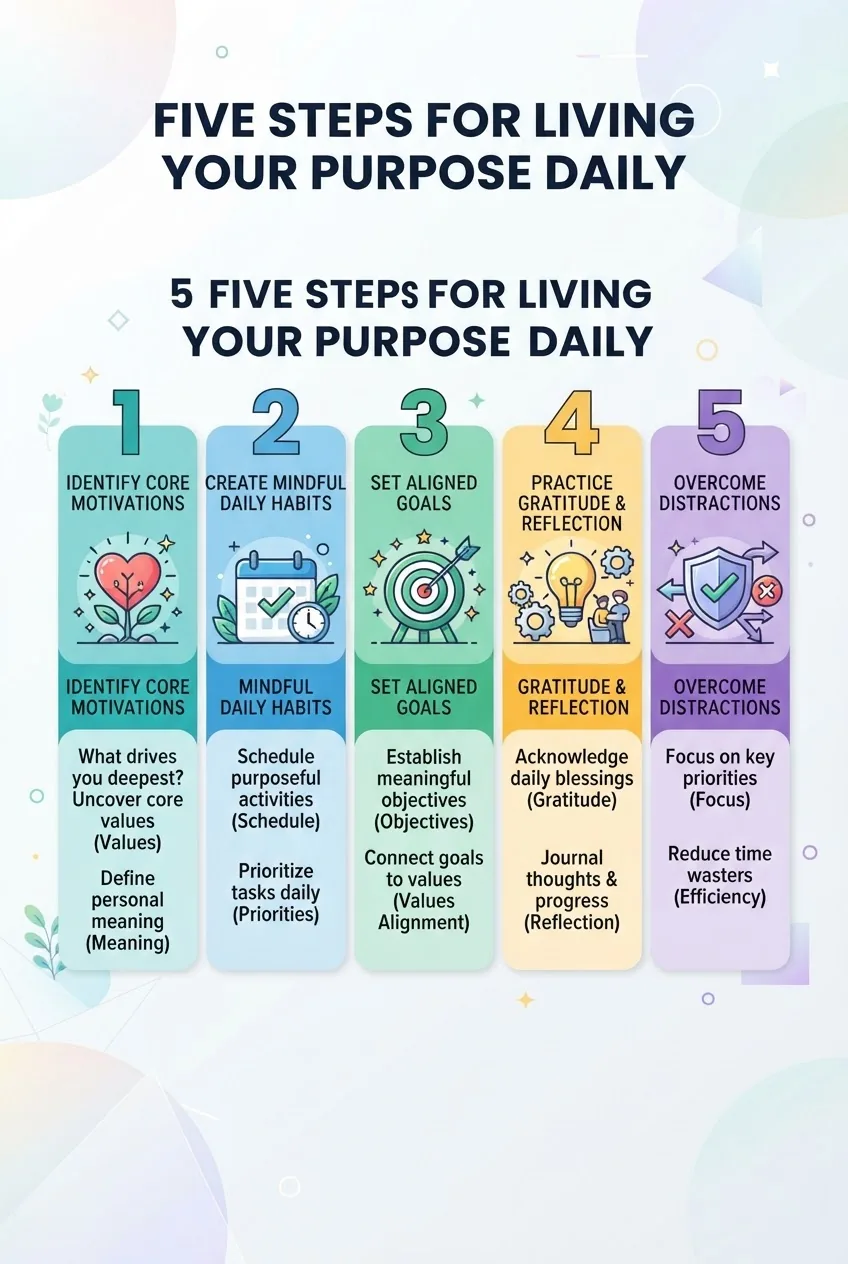
This section is the hands-on core: follow these numbered steps every day or week to embody purpose.
- Start each morning with a 10–15 minute purpose check. Sit, breathe for 3 minutes, read your one-sentence mission, then write one specific intention for the day tied to that mission (one line). Time: 10–15 minutes. Repeat daily for 28 days to encode habit.
- Design a 20–30 minute “power hour” three times weekly. Use dedicated blocks for work that directly advances your mission—no email, no social media. Set a timer for 50 minutes with 10-minute breaks. Measure output: one completed task per block for four weeks.
- Use micro-decisions to protect focus. Create two default rules: (a) No smartphone during power hour and family time; (b) Say “not now” to two low-alignment requests per day. Track refusals in a journal to increase boundary confidence.
- Deploy an evening 10-minute reflection ritual. Each evening, note three things you did that day aligned with purpose and one improvement for tomorrow. This habit strengthens clarity and focus and feeds weekly reviews.
- Schedule a weekly 30-minute review on Sundays. Review the week’s wins, update goals, and pick three aligned priorities for the coming week. This weekly cadence prevents drift and keeps life goals alignment active.
- Integrate brief mindfulness pauses. Practice a 2–3 minute breathing or body scan before high-stakes meetings or decisions. Mindfulness interrupts reactivity and supports inner motivation; set a phone reminder to prompt these pauses twice daily. For research context on benefits, see the NIH review linked earlier.
- Keep a “values-to-task” mapping sheet. For every major weekly task, write the primary value it serves and the expected outcome. If a task serves no value, delegate or remove it. Re-evaluate this map monthly.
- Adopt gratitude-oriented closure for tasks. After completing a meaningful task, write one sentence about impact and who benefits. This builds the neural association between work and fulfillment.
- Create a distraction plan: two defenses. First, use app blockers during power hours. Second, have a physical “distraction box” to place devices during focused time. Test both approaches for two weeks and keep whichever yields a 30% improvement in uninterrupted focus duration.
- Blend spiritual practices into habit architecture. Small rituals like mindful breathing, 5-minute intention-setting, or a brief gratitude prayer can be scheduled as part of your morning or evening routines. For inspiration, explore daily spiritual practices and spirituality and practices examples to find compatible formats that won’t overload your schedule.
- Use metrics and thresholds to test alignment. Example metrics: weekly percentage of hours spent on mission-aligned tasks (target 30–50%), number of boundary asserts per week (target 2), and subjective fulfillment rating (1–10) recorded weekly. Recalibrate after 6 weeks.
- Build an accountability loop. Share your one-sentence mission and weekly priorities with a trusted peer and commit to a 15-minute check-in once every two weeks. Accountability increases follow-through by estimated 65% according to industry coaching reports (industry report, 2022).
- Keep a one-page “decision rule” cheat sheet. When an opportunity arises, use this prompt: “Does this directly support my mission in the next 90 days?” If yes, accept; if no, defer or decline. Use the 90-day window to prevent mission creep.
Tool walkthrough — a simple daily habit tracker (example): create a spreadsheet with columns Date, Morning Check (Y/N), Power Hour Minutes, Evening Reflection (Y/N), Alignment Rating (1–10). Fill it each day in under 2 minutes. After 28 days, compute average alignment rating and power hour minutes to decide next adjustments.
Brief case study: a client I coached shifted from scattered volunteer projects to a single community literacy program. They used the power hour, weekly review, and the decision rule for 12 weeks; their measured mission-aligned hours increased from 4% to 35% of their discretionary time, and reported fulfillment rose from 4/10 to 8/10. This is the practical payoff of repeated small habits.
Transition: These daily tactics require supporting mindsets—next we cover how to cultivate attitudes that keep purpose durable and resilient.
Cultivating Mindset and Attitudes to Support Purposeful Living
To make purposeful living resilient, adopt psychological orientations that translate setbacks into growth and maintain authenticity. Start by recognizing that mindset is trainable: you can cultivate a growth mindset, greater resilience, and consistent self-compassion through short daily exercises.
Fulfilling certain spiritual needs and their importance—such as connection, meaning, and transcendence—reduces existential drift and strengthens motivation to persist in purposeful actions.
Practical mindset shifts and exercises:
- Reframe setbacks as information: After any setback, write one sentence describing what the data tells you and one specific experiment to try next. Limit this reframe to 10 minutes to avoid rumination.
- Practice self-compassion steps: Use a 3-part script when you’re self-critical—(1) acknowledge the pain, (2) normalize the experience, (3) suggest a gentle corrective action. Say this aloud once daily for 7 days to form a habit.
- Short growth-mindset drills: Choose one skill tied to your mission and practice deliberate attempts for 15 minutes daily with immediate feedback. Growth is about process, not fixed identity.
- Use values language: Replace “I should” with “I choose” to reclaim agency and align action with inner motivation. For instance, “I choose to spend 3 hours on the literacy program on Saturdays” increases commitment and reduces resentment.
- Daily micro-reflections for authenticity: Ask one question nightly: “What action today felt most like my authentic self?” Record the example to build a pattern of what authenticity looks like for you.
For those who want to deepen spiritual perspective alongside mindset work, try practices from the being more spiritual guide—pick one practice and track integration for four weeks.
Inner calm supports clarity. Use short practices aimed at achieving inner peace—for example, 5-minute breathing breaks three times daily—which reduces reactivity during tough choices.
Practical cognitive-behavioral technique: label unhelpful thoughts (e.g., “I can’t do this”) and replace them with evidence-based counters (e.g., “I have completed similar tasks before—here’s one example”), then take a small aligned action within 30 minutes.
When spiritual support is needed: combine mindset work with community rituals, mentorship, or spiritual practices. These nourish inner motivation and guard against burnout. For more on how spiritual activity meets psychological needs, see spiritual needs and their importance.
Transition: With mindset and habits in place, the practical task becomes keeping long-term goals aligned. The next section gives a stepwise method to match life decisions with purpose.
Aligning Your Life Goals and Choices With Your Purpose
Alignment requires both ongoing review and simple decision rules that translate mission into measurable choices. Below is a step-by-step alignment process plus a compact checklist you can use immediately.
- Write a 3-tier goal structure: Tier 1: 1–3 year mission-oriented outcomes (example: “increase community literacy by 25% in three years”). Tier 2: 90-day projects that move Tier 1 forward. Tier 3: weekly tasks supporting Tier 2. Set one Tier 1 metric and two Tier 2 projects every quarter.
- Map each goal to core values and time budget: For each Tier 2 project, list which of your top 5 values it serves and the weekly hours required. Example: Project A (value: service) — 6 hours/week. If time budget exceeds 50% of discretionary hours, recalibrate or delegate.
- Create explicit decision rules for new opportunities: Use three quick checks: (A) Does it serve a top value? (B) Does it advance a Tier 2 project within 90 days? (C) Is the time cost under the threshold you set? If two out of three are “no,” defer.
- Quarterly alignment audits (90 minutes): Review metrics and reassign resources. Keep a 90-minute block at the start of each quarter to assess whether goals still reflect current meaning and context. Use a 3-column audit: What worked, What to stop, What to start.
- Translate goals into “if-then” plans: Example: “If I receive a new project request that requires >8 hours/week and doesn’t map to my top value, then I will decline or propose an alternative that fits my mission.”
- Establish financial alignment thresholds: Decide minimum income-to-time ratios for paid work that supports your purpose. Example: refuse roles paying below $X/hour if they displace mission time beyond Y hours/week.
- Use quarterly role experiments: If you’re unsure, test commitment for 6–12 weeks with clearly defined metrics (hours, outcomes, feelings). If metrics meet pre-set thresholds (e.g., 3 missions tasks completed and fulfillment rating ≥7/10), continue.
To operationalise this structure, pair it with tools from the identifying your values and goals guide; it supplies a values-scorecard template to map goals and time budgets quickly.
Quick comparison table: goals alignment vs. reactionary choices
| Aligned Decision | Reactionary Choice |
|---|---|
| Supports Tier 2 goals; time budget recorded. | Taken due to immediate pressure; no metric attached. |
| Linked to explicit value(s). | Chosen to appease others or avoid conflict. |
| Has decision rule applied (if-then). | No decision rule; emotion-driven. |
Transition: Even the best plans meet obstacles. Next, we cover common blocks and practical solutions to stay on course.
Overcoming Common Obstacles to Living Your Purpose
Obstacles to purposeful living are usually psychological, social, or structural. Below are the most frequent barriers and precise countermeasures that have worked in practice.
- Fear and self-doubt: Action: run a 7-day “evidence bootcamp.” Each day, list one past success, one skill you used, and one small action you will take today. Time: 10 minutes/day. Outcome: reduces fear-driven avoidance and builds a record of competence.
- External pressures and expectations: Action: conduct a 15-minute boundary audit. Identify the three obligations that absorb most energy; for each, decide if it can be delegated, declined, or renegotiated. Use the script: “I can’t commit to X at this time, here’s an alternative.”
- Overwhelm and procrastination: Action: apply the “two-minute start” rule—commit to two minutes on a task. For many, two minutes become 20–40 because of initial momentum. Track-start frequency as a progress metric.
- Burnout and exhaustion: Action: adopt a 48-hour recovery protocol: two consecutive rest activities (sleep priority, nature walk, or no work) and a reduction of weekly mission hours by 30% for one week. If symptoms persist, consult a health professional.
- Distraction (digital and otherwise): Action: schedule three phone-free windows totaling at least 90 minutes per weekday. Measure uninterrupted focus using a timer app; aim to increase average focus duration by 20% in four weeks.
- Misaligned relationships: Action: have an alignment conversation using a 5-question script: “What do you value about what I do?” “How can we support each other?” “What boundaries would help me be more present?” Limit to 20 minutes and listen actively.
- Lack of clarity about next steps: Action: define a 3-step micro-experiment to test a hypothesis in 21 days. Example: test whether running a weekend workshop increases impact—host one, record attendance and feedback, and decide to continue or pivot.
When an obstacle requires deeper reflection, use guided prompts from the deep reflection around life questions to surface root causes and new pathways.
Real example: I once worked with a mid-career professional paralyzed by the fear of leaving a secure job to pursue a nonprofit idea. We ran a 12-week experiment: 10 hours/week on the project, weekly review with metrics, and an “if-then” exit rule. The structured test reduced anxiety, produced pilot outcomes, and created a transition plan that balanced finances and meaning.
Transition: Sustaining purpose means adapting with life. The next section addresses long-term maintenance and growth strategies.
Maintaining Purpose Over Time: Growth and Adaptation
Purpose is not static; it evolves with experience, relationships, and life transitions. Maintenance is systematic reassessment plus self-care practices that shore up spiritual wellness and adaptability.
Schedule these recurring practices:
- Six-month reassessment (90 minutes): Revisit mission statement, audit Tier 1 goals, and update metrics. If your life role changes (new parent, relocation), revisit value weights and time budgets.
- Annual growth review (3 hours): Document major outcomes, lessons learned, and a three-year horizon plan. Include a SWOT-style look at strengths and areas needing support.
- Weekly micro-self-care checkpoints: Track sleep, movement, social connection and spiritual practices; set minimum thresholds (e.g., 7 hours sleep/night, 3 social connections/week).
- Rolling 90-day experiments: Use short experiments to test new directions without full commitment.
For long-term spiritual practice and recovery strategies, consult approaches in enhancing spiritual health and wellness. Regular spiritual nourishment supports endurance through transitions and grief.
Practical reminders and timings:
- Check mission alignment weekly (10 minutes), do a quarterly audit (60–90 minutes), and plan annually (2–3 hours).
- When life roles change, give yourself one full reassessment cycle (90 days) before making major irrevocable choices.
- If fulfillment falls below 5/10 for more than 6 weeks despite changes, escalate to deeper work—coaching, therapy, or a sabbatical.
To support balance during transitions, see practical strategies in building meaning and balance in life.
Transition: Now that you have the practical map and maintenance plan, read the hands-on practitioner notes below: common mistakes, a verification checklist, and guidance for when to call in a professional.
Common mistakes and how to avoid them
I’ve watched people make the same mistakes repeatedly: they either try to overhaul everything at once or they treat purpose as a one-time discovery. I observed one client who spent six months endlessly “finding” a mission without testing it. We corrected course by running a 6-week experiment focused on one measurable action. The fix: start with micro-experiments (6–12 weeks), use time-boxed habit formation (10–30 minutes daily), and measure two simple metrics (hours spent on mission; fulfillment rating).
Common practical failure modes I see and fixes
- Failure: No metrics. Fix: Track one objective metric and one subjective metric weekly.
- Failure: All-or-nothing changes. Fix: Start with a 2-minute rule and scale by 10% weekly.
- Failure: Social isolation from mission focus. Fix: Pair work with weekly community check-ins or accountability.
Checklist: Verify your work
- Do you have a one-sentence mission statement? (Yes / No)
- Are there scheduled morning and evening rituals? (Morning 10–15 min; Evening 10 min)
- Do you run at least one 50-minute focus block for mission work three times weekly?
- Is there a weekly review of no more than 30 minutes?
- Are you tracking at least two metrics (time spent, fulfillment rating) weekly?
- Do you have a decision rule for new commitments (90-day test or if-then)?
- Have you scheduled quarterly reassessments? (Every 90 days)
When to call in a professional
If persistent anxiety, depressive symptoms, or burnout interfere with daily function (sleep disruption, inability to work), consult a licensed mental health professional. If you need structured support to build a transition plan (career change, launching a social enterprise), a certified coach or mentor with relevant domain experience can reduce risk. Use professional support when symptoms persist beyond six weeks despite applying the strategies above.
Final encouragement: Living your purpose is an iterative practice. Use the micro-experiments, weekly reviews, and values-alignment tools in this guide to transform intention into embodied, everyday direction.
To deepen your learning, pick one small habit from the “Strategies” section and commit to 28 days. Track it, review it, then scale what works.
Natural next step: if you want structured discovery work, use finding your purpose with clarity and focus to expand the diagnostic and experiment sections in this guide.