
By the end of this hands-on guide you will have a clear, practical ritual and a set of written outcomes that point to your working purpose; expect to spend 6–12 hours across 2–4 weeks experimenting (skill level: beginner to reflective practitioner). This step-by-step process helps you answer what is my purpose through spiritual and practical discovery.
Before you start
- Quiet space (30–60 minutes for each reflection session)
- Notebook or journaling app and a pen
- Timer (set blocks of 25–45 minutes)
- Values worksheet or card-sort (20–40 items) — printable or digital
- Support contact (friend, mentor or therapist) for debriefing insights
Understanding What Is My Purpose
Purpose is a practical compass and an orienting story you give your life that shapes choices, attention, and resilience. To define *purpose in life* is to name the core directional thread that informs your daily actions and long-term goals. Philosophically, purpose answers “why I wake up” rather than merely “what I do”; psychologically, it organizes attention and meaning; spiritually, it connects personal narrative to something larger than the self.
A useful working definition: purpose for living is a sustained intention or cause that provides coherence, motivation, and a felt sense of contribution across time. It can be specific (teaching underserved children) or abstract (cultivating kindness), change over life stages, and coexist with multiple roles. Maslow’s Hierarchy of Needs places self-actualisation and transcendence near the top—purpose operates there by orienting growth beyond basic needs.
Viktor Frankl’s Logotherapy reframes suffering as an opportunity to discover meaning—he observed that purpose can be found through work, love, or courageous attitude toward unavoidable suffering. Practically, purpose is neither a single “destination” nor a fixed trait; it’s a pattern you surface through reflection, testing, and alignment with values and gifts.
This guide emphasises personal meaning over generic answers: it teaches how to identify the thread that feels meaningful to you and how to test it in real life.
Transitioning from a broad definition to practical clarity, the next section distinguishes purpose from meaning so you can target the right work.
The Difference Between Life Meaning and Purpose
“Life meaning” and “purpose” overlap but serve different roles. Meaning answers “what makes life coherent?” — it’s the story you tell about your life’s events and their value. Purpose answers “what am I for?” — it’s an active, future-oriented intention guiding decisions and energy.
| Aspect | Life Meaning | Purpose |
|---|---|---|
| Time orientation | Past and present coherence | Future-directed intent |
| Emotional tone | Satisfaction, narrative comfort | Motivation, activation |
| Example | Finding meaning after loss by reinterpreting the event | Committing to support grieving families as a career |
If you’re asking what is life meaning and purpose, start by separating story (meaning) from action (purpose). You can hold both: meaning stabilises identity, while purpose mobilises energy toward the life you value. For help exploring meaning specifically, see finding meaning in life.
Next we’ll address common challenges you’ll meet while searching for your purpose so you can anticipate and manage them.
Common Challenges in Finding Your Purpose
- Analysis paralysis — endless options create decision freeze; set a 30-minute “choose one small test” rule to move forward.
- Identity confusion — rapid role changes (career, parenting) blur values; use a 60-minute life-role mapping exercise to externalise roles.
- Perfectionism — waiting for “perfect clarity” prevents action; accept 70% certainty as launch-worthy.
- Spiritual doubt — unanswered prayers or practices can feel like failure; recognise spiritual development is non-linear and experiment across traditions.
- External pressure — family or cultural expectations mask inner callings; practice a 15-minute boundary script to communicate small, testable choices.
- Fear of loss — leaving stable roles risks security; plan a 3–6 month safety net (savings, part-time shift) before major changes.
- Comparing paths — measuring against others’ highlight reels reduces clarity; limit social media to 30 minutes weekly during your discovery phase.
- Confusing passion with purpose — passion can be fleeting; test passions against a “service + sustainability” filter before committing.
- Misreading feelings — low mood can be mistaken for “no purpose”; screen for depression with a clinician if persistent. According to a 2023 mental health report by Mental Health America, ongoing low mood often requires professional assessment.
- Spiritual bypassing — using spirituality to avoid practical work; balance inner work with external action plans.
Having flagged roadblocks, the next section gives the core step-by-step reflective process to discover a working purpose — follow it as listed and test each outcome.
Reflective Exercises to Discover Your Purpose
This section is the hands-on core: follow the numbered steps over 4–6 sessions (25–60 minutes each). Each step starts with a bold, action-first phrase and includes concrete timings, tools, and expected outputs.

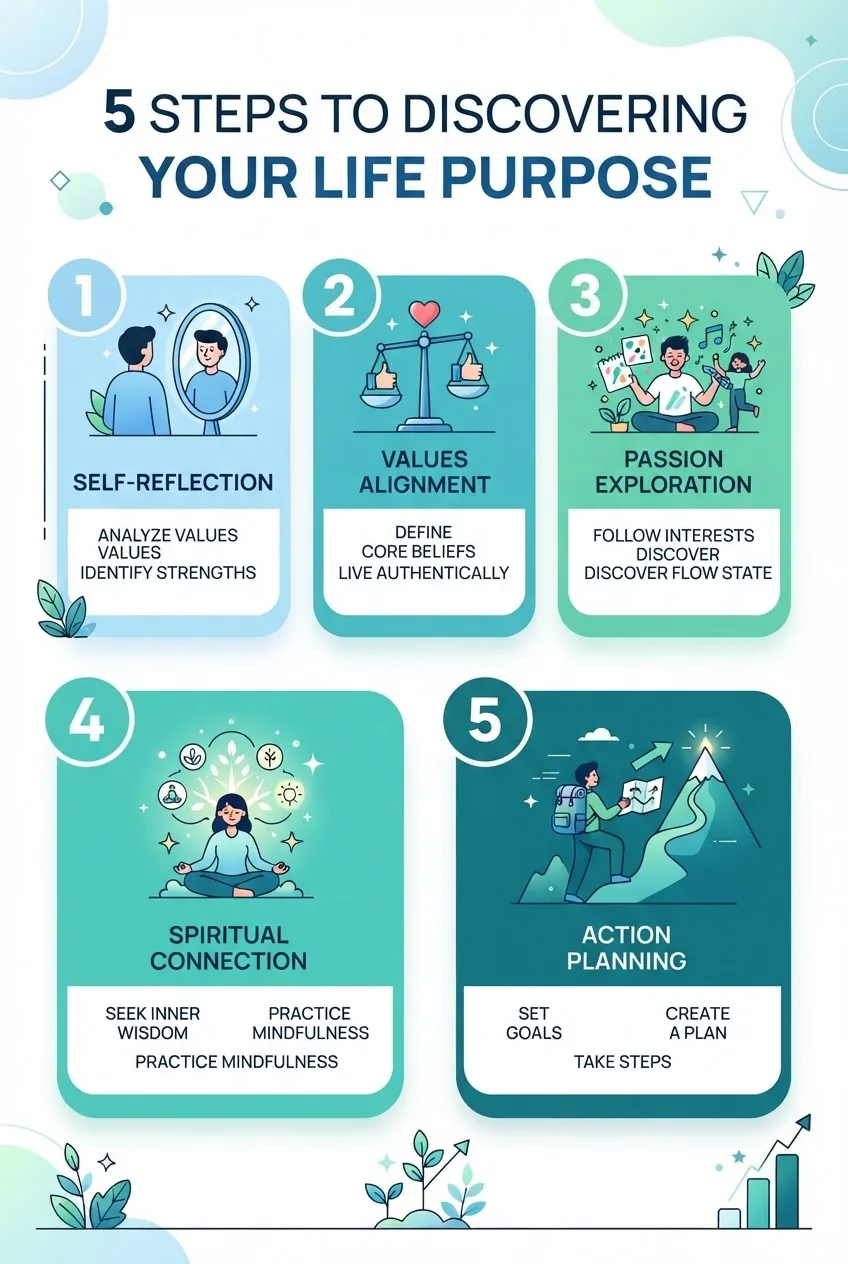
-
Clarify your current story (60 minutes)
Set a 60-minute timer. Write answers to 6 prompts without editing: 1) Biggest wins (last 5 years) — list 5; 2) Deep satisfactions — name 3 tasks you lose time in; 3) Recurring regrets — list 3 choices you’d change; 4) Natural gifts — identify feedback you often get; 5) Who you serve naturally — name 2 groups; 6) Themes you see. Output: a one-paragraph “current story” summary.
Tip: speak your answers aloud and record for 5 minutes if writing stalls.
-
Identify core values (45 minutes)
Use a 40–60 item values card-sort or a values worksheet. If you don’t have one, pick 20 values from a list and rank your top 10. For each top-10 value, write a short behavioural indicator (what it looks like in action) and a 1–3 sentence example from your life. Output: ranked values list and indicators.
core life values are the anchor for purpose alignment; refer to that guide as needed.
-
Map passions to practicality (45 minutes)
Create a two-column table: left column passions (top 6), right column income/impact options (3 each). For each passion, rate viability 1–5 on sustainability (can it fund your life or be paired with paid work), and impact (how many people benefit). Output: two to three promising intersections you can pilot.
-
Test small actions (2–8 weeks)
Pick one promising intersection. Plan a 4-week pilot with 3 measurable actions per week (e.g., volunteer 2 hours, create one blog post, teach a mini-class). Use 30–60 minute experiments; record outcomes and emotional responses after each session. Output: a decision—persist, pivot, or pause—based on energy, impact, and feasibility.
finding your purpose with clarity is a useful companion during this testing phase.
-
Reflect with spiritual practices (20–40 minutes each session, ongoing)
Introduce a weekly practice: contemplative journaling (20 min), centring breathwork (10 min), and a 15-minute guided gratitude practice oriented to service. Track shifts in conviction and resonance with a weekly rating (1–10). Over 4 weeks, notice trends. Output: a “felt-sense” score for each pilot.
deep soul connection readings often shift in this step.
-
Write a one-sentence mission and a one-paragraph purpose statement (45 minutes)
Mission sentence formula: “I help [who] by [how] so that [result].” Purpose paragraph: 2–4 sentences that explain motivation, methods, and hoped-for long-term impact. Keep language testable: if you can’t describe the first concrete action someone would observe, revise. Output: mission sentence + purpose paragraph.
finding your path in life complements this step.
-
Align with life constraints and set a timeline (30 minutes)
List non-negotiables (income, caregiving, health). Build a 3–6 month calendar with milestones: Week 0 (pilot launch), Month 1 (review), Month 3 (decision checkpoint), Month 6 (scale or pivot). Output: a realistic timeline with at least one concrete milestone per month.
-
Create a “micro-commitment” habit plan (daily/weekly)
Choose 2 daily micro-habits (10 minutes each) and 1 weekly action (60 minutes). Micro-habits could be a 10-minute reflective journal, a 10-minute skill-practice tied to purpose, and a weekly outreach or service task. Use habit trackers for 90 days and reassess.
-
Document evidence and evaluate (monthly review)
Collect three evidence types each month: emotional (felt-sense ratings), practical (tasks completed, audience reached), and feedback (responses from 3 people you serve). Use a simple table to score evidence and make a binary decision at each checkpoint: continue, iterate, or stop.
deep reflection questions help structure your monthly evaluation.
Tools and worksheets to use
- Values card sort (20–60 items) — printable
- Ikigai/overlap canvas (one-page)
- Purpose mission template: “I help [who] by [how] so that [result]”
- Habit tracker (paper or app) set to 90 days
Common mistakes and how to avoid them
I often saw people skip testing because their idea “felt right.” I watched several stall for months; testing quickly corrected false starts. I now insist on a 4-week pilot before any major commitment—this saved time and clarified real resonance.
I’ve observed people conflate passion with purpose and chase short-lived excitement. To avoid this, I require a sustainability check (3 months of consistent activity) before allowing a pivot to a new purpose project.
Another frequent error: neglecting spiritual practice. When clients added a weekly contemplative practice (20–30 minutes) their clarity and persistence increased; I recommend the exact 3-practice rotation in Step 5 above.
Checklist to verify your work
- One-paragraph current story completed
- Top 10 values listed with behavioural indicators
- Two-to-three tested passion/practicality intersections
- At least one 4-week pilot completed and evaluated
- Mission sentence and one-paragraph purpose drafted
- 3-month timeline with milestones created
- Daily/weekly micro-habits scheduled for 90 days
When to call in a professional
If you experience persistent lack of motivation (more than 6 weeks), symptoms of depression or anxiety, recurrent traumatic memories blocking reflection, or need structured career transition support, consult a licensed therapist or certified purpose coach.
Now that you’ve practiced reflective discovery, we’ll explore how to align those insights with core values and passions to make purpose durable.
Aligning Your Purpose With Your Core Values and Passions
Alignment is the act of translating internal priorities into consistent external behaviour. Start by cross-referencing your mission sentence against your ranked values: each sentence element should map to at least one top-three value. Where a mission element lacks a value tie, revise it or create a behavioural indicator linking the two.
Actionable steps:
- Map values to behaviors (30 minutes): For each top-5 value, list 3 observable behaviours you will commit to weekly. Example: if “service” is a value, behaviours might be “two volunteer hours,” “one pro-bono consult monthly,” and “public resource creation quarterly.”
- Apply the service+sustainability filter (20 minutes): Rate potential purpose projects for both service (impact on others) and sustainability (income/time viability) on a 1–5 scale. Prioritise projects that score 3+ in both categories.
- Create a passion–skill rubric (45 minutes): For each passion, list the specific skills you have and skills to develop. Set one 30-minute daily skill habit for 90 days to close key gaps.
For deeper step-by-step value identification tools, see identifying values and goals and the core life values guide.
Transitioning from alignment to deeper spiritual integration, the next section explains how spirituality amplifies clarity and commitment.
How Spirituality Enhances Purpose Discovery
Spirituality—understood broadly as a felt connection to something larger than oneself—adds layers of meaning, resilience, and communal context to purpose. Spiritual practices cultivate attention, patience, and discernment; they create the inner conditions for noticing subtle callings and sustaining long-term service. Different traditions provide distinct frames: Buddhist practices emphasise mindful presence and compassion; Christian frameworks often locate purpose within vocation and service; secular spirituality highlights values and connection.
A practical view: spirituality provides attunement (how you listen), anchoring (how you return when doubt arises), and integration (how you weave meaning into daily life). Practices that increase attunement—meditation, contemplative prayer, or nature-based rituals—improve your sensitivity to “felt-sense” data during pilots.
To deepen knowledge on spirituality’s role, see the pillar essay on the importance of spirituality in purpose. For signs and forms of spiritual connection consult deep soul connection, and for wider practices see spirituality examples and practices.
If you want to understand spiritual needs in relation to purpose, read spiritual needs and importance. If you’re exploring whether you’re being called, look for signs of spiritual connection.
Spiritual growth supports purpose in practical ways: increased tolerance for ambiguity, improved attention for subtle interests, and stronger community ties that offer feedback and opportunities. If you’re committed to growing spiritually as part of purpose-finding, review growing spiritually for purpose and enhancing spiritual health.
When claims are made about spirituality and wellbeing, evidence matters: a growing body of psychological research connects a sense of purpose with better mental and physical health. For example, a meta-analysis linked higher purpose scores to lower mortality and improved health behaviours (see external research below). These findings suggest integrating spiritual practices is not merely metaphorical but has measurable benefit.
Next we move from spiritual integration to daily practical habits that make purpose a lived practice.
Living a Purpose-Driven Life: Practical Tips and Daily Habits
Turning a discovered purpose into daily reality requires habits, routines, and design choices that sustain momentum. Treat purpose as a system: identity cues + daily micro-habits + monthly evidence checks.
- Start with a 10-minute morning ritual — journaling: one gratitude, one micro-goal tied to purpose, one daily action. Time: 10 minutes.
- Schedule a 30-minute weekly planning session — block 30 minutes on Sunday to align the week’s tasks with your mission sentence.
- Use the two-hour deep work block — reserve one 2-hour block twice weekly for purpose work (creative, service delivery, skill development).
- Practice the 5:1 feedback loop — seek five pieces of feedback for every one major decision; prioritize qualitative input from people you serve.
- Maintain a 90-day learning sprint — choose one skill to develop tied to purpose, practice 30 minutes daily.
- Protect margin and rest — schedule two full rest blocks per week (3–4 hours) to prevent burnout; purpose work requires recovery.
- Document weekly wins — keep a running log of outcomes; review at the monthly checkpoint.
For small spiritual reinforcements during daily life, consider simple everyday spiritual practices. To cultivate calm that supports focused purpose work, see achieving inner peace, and for integrating a life of intention and purpose, refer to personal peace. For more ideas on ongoing living practices, review living your purpose.
Next, guidance on when to bring in professional support is covered to ensure safe, evidence-based progress.
When to Seek Help: Coaches, Therapists, and Spiritual Advisors
Professional support accelerates clarity and provides containment for challenging emotions. Choose your support depending on needs:
- Therapist (licensed) — for depression, anxiety, trauma, identity disruptions that block discovery; look for CBT, acceptance-based, or narrative therapy experience.
- Certified purpose coach — for structured discovery, accountability, and career transitions; seek coaches with measurable frameworks and client testimonials.
- Spiritual advisor/mentor — for tradition-specific guidance, deep contemplative practices, and community integration; prefer advisors with supervision and ethical codes.
If you’re unsure where to start, a 60-minute intake with a therapist or a certified coach is a pragmatic first step. Use professional support when low mood persists beyond 6 weeks, when life transitions feel unmanageable, or when you need help translating purpose into livelihood.
Next, a concise summary of wellbeing benefits supported by research.
The Benefits of Knowing Your Purpose for Wellbeing and Fulfillment
Research consistently links a clear sense of purpose with measurable wellbeing outcomes:
| Benefit | Evidence summary |
|---|---|
| Lower mortality & better physical health | Multiple longitudinal studies report associations between higher purpose scores and lower mortality risk (see external research). |
| Improved mental health | Studies show purpose correlates with reduced depression and greater psychological resilience (source: psychological research summaries). |
| Greater life satisfaction | Surveys indicate people with a clear purpose report higher life satisfaction and coherence. |
According to a 2023 mental health report by Mental Health America, sustained meaning and purpose are linked with better emotional regulation and coping strategies. For practical strategies on integrating purpose with life balance, see building meaning and life balance. Purpose is also associated with lasting peace of mind and improved peace of mind meaning.
Transitioning to wrap-up: a short summary and next steps to keep momentum.
Summary and Next Steps on Your Purpose Journey
You now have a stepwise approach: clarify story, identify values, map passions to practicality, run short pilots, integrate spiritual practices, and convert outcomes into mission-language and habits. Expect iterative cycles: each 3–6 month sprint refines your purpose.
Next steps: commit to a 90-day cycle using the checklist above, schedule two 2-hour deep work blocks weekly, and keep a monthly evidence table. Remember the journey varies by person—this process emphasises testing, evidence, and gentle spiritual practices rather than fixed revelations.
If you’d like external reading on the psychology of purpose, consult the American Psychological Association and PubMed studies linked below. When you’re ready to expand into a career or deeper spiritual role, consider the professional routes described earlier.
Call to action: Choose one pilot from your worksheet, schedule a 4-week block, and start the first experiment within 7 days.