
By the end of this hands-on guide you will have a clearly written set of 4–8 prioritized life values, a practical daily ritual to test them for 30 days, and a follow-up reassessment plan. Expect to spend two focused sessions (90–120 minutes total) plus short daily checks for a month. Skill level: beginner to intermediate — no prior spiritual training required.
Before you start
- A quiet notebook or journal and pen (A5 or A4, 40–80 pages)
- 30–60 minutes of uninterrupted time for two separate sessions
- A simple timer (set for 25–45 minute blocks)
- Optional: a phone or recorder for voice reflections
- A willingness to test and adapt your values for at least 30 days
Understanding What It Means to Define Life Values
Define life values means to identify the personal principles that consistently guide your decisions, shape your priorities, and create a felt sense of meaning. Values are not the same as transient likes or habits; they are durable preferences about how you want to live — an inner compass rather than a shopping list.

Think of values as a navigation system: they set the bearing, not the exact route. Practically, defining values involves listing candidate values, clarifying what each means personally, prioritising them, and testing them in real-life choices.
Core values vs. peripheral values
Core values are 3–8 principles that consistently explain the why behind major life choices — career direction, relationships, spiritual commitments. Peripheral values are situational or context-specific preferences (favouring a certain food, a weekend routine). Prioritising core values reduces inner conflict because you have a clear hierarchy when choices collide.
| Feature | Core Values | Peripheral Values |
|---|---|---|
| Stability over time | High — years to decades | Low — weeks to months |
| Influences major choices | Yes | Sometimes |
| Easily changed | No | Yes |
Research supports the link between value clarity and wellbeing: According to a 2018 peer-reviewed review, values clarity predicts better psychological adjustment and goal pursuit across cultures — clarity acts like a cognitive filter that reduces decision fatigue. Read the review.
A useful exercise here is to write a one-sentence definition for each candidate value — for example, rather than listing “honesty”, write “I show honesty by speaking the truth gently and taking responsibility for mistakes.” This converts abstract words into actionable behaviours.
Transition: With a working understanding of values and how they differ, next we’ll place them within a spiritual wellness and purpose framework so they function as more than rules — they become the language of your inner life.
The Role of Core Values in Spiritual Wellness and Purpose
Core values and spiritual wellness are mutually reinforcing: values give spiritual practice practical aim, while spiritual practice deepens the lived meaning of values. When values and spirit align, decisions feel less like chores and more like an expression of purpose — your inner compass illuminates daily choices.
Many spiritual frameworks treat values as expressions of the sacred — compassion, integrity, humility become practices that refine consciousness. When you translate values into ritual, you create embodied commitments instead of intellectual ideals.
For a closer look at how values feed spiritual wellbeing and life purpose, explore the site’s pillar on the importance of spirituality and purpose for wellbeing. This link offers extended evidence and practice recommendations.
Recognising values also sharpens spiritual perception: practised value-alignment highlights deep soul connection signs that previously felt vague — those moments of resonance often indicate values being honoured.
Core values also meet essential spiritual needs: belonging, meaning, transcendence, and moral coherence. For a focused read on those needs see spiritual needs and their importance.
There are measurable health gains from value-driven living. According to a 2020 character-research report from a recognised values institute, people reporting high values congruence experience better life satisfaction and lower depressive symptoms. VIA Institute on Character offers frameworks and assessments that are practical for this work.
Mindfulness and MBSR-style practices have been shown to improve alignment between intention and action. According to a 2017 mindfulness program review, regular mindfulness practice increases awareness of internal priorities, creating space to choose value-consistent responses. See the Center for Mindfulness at UMass for program details: Center for Mindfulness.
Transition: Knowing the role of values in spiritual wellness sets the stage for a practical, step-by-step discovery process you can do immediately.
Step-by-Step Guide on How to Discover Your Core Life Values
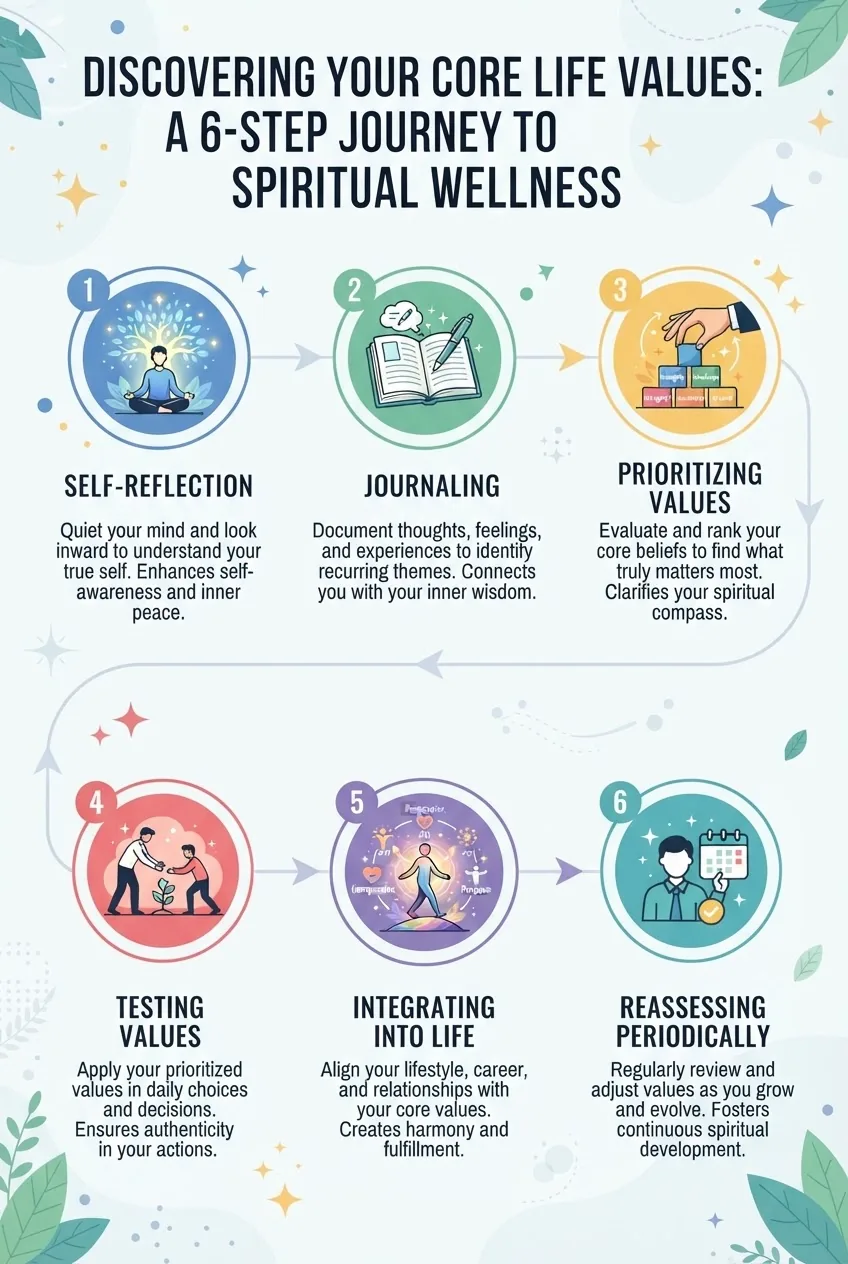
This section is the hands-on core: follow the steps below in order. Each step includes concrete timings, outputs, and how to test results over 30 days.
-
Prepare your reflective space (30–45 minutes)
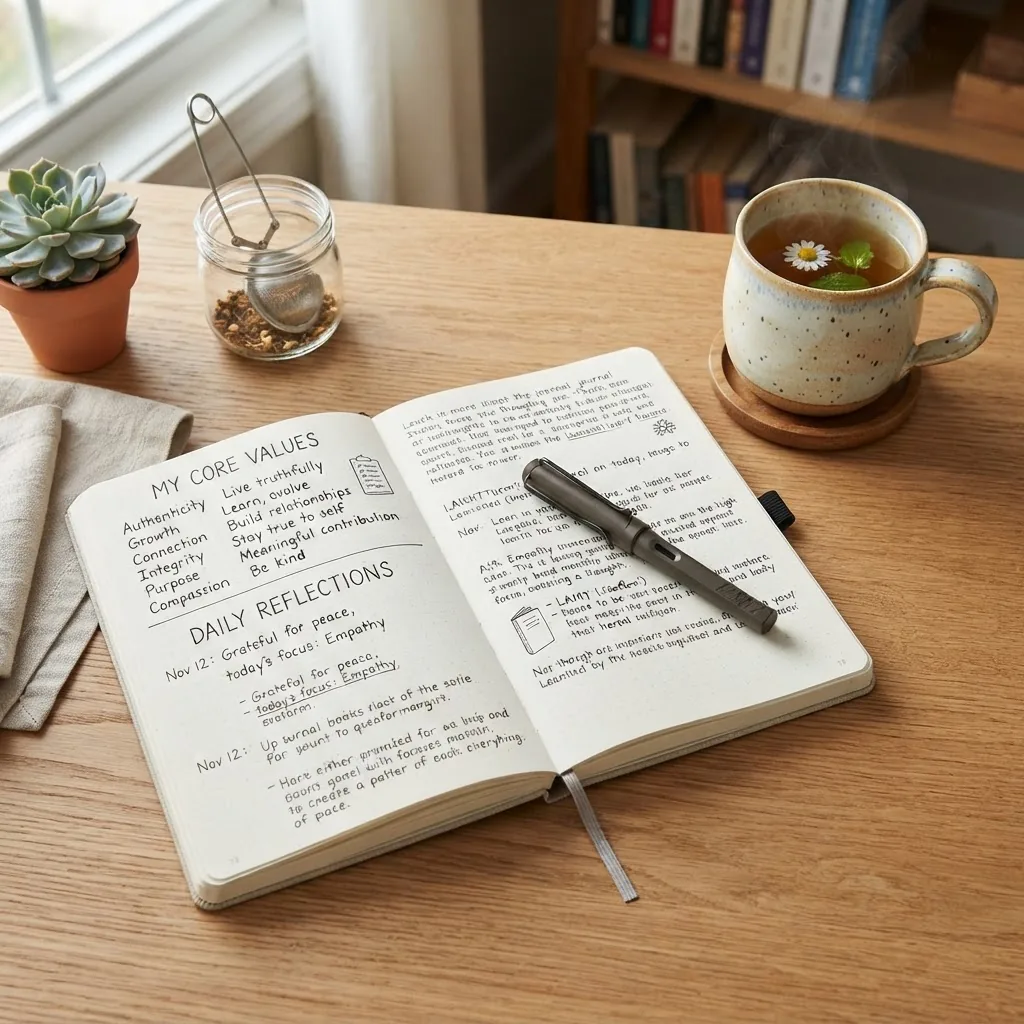
Set a 30–45 minute uninterrupted session. Tools: journal, pen, timer, warm drink. Outcome: a free-writing page titled “Values Inventory”. Prompt: “When I feel most alive and peaceful, what am I doing and what quality is present?” Write for 20 minutes without editing, then underline repeated words.
-
Create a values seed list (20–30 minutes)
From the free-write, extract 30–50 candidate words (honesty, service, presence, freedom, etc.). If you need prompts, scan a values list and pick words that produce a somatic response. Outcome: a single-column list of candidates in your journal.
-
Define each candidate in your language (2–3 hours total, in two sessions)
For your top 20 candidates, write a one-sentence personal definition and a one-line behavioural example (e.g., “Generosity: giving time without expecting reward — I volunteer for 1 hour/week”). This converts abstract words into identifiable actions and avoids vague ideals.
-
Sort and short-list by impact (45–60 minutes)
Use a two-column sort: Column A = “Non-negotiable” (would choose over career, partner, location); Column B = “Preferable”. Keep at most 8 in Column A. If more than 8 appear, perform pairwise comparisons: ask “If I could only keep one of these two, which would I choose?” Repeat until you have 4–8 core items.
-
Prioritise into a hierarchy (30 minutes)
Rank your 4–8 core values from 1–8 by imagining hard trade-offs (e.g., career offer vs family time). Decide which value you would allow to take precedence. Note trade-offs on each rank to clarify real-life consequences.
-
Test values in a 30-day experiment
Design a simple experiment: for each top value, choose a daily or weekly behaviour that visibly supports it (15–30 minutes per day total). Track compliance and felt resonance in a log. After 30 days, measure whether each value increased subjective wellbeing and coherence.
For guidance on aligning values with your life direction, see finding your true path.
-
Create a daily value-check ritual (2 minutes daily)
Each morning, read your top 3 values aloud and pick one micro-action for the day (e.g., “Today I will demonstrate presence by having one focused conversation of 15 minutes without distraction”). Set a timer for 15 minutes of focused practice. Track in your journal each evening.
-
Map values to medium-term goals (60–90 minutes)
For each core value, list one 3–12 month goal that expresses it. Use the structure: Value → Goal → Monthly Milestone → Weekly Task. If you want help on goal alignment, consult identifying values and setting goals.
-
Reflect on spiritual alignment (30–45 minutes)
Ask: “Does this value connect to my sense of spiritual purpose?” If uncertain, use a short guided meditation (5–10 minutes) to notice bodily responses to each value — a warm, open sensation usually signals alignment. If you wish to deepen spiritual practice aligned with values, explore discovering your purpose.
-
Document values statements and boundaries (45–60 minutes)
Draft 1–2 sentence values statements (e.g., “Compassion: I pause, listen, and respond with kindness, while keeping healthy boundaries by limiting availability to 90 minutes daily for listening work”). Include clear boundaries — what you will and will not do to live the value.
-
Teach and socialise your values (ongoing)
Share your values with trusted friends or a spiritual mentor and request accountability once a month. Publicly naming values increases commitment. If you’re seeking structured spiritual growth aligned with values, see resources on ways to grow spiritually.
-
Reassess quarterly (30 minutes)
Every 3 months, run a 30-minute check: which values felt lived, which felt aspirational, and which were surprising? Reorder or retire values that no longer reflect how you want to live. Values are directional, not static.
Case vignette (real-world example): Maya, a 34-year-old teacher, spent two sessions completing steps 1–5 and committed to the 30-day experiment. Her top values became Presence, Service, and Integrity. By tracking 15 minutes daily of focused presence with students and a weekly 2-hour volunteer shift, she reported less burnout and clearer purpose after 30 days. Her journal entries documented a 30% reduction in decision stress and a clearer sense of spiritual alignment.
Transition: After you discover and test your values, see how common values look in life choices to get a sense of practical translation.
Common Values to Live By: Examples and How They Shape Life Choices
Below are commonly identified core values with short definitions and examples of how they appear in real choices.
- Compassion — acting to relieve suffering. Example: choosing caregiving work or limiting harsh criticism in relationships.
- Integrity — honesty with self and others. Example: refusing a promotion that requires unethical compromise.
- Presence — giving full attention in the moment. Example: turning off devices during meals.
- Service — contributing time or skills to others’ wellbeing. Example: volunteering 2–4 hours weekly.
- Growth — intentional learning and development. Example: committing to one professional course per year.
- Freedom — autonomy to choose how to live. Example: designing a job with flexible hours.
- Creativity — valuing original expression. Example: scheduling weekly creative practice for 90 minutes.
- Faith/Spirituality — devotion to a transcendent reality or practice. Example: daily prayer or meditation for 10–20 minutes.
- Justice — working toward fairness and equity. Example: participating in advocacy or policy work.
- Connection — prioritising close relationships. Example: weekly family dinner and monthly friend check-ins.
- Balance — sustaining healthy proportions of work, rest and play. Example: enforcing a 45-hour weekly work cap.
- Stewardship — caring for environment and resources. Example: reducing waste and donating 5% of income.
Each value reshapes choices by creating ready-made filters: when a decision arises, ask which value it serves and how strongly. That reduces cognitive load and increases meaning.
Transition: Once you know your values and how they appear, you’ll want concrete methods to live them daily and embed them in spiritual practice.
Integrating Your Core Values into Daily Life and Spiritual Practice
Integration is the bridge between knowing and being. Start with tiny actions: 2 minutes in the morning, 15 minutes mid-day, and a 5–10 minute reflection in the evening. These short, repeatable habits compound into identity change over months.
Practical mini-examples:
- Value: Presence — Daily practice: a 15-minute mindful conversation once per day with no devices.
- Value: Service — Weekly practice: 90 minutes volunteering or mentoring.
- Value: Spirituality — Morning ritual: 10 minutes of breath prayer or reading a sacred text.
If you want a structured routine of spiritual activity that mirrors your values, see the daily spiritual practices guide for sample routines and timing.
To expand the range of practices that fit your values, consult this overview of spirituality and practices. Use these to design rituals from 2 minutes to 2 hours.
Mini case example: Jonah prioritised “Justice” and “Presence.” He blocked Mondays as advocacy time (3 hours) and added 15-minute daily reflection to notice how advocacy affected his relationships. The ritual preserved Presence while he pursued systemic goals.
Transition: Sustaining values is not automatic. The next section explains typical challenges and practical fixes drawn from practice.
Challenges and Tips for Determining and Staying True to Your Values
Common challenges arise during discovery and maintenance: confusion between preference and value, social pressure, and conflict between two high-priority values. Each requires a different strategy.
Challenge: Values feel like a long list (analysis paralysis)
Tip: Use time-boxed sorting (45 minutes) and the pairwise comparison technique described above to force decisive prioritisation. Keep no more than 8 core values.
Challenge: Social or family expectations clash with your values
Tip: Set boundaries in the language of values: state the value, the behaviour you will do, and a firm limit (e.g., “I value presence; I will not take calls during our dinner and will step outside if I need to take urgent work.”).
Challenge: Two values conflict (e.g., Service vs. Balance)
Tip: Inspect trade-offs by imagining concrete scenarios and default to the higher-ranked value for that decision domain. Create compensations (shorter volunteer shifts but more focused impact).
Psychological insight
Values are dynamic and context-sensitive. According to a 2018 peer-reviewed psychology review, people often shift value salience across life phases. Expect change and build reassessment into your calendar every 3–6 months.
Common mistakes and how to avoid them (from my practice)
I once coached a client who wrote “helping others” as a value but hadn’t defined boundaries; they burned out because every request felt mandatory. I now insist clients define the exact time commitment (e.g., 90 minutes/week) before labelling a behaviour as a value. Another mistake I saw: treating values like rules — rigid adherence caused guilt. I encourage clients to allow a 10% flexibility buffer each month to reduce shame when life disrupts practice.
Transition: With obstacles anticipated and mitigations ready, you can use values not only to cope but to grow long-term.
Using Your Core Values for Long-Term Personal Growth and Fulfillment
Long-term growth requires folding values into life goals and milestones. Values give direction to long-term planning by clarifying which projects you accept and which you decline.
Strategy: For each core value, create a 1-year aspiration and a 5-year vision. Translate each into quarterly goals and monthly milestones. Use the 30-day test described earlier to validate whether the aspiration feels authentic in practice.
When values and long-term goals match, motivation sustains even through setbacks. According to a 2021 organisational psychology study, value-goal congruence predicts higher persistence on difficult tasks. See related review.
If you want support designing balanced life plans that integrate values, see the guide on building meaning and balance in life.
Practical reassessment rule: if a value consistently fails to produce a sense of meaning after two 90-day cycles of disciplined practice, consider retiring or redefining it. Values are tools for flourishing, not chains.
Transition: Final section gives you quick checks and when to call in professional help.
Final checklist and next steps
- You have 4–8 written core values with one-line personal definitions.
- Each value has at least one measurable behaviour and a weekly time commitment (minutes/hours).
- You have run at least a 30-day experiment logging daily practice and felt resonance.
- You have mapped each value to a 3–12 month goal with milestones.
- You scheduled a 90-day reassessment and monthly accountability check-ins.
When to call in a professional
Seek a counsellor, spiritual director, or coach if values work triggers deep emotional pain, unresolved trauma, or persistent conflict that impairs functioning. Also consult a professional when value-driven choices produce social or legal consequences requiring expert mediation.
Transition: Summing up the steps and your next move.
Key takeaways: Defining life values is a skill you can learn in focused sessions and refine through 30-day tests. Values are practical guides for spiritual wellness, decision-making, and sustained purpose. Treat them as living instruments — define, test, integrate, and reassess.
If you’re ready, begin with the two-session journal work this week and commit to the 30-day experiment — then revisit this guide and compare notes. For structured spiritual routines that align with your newly clarified values, consult the daily spiritual practices resource.