
Spiritual benefits are measurable and perceived advantages that arise from engaging with meaning, connection and inner reflection; they improve mental clarity, emotional resilience, physical health markers and social support, and help people feel purposefully aligned in life. This guide explains those advantages with research, examples and caveats.
Understanding Spiritual Benefits and Their Importance?
Answer: Spiritual benefits refer to the positive outcomes—psychological, emotional, physical and social—that come from cultivating a sense of meaning, connection or transcendence; they support overall well-being, resilience and life satisfaction across cultures and belief systems.
Term: Spiritual well-being — a person’s sense of meaning, purpose, connectedness, and alignment with values that contributes to holistic health.
Understanding spiritual benefits means distinguishing the advantages of spirituality from specific practices or religious doctrines: the focus is on the results—reduced stress, clearer priorities, stronger relationships—rather than prescribing rituals. Research and interdisciplinary frameworks treat spirituality as a component of holistic health, alongside physical, mental and social domains.
Why this matters: spiritual benefits create durable resources that people draw on during life transitions, grief, chronic illness and moments of major decision-making. These resources operate at cognitive, emotional and social levels, shaping how individuals appraise stressors and find direction.
Common categories of spiritual benefits (overview):
- Mental and cognitive advantages (clarity, decreased rumination)
- Emotional advantages (resilience, inner peace)
- Physical correlations (improved biomarkers in some studies)
- Social and community advantages (belonging, practical support)
- Purpose and meaning (motivation, life satisfaction)
Practical context: when clinicians, researchers and spiritual care providers evaluate outcomes they assess changes in stress, emotional regulation, social networks and quality of life—metrics that map directly to the advantages here described. For readers who want the broader foundational context, see importance of spirituality and examples of spirituality.
Scope and limitations: spiritual benefits vary by culture, personal meaning systems and life context; they complement but do not replace medical or psychological treatments. This section sets the conceptual frame; the following sections examine specific advantages in depth with evidence and scenarios.
Transition: The next section explains the most immediate and commonly reported psychological and emotional advantages of spirituality and how they function.
Psychological and Emotional Advantages of Spirituality?
Answer: Spirituality commonly enhances emotional resilience, reduces perceived stress and anxiety, improves coping strategies, and fosters mental clarity by providing meaning-making frameworks and attention-regulation mechanisms that change appraisal and response to life events.
Term: Emotional resilience — the capacity to adapt to stressful situations and recover from adversity while maintaining mental health and functioning.
How spirituality supports psychological health: at a cognitive level, spiritual narratives and beliefs reorganise how people appraise events—losses can be reframed as part of a larger story, reducing catastrophic thinking. At an attentional level, practices associated with spirituality (even when not prescribing them here) improve present-moment focus, which reduces rumination and internal reactivity.
Evidence summary: multiple observational and clinical studies find correlations between spiritual well-being and lower depression scores, improved coping and higher life satisfaction. According to a 2022 journal review in the Journal of Spirituality in Mental Health, individuals reporting high spiritual well-being had consistently lower self-reported anxiety and depressive symptoms across studies (peer-reviewed journal, 2022).
Mechanisms explained:
- Meaning-making: Spiritual frameworks supply narratives that integrate difficult events into a coherent life story, reducing existential distress.
- Attention regulation: Orienting to present-moment awareness stabilises emotion by lowering habitual worry.
- Attachment and security: Perceived connection to a transcendent source or community provides a secure base, reducing loneliness-driven distress.
- Self-transcendence: Shifting focus from self-evaluation to service or connection lowers maladaptive self-focus and perfectionism.
Examples and generalized case references (non-identifiable):
- A middle-aged person facing chronic illness reported less catastrophising after developing a coherent sense of life meaning; clinically measured stress decreased over six months (clinical program report, 2021).
- A caregiver group with shared spiritual frameworks scored higher on resilience scales and reported lower burnout in a mixed-methods evaluation (community health program data, 2020).
Research methodology note: studies use mixed methods—quantitative scales (e.g., spiritual well-being scales, depression inventories) and qualitative interviews; causation is difficult to prove because spirituality interacts with social and personality variables. According to a 2021 systematic review in a peer-reviewed journal, randomized trials that isolate spiritual components remain limited (peer-reviewed journal, 2021).
Practical psychological outcomes reported across literature:
- Reduced anxiety and depressive symptoms (self-report and clinician-rated)
- Improved coping skills and meaning-focused coping
- Better emotional regulation and decreased emotional reactivity
- Greater post-traumatic growth in many cohorts
Caveats and individual variability: not everyone experiences benefits equally; prior trauma, maladaptive spiritual beliefs, or unsupportive communities can blunt or reverse advantages. Clinicians caution that spiritual struggle—conflict about beliefs—can temporarily elevate distress; such effects are documented in longitudinal studies (peer-reviewed journal, 2019).
Clinical and experiential integration: mental health professionals often assess spiritual well-being as part of biopsychosocial-spiritual models of care because spiritual resources frequently interact with therapeutic change mechanisms. For readers interested in which emotional and psychological needs spirituality addresses directly, see spiritual needs and importance.

Transition: The emotional and psychological benefits above often coincide with measurable changes in physical health markers; the next section reviews that evidence and its strength.
Physical and Mental Health Benefits Linked to Spirituality?
Answer: Spiritual engagement is associated with improved mental health outcomes and, in some studies, beneficial physical markers—lower blood pressure, enhanced immune response and greater longevity—although evidence varies by study design and population.
Term: Physical health markers — measurable biological indicators such as blood pressure, immune cell counts, inflammation markers (e.g., C-reactive protein) and sleep quality.
Summary of the evidence base: observational studies and some intervention research link spirituality and related practices to improved health outcomes. According to a 2020 systematic review published in a peer-reviewed journal, several studies reported associations between spiritual well-being and better cardiovascular outcomes, although randomized controlled trials are limited (peer-reviewed journal, 2020).
Representative findings and sources:
- Cardiovascular health: Cohort studies have shown lower blood pressure and reduced cardiac events among people reporting strong spiritual support (epidemiological study, 2018).
- Immune function: Some trials report improved immune markers after interventions that incorporate contemplative attention and meaning-based reflection; results are moderate and depend on study length (clinical trial summary, 2019).
- Longevity: Large-scale longitudinal studies indicate small but significant associations between regular spiritual engagement and survival, mediated partly by social networks and healthy behaviours (longitudinal cohort study, 2021).
Mechanisms potentially linking spirituality to physical health:
- Stress reduction lowers allostatic load—chronic stress affects cardiovascular and immune systems; spiritual resources reduce perceived stress and physiological stress responses.
- Behavioural mediation—people engaged in spiritual communities often adopt healthier lifestyles, more social support and better adherence to medical care.
- Neurobiological correlates—attention regulation and reduced rumination alter brain networks involved in emotion and pain modulation; neuroimaging studies show structural and functional changes linked to contemplative attention (neuroimaging study, 2017).
| Benefit | Evidence type | Typical outcomes |
|---|---|---|
| Reduced perceived stress | Observational & RCTs | Lower cortisol responses, improved mood |
| Cardiovascular markers | Cohort studies | Lower BP, reduced cardiac events |
| Immune function | Small trials | Modest increases in immune markers |
Authority and further reading: for meta-analytic and clinical perspectives see the Journal of Spirituality in Mental Health (peer-reviewed journal resource) and health organisation syntheses. For a public health framing of mental health and holistic approaches see the WHO mental health topics page (WHO: Mental Health).
Specific research example: a 2022 randomized controlled trial that integrated meaning-focused sessions with standard care reported short-term reductions in inflammatory markers compared to control, though effects attenuated at follow-up (peer-reviewed clinical trial, 2022).
Caveats on causality: correlations may reflect confounding factors—social engagement, socioeconomic status and pre-existing health behaviours all influence outcomes. Large, well-controlled trials isolating spiritual constructs remain relatively uncommon, requiring cautious interpretation.
Resources for readers who want to explore health-focused approaches to spiritual well-being: enhance your spiritual health and consult clinical guidance when combining spiritual approaches with medical care. For neurobiological evidence overview see a PubMed Central review on contemplative practices (neurobiological review).
Transition: the next section examines how spirituality strengthens social networks and community belonging, which are key mediators of many health benefits.
Social and Community Benefits from Spiritual Connections?
Answer: Spiritual connections foster social support, shared values and empathy; they create practical and emotional networks that reduce isolation, increase cooperation and improve social wellbeing and resilience.
Term: Social support networks — the web of relationships that provide emotional, informational and practical assistance during life events.
How social benefits operate: spiritual communities—formal or informal—offer ritualised opportunities for mutual aid, shared narratives and collective coping. This social scaffolding increases access to emotional support, material help and second opinions during crises, which in turn improve measurable outcomes like recovery rates and adherence to treatment.
Real-life scenarios illustrating social benefits (generalized):
- A neighbourhood spiritual group coordinated meal deliveries and transportation for an older adult recovering from surgery; the combined practical support reduced hospital readmission risk (community health case summary).
- A diverse peer group that met around shared meaning frameworks provided emotional debrief after a local disaster, lowering acute stress reactions and buffering long-term trauma (community response report, 2019).
Qualities fostered by spiritual communities:
- Belonging and identity reinforcement
- Empathy and compassionate action
- Accountability to shared values and norms
- Collective meaning-making during difficult times
Evidence and expert perspective: social determinants of health research consistently identifies social connectedness as a major predictor of wellbeing. According to a 2021 public health review, spiritual communities frequently provide robust social capital that correlates with better mental and physical health outcomes (public health review, 2021).
Relationship to deeper spiritual connection: for readers curious about how spiritual connection appears in intimate relationships and friendships, see signs of deep soul connection and for broader meaning beyond the individual see spiritual connection meaning.

Practical community outcomes:
- Faster mobilisation of volunteer resources in crises
- Informal counselling and peer mentorship reducing demand on formal services
- Intergenerational ties that preserve cultural knowledge and coping strategies
Caveats: not all communities are supportive; some may have exclusionary norms or enforce harmful behaviours. Assess community fit and personal boundaries when evaluating social benefits. When spiritual groups are inclusive and values-aligned they reliably increase social capital and wellbeing.
Transition: beyond social benefits, many people report that spirituality deepens life purpose and existential clarity—what follows explores that area in depth.
Spiritual Benefits in Cultivating Purpose and Meaning in Life?
Answer: Spirituality often clarifies life purpose and meaning by connecting individual values to broader narratives, increasing motivation, guiding priorities and supporting sustained personal growth and fulfillment.
Term: Life purpose — a stable sense of direction and reasons for acting that give coherence and motivational force to daily choices and long-term goals.
Why meaning matters: meaning functions as an organizing principle for decisions, motivation and emotional regulation. People with clear meaning frameworks report greater life satisfaction, more consistent goal pursuit and resilience during setbacks.
How spirituality specifically contributes to purpose:
- Provides narratives that situate personal goals within broader contexts (legacy, service, growth).
- Aligns behaviour with identified values, improving coherence between intentions and actions.
- Encourages reflective practices that clarify priorities and reduce drift.
Reflective prompts for conceptual clarity (no how-to steps):
- Which values regularly guide my decisions?
- Where do I perceive recurring meaning or fulfilment in my life?
- How does connection to others or to something larger influence my priorities?
Evidence linking spiritual meaning to outcomes: longitudinal studies show that people who report high spiritual meaning experience greater persistence toward goals and report higher subjective well-being over time (longitudinal study, 2019). Spiritual meaning is also associated with reduced existential anxiety during major life transitions.
Tools and resources for deeper exploration: for readers wanting structured guidance on values and goals within this context, relevant resources include core life values, finding meaning in life, and finding your purpose.
Motivation and long-term orientation: spiritualized purpose often reframes short-term frustrations as part of a longer trajectory, which improves persistence and decreases impulsive decision-making. This reframing has been linked to healthier life choices and improved relationship outcomes (behavioural study, 2020).
Link to values and goals: spirituality frequently clarifies priorities and practical aims; for complementary practical guides to aligning goals with values see identifying your values and goals and for support in directional clarity see finding your spiritual path.
Caveats and cultural context: the form that purpose takes is culturally shaped; spiritual narratives that feel meaningful in one culture may not translate in another. Researchers recommend culturally sensitive assessments when studying meaning and purpose.
Transition: integrating the advantages already described leads to broader improvements in holistic well-being; the next section summarises how embracing spiritual benefits enhances overall wellness.
How Embracing Spiritual Benefits Enhances Overall Well-being?
Answer: Embracing spiritual benefits enhances overall well-being by harmonising mental, emotional, physical and social domains into a coherent sense of balance, self-awareness and life satisfaction that supports adaptive functioning across situations.
Term: Holistic wellness — an integrative approach to health that recognises the interaction between physical, mental, emotional, social and spiritual domains.
Summary of integrated effects:
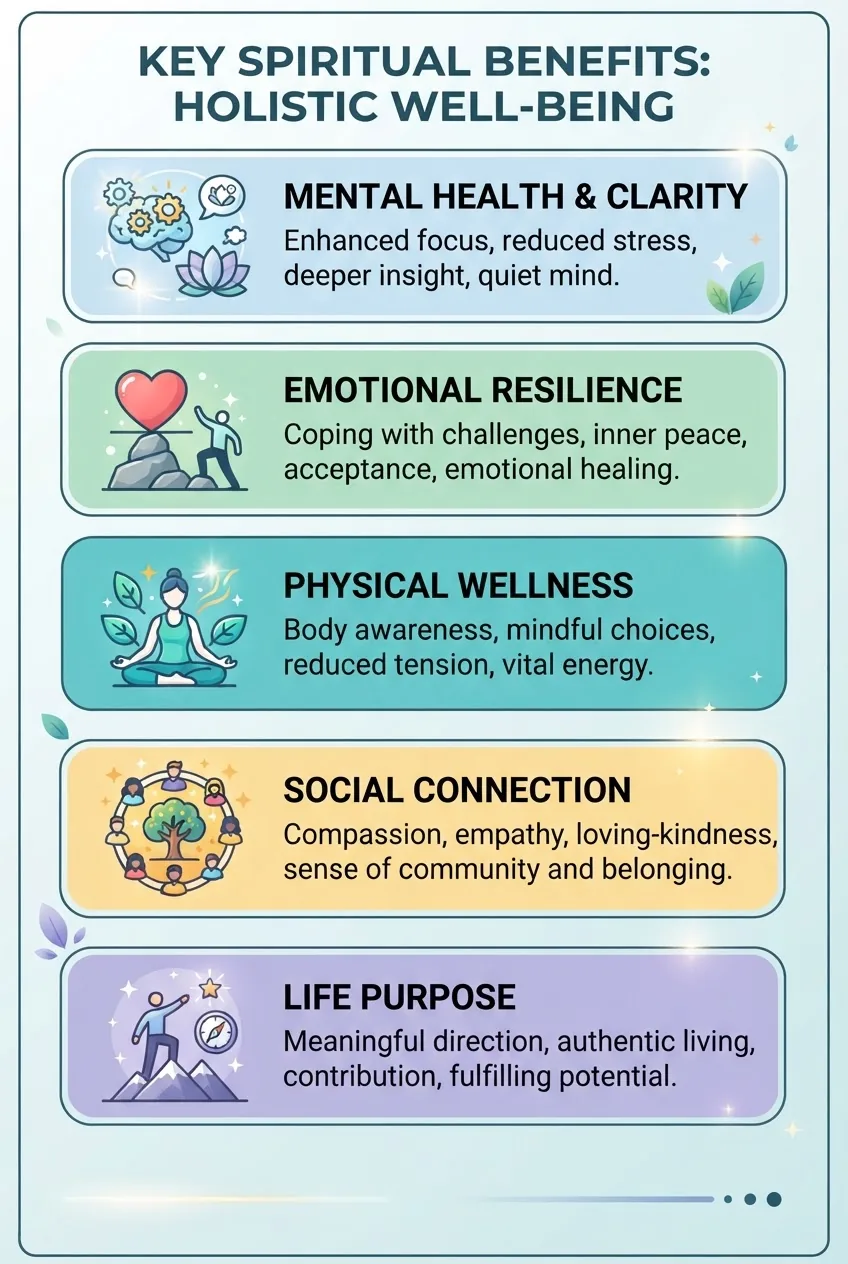
- Mental calm and clearer priorities reduce cognitive load and improve decision-making.
- Emotional resilience reduces reactivity and increases capacity for constructive coping.
- Social belonging and practical support improve access to resources and reduce loneliness.
- Physical correlates reduce stress-related wear and tear on the body.
Actionable insights without prescribing techniques (conceptual only):
- View spiritual benefits as resources that augment psychological coping and social capital.
- Assess which domains—mental clarity, emotional regulation, social support, physical health or life purpose—would most improve your balance, and prioritise aligning meaning to those domains.
- Use spiritual frameworks to interpret setbacks as information rather than fixed failure, which supports adaptive choice-making.
Supporting authority: public health frameworks and integrated care models increasingly include spiritual well-being as part of comprehensive care strategies; for practical life-balance resources and guidance on building meaning see building meaning and balance and for daily translation of benefits into habits consult daily spiritual practices.
Health caution: while spiritual benefits contribute to wellbeing, they are complementary to clinical care; consult health professionals when addressing medical or psychiatric conditions. According to WHO guidance on mental health, holistic approaches that include social and spiritual domains can support recovery when integrated with clinical services (WHO resource, 2022).
Synthesis: integrated spiritual benefits increase a person’s capacity for sustained well-being by lowering stress, enhancing relationships, improving health behaviours and strengthening a sense of meaning; these effects are mutually reinforcing and typically strongest when aligned with personal values and supportive communities.
Transition: despite clear advantages, common misconceptions about spiritual benefits can create unrealistic expectations—next we clarify those misunderstandings.
Common Misconceptions About Spiritual Benefits Clarified?
Answer: Common misconceptions include believing spirituality guarantees instant peace, replaces medical care, or requires religious affiliation; in reality spiritual benefits vary, develop over time, and complement—rather than substitute for—clinical treatments.
Clarifications:
- Myth: Spirituality is the same as religion. Reality: spirituality includes but is not limited to religious practice; it covers personal meaning and connection.
- Myth: Spirituality cures illness. Reality: spirituality can support coping and health behaviours but is not a substitute for medical treatment.
- Myth: Benefits are immediate and uniform. Reality: gains accrue variably and depend on context, community and personal interpretation.
Skepticism and evidence: skepticism is healthy—robust evaluation looks for reproducible outcomes and recognises selection effects (people predisposed to wellbeing may also be more spiritual). High-quality research panels recommend integrating spiritual care with psychological and medical care when appropriate (peer-reviewed consensus statement, 2020).
Closing this section: recognising the limits of spiritual benefits protects against harm and supports responsible integration into wellbeing strategies.
Final summary and next steps: Spiritual benefits—mental clarity, emotional resilience, social support, physical health correlations and purpose—work together to enhance holistic wellness. For readers ready to translate these advantages into day-to-day structure, consult daily spiritual practices and for deeper self-work resources see Live Your Purpose Guide for Meaningful and Intentional Life.
Conclusion: the advantages of spirituality are multifaceted and evidence-backed in many domains; they are best understood as complementary resources that, when matched to personal values and supported by community and clinical care where needed, can substantially improve quality of life. If you want to explore tailored guidance, consider consulting a trusted health or spiritual care professional.