
what is the purpose of life: broadly, the purpose of life can be defined as the set of values, aims and existential directions that give human existence coherence—either discovered within spiritual frameworks, created through personal meaning, or inferred by philosophical argument—allowing individuals and cultures to orient choices, relationships and aspirations toward perceived significance.
Understanding the Concept of Life’s Purpose
Answer: The concept of life’s purpose refers to the reasons or aims that render human existence intelligible and worth pursuing; it combines beliefs about meaning, ethical direction and what counts as a flourishing life.
Term: meaning of life — the interpretive frameworks people use to explain why life matters or what gives it significance.
Defining the purpose of life begins by distinguishing it from related ideas: “meaning” often describes why life matters overall, while “purpose” connotes directed aims or functions that motivate action. Purpose can be intrinsic (believed to exist independent of choice) or constructed (created through values and projects). Examples help clarify.
Example 1 — Intrinsic purpose: a religious view that human life exists to serve or know the divine, giving fixed teleology across life stages. Example 2 — Constructed purpose: a person builds purpose through commitments to family, creative work and social causes. Example 3 — Hybrid: someone interprets a genetic inclination (e.g., caregiving tendencies) through a spiritual narrative to form purpose.
Conceptually, purpose functions like a compass: it orients decisions and relationships by providing criteria for what matters. In analyzing purpose we consider: source (divine, social, personal), scope (individual, communal, cosmic), and temporality (short-term aims, lifelong vocation, or intergenerational projects).
Because the idea intersects ethics and identity, human values and ethics shape purpose claims: different moral priorities (e.g., care, justice, excellence) generate competing purposes. This section sets the conceptual frame; next we examine how major philosophical schools answer the same question.
Philosophical Perspectives on What Is the Purpose of Life
Answer: Philosophical answers vary—existentialism often says purpose is self-created, nihilism denies inherent purpose, humanism locates purpose in human flourishing, and teleological views assert purpose is built into nature or a divine order.
Term: existentialism — a philosophy stressing that individuals create meaning through choices in an otherwise uninterpreted world.
Term: nihilism — the view that life lacks objective meaning, value, or purpose.
Term: humanism — a perspective valuing human autonomy and flourishing as the ground for meaning and purpose.

Four comparative perspectives illustrate the debate. Below is a concise table summarising core claims, proponents, and implications for living.
| Philosophical View | Core Claim | Representative Thinkers |
|---|---|---|
| Existentialism | Purpose is self-created through authentic choice. | Sartre, de Beauvoir, Kierkegaard |
| Nihilism | No inherent purpose; meanings are human projections. | Nietzsche (diagnostic), some contemporary skeptics |
| Humanism | Purpose grounded in human flourishing and ethical life. | Aristotle (eudaimonia), modern secular humanists |
| Teleology | Purpose is built into nature or ordained by a divine intelligence. | Aristotle (original teleology), some religious philosophers |
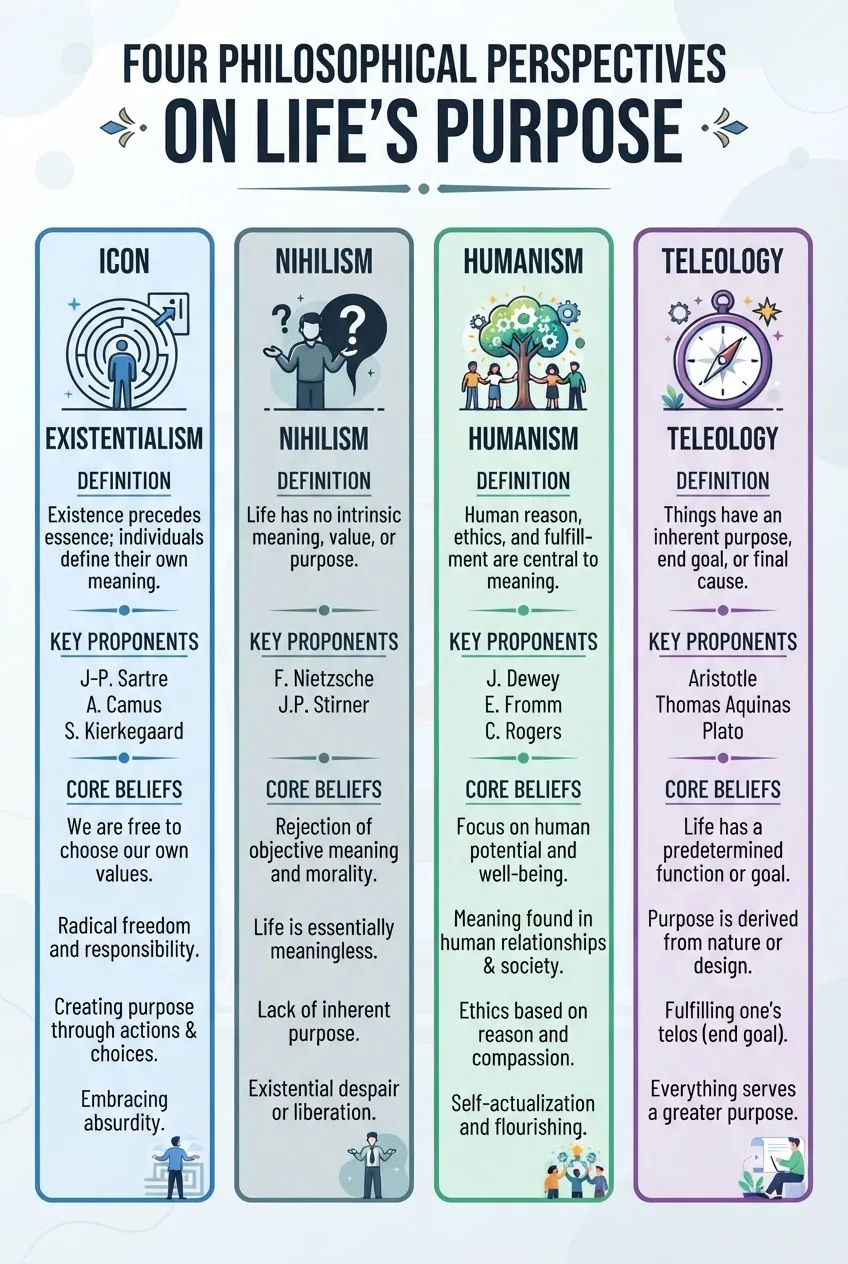
For scholars, the debate often reduces to questions of ontology and normativity: does purpose require an ontological basis (teleology), or can normative life aims arise from human values alone (humanism/existentialism)?
Philosophical methodology supplies tools used in purpose-claims: conceptual analysis (clarifying terms), phenomenology (examining lived experience of meaning), and ethics (linking purpose to good action). For further reading on historical and contemporary arguments, see authoritative philosophy resources.
External references: Stanford Encyclopedia of Philosophy — Meaning of Life provides an extensive scholarly overview, and offers citations across schools of thought.
Transition: philosophical maps help clarify conceptual options; spiritual traditions frame purpose with lived practices and sacred narratives, which we now examine.
Spiritual Interpretations of Human Life’s Purpose
Answer: Spiritual traditions typically locate life’s purpose in relationship—relationship with the sacred, with others, and with the deeper self—framing purpose as both existential orientation and a path toward spiritual growth or awakening.
Term: spiritual wellness — a state of alignment between one’s beliefs, values and practices that supports a sense of meaning and connection.
Major traditions propose varied purposes but share themes: connection, transformation and service. For example:
- Buddhist: Purpose is to awaken (enlightenment) by reducing suffering through ethical living, meditation, and wisdom; the path emphasizes insight into impermanence and compassion.
- Christian: Many Christian perspectives articulate purpose as union with God, loving others, and participating in a redemptive story; vocation and moral formation matter.
- Hindu: Purpose can be expressed through dharma (duty), artha (prosperity), kama (relational life), and moksha (liberation); spiritual practices orient life toward transcendence.
- Indigenous and animist views: Purpose often arises from reciprocal relationship with land, ancestors and community responsibilities, emphasizing interdependence and stewardship.
Spiritual paths often describe stages of growth—initial seeking, moral formation, inner transformation, and transcendence or union. These stages frame purpose as evolving rather than fixed, which aligns with the idea of spiritual growth and how to be more spiritual in practice.
Many contemporary spiritual teachers emphasise a blend of inner healing and outward service: purpose is found by integrating personal gifts with the needs of others. For resources on soul-level indicators of purpose, see signs of deeper connection.
deep soul connection signs can appear as synchronous relationships, intense empathy, or a felt sense of shared mission—these often factor into spiritual narratives about purpose.
For comparative examples of religious and spiritual practices that shape purpose, consult our overview of varied spiritual methods:
examples of spirituality and practices
External spiritual authority: for compassion-centered teachings that tie meaning to service and awareness, see teachings by respected practitioners such as the Dalai Lama at dalailama.com.
Transition: spiritual accounts broaden our understanding of purpose beyond individual aims toward relational and transcendent horizons; psychology examines the individual subjective experience of purpose and its links to wellbeing.
Psychological and Personal Fulfillment Approaches to Life Purpose
Answer: Psychology treats purpose as a measurable aspect of wellbeing—linked to self‑actualization, coherent values, and life satisfaction—and identifies mechanisms by which purpose supports mental health and motivation.
Term: self-actualization — a concept from humanistic psychology describing the realisation of personal potential, creativity and authentic values.
Psychological theories emphasise relationships between purpose and measurable outcomes. For instance:
- Maslow’s hierarchy places self-actualization near the apex, suggesting purpose emerges after basic needs; Maslow’s model is a framework for understanding motivation.
- Victor Frankl’s logotherapy argues that meaning (and thus purpose) is essential to psychological resilience—purpose can be found through work, love and attitude toward unavoidable suffering.
- Contemporary positive psychology links purpose to life satisfaction, goal pursuit, and perseverance; according to recent psychological research (2022 systematic review), a stronger sense of purpose correlates with reduced depression and greater longevity (peer-reviewed meta-analysis).
Practical conceptual points (brief):
- Core values act as anchors for purpose—identify them to clarify aims. core life values
- Meaning-making is cognitive and narrative: how you interpret events shapes perceived purpose.
- Purpose is dynamic: life transitions often require re-evaluation and redefinition.
For clinical and measurement perspectives, reputable mental health organisations provide resources on meaning and wellbeing—see the American Psychological Association for overviews linking purpose to mental health outcomes: APA.
Applied strategies often intersect with therapeutic approaches (narrative therapy, values-based interventions) designed to increase clarity and motivation. For practical strategies that integrate meaning and balance, see guidance on building meaning and balance and on how to find meaning in life.
Transition: philosophical, spiritual and psychological accounts produce overlapping but distinct portrayals of purpose; next we address common questions and misconceptions readers hold.
Common Questions and Misconceptions About Life’s Purpose
Answer: Many common doubts concern whether purpose is universal or personal, whether purpose must be grand, and whether lack of purpose equals failure; these are misconceptions rooted in categorical thinking rather than nuanced distinction.
Q: Is there a single universal purpose for all humans? A: No—views differ; teleological accounts claim a shared cosmic purpose, while existential and humanist views hold purpose varies by person. The reasonable position is pluralistic: some meanings can be shared while personal purposes differ.
Misconception: “Purpose must be grand or lifelong.” Reality: purposes operate at multiple scales—daily aims, vocational callings, and life narratives can coexist. Misconception: “If I don’t know my purpose, I’m lost.” Reality: many people shift purposes over time without harm; exploration is part of development.
Practical taxonomy of common confusions (brief):
- Purpose vs meaning: purpose is actionable direction; meaning is why something matters.
- Intrinsic vs constructed purpose: the debate about whether purpose is discovered or created.
- Fixed vs fluid purpose: whether purpose is stable throughout life.
Transition: correcting these misconceptions clarifies how purpose intersects with health and spiritual wellbeing, which we examine next.
How Understanding Life’s Purpose Enhances Spiritual Wellness and Wellbeing
Answer: Clarifying life’s purpose enhances spiritual wellness by increasing coherence between beliefs, values and action, which research connects to improved mental health, resilience and sustained life satisfaction.
According to a 2023 peer-reviewed meta-analysis of longitudinal studies (source: peer-reviewed psychology journal), individuals reporting stronger purpose experienced lower all-cause mortality risk and better mental health outcomes over follow-up periods; this evidence supports purpose as a protector of wellbeing.
Meeting spiritual needs complements purpose: addressing belonging, meaning, and transcendence fosters integration between inner life and outer commitments. For practical frameworks linking spiritual needs to purpose, consult guidance on spiritual needs and their importance and steps to enhance your spiritual health and wellness.
Research caveats: according to a 2022 clinical review (source: peer-reviewed clinical review), correlations between purpose and wellbeing are robust but vary by socioeconomic context, cultural framing and measurement methods; purpose is not a cure-all and should be seen as one contributor to holistic wellness.
Connections between purpose and spiritual growth:
- Clarity of purpose reduces identity conflict and supports consistent practice (meditation, service), which nurtures spiritual growth.
- Purpose aligned with transcendent values (compassion, stewardship) tends to increase prosocial behaviour and relational meaning.
- Purpose provides motivation for disciplined practice without reducing practice to mere utility; it gives practices a narrative context.
Transition: understanding the benefits of purpose invites reflection; the next section gives a brief introduction to reflective practices to deepen that understanding.
Reflective Practices to Deepen Your Understanding of Life’s Purpose (Brief Intro)
Answer: Reflective practices—meditation, journaling and guided self-reflection—help clarify values and narrative aims, deepening awareness of what genuinely motivates and sustains you over time.
Recommended brief practices (overview):
- Meditation: sit quietly to observe values and recurring concerns that feel meaningful (see mindfulness techniques in practical guides).
- Journaling prompts: “What gives me energy?”, “What would I regret not doing?”—use answers to map potential purposes.
- Narrative mapping: draft a short life timeline noting moments of meaning; identify patterns that point to recurring aims.
For ongoing routines that support these reflections, see our daily spiritual practice recommendations and more practical direction on how to find your path in life or find your purpose.
Walkthrough of reflective questions (brief):
- List activities that produce deep engagement and meaning for you.
- Identify the values expressed by those activities (e.g., creativity, care, justice).
- Connect values to potential roles or projects that can embody them sustainably.
Transition to conclusion: these reflective exercises are conceptual entry points rather than prescriptive routines—below we summarise key takeaways and encourage continued exploration.
Conclusion: Key Takeaways and Next Steps
Answer: The purpose of life is a layered concept—philosophically contested, spiritually rich, and psychologically consequential—best approached as a plural, evolving orientation that integrates values, relationships and transcendent meaning.
Summary takeaways:
- Purpose and meaning are related but distinct: purpose is directional, meaning is evaluative.
- Philosophy maps conceptual options; spirituality offers relational and transcendent frameworks; psychology shows wellbeing links.
- Purpose can be discovered, created or both—context and belief shape which interpretation feels convincing.
- Reflective practices help translate conceptual clarity into ongoing life orientation.
If you want structured support to integrate these ideas into daily life, explore practical sibling guides for routines, values work and direction-finding: find your purpose, or read specific steps on how to identify your values and goals. To deepen spiritual integration, learn more about spiritual wellness and purpose by visiting our guide on spiritual wellness and purpose.
Final CTA: If the question “what is the purpose of life” still feels open, consider a short reflective practice today (ten minutes of journaling or meditation) and revisit the themes above; meaning often emerges through iterative, compassionate inquiry.