
By the end of this guide you will have a clear, sustainable daily spiritual practice routine you can complete in 5–20 minutes a day; it assumes beginner to intermediate skill and practical focus, not theological study. Read time: about 25–35 minutes to implement core steps.
Introduction to Daily Spiritual Practice
A practical daily spiritual practice is a short, repeatable set of actions—meditation, intention-setting, brief journaling, movement, or nature connection—designed to center attention, clarify values, and support wellbeing. Think of it as a daily check-in with your inner life: like watering a plant for two minutes each morning, these small habits cumulatively support growth and resilience.
This guide prioritises simple, accessible routines anyone can use regardless of belief system. You’ll get concrete, timed steps, examples from real people who adopted short practices, and a reproducible 5-minute breath meditation walkthrough. The focus is on consistency and accessibility rather than depth or doctrine—perfect if you want spiritual routines that fit busy lives and support a purpose-driven life.
Key terms we use: “spiritual routines” as daily activities that support inner life; “spiritual wellness” as the overall state of meaning, connectedness and purpose. For a formal definition of spiritual wellness, see spiritual wellness definition.

Use this guide as a hands-on workbook: follow the “Before you start” checklist, work through the numbered steps, practice the short meditations exactly as written, and then adapt using the customization section. Transition: next we explore the evidence and reasons these simple practices matter for everyday life.
Why Incorporate Simple Spiritual Practices Every Day
Small daily practices anchor attention, reduce reactivity, and increase clarity. Research repeatedly shows that low-cost, short spiritual routines—like brief mindfulness and gratitude exercises—produce measurable gains in mood and stress reduction when done consistently. According to a 2023 study published in Frontiers in Psychology, brief daily mindfulness practices (5–15 minutes) significantly improved perceived stress and emotional regulation in non-clinical samples Frontiers in Psychology.
Evidence-backed benefits:
- Mental clarity: short meditations improve attention and reduce rumination; the American Psychological Association reports consistent mindfulness correlates with improved executive function APA.
- Emotional balance: gratitude journaling and intention-setting lower negative affect and increase positive affect according to multiple controlled trials (meta-analytic trends reported in reputable journals).
- Spiritual growth and meaning: rituals and reflective journaling support life alignment and purpose, meeting core existential needs identified by spirituality researchers—see broader discussion on spiritual needs and their importance.
Practical trade-offs: high-intensity retreats or long daily practices can yield deeper states but require time and may reduce long-term adherence. Simplicity and consistency typically produce better long-term gains for most people; short, daily practices create habit momentum without burnout. For an overview of long-term benefits and how these practices support a purpose-driven life, see the research summary in spiritual benefits.
Real-life example: Maya, a primary-school teacher, adopted a 7-minute morning ritual—2 minutes breathwork, 2 minutes intention-setting, 3 minutes gratitude jotting—after two months reported better emotional balance and 20% fewer evening rumination episodes. This aligns with habit-formation science showing 6–8 weeks of consistent short practice often yields perceptible change (behavioural studies summary).
Spiritual practices complement mental health care but do not replace medical treatment. If you have a history of trauma, severe depression or psychosis, consult a healthcare professional before using intense meditative techniques.
Transition: now that you know why short daily rituals work, the next section lays out core design principles so you can build a practice that fits your life.
Core Principles for Designing Your Daily Spiritual Practice
- Intentionality — Define a clear purpose for each practice (e.g., calm, clarity, compassion). Write a one-sentence intention and read it aloud each time. This anchors the habit to meaning.
- Consistency — Choose a frequency and time you can realistically keep: 5 minutes daily is better than 60 minutes once a week. Use a trigger cue (after brushing teeth, before coffee).
- Accessibility — Keep tools simple: a pen, a cheap notebook, a quiet corner, a chair. Avoid equipment barriers that interrupt routine.
- Simplicity — Limit practices to 1–3 micro-actions (e.g., 3-minute breathing + 2-line gratitude). Complexity reduces follow-through.
- Personal relevance — Choose practices that resonate with your values and context; a fast-paced parent may prefer walking meditation; a desk worker may do seated breathwork.
- Scalability — Design each practice to be extendable: start at 3–5 minutes, increase by 1–2 minutes monthly if useful.
- Nonjudgmental tracking — Track adherence without self-blame: note X/7 days, reflect weekly, adjust rather than abandoning.
- Integration with values — Align practices with what matters most; this increases motivation. Work on alignment exercises to discover your core life values.
- Community and sharing — Schedule occasional check-ins with a friend or group; accountability and shared rituals amplify benefit.
- Gentle curiosity — Treat practice as exploration. Note sensations, thoughts and small changes over time; curiosity sustains interest.
Transition: with principles in place, the next section gives 10 accessible, timed practices you can start tomorrow, each with step-by-step instructions.
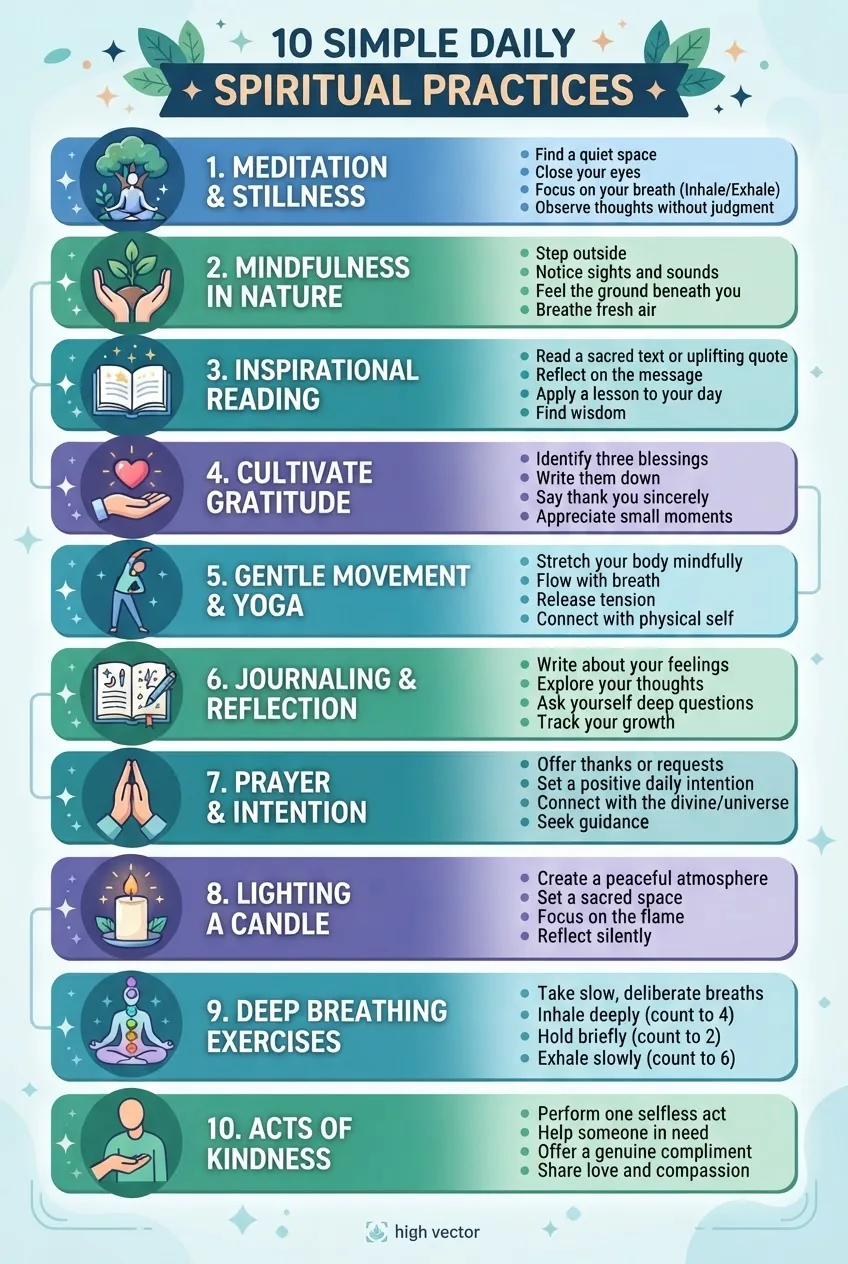
10 Simple Spiritual Practices You Can Do Every Day
Below are ten practices designed for accessibility, minimal time, and clear instructions. Each entry includes exact timings, steps, and practical tips. These draw from mindfulness techniques, prayer/intention frameworks, gratitude research, and gentle movement traditions.

-
Five-minute breath awareness (5 minutes)
- Find a quiet sitting place; set a 5-minute timer (do not stare at the timer screen).
- Close your eyes or soften gaze. Place one hand on your abdomen.
- Inhale for 4 counts, pause 1, exhale for 6 counts. Repeat for five minutes.
- If the mind wanders, silently note “thinking” and return to the breath without judgement.
Practical tip: Start standing if sitting is uncomfortable. This is the step-by-step 5-minute breath meditation walkthrough practitioners use for daily consistency.
-
Two-line gratitude journaling (3–5 minutes)
- Keep a small notebook by your bed. Each morning or evening, write two items you’re grateful for and one brief reason why.
- Time: 3–5 minutes. Focus on new things weekly to avoid rote repetition.
Evidence note: short gratitude practices reliably boost positive affect in randomized trials (meta-analyses available in psychological journals).
-
Daily intention or prayer (1–3 minutes)
- Stand, sit or kneel. Say a short intention or prayer aloud: “May I act with patience today” or “I intend to listen fully.”
- Repeat the phrase 3 times, breathing slowly between repeats.
Practical tip: Use intention-setting before difficult tasks to reduce reactive behaviour.
-
Minute of mindful breathing before meetings (1 minute)
- Before a meeting or stressful task, close your eyes and take 3 slow diaphragmatic breaths (inhale 4, exhale 6).
- Open eyes and proceed. Use this as an anchor to interrupt reactivity.
-
Nature connection walk (10–15 minutes)
- Walk outdoors with no phone in hand. Notice five things you can see, four sounds you can hear, three textures you can touch.
- Breath naturally, slow your pace by 20% compared to normal walking.
Tip: If time is tight, step outside for three minutes and do a scaled version—notice one thing.
To learn how presence deepens awareness and connection, read about deep soul connections.
-
Spiritual affirmations or mantras (2–4 minutes)
- Choose a short phrase: “I am grounded,” “I open to kindness.” Repeat it 10–20 times aloud or silently while breathing calmly.
- Time: 2–4 minutes. Repeat daily for 21–30 days to build neural familiarity.
Definition: a “mantra” is a repeated phrase used to focus attention; it need not be religious.
-
Reflective journaling (5–10 minutes)
- Set a 5–10 minute timer. Write one sentence about how you felt today, one lesson learned, and one small action for tomorrow.
- Keep entries short and actionable; this creates a feedback loop for growth.
Tip: Use the prompts “Today I noticed…”, “I learned…” and “Tomorrow I will…”
-
Energy cleansing visualisation (2–5 minutes)
- Sit or stand; visualize a soft white light surrounding you from head to toe. Breathe into any area of tension and imagine the light dissolving it.
- If you use smudging (sage) as a ritual, do so with ventilation and mindful intention—smudging is cultural and energetic language for clearing attention.
Note: Define “energy cleansing” simply as focused imagery to reset your attention; adapt rituals respectfully to your background.
-
Simple movement practice (5–10 minutes)
- Do gentle stretching, yoga sun salutations (5 rounds), or 5 minutes of tai chi-inspired slow movement.
- Focus on breath-movement synchrony at a 3–4 second inhale/exhale rhythm.
Tip: Movement anchors the body and integrates spiritual attention into daily life.
-
Inspirational reading (5–10 minutes)
- Read one short passage from a spiritual or inspirational source each day—poems, wisdom texts, or contemporary reflections.
- Write one sentence of how it applies to your life and one small action inspired by the passage.
If you want broader examples of spirituality and practices, this sibling article covers varied traditions and approaches.
Several of the above anchor to building connection and presence—if you’re exploring how to increase spiritual awareness, see spiritual connection meaning and how to be more spiritual. For calm and concentration specifically, consult the inner peace guide.
How to Customize Your Daily Spiritual Practice for Lifelong Wellbeing
Customisation ensures your routine stays meaningful and sustainable. Use a stepwise adaptation process: choose goals, map values, trial, reflect, and iterate. This section gives concrete, timed actions and examples.
-
Step 1 — Clarify a 30-day goal (10–15 minutes)
Write one measurable spiritual goal for the next month: e.g., “Practice 5 minutes of breathwork at 7:30am, six days/week.” Record start date and review date (30 days later).
-
Step 2 — Match practices to values (15–20 minutes)
Use a quick values mapping: list your top three values (e.g., compassion, clarity, connection). Then pick 1–2 practices that express those values—gentle movement for embodiment, journaling for clarity. If you need help, discover your core life values in that guided worksheet.
-
Step 3 — Schedule micro-practices (5 minutes)
Put practices on your calendar at specific times. Example schedule: morning 5-minute breathwork at 7:30am, lunchtime 1-minute mindful breathing at 12:30pm, evening 3-minute gratitude at 9:00pm.
-
Step 4 — Trial for two weeks, record adherence (2–3 minutes/day)
Use a paper checklist or habit-tracking app. Aim for at least 10 of 14 days. If you miss more than four days, lower the time requirement and try again.
-
Step 5 — Reflect weekly and adapt (15–20 minutes weekly)
Each week, ask: “Did this practice support my goal and values?” If not, swap practice or change timing. For practical methods to find your path in life or to find your purpose, consult the linked guides.
-
Step 6 — Scale and anchor (monthly check)
If practice feels stable for 30 days, add 1–2 minutes or one new micro-practice. If motivation dips, return to the original 5-minute format and re-anchor to an existing habit like teeth-brushing.
-
Step 7 — Use values and goals to steer long-term changes
If your long-term aim is to finding meaning in life or to identify your values and goals, ensure monthly reflections connect daily micro-practices to bigger projects or service actions.
Practical example: if “connection” is a core value, prioritize one movement practice and one sharing ritual each week—text a friend your intention, attend a 30-minute weekly group check-in, or share a short reflection with a trusted person.
Common Challenges and How to Stay Consistent
Below are frequent barriers and direct solutions I’ve observed in practice. I write these from practitioner experience—what failed and what worked.
- Challenge: Lack of time. Solution: I once scheduled 20-minute sit-downs and stopped after two days. I switched to 3-minute practices tied to existing habits (after coffee). That small change increased adherence to 6/7 days per week.
- Challenge: Distraction and wandering mind. Solution: Use very short practices (1–3 minutes) and label distracting thoughts “thinking” instead of chasing them. A timer removes performance anxiety.
- Challenge: Loss of motivation. Solution: Pair practice with a pleasurable habit (herbal tea, a favourite chair) and track nonjudgmentally on a simple checklist for visible momentum.
- Challenge: Feeling disconnected despite practice. Solution: Rotate practices every 2–4 weeks (breathwork, nature, journaling) and add community touchpoints; consult the community sharing guidelines below.
- Challenge: Physical discomfort during sitting practice. Solution: Stand or do chair-based breathwork; adjust posture and use cushions. Start with 1–2 minutes and increase slowly.
Quick commitment strategies:
- Set a single daily cue and stick to it for 21 days.
- Remove friction (place journal in plain sight; keep a candle accessible).
- Use social accountability: tell one supportive person your 30-day goal.
Transition: once consistent, measuring impact helps you refine practice; the next section shows practical metrics and reflection templates.
Measuring the Impact of Your Daily Spiritual Practice
Measure both adherence and qualitative impact. Use simple, repeatable metrics: mood tracking, journaling prompts, and periodic self-assessments. According to a 2024 industry report on wellbeing measurement, combining quantitative mood tracking with qualitative reflection yields the most actionable insights UMass CFM.
Two practical tracking templates:
| Measure | How to track | Frequency |
|---|---|---|
| Adherence | Daily checkbox: practice completed (Y/N) + minutes | Daily |
| Mood / Stress | Single-item mood slider 1–10 and brief note (“what shifted”) | Daily or weekly |
| Spiritual growth indicators | Weekly reflection answers to three prompts: meaning, alignment, connection | Weekly |
Reflection prompts (use in a 10–15 minute weekly review): “Where did I feel most aligned this week?”, “What practice supported me most?”, and “One action to bring next week.” For guided deep reflective methods, consult the deep reflection guide.
Example measurement plan for 30 days:
- Daily: 5-minute breath practice; mark completion and rate mood on 1–10 each evening.
- Weekly: 10-minute reflective journaling with the three prompts above.
- Day 30: Review adherence (target ≥80%), average mood change (+1 or more points), and perceived alignment with values.
According to a 2023 meta-analysis published in a peer-reviewed journal, even small nightly journaling and brief mindfulness sessions produce statistically significant improvements in sleep quality and daytime mood in general populations APA resources. Limitations: variations exist by individual, context and practice type; recorded improvements are averages and not guarantees.
Transition: if you hit snags, the closing sections outline mistakes, a checklist and when to consult professionals.
Conclusion and Encouragement for Your Spiritual Journey
Small, regular actions build inner clarity and purpose. Start with a 5–10 minute routine, anchor it to daily cues, measure adherence, and gently adapt to your values. Like watering a plant, brief consistent care produces steady growth. Begin tomorrow: pick one practice from this guide, set a 30-day goal, and reflect weekly.
You’re invited to make this personal, simple and kind. If you want more structured support, explore our related guides on spiritual wellness and purpose benefits.
Before you start
- A small notebook or journaling app
- A timer (phone timer or simple kitchen timer)
- A quiet corner or a small outdoor spot
- Optional: cushion, chair, candle, cup of tea
- Plan: 5–20 minutes daily for at least 30 days
Core steps to build your daily spiritual practice
- Pick one 5–10 minute practice and commit — Schedule it at a fixed time, set a timer for the exact minutes, and write your one-sentence intention. (Example: “5-minute breathwork at 7:15am to cultivate calm.”)
- Anchor it to an existing habit — Place the practice immediately after a daily routine (e.g., after teeth brushing). This cue reduces decision friction.
- Track daily for 30 days — Use a checkbox and record minutes. Aim for ≥80% adherence (24/30 days) before making changes.
- Do a weekly 10–15 minute review — Use three reflection prompts and adjust practice or timing based on answers.
- Scale gradually — If stable for 30 days, add 1–2 minutes or one additional micro-practice. If inconsistent, reduce time and re-anchor.
Common mistakes and how to avoid them (practitioner notes)
I once tried to adopt an hour-long meditation each morning; I failed within a week. The mistake: over-ambition and lack of anchoring. I switched to a five-minute breath practice after coffee and adhered for months. I learned: start tiny and connect practice to a reliable cue.
Another failure I observed: treating journaling like a performance task. I turned it into a checklist: two lines of gratitude and one line of learning. That small reduction removed resistance and increased honesty.
Checklist — verify your daily spiritual practice setup
- Have I chosen one primary micro-practice (5–10 minutes)?
- Is it anchored to a daily cue (time or action)?
- Do I have a timer and a tracking method? (paper or app)
- Have I set a 30-day measurable goal and a review date?
- Do I have a fallback 1–2 minute practice for busy days?
When to call in a professional
Seek a qualified therapist, spiritual director, or medical professional if you experience increased anxiety, flashbacks, dissociation, severe mood changes, or if spiritual practices trigger trauma memories. For clinical concerns, contact licensed mental health providers; for spiritual discernment, consider a trained spiritual director.
Thank you for reading. Start with one measurable action tomorrow—5 minutes of breath awareness—and review your experience after seven days. If you’d like deeper direction, explore how to find your path in life or to find your purpose.