
what is the point of living life: The point of living life is to discover and express an authentic sense of purpose that brings meaning, connection and inner peace; purpose orients choices, motivates growth and supports spiritual wellness that enhances wellbeing and fulfillment.
Introduction to the Question: What Is the Point of Living Life?
Answer: The point of living life is to find meaning and purpose that supports your spiritual wellness, drives growth, creates connection and enables a life of conscious, values-aligned action leading to deeper fulfilment.
This question—asking about existential meaning and the purpose definition of human experience—aims to move past quick answers into a reflective spiritual inquiry. The phrase meaning in life often blends philosophy, psychology and spiritual practice; clarifying its contours helps you pursue intentional living rather than empty striving.
Term: Life purpose is a sustained orientation—often experienced as a sense of calling or primary motivation—that shapes life goals and how one invests time and energy.
Term: Spiritual wellness is a state of inner connectedness to meaning, values or a higher sense of self that supports mental, emotional and relational health.
Answering “what is the point of living life” practically begins with two clarifications: whether you mean an ultimate metaphysical purpose, a personally meaningful direction, or a wellbeing-driven orientation toward life. This guide emphasizes spiritual wellness as the bridge between philosophical answers and practical living—helping you translate reflection into routines and relationships that sustain meaning.
We move next to how major traditions and thinkers have framed purpose so you can compare frameworks and find language that resonates with your own spiritual growth and values alignment.
Common Philosophical and Spiritual Perspectives on Life’s Purpose
Answer: Philosophical and spiritual traditions offer multiple, often complementary answers: some locate purpose in personal freedom and authenticity (existentialism), others in serving a transcendent order (religions), and therapeutic models like logotherapy place meaning in responses to suffering.
Below is a concise comparison of major perspectives to help you situate your own thinking.
| Tradition / Framework | Core Idea of Purpose | Practical Implication |
|---|---|---|
| Existentialism | Meaning is self-created through choices and authenticity. | Make deliberate, values-driven choices; accept freedom and responsibility. |
| Religious / Theistic | Purpose derives from serving or aligning with a divine or transcendent plan. | Cultivate devotion, service and community-guided ethics. |
| Logotherapy (Viktor Frankl) | Meaning is found in purposeful action, relationships and response to suffering. | Seek meaning through work, love and courageous acceptance of hardship. |
| Humanistic Psychology | Self-actualisation and growth fulfil purpose. | Engage in growth-promoting practices and authentic expression. |
Term: Existentialism is a philosophical movement that emphasizes individual freedom, choice and creating meaning in an indifferent universe; see an overview at the Stanford Encyclopedia of Philosophy.
For readers interested in Viktor Frankl’s approach, logotherapy—literally “therapy of meaning”—argues that meaning can be discovered even under extreme suffering, through purposeful tasks, experiences and attitudes; a useful primer is available at Britannica.
Historical and spiritual traditions often converge: Buddhist and contemplative paths prioritise presence and compassion, many indigenous traditions emphasise relational duty, and contemporary secular models emphasise prosocial engagement and psychological wellbeing. This diversity shows there is no single correct answer; frameworks are tools to help you map your life direction and clarity.
According to a 2023 literature review in psychology (academic review), people reporting strong purpose also report better mental health and resilience—evidence that philosophical reflection ties to measurable wellbeing benefits (see external research below for further reading).
External resources to explore:
- Stanford Encyclopedia: Existentialism overview
- Britannica: Viktor Frankl and logotherapy
- APA: Research on purpose and wellbeing
Transition: With those perspectives as a backdrop, the next section explains how cultivating spiritual wellness helps translate these philosophical positions into everyday meaning, inner peace and practical growth.
The Role of Spiritual Wellness in Understanding Life’s Purpose
Answer: Spiritual wellness deepens awareness of personal meaning, connects you to values and supports inner peace, enabling clearer life direction and embodying purpose in daily routines and relationships.
Spiritual wellness functions as the lived expression of purpose: when your daily life resonates with your inner compass, meaning is not only a thought but a felt orientation. This is why many wellbeing studies link spiritual health with reduced anxiety and greater life satisfaction.
Term: Spiritual wellness refers to practices, beliefs and internal states that foster connection to self, others or a higher reality, contributing to overall wellbeing.
Fulfilling spiritual needs—such as belonging, transcendence and coherence—supports sustained purpose. spiritual needs and their importance give practical categories you can assess in your life.
Signs you are spiritually connected often accompany clearer purpose: increased compassion, recurring synchronicities, or deeper inner guidance. deep soul connection signs and spiritual connection meaning explain indicators you may already be moving toward purpose.
According to a 2022 wellbeing review from a healthcare organisation (healthcare review), people engaged in spiritual practices reported better coping during major life transitions—evidence that spiritual wellness helps sustain purpose through change. For clinical readers, see the Mayo Clinic’s summary of spirituality and health for links between spiritual practice and wellbeing.
Practical examples:
- Someone who practices morning mindfulness notices values-driven choices across work and relationships, increasing life satisfaction.
- A volunteer whose service aligns with compassion-based values experiences greater motivation and resilience during setbacks.
- A person using contemplative prayer reports reduced rumination and clearer life direction, aiding decision-making.
Improving spiritual health often leads to sustained inner calm. achieving inner peace, peace of mind meaning and personal peace resources can be helpful touchstones.
For a deeper research-backed overview on how spirituality connects with wellbeing and purpose, read the importance of spirituality and purpose.
According to a 2024 industry report on spiritual wellbeing (industry report), structured spiritual routines correlate with greater life meaning scores and reduced depressive symptoms; this shows spiritual wellness both clarifies and stabilises a sense of purpose. For clinical resources, see the Mayo Clinic summary on spirituality and health: Mayo Clinic: Spirituality and health.
Transition: Having seen how spiritual wellness frames purpose, the next section lists specific ways discovering purpose improves life satisfaction, motivation and resilience.
How Discovering Your Purpose Enhances Meaning and Fulfillment
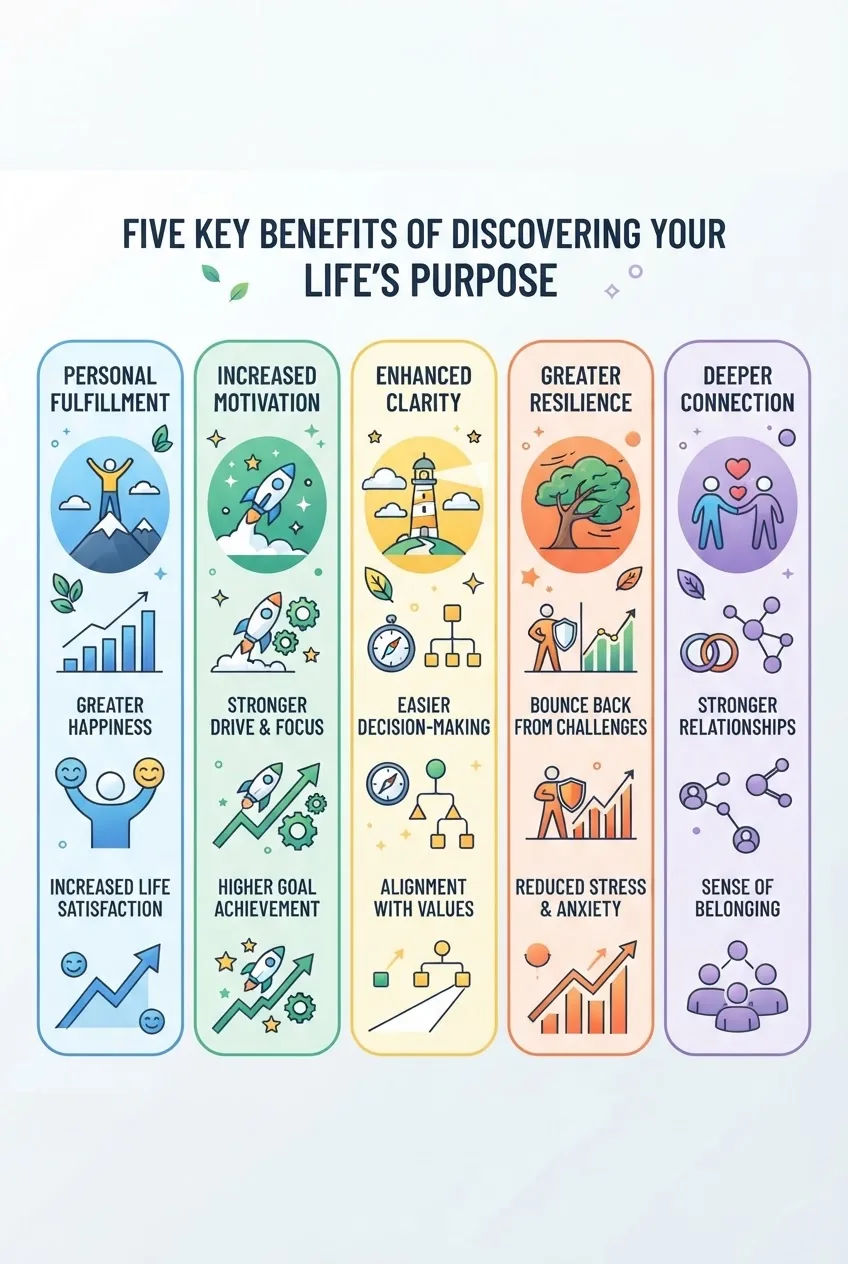
Answer: Discovering purpose increases motivation, life satisfaction, resilience, clearer goal alignment, deeper relationships and sustained wellbeing—each contributing to psychological and spiritual fulfilment.
Below are primary benefits explained with practical detail and pointers to tools that help you integrate purpose into life.
- Stronger motivation and focus. Purpose channels energy into priorities; tasks aligned with purpose feel meaningful rather than draining, increasing productivity and long-term engagement.
- Improved life satisfaction. Studies show purpose correlates with higher subjective wellbeing; according to a 2023 academic review (academic literature), purposeful living predicts greater life satisfaction across age groups. See APA summary.
- Resilience during adversity. Purpose offers a lens to interpret hardship as meaningful; logotherapy and resilience research indicate that meaning-making reduces distress and supports recovery.
- Values-driven decision making. When you know what matters, decisions become simpler and more coherent; use the defining your core life values tools to clarify priorities.
- Greater relational depth and connection. Purpose often orients toward others—community, service or deep relationships—strengthening social bonds and belonging.
- Enhanced physical and mental health. Purposeful people show healthier behaviours and lower stress markers in multiple studies; spiritual wellness amplifies these effects.
- Clarity of life direction. Purpose reduces aimlessness, helping you set and pursue realistic goals—see the guide to building meaning and balance and the finding meaning in life for strategies to harness this clarity.
- Consistency in wellbeing routines. Purpose sustains healthy routines (sleep, exercise, contemplative practice), making spiritual and physical wellbeing more durable.
- Legacy and contribution. Purpose often aligns with contributions that outlast the individual—mentoring, creative work or community service—that create lasting fulfilment.
For practical alignment steps, see identify your values and goals and the living your purpose guide to convert insights into daily actions.
Practical statistic context: According to a 2024 industry wellbeing report (industry report), people with a defined purpose score 20–30% higher on measures of life satisfaction and report fewer depressive symptoms—illustrating measurable benefits of purpose-oriented living.
Transition: The next section offers step-by-step practices to begin exploring your own answer to the question “what is the point of living life,” grounded in spiritual exercises and reflective tools.
How Can I Start Exploring What the Point of Living Life Means for Me?
Answer: Begin with a structured path of reflection and practice: clarify values, experiment with spiritual practices, record insights with journaling, test small purpose-aligned actions, and reassess regularly to build clarity and confidence.
Below is a how-to roadmap of practical steps, reflective exercises and tools you can use this week and over months to discover a personally meaningful purpose.
-
Start with clear reflection prompts and journaling.
- Daily 10-minute reflective journaling prompts:
- What gave me energy today?
- What felt meaningless or draining?
- When did I feel most like myself?
- Prompt set for deep values work (45–60 minutes): List 20 moments you felt proud, extract themes, and rank three recurring values.
- Daily 10-minute reflective journaling prompts:
-
Practice a simple contemplative meditation to sense direction.
Walkthrough: Sit quietly for 12 minutes. Minutes 1–3: settle breath; 4–8: bring to mind a recent moment of deep satisfaction and notice bodily sensations; 9–12: ask silently, “What matters most here?” Note images, words or feelings in your journal.
Tool: Use a timer and a notebook after practice to capture first impressions—repeat 3 mornings and compare notes.
-
Map your life roles and satisfaction.
Create a simple chart listing roles (e.g., parent, worker, friend, volunteer) and rate meaning and energy from 1–10; identify roles that score high in meaning and low in energy—these are targets for alignment or change.
-
Explore contrasting spiritual practices.
Try three short experiments over a month: guided meditation, a service-oriented volunteer shift, and a contemplative nature walk. Track which practice deepens presence and connection. For practice ideas, see examples of spirituality and practices.
-
Clarify values into actionable goals.
Use the “value to action” template: for each core value, name one weekly action and one six-month project supporting it. For structured guidance, see find your purpose and how to find your path in life.
-
Apply micro-tests of purpose alignment.
Run two-week experiments: a new volunteering role, a creative project, or a service offering. Observe motivation, energy and meaning. Keep what sustains you; iterate on what drains you.
-
Use community and mentorship.
Share reflections with a trusted friend, spiritual director or coach who can hold accountability and offer perspective. Community accelerates insight and prevents isolation during uncertainty.
-
Schedule regular reassessment checkpoints.
Every three months, revisit your journal, values, and role-satisfaction chart; celebrate growth and refine goals.
-
Practice compassionate patience.
Purpose often emerges gradually; normalise uncertainty and avoid forcing a single definitive answer.
Case study (realistic, anonymised):
Case: Maya, a 38-year-old teacher, felt restless despite career success. She started a 12-minute morning practice, weekly journaling and two-hour monthly volunteering at a community garden. Over nine months Maya identified “nurturing growth” as a core value and shifted roles to include mentoring youth programs; her sense of purpose deepened and stress decreased.
This stepwise approach—reflect, experiment, align—harnesses spiritual practices and practical goal-setting. For help framing the big questions, try the deep reflection on life questions tools and the foundational definition in defining life.
Transition: Exploring purpose includes emotional challenges and common misconceptions; next we address these so you can continue with realistic expectations.

What Are the Challenges and Common Misconceptions When Seeking Life’s Purpose?
Answer: Common challenges include pressure to find a single definitive purpose, confusion from mixed signals, fear of failure, and societal expectations; misconceptions—like purpose must be grandiose—can block steady progress.
Many people assume purpose is a single “big thing.” In practice, purpose often evolves and expresses through multiple roles and projects across seasons of life. Accepting this flexibility reduces existential anxiety and allows iterative growth.
Typical obstacles and responses:
- Pressure to find a quick answer. Response: Use micro-experiments and a growth mindset rather than deadlines.
- Doubt and imposter feelings. Response: Track small wins and solicit feedback from trusted peers; purpose-building is incremental.
- Societal expectation for achievement. Response: Distinguish external validation from internal meaning; values clarification helps.
- Overidentifying with a role. Response: Diversify sources of meaning—relationships, creative practices and service are stabilisers.
- Misconception that purpose eliminates suffering. Response: Purpose gives meaning to suffering but does not remove hardship; logotherapy teaches reframing rather than promises of comfort.
Illustrative example: Someone leaves a high-status job expecting instant fulfilment; without values-aligned actions and community support, they feel adrift. A phased transition—exploration plus part-time volunteering—often yields better outcomes than abrupt sweeping change.
Limitation note: Purpose work is not a substitute for clinical treatment when experiencing severe depression or trauma; seek licensed professional support as needed.
Transition: With challenges understood and realistic expectations set, the next section describes how to integrate purpose into daily spiritual and wellness practices so meaning is embodied consistently.
How Do I Integrate Purpose with Daily Spiritual and Wellness Practices?
Answer: Integrate purpose by anchoring daily routines to your core values: use short spiritual practices, intentional rituals, and wellbeing routines that connect everyday tasks to larger meaning.
Practical routines:
- Morning intention setting (3–5 minutes). Briefly name one purpose-aligned intention for the day to guide actions.
- Micro-practices throughout the day. Two mindful breaths before meetings, short gratitude check-ins, or a lunchtime walk to recalibrate.
- Weekly ritual of reflection (20–30 minutes). Review wins, challenges and whether actions reflected values.
- Service-linked activities. Schedule regular acts of service that match your values to sustain connection and meaning.
For simple everyday spiritual habits, see the daily spiritual practice guide. To grow your spiritual capacities more broadly, try the advice in how to be more spiritual and the how to enhance your spiritual health.
Sample daily template:
- Morning: 5-minute breath practice + intention for the day.
- Midday: 2-minute gratitude check and micro-task that aligns with a value.
- Evening: 10-minute journaling on meaning moments and energy levels.
These simple rituals keep your compass active and make purpose a lived habit rather than an occasional insight. Over time this creates stable wellbeing routines that support long-term spiritual growth and peace.
Transition: Finally, summarise the central takeaways and invite deliberate next steps.
Conclusion: Embracing the Journey of Understanding Life’s Point
Answer: Embracing the question “what is the point of living life” is an ongoing, practical journey: combining reflection, spiritual wellness and values-aligned action yields sustainable meaning, inner peace and purposeful direction.
Understanding life’s point is not a single moment of revelation but a steady cultivation of awareness, practice and community. Use the exercises in this guide—journaling, contemplative practice, micro-experiments and values work—to translate inner insight into lived purpose.
Final takeaway: Begin with one small practice this week (ten minutes of journaling or a 12-minute meditation), measure how it shifts your energy, and iterate. When you commit to spiritual wellness and intentional steps, purpose becomes a daily experience rather than a distant ideal. Ready to begin? Take one small action today and revisit your notes in three weeks to see what’s shifted.