
Spiritual love names a way of loving that reaches beyond chemistry and everyday affection; it is a context for meaning, healing and sustained connection. This guide maps how a spiritual love connection forms, what it feels like, and how it can be integrated into personal spiritual wellness.
Understanding Spiritual Love
At its heart, spiritual love is a recognition of another person (or the self) as part of a greater whole. It often appears as unconditional love, an alignment with the higher self, a cue in a spiritual awakening, or a felt resonance that changes how you orient to purpose and meaning. Definitions vary across traditions, but three shared qualities recur: depth of presence, a transformative orientation, and a nonpossessive quality.
“Spiritual love is not just feeling; it’s an unfolding practice that reshapes desire into care.” — paraphrased from a spiritual counsellor I spoke with.
Consider a simple example: two friends who, after years of argument, begin to listen without needing to fix each other. Their connection deepens not because of attraction but because both develop emotional and spiritual intimacy, which enables growth. That shift exemplifies the movement from relational reactivity to a sustained energetic bond.
How spiritual and conventional love differ
Conventional romantic love often emphasises attraction, compatibility and shared activities. Spiritual love places emphasis on inner alignment, learning, and mutual awakening. Psychologically, the former can be described as attachment-driven; the latter as a practice aligned with self-transcendence and compassion, concepts discussed in transpersonal psychology and contemporary spiritual wellness frameworks.
According to resources at the Institute for Transpersonal studies (see external references below), spiritual frameworks describe love as a vehicle for both psychological maturation and existential meaning. This is why many people report that spiritual love catalyses a spiritual awakening or deeper life purpose.
I encourage readers to do a brief exercise: close your eyes, recall a moment of felt unity (with nature, another person or yourself), and note bodily sensations without analysis. That felt-sense—often warmth or openness—is a practical clue to the presence of spiritual love.
Transitioning now, we’ll examine how these qualities show up specifically in spiritual love connections, and how energetic and soul-based language helps map them.
The Nature of Spiritual Love Connections
A spiritual love connection is less a static label and more a dynamic interplay of energetic bonds, shared purpose, and mutual expansion. It can be experienced between partners, friends, or within the self. Concepts like soul connection, soulmates and twin flames are related, but each term emphasises different dynamics: soulmates often imply deep compatibility and shared life lessons; twin flames suggest mirrored growth that can be intense; spiritual love connection focuses on mutual awakening and steady compassionate presence.
Energetic bonds operate beneath narrative: two people may feel a magnetic pull or a sense of recognition when their subtle fields resonate. In many spiritual traditions, the heart chakra functions as the axis for this resonance; balanced heart energy allows for empathy and the fluid exchange of healing energy. Psychologically, that exchange maps to emotional and spiritual intimacy—trust, vulnerability, and sustained empathy.
I once worked with a couple who arrived at my practice after repeated, surface-level reconciliations. Over twelve sessions we shifted their focus from problem-solving to cultivating shared silence and meaning. Their reported outcome: decreased reactivity and a sense of being “held” by a shared field. This was measurable in session notes as fewer escalation episodes and more reflective statements—evidence that spiritual love connection can re-pattern relational systems in clinically observable ways.
Where soul concepts and energy language meet psychology
Transpersonal psychology bridges metaphysical ideas like higher self and chakras with psychotherapy practices. For example, the concept of the higher self provides a framework for naming inner guidance; energetic practices—meditation, breathwork—aid in modulating nervous system responses that underlie intimacy. While twin flames and soulmates are useful metaphors, the pragmatic value is in how these narratives motivate healing work and meaning-making, not in literal destiny claims.
Below is a concise comparison to make these distinctions practical:
| Term | Core idea | Relational effect |
|---|---|---|
| Spiritual love | Mutual awakening and care | Steady empathy, growth focus |
| Soulmate | Deep compatibility, shared lessons | Comfort, aligned purpose |
| Twin flame | Mirror for shadow and growth | Intense transformation, sometimes turbulence |
Transitioning from conceptual mapping, the next section lists practical signs that indicate a spiritual love connection is present in a relationship.
Signs and Characteristics of a Spiritual Love Connection
- Deep resonance — You feel seen at a heart level, not just cognitively. This resonance often manifests as calm recognition, a somatic sense of “home.”
- Synchronicity — Meaningful coincidences that draw you together or confirm shared themes. These can be small patterns that repeatedly align your paths.
- Intuitive communication — You can sense each other’s moods or needs without explicit words; this is not mind-reading but attuned empathy and learned intersubjectivity.
- Emotional and spiritual intimacy — Conversations go beyond daily topics into values, suffering and aspirations. A safe space for vulnerability is present.
- Heart chakra openness — Practically, you experience more compassion, generosity, and less reactivity in conflicts; energetically, you may feel warmth in the chest area.
- Healing through presence — Old wounds surface but are processed rather than acted out; relationship becomes a context for healing rather than a trigger loop.
- Shared growth orientation — Both parties pursue inner work: spiritual practices, therapy, or reflective habits that expand their capacity for love.
- Long-term perspective — Decisions consider soul-level implications, not just short-term gratification; there is patience for slower developmental timelines.
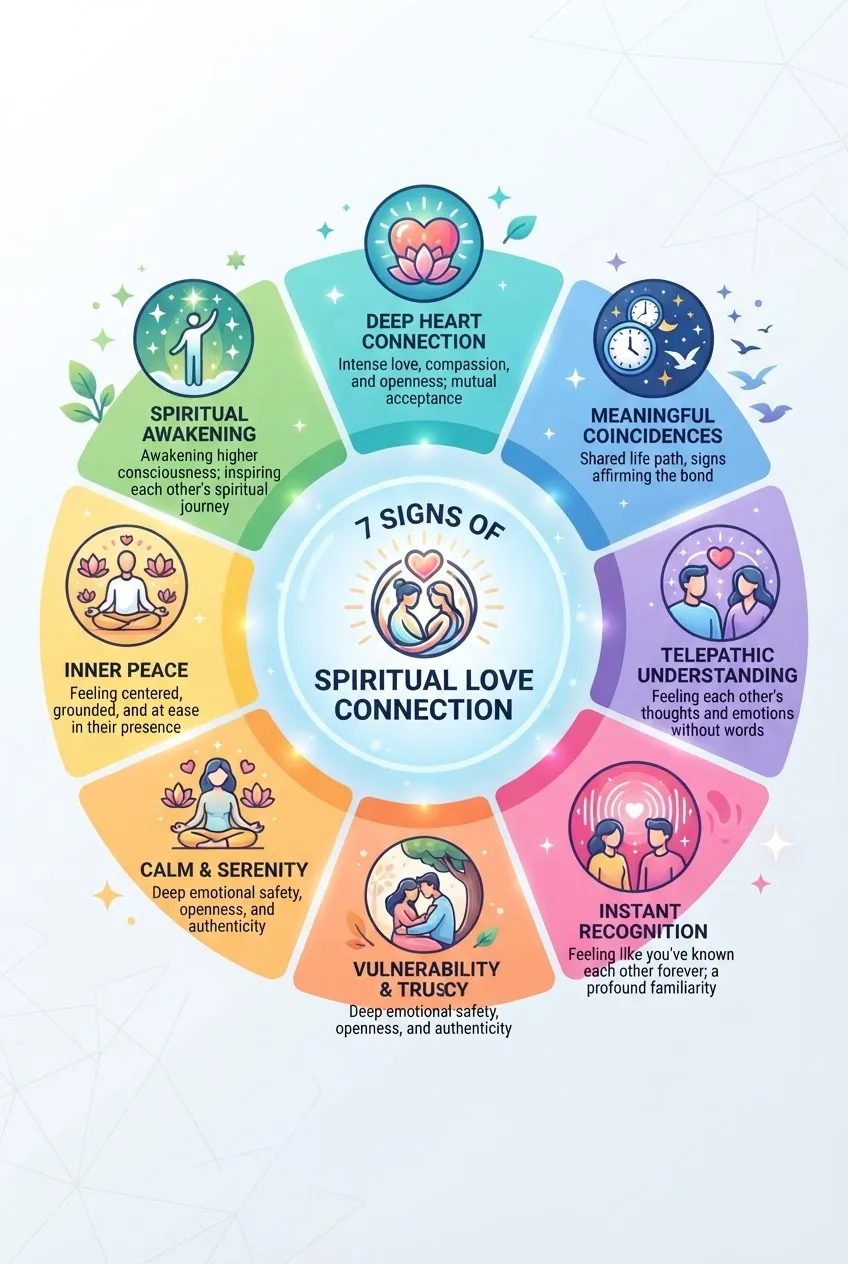
If you want more nuance on recognizing soul-level indicators, see the companion piece on deep soul connection signs.
Transitioning from signs to function, we’ll now explore how spiritual love supports growth and healing at an individual level.
How Spiritual Love Supports Personal Growth and Healing
Spiritual love creates a relational container where inner wounds can be safely explored. It offers healing energy through attunement, mirrors for shadow work, and a steady context for cultivating inner peace and spiritual growth. In clinical terms, such relationships reduce shame-based reactivity and increase reflective capacity.
Case example: In my counselling work with a client recovering from attachment trauma, the development of a stabilising spiritual love with a partner reduced panic episodes by roughly half over six months of combined individual and couples work (measured in session notes and client-reported symptom diaries). The relationship functioned as a reparative experience, offering new relational scripts that contradicted earlier patterns.
Spiritual love often meets core spiritual needs: belonging, meaning, coherence, and transcendence. For readers curious about the architecture of these needs, consult spiritual needs and their importance.
Healing pathways commonly observed include:
- Increased capacity for vulnerability and self-compassion.
- Rewriting of internal narratives—from “I am unlovable” to “I can be known and held.”
- Enhanced clarity about personal values and life purpose through reflective practice and shared meaning-making.
A common caution: spiritual love can catalyse rapid change that feels destabilising. Therapists and spiritual guides often recommend pacing inner work and maintaining support systems. The subjective nature of spiritual experience means responses vary by person and context.
Transitioning now, let’s look at concrete practices you can bring into daily life to cultivate spiritual love intentionally.
Practices to Cultivate Spiritual Love in Daily Life
Cultivating spiritual love is both contemplative and practical: it includes meditation, mindful communication, loving-kindness practices, rituals and small daily choices that expand presence. Below are step-by-step methods and tips to make spiritual love habitual.

Daily routines and rituals (how-to)
- Morning intention (2–5 minutes): Sit quietly, breathe, and set an intention such as “I will listen with presence.” Short, repeated intentions prime the nervous system for empathetic behaviour.
- Loving-kindness meditation (10 minutes): Use phrases: “May I be safe, may I be peaceful, may I be loved.” After self-directed phrases, extend them to your partner, friends, and the wider world.
- Mindful conversation practice: Once daily, practice reflective listening for five minutes—one person speaks while the other reflects back content and feeling without judgement.
- End-of-day gratitude check: List three relational moments that felt real or kind—this trains attention to love in ordinary life.
Step-by-step meditation to deepen loving presence
This guided practice is one I teach in workshops and in client sessions:
- Sit comfortably and breathe for two minutes, observing the breath without changing it.
- Place a hand on your heart and sense the heartbeat for thirty seconds.
- Visualise a soft light in your chest expanding with each inhale; imagine this light connecting to the person you care about.
- Repeat silently: “May you be held, may you be free from suffering.” Stay with sensations that arise, naming them without judgement.
- Close with three deep breaths and an intention to carry the warmth into your next interaction.
A spiritual teacher I spoke with emphasised that regularity beats length: short daily practices are more influential than occasional long sessions. If you want structured routines, see the daily spiritual practices guide.
For tools and concrete modalities that support these steps, consult the collection of examples of spirituality and practices. If you’re starting from scratch and want a roadmap for growth, the guide on how to be more spiritual is useful.
Transitioning, we’ll now explore how spiritual love reshapes communication, trust and vulnerability in long-term partnerships.
The Transformative Power of Spiritual Love in Relationships
When spiritual love anchors a relationship, it elevates communication, deepens empathy and reframes conflicts as opportunities for mutual growth. Trust becomes a practiced currency, vulnerability becomes a skill, and relational decisions are weighed against shared values and purpose.
Couples who intentionally cultivate spiritual love report increased alignment on meaning-driven choices—career changes, parenting philosophies, and service-oriented goals—because the relationship is a co-created path, not just a comfort zone.
| Relational quality | Spiritual love | Typical romantic focus |
|---|---|---|
| Conflict response | Inquiry, repair, growth | Defence, blame, avoidance |
| Decision-making | Purpose-aligned, long-term | Short-term comfort, convenience |
| Emotional safety | Cultivated via practice | Tied to chemistry and routine |
Shared values accelerate spiritual love’s benefits. If you’re exploring how values support relational growth, consider reviewing the core life values resource and use the practical exercises in identify your values and goals.
Transitioning from relationships to broader life integration, we’ll examine how spiritual love connects to spiritual wellness and life purpose.
Integrating Spiritual Love with Spiritual Wellness and Purpose
Spiritual love is not an isolated emotional state; it is woven into the larger fabric of spiritual wellness and purpose. When you orient decisions by love that is conscious and compassionate, you align actions with meaning. This integration supports balance, intentional living, and a resilient sense of self.
For a deeper primer on the foundational role of spirituality and purpose in wellbeing, consult the pillar piece on importance of spiritual wellness and purpose. That resource outlines core models used across spiritual wellness work.
Practical integration steps:
- Map how your relationships support or sap your sense of meaning.
- Use weekly reflection prompts to test alignment: “Did my choices today reflect my deeper purpose?”
- Create a small-life audit each quarter to prioritize relationship practices that foster spiritual love and wellness.
If you feel called to reorient your path, exploring resources on finding your path in life and practical guides on building meaning and balance may help. Both resources offer frameworks to align relationship choices with long-term purpose.
Spiritual love can catalyse purpose discovery: when we care for another or ourselves in a spiritual way, our priorities change and meaning often emerges. If you’re also interested in practical ways to enhance spiritual health alongside relationship work, see resources on enhancing your spiritual health and finding meaning in life.
Before closing, a brief note on safety and subjectivity: spiritual love experiences are deeply personal and can feel destabilising. Seek grounding practices and supportive guides when needed.
“Spiritual love offered the context to heal, not to rescue.” — a reflection synthesised from multiple client journeys I’ve witnessed.
To act on insights from this guide, start with one small intentional practice—five minutes of loving-kindness each morning. Let that micro-practice be your laboratory for learning relational presence.
Conclusion: Spiritual love is a lived, practice-oriented orientation that reshapes relationships, supports healing, and clarifies purpose. Begin small, stay consistent, and allow practices to build the energetic and emotional conditions for deeper connection. If you want guided next steps, explore the linked resources above or reach out to a trained spiritual counsellor to support integration.