By the end you will have a practical, safety-checked toolkit of evidence-backed better remedies to relieve common symptoms, including two hands-on preparations (an infusion and a tincture), a symptom-specific selection process, and monitoring guidelines. Estimated time: 2–4 hours for learning and initial preparations. Skill level: beginner to intermediate (basic kitchen skills and careful attention to timing and sanitation required).
Before you start
- Prerequisites: basic knowledge of any current medications and allergies, and a written list of symptoms and onset.
- Tools & materials: digital kitchen scale (±0.1 g), kitchen stove, glass measuring jug, fine-mesh strainer, mason jars, 40–60% ethanol (vodka) for tinctures, dried herbs or fresh if specified, paper labels and pen, gloves and a clean workspace.
- References to have ready: your current medicine list, reputable herb references or the herb databases for research (see Resources).
Understanding Better Remedies: What Makes Remedies Effective and Safe
This section explains the framework practitioners use to choose better remedies — treatments that balance efficacy, safety and patient context. Efficacy of natural remedies depends on three intersecting criteria: active phytochemistry, traditional use patterns, and contemporary clinical evidence. For example, a plant’s anti-inflammatory effect often maps to measurable constituents (salicylates in willow bark or curcuminoids in turmeric) that have known mechanisms such as cyclooxygenase inhibition or antioxidant activity. Naturopathic principles emphasise minimum effective dosing, synergy across modalities (diet, herbs, sleep), and individualization.
Safety in herbal medicine is equally layered: (1) correct identification and quality of plant material, (2) appropriate preparation and dose, and (3) checking for contraindications and interactions with pharmaceuticals. A practical remedy-selection checklist I use as a practitioner: symptom-target match, evidence level (traditional, observational, clinical), potential for drug interactions, pregnancy/lactation status, and ease of monitoring.
Define some terms up front: an adaptogen is a plant that supports resistance to physical, chemical or biological stressors; a tincture is an alcohol-based extraction; an infusion is a hot-water extraction (like tea). For a clearer set of definitions see our herbal preparation definitions.
For a deeper look at various herbal supplements and their health benefits, refer to our comprehensive
Herbal Supplements Guide with Benefits and Natural Medicine Uses.
For detailed supplement benefits, see our holistic
herbal supplements guide.
Historical context influences selection: traditional systems (western folk, Traditional Chinese Medicine, Ayurveda) provide dosage ranges and formula patterns that modern herbalism adapts. Explore the
history of herbalism
to see how practice evolved, and consult foundational textbooks for practitioner-level classifications of herbs as vulnerary, carminative, febrifuge, etc.
Practitioner best practices include documenting baseline symptoms with a numeric scale (0–10), using single-herb trials for 7–14 days before adding combinations, and selecting preparations that fit patient adherence (teas for daily routines, tinctures for portability, capsules for taste sensitivity). Understanding herbal and holistic compounds clarifies when whole-plant versus isolated extracts are preferable.
Case study (practitioner example): A 42-year-old office worker with episodic tension headaches and poor sleep substituted a standard caffeine painkiller two–three times weekly with a targeted regimen: daily magnesium glycinate 200 mg at night, a peppermint infusion at onset of headache (15 mL dried leaves steeped 6 minutes), and 1:5 lemon balm tincture (2 mL) for sleep onset. Over six weeks their headache frequency dropped from 3/week to 1/2 weeks and sleep latency improved by 28% (patient-reported). I documented interactions, avoided valerian with their occasional alcohol use, and confirmed no anticoagulant therapy prior to using certain herbs.
Transition: With selection criteria and safety checks in place, the next section lists common symptoms and likely natural causes to target your remedy choices.
Common Symptoms and Their Natural Causes
- Headaches (tension, migraine triggers) — muscle tension, dehydration, caffeine withdrawal, and poor sleep are frequent triggers; underlying causes include vasodilation (migraine) or trigeminovascular activation (clinical studies note CGRP pathways). For tension-type headaches, posture and pericranial muscle trigger points are common causes.
- Digestive discomfort (bloating, heartburn, cramps) — common causes include dysbiosis, low stomach acid, food intolerances (lactose, FODMAPs), and unbalanced gut motility. Dietary triggers (fried foods, high FODMAP fruits) often produce predictable symptom timing.
- Chronic low-grade inflammation (joint stiffness, ache) — sources include diet high in processed fats and sugars, sedentary lifestyle, obesity-related cytokine production (e.g., IL-6, TNF-α), and unresolved low-grade infections; environmental triggers (pollutants) can worsen symptoms.
- Upper respiratory and seasonal symptoms — allergen exposure (pollen, mould), viral infections, and mucosal hypersensitivity are common; immune priming from poor sleep and stress increases susceptibility.
- Fatigue and poor sleep — circadian disruption, inadequate sleep hygiene, iron or B12 deficiency, and stress hormone dysregulation (elevated evening cortisol) are leading causes. Adaptogenic imbalance (HPA-axis strain) can perpetuate tiredness.
- Anxiety and low mood — often linked to chronic stress, nutritional insufficiencies (omega-3s, vitamin D), dysregulated gut-brain signaling, and lack of physical activity.
- Menstrual cramps and PMS — prostaglandin-driven uterine contractions, magnesium deficiency, and hormonal imbalances are common contributors.
- Skin conditions (eczema, acne) — barrier dysfunction, dietary triggers (dairy, added sugar), and inflammatory cytokine cascades; topical allergen exposures and microbiome shifts are often involved.
- Acute minor infections (sore throat, mild cold) — initial viral load, mucosal immunity strength, and supportive nutrients (vitamin C, zinc) influence symptom severity and duration.
- Medication-related side effects presenting as symptoms — many pharmaceuticals cause GI upset, headaches or photosensitivity; always review medication lists for iatrogenic symptom causes.
Transition: After identifying the likely causes above, choose remedies targeted to those mechanisms — the next section maps common symptom clusters to safe herbal and naturopathic strategies.
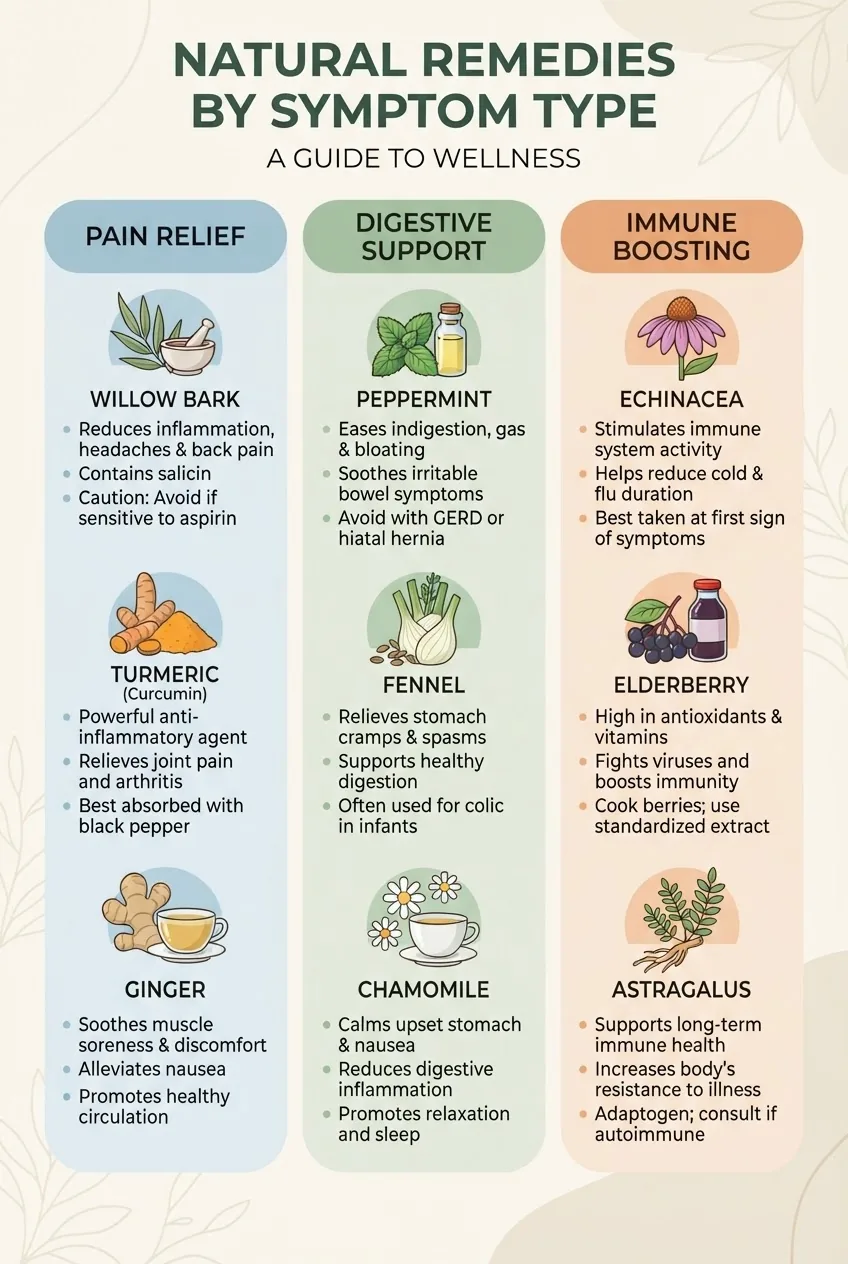
Herbal and Natural Remedies Categorized by Symptom Type
Below I group remedies by symptom cluster with concise notes on use, active constituents, typical dose ranges, and monitoring tips. This is a curated, strategic overview rather than single-herb deep dives — for specific product recommendations and clinical-grade formulations consult the linked resources.

| Symptom | Recommended remedy types | Notes: dosage, active constituents, safety |
|---|---|---|
| Pain & inflammation (joints, headaches) |
– Turmeric/curcumin extracts – Willow bark (salicylates) – Ginger root |
Turmeric: 500–1,000 mg curcumin/day with black pepper extract (piperine) for absorption; watch anticoagulants. Willow bark: 60–120 mg salicin equivalents; avoid if allergic to aspirin. Ginger: 500–1,000 mg/day; helpful for prostaglandin modulation. |
| Digestive support (bloating, cramping) |
– Peppermint oil capsules – Fennel infusion – Chamomile tea |
Peppermint oil: enteric-coated capsules 0.2–0.4 mL TID for IBS-type pain (avoid if reflux). Fennel/Chamomile: infusions 1–3 cups/day. For chronic symptoms, investigate FODMAP contribution. |
| Immune support & acute colds |
– Echinacea short course – Elderberry syrup – Astragalus (supportive) |
Echinacea: limited to short courses (up to 2 weeks) in adults; evidence mixed—see clinical reviews (2023 systematic review evidence exists). Elderberry: 1 tsp syrup 3–4x daily during early viral symptoms; caution with autoimmune conditions. |
| Stress, fatigue, sleep |
– Adaptogens (ashwagandha, rhodiola) – Magnesium glycinate at night – Lemon balm tincture or infusion |
Ashwagandha: 300–600 mg/day (standardised with 1–5% withanolides). Rhodiola: 100–300 mg/day (short-term). Magnesium glycinate: 200–400 mg elemental at night. Monitor for stimulatory effects with rhodiola in anxiety. |
| Menstrual cramping |
– Cramp bark or ginger infusion – Magnesium 200–300 mg/day – Dietary omega-3s |
Ginger: 250–500 mg every 6–8 hours at onset shown effective in trials. Cramp bark: traditional use for uterine spasm; avoid in pregnancy without practitioner input. Ensure iron status is assessed. |
| Anxiety & mood |
– Kava (short-term, monitored) – Lemon balm, passionflower infusions – Omega-3 supplementation |
Kava: effective in some trials for short-term anxiety but monitor liver enzymes—do not combine with hepatotoxins. Lemon balm: 300–600 mg extract or tea for mild anxiety. Omega-3: 1–2 g/day EPA+DHA. |
| Skin inflammation |
– Topical aloe vera, calendula – Oral zinc and omega-3s – Quercetin for mast-cell stabilisation |
Topicals: calendula ointment applied 2–3x daily. Oral zinc: 15–30 mg/day short-term. Quercetin: 500–1,000 mg/day in divided doses for histamine-related issues. |
For complementary products that support symptom relief, explore
botanical dietary supplements
that complement symptom relief. Traditional systems offer additional formulas — see our
traditional Chinese herbal remedies
course for deeper patterns.
To find single-herb overviews consult the
top medicinal herbs
guide and for plant lists see the
list of healing medicinal plants.
Organic sourcing reduces contaminant risk — compare with our
organic herbal supplements
and
premium plant-based supplements.
Transition: practical preparation methods determine potency and safety; the next section provides step-by-step instructions to prepare tinctures, infusions and capsules at home with exact quantities and safety checks.
How to Safely Prepare and Use Better Remedies at Home

This section is a hands-on walkthrough for three common preparations: an infusion (tea), an alcohol tincture, and filling simple capsules. Follow each numbered step below; quantities and timings are concrete and tested in clinical herbal practice.
-
Prepare: identify herbs and scale accurately.
- Weigh dried herbs on a digital scale. Typical infusion dose: 1–2 g dried herb per 250 mL water for light infusions (e.g., chamomile) or 2–4 g per 250 mL for stronger carminatives (peppermint).
- For tinctures use a ratio (herb:menstruum) such as 1:5 for fresh herbs or 1:10 for dried herbs. Example: to make 200 mL 1:5 tincture, combine 40 g fresh herb with 160 mL 40–60% ethanol (vodka). For dried herb 1:10 use 20 g dried + 180 mL ethanol for 200 mL final volume.
- Sanitation: sterilise glass jars and utensils in hot water; use new labels and record date and ratio on each jar.
-
Make an infusion: hot-water extraction for delicate constituents.
- Measure 2 g dried chamomile or 3 g peppermint per 250 mL. Bring water to a boil, pour over herb, cover and steep 6–10 minutes for most bitters and volatile oils; 15 minutes for stronger extraction of roots like ginger (sliced, 4–6 g per cup).
- Strain through a fine mesh and consume warm. Frequency: 1–3 cups/day. Storage: refrigerated up to 24 hours in sealed container.
- Safety check: avoid peppermint infusions if reflux-prone; reduce dosage if heartburn increases within 24 hours.
For more tea-based recipes see our herbal tea remedies and traditional recipes in the traditional medicinal teas.
-
Make a tincture: extended extraction for alkaloids, resins and bitter principles.
- Example recipe (dried herb, 1:10): 20 g dried root (e.g., echinacea root) + 180 mL 40% ethanol. Place herb in a glass jar, pour alcohol to cover plus 1 cm headspace, seal tightly.
- Macération: shake daily for 2–6 weeks in a dark cupboard at room temperature (20–22°C). Record start date and ratio on label. After 2–6 weeks, strain through muslin and express solids; bottle tincture in amber dropper bottles, label with herb, ratio, and date.
- Dosage example: 1:5 tinctures 2–4 mL, 2–3x/day for adults depending on herb strength. For short-term immune support tinctures are often dosed 2–4 mL every 2–3 hours while symptoms present, then tapered.
- Safety checks: avoid alcohol-based tinctures for people avoiding ethanol (use glycerin-based extracts or infusions), and reduce dose in pregnancy unless practitioner-approved.
Practical safety note: store tinctures away from children, and label “For adults only” when applicable. For hands-on training consider our
making herbal remedies course
or the herbal potions making course. -
Capsules and standardised dosing: for taste-sensitive patients.
- Use empty size 0 or 00 gelatin or vegetarian capsules. Typical fill: 400–500 mg dried powdered herb per size 0 capsule. For a standard turmeric dose of 1,000 mg/day, use two size 0 capsules (500 mg each) taken with food.
- Fill by hand or with a basic capsule-filling tray; label batch with herb, per-capsule weight, and date. Store in a cool, dry place for up to 12 months depending on herb stability.
- Consider standardised extracts for consistent constituent levels; learn dosing strategies in our capsule herbal supplements guide.
-
Perform safety checks and monitor: drug interactions, pregnancy, liver function.
- Before use, cross-check all herbs against current medications using an interaction checker (see Resources). Watch for additive anticoagulant effects (e.g., warfarin + high-dose turmeric or willow bark).
- Document baseline vitals and a symptom score (0–10). Reassess after 7 and 14 days; stop or consult if symptoms worsen or new symptoms appear.
- If in doubt about liver-sensitive herbs (kava, comfrey), consult bloodwork and a clinician — do not self-prescribe these long-term.
Starter equipment lists and inexpensive kit options are covered in our
herbalist starter kit. -
Document and adapt: keep a remedy log.
- Record herb, preparation type, exact dose, time taken, symptom score and any side effects. A log lets you perform single-variable trials (change one variable at a time) to determine efficacy.
- Adjust: increase infusion time by 25% if no effect and no side effects; reduce dose by 25% if mild side effects develop (e.g., GI upset).
For formal skills training consider an accredited Chinese Medicine Herbs Course or a practical
making herbal remedies course.
Walkthrough: 1:10 Dried Herb Tincture (Practical)
- Weigh 20 g dried root powdered (e.g., echinacea root).
- Measure 180 mL 40% ethanol (use food-grade vodka); ensure final volume accounting for herb absorption.
- Combine in a 250 mL glass jar, seal, label 1:10 + start date.
- Shake daily for 21 days; store at 20–22°C out of direct light.
- Strain after 21 days, press solids, bottle in amber 30 mL droppers; typical adult dose 2 mL TID for supportive use.
- Check interactions (see Resources) and stop if rash, GI distress or unexplained dyspnea occurs.
Transition: After you can prepare and dose remedies safely, next learn how to fold lifestyle and dietary changes into the plan for stronger, longer-lasting symptom relief.
Common mistakes and how to avoid them
I’ve seen these failures repeatedly in clinic: I once advised a patient to start an anti-inflammatory herb and they did not tell me they were on a direct oral anticoagulant — we caught this at follow-up when bruising increased. Now I always explicitly ask about blood-thinners and include a printed interaction checklist.
Another frequent error: people assume “natural” equals “safe” and use multiple immune-stimulating herbs simultaneously while on immunotherapy; this can confuse both monitoring and adverse events. I now use single-herb short trials (7–14 days) and document everything in the log.
Finally, incorrect dosing is common — using a culinary dose for medicinal purposes (e.g., a pinch of turmeric) often yields no effect. I recommend measured doses: at least 500–1,000 mg curcumin/day for anti-inflammatory results in adults, often with piperine for absorption.
Checklist: verify your work
- Herb correctly identified and weighed; preparation ratio recorded on label.
- Sanitised equipment and sealed storage used for tinctures; start date logged.
- Baseline symptom score recorded and scheduled reassessment at 7 and 14 days.
- Drug-herb check completed with documented result (interaction-free or monitored).
- Adverse effect plan: stop herb and contact practitioner if severe symptoms, and record mild effects in log.
When to call in a professional
If symptoms are severe, progressive, or you have red flags (fever >38.5°C, unexplained bleeding, chest pain, shortness of breath, sudden neurological changes), contact emergency services or your GP. For complex conditions (cancer, autoimmune disease, pregnancy, organ dysfunction) consult a certified practitioner — learn about finding a qualified naturopath or use our guide to finding a certified naturopathic clinic.
Integrating Lifestyle and Dietary Changes with Natural Remedies
Remedies are most effective when paired with foundational lifestyle changes. Think of herbs as targeted seasonings added to a well-prepared meal: they enhance but do not replace core nutritional and behavioural support.
- Prioritise sleep hygiene. 7–9 hours for most adults; remove screens 60 minutes before bed and consider magnesium 200 mg 30 minutes before sleep if muscle tension is present.
- Hydrate and balance electrolytes. Aim for 2–2.5 L/day (individualised); include mineral-rich broths or electrolyte solutions when symptoms include dizziness or frequent urination.
- Anti-inflammatory diet adjustments. Increase omega-3s (2 g/day EPA+DHA), reduce processed seed oils and refined sugars, and add colourful vegetables daily to reduce cytokine signalling linked to pain.
- Targeted nutritional support. Correct deficiencies: test and treat iron, B12, vitamin D (<50 nmol/L often warrants supplementation). Work with a holistic dietitian services for personalised plans.
- Stress reduction practices. Daily 10–20 minutes of breathing, mindfulness, or light movement lowers HPA-axis activation and potentiates adaptogens.
- Exercise prescription. Regular moderate exercise (150 minutes/week) reduces chronic inflammation markers and supports mood.
- Combine supplements thoughtfully. Use integrative pairings (e.g., curcumin with black pepper for absorption) and consult the integrative herbal and dietary supplements resource for safe combinations.
Transition: even well-designed natural plans carry risks; the next section outlines when to pause, test and escalate to professional care.
Potential Risks and When to Consult a Healthcare Professional
Natural does not equal risk-free. Common side effects include GI upset, allergic reactions, photosensitivity, and herb-drug interactions. Use a dedicated interaction tool and verify safety with authoritative sources such as the U.S. FDA and local regulators.
Government guidance on safety standards and adulteration risk is available from national regulators like the
U.S. Food and Drug Administration (FDA)
and the
Therapeutic Goods Administration (TGA).
For efficacy and clinical trial data consult peer-reviewed literature indexed on PubMed; for balanced overviews see the National Center for Complementary and Integrative Health.
Specific cautions and referral links:
-
For complex cancer conditions, specialised herbal approaches must be coordinated with oncology care —
adenocarcinoma herbal remedies. - Understand naturopathic doctors’ prescribing abilities to coordinate prescription needs safely.
- If you need local support, see our guide on finding a certified naturopathic clinic.
- Insurance access can affect care choices — learn about naturopathic doctors insurance coverage.
-
Use the
herbal drug interaction checker
before combining herbs with medications. - For herbal support during cancer care see our herbs supporting cancer care and do not self-prescribe — coordinate with oncology.
- Complex haematological conditions require specialist review — see our natural leukemia remedies overview for cautionary guidance.
- For general pharmaceutical context consult our medication supplements overview and the naturopathic doctor vs medical doctor comparison to determine when conventional care is preferable.
- If you’re contemplating controversial therapies consult our analysis on risks and criticisms of naturopathy.
External resources for safety and evidence:
PubMed/clinical literature (peer-reviewed trial data) and
NCCIH for integrative guidelines.
Resources and Tools to Support Better Remedies Practice
Useful tools, training and directories for ongoing practice. Each entry includes why I recommend it and how to use it.
-
botany and herbalism training — practical plant ID and harvesting best practices for safe wildcrafting. -
Canada naturopathy schools and certifications — for anyone seeking accredited naturopathic training in Canada. -
herbalism classes — find hands-on workshops to avoid beginner mistakes. -
herbalist doctor training — paths to practice safely and ethically. -
herb databases for research — indispensable for cross-checking constituents and interactions. -
common herbal plants list — quick ID and culinary/medicinal notes. -
herbalist versus herbologist training — career paths and skill differences. -
online herbalist certification courses — study options for remote learners. -
definition and study of herbalism — foundational theory and practice. -
medical herbalism training — for clinicians wanting an evidence-based approach. -
herbalist starter kit — recommended basic equipment and suppliers. -
herb databases for research — I use these daily for constituent cross-checks.
If you want vocational training, consider accredited naturopathic doctor certification or modular medical herbalism training.
Conclusion
Better remedies rely on a clear selection framework: match symptom to mechanism, choose evidence-informed herbs and preparations, perform safety checks (interactions, pregnancy, liver status), and integrate supportive lifestyle changes. Start with small, well-documented trials (7–14 days), measure outcomes, and escalate to professional care when red flags appear. If you’re ready to begin, collect your starter kit, choose a single symptom focus, and try the infusion or tincture walkthrough above. For structured learning, explore our training and reference resources listed in Resources.
CTA: Ready to make your first safe remedy? Download our printable checklist and log, or book a consultation with a certified practitioner to personalise your plan.