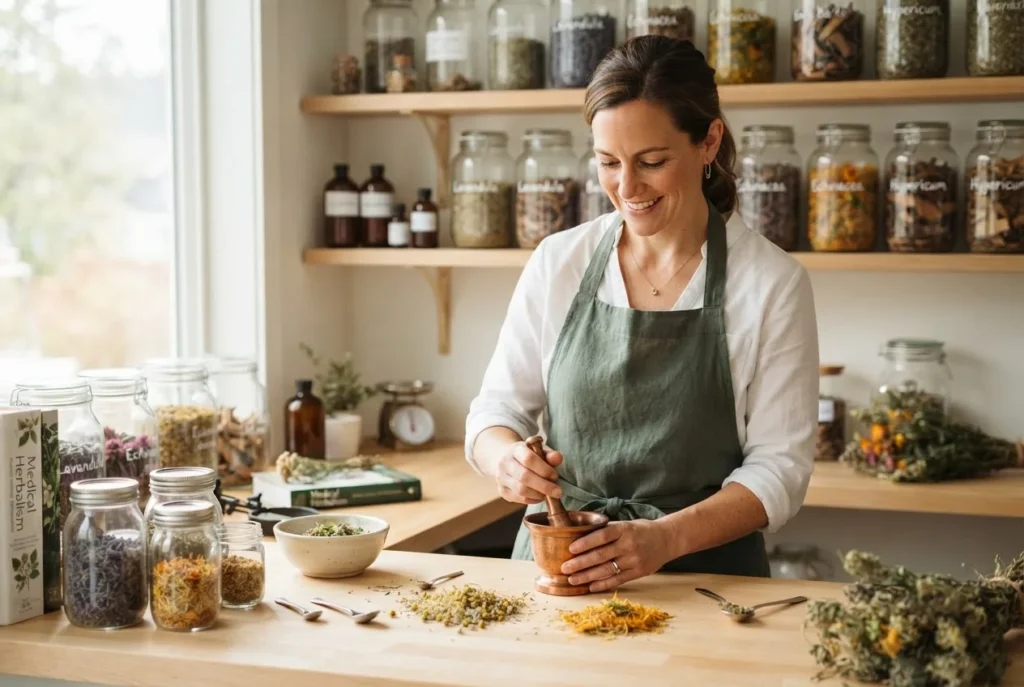
herbalist herbalist: A herbalist is a trained practitioner who uses plant-based medicines and botanical knowledge to support health through assessment, personalized herbal prescriptions, and preparation of herbal remedies; they study plants, safety, and clinical use, blending traditional systems with scientific methods to guide safe, evidence-informed care.
What Is a Herbalist? Understanding the Herbalist Role
Answer: A herbalist is a practitioner who assesses clients, recommends plant-based interventions, and prepares herbal products while integrating botanical identification, safety assessment, and clinical reasoning.
Herbalist: a person trained in the medicinal use of plants and their preparations for health support and disease prevention.
A herbalist’s day-to-day work combines consultation, botanical knowledge, formulation and preparation of remedies, and follow-up. For example, a respiratory-care herbalist might assess a client’s history, confirm herb–drug safety, then prepare a supportive formula of elecampane infusion and elderberry syrup, monitoring outcomes over weeks.
Herbalists work in several settings: private clinics, integrative healthcare teams, apothecaries, research labs, or community education. They differ from retail supplement vendors by performing individualized assessment, contraindication screening and documentation of outcomes.
Practical roles include:
- Client assessment and intake, including health history and current medications.
- Plant identification and sourcing quality botanical materials.
- Designing and preparing individualized remedies (teas, tinctures, salves).
- Monitoring efficacy and safety, recording outcomes and referrals when needed.
- Education and community workshops on safe herbal use.
Case scenario: A working herbalist sees a client with mild insomnia, reviews sleep hygiene and medications, recommends an evidence-informed low-dose chamomile–lavender tea, documents expected timelines, and advises cessation if daytime sedation occurs.
Transition: Understanding this role leads naturally to the larger question of what herbalism means as a practice and philosophy.
The Definition and Philosophy of Herbalism
Answer: Herbalism is the study and practice of using whole plants and plant extracts to support human health, grounded in both traditional knowledge systems and principles of pharmacognosy and phytochemistry.
Herbalism: a system that uses botanical medicines—whole herbs, extracts and preparations—for prevention and treatment, guided by plant action, safety, and individualized care.
Core philosophical pillars include:
- Holism: treating the whole person (physical, emotional, environmental) rather than an isolated symptom.
- Vitalism vs Mechanism: many traditional herbal systems emphasise the plant’s energetic actions; modern herbalism integrates that with biochemical mechanisms.
- Evidence integration: combining traditional use-cases, ethnobotany, observational outcomes and current scientific evidence when available.
- Sustainability and ethics: sourcing botanicals responsibly and prioritizing conservation.
Herbal medicine principles combine botanical actions (e.g., anti-inflammatory, adaptogenic), dose, preparation method, and patient context. Definitions vary by tradition—Western clinical herbalism, Ayurvedic herbalism and Traditional Chinese Medicine (TCM) all interpret plant use through different diagnostic frameworks.
For readers who want practical uses of supplements beyond definitions, see this broader guide:
Herbal Supplements Guide with Benefits and Natural Medicine Uses
To explore botanical supplement benefits specifically, consult research and consumer guides that evaluate safety and dosing.
botanical dietary supplements benefits
Transition: With philosophy and definitions set, the next practical question is which preparations herbalists commonly use.
Key Herbal Preparations and Practices Used by Herbalists
Answer: Herbalists use a set of core preparations—tinctures, teas, salves, poultices, syrups, capsules and infusions—chosen for botanical chemistry, desired action and client needs.
Herbal preparation: any method that extracts, preserves or delivers active plant constituents for therapeutic use.
- Infusions (herbal teas): steeping leaves or flowers in hot water to extract water-soluble constituents; used for delicate parts like chamomile. natural symptom remedies provides complementary home strategies.
- Decoctions: simmering tougher plant parts (roots, bark) to extract denser constituents; used for ginger root or licorice.
- Tinctures: alcohol (or glycerin) extracts concentrating both water- and alcohol-soluble compounds; long shelf-life and precise dosing.
Tincture: a concentrated plant extract preserved in ethanol or a glycerin base for oral dosing.
- Syrups: herbal extracts combined with sweeteners (honey, sugar) used for palatable delivery of respiratory herbs.
- Salves and balms: oil-based infusions combined with beeswax for topical use on skin conditions or muscle ache.
- Poultices and compresses: fresh or heated herb applications to localized areas for anti-inflammatory or drawing actions.
- Capsules and tablets: powdered herbs standardized for convenience; see quality and standardization guidance. herbal preparation definitions
- Extracts and concentrates: standardized extracts containing measured active markers for research-compatible dosing.
- Topical oils and infused oils: macerated plant oils used in bodywork and skin formulations.
Choice of preparation depends on plant chemistry (volatile oils favor tinctures or steam distillation; mucilaginous herbs suit infusions), patient preference, and safety. For practical DIY approaches and symptom-targeted options, consult the companion guide on natural symptom remedies and product-form specifics.
capsule herbal supplements benefits
Transition: Knowing preparations helps clarify how herbalists learn to choose and produce them safely.
How Herbalists Study Herbs: Training, Research, and Practical Applications
Answer: Herbalists study herbs through combined classroom learning (botany, phytochemistry, pharmacology), hands-on herb identification and remedy-making, supervised clinical internships, and ongoing research appraisal.
Study of herbs: the formal and experiential process of learning plant taxonomy, chemistry, safety and clinical application.
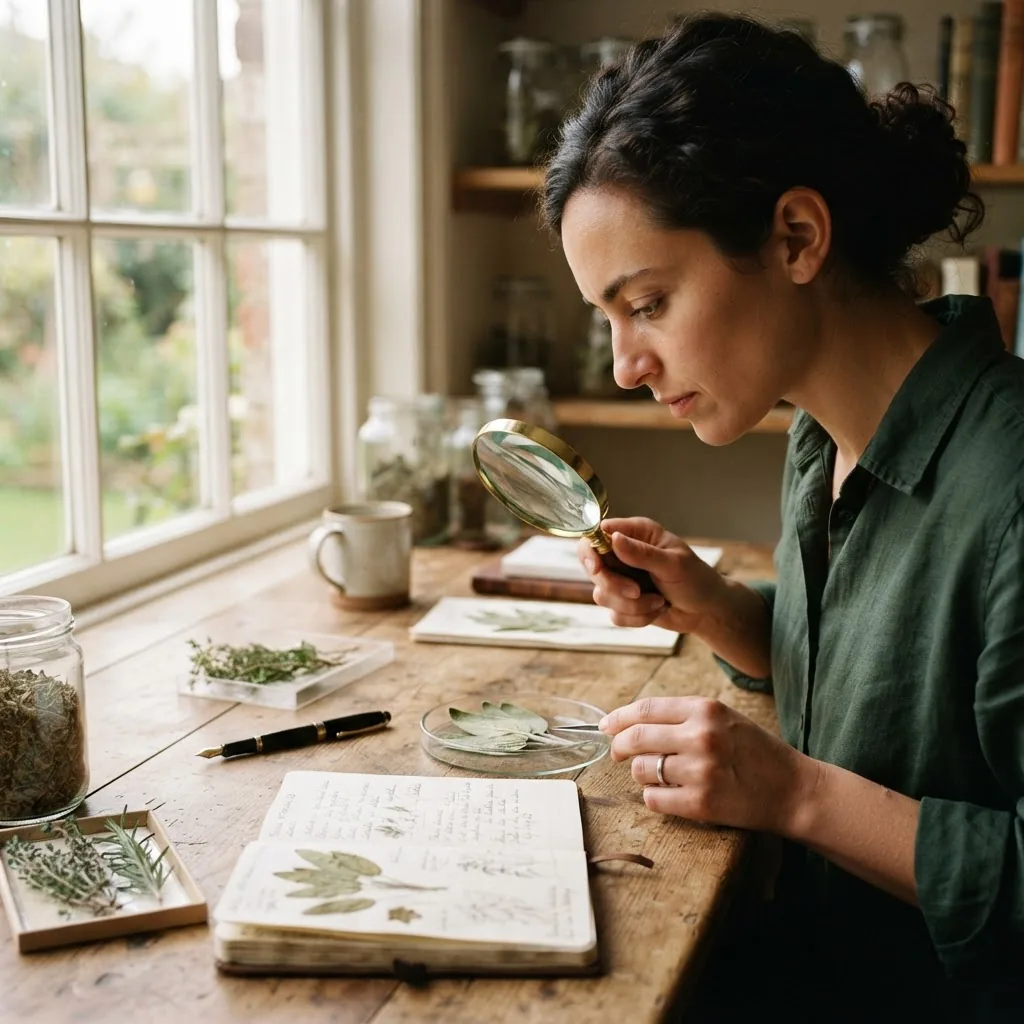
Typical study elements, in practical sequence:
- Foundations in botany and plant ID: learning scientific names, family traits, morphology and habitat to reliably identify medicinal species.
- Phytochemistry basics: understanding principal constituents (alkaloids, glycosides, volatile oils, flavonoids) and how they correlate with actions and safety.
- Ethnobotany and traditional uses: studying cultural knowledge and recorded traditional indications to inform hypotheses for modern use.
- Clinical skills and case management: intake, differential assessment, herb–drug interaction screening, dosing, and documentation.
- Preparatory practice: hands-on training making infusions, decoctions, tinctures, salves, and standardized extracts.
- Research literacy: learning to appraise trials, systematic reviews, and in vitro studies to weigh evidence levels. For example, According to a 2023 systematic review of herbal interventions for anxiety (peer-reviewed journal), evidence was mixed and highlighted variability in preparations and study quality — peer-reviewed source: PubMed Central. PubMed
- Ethics and professional standards: codes of practice, informed consent, scope of practice, and referral protocols guided by professional associations. See guidance from professional bodies such as the American Herbalists Guild: American Herbalists Guild.
- Supervised clinical internships: practical mentorship under experienced herbalists or integrative clinics to build case management skills; many programs require clinical hours before certification.
- Continued professional development: attending workshops, reviewing new safety data and regulatory changes (e.g., government guidance on supplements). For regulatory standards see the FDA dietary supplements page: FDA Dietary Supplements.
Phytochemistry: the study of chemicals produced by plants and their biological effects.
Paths to study vary: diplomas in clinical herbalism, degrees in herbal science or naturopathy, short courses in materia medica, and hands-on workshops. For options on classroom or community-based paths, explore local classes and accredited online courses.
naturopathy certification and herbalist training in Canada
certified herbalist training classes
herbalist training and qualifications
online herbalist certification courses
Practical study example (walkthrough): an herbal student learns leaf morphology in the lab, practices identifying Achillea millefolium, conducts a phytochemical assay class to see flavonoid reactions, then prepares and quality-controls a calendula salve under supervision, documenting stability and client outcome.
Transition: Training and practical skills are distinct from other roles that use herbs — the next section compares those professions.
Differences Between Herbalists and Related Professions
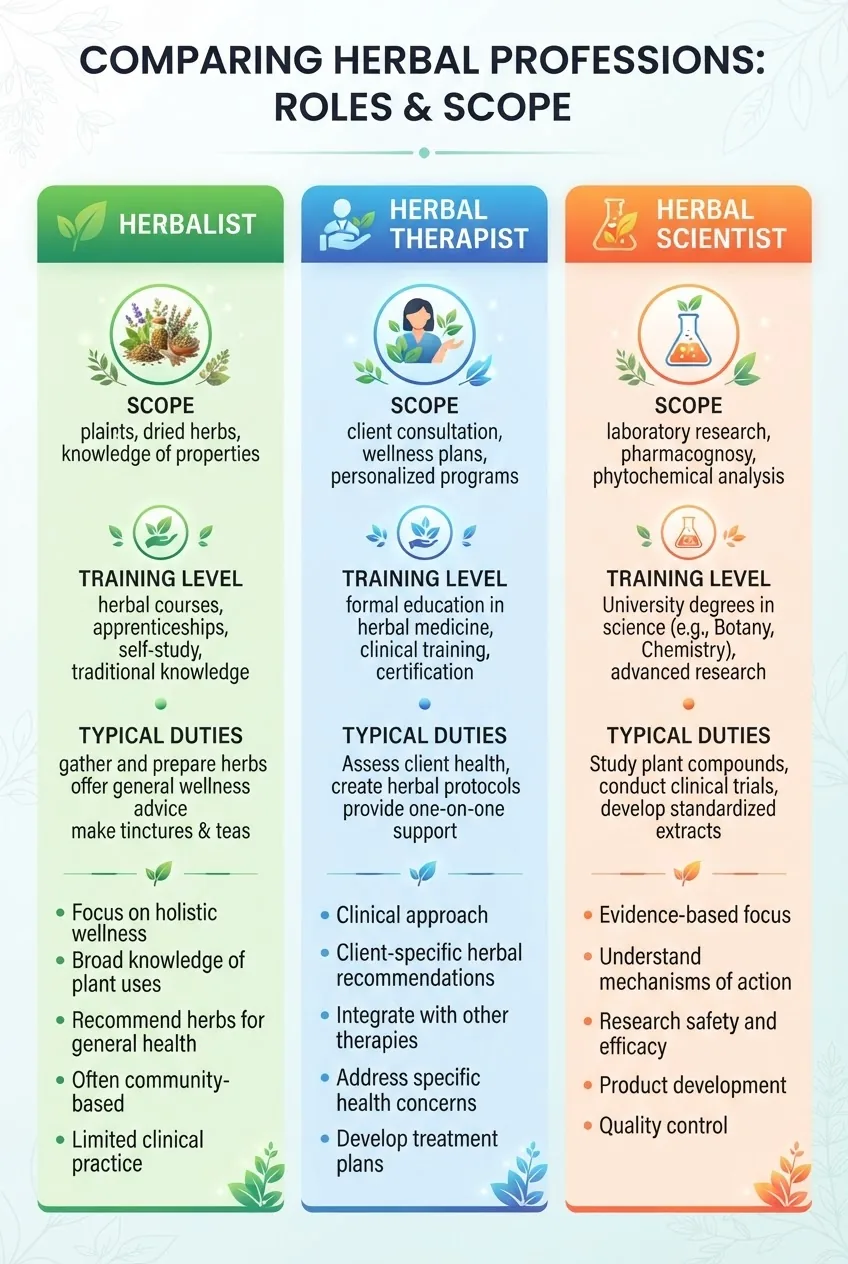
Answer: Herbalists focus on individualized plant-based care and formulation, herbal therapists may combine herbal approaches with psychotherapy or bodywork, while herbal scientists research plant chemistry and clinical efficacy.
Herbal therapist: practitioner blending herbal practice with complementary therapies such as counselling or massage.
Herbal scientist: a researcher studying plant compounds, mechanisms, and clinical trials to generate evidence.
| Role | Scope | Typical Training | Typical Duties |
|---|---|---|---|
| Herbalist | Clinical plant-based care, individualized remedies | Diploma/degree + clinical hours | Assessment, formulation, preparation, follow-up |
| Herbal Therapist | Holistic therapies with herbal adjuncts | Training in therapy + herbal modules | Therapy sessions, supportive herbal use |
| Herbal Scientist | Research and evidence generation | University degrees in pharmacognosy/biochemistry | Laboratory studies, clinical trials, publications |
| Naturopathic Doctor (ND) | Broader primary care, may include pharmaceuticals in some regions | Professional ND program + licensing | Diagnosis, prescriptions, integrative referrals |
Summary: The primary difference is scope and training. Herbalists specialize in plant medicine and client-centered herbal formulations; herbal therapists integrate other therapeutic modalities; herbal scientists focus on laboratory and clinical research. Naturopathic doctors have a broader medical training including diagnostics
To clarify prescription scope for related professions, see information on naturopathic medication rights:
naturopathic doctor prescription rights
herbalist vs herbologist differences
Transition: Knowing these roles helps place herbalism in a historical context and its modern evolution.
Historical Context and Modern Role of Herbalists in Natural Medicine
Answer: Herbalism has ancient roots across cultures; modern herbalists synthesize traditional knowledge with scientific methods to meet contemporary health needs and regulatory environments.
History of herbalism: the recorded use of medicinal plants across civilizations, from classical Greek materia medica to indigenous pharmacopeias.
Chronology:
- Ancient and classical eras: Egyptian, Mesopotamian, Ayurvedic and Chinese records document plant use for millennia; Hippocrates and Dioscorides systematized Western herbal knowledge.
- Medieval to early modern: monastic gardens preserved herbal knowledge; herbals (illustrated texts) spread botanical knowledge.
- 19th–20th century: isolation of active compounds (e.g., morphine, quinine) reframed some plant uses into pharmacology while folk herbalism persisted.
- Late 20th–21st century: resurgence of interest in integrative medicine and research into phytochemistry, safety and clinical efficacy.
Modern herbalists operate in a landscape shaped by regulatory frameworks, research, and consumer demand. According to a 2024 industry report on complementary medicine usage (industry report), adult consumer interest in herbal supplements remained high, driving research into standardization and quality control standards.
Contemporary herbalists often collaborate with conventional providers, contribute to integrative care plans, and participate in clinical research to clarify efficacy and safety. They also engage in conservation work to protect medicinal plant populations and ensure sustainable supply chains.
Transition: Operating ethically and safely is a crucial ongoing responsibility for herbalists, which the final section addresses.
Safety, Efficacy, and Ethical Considerations for Herbalists
Answer: Herbalists must evaluate evidence levels, manage herb–drug interactions, ensure product quality, obtain informed consent, and follow professional standards to mitigate risks and support efficacy.
Herbal safety: monitoring adverse effects, contraindications, and interactions between herbs and pharmaceuticals.
Key safety and efficacy points:
- Evidence tiers: randomized controlled trials and systematic reviews provide higher-quality evidence; observational, traditional and in vitro data are lower tiers. For example, according to a 2023 systematic review (peer-reviewed journal), evidence for certain botanical treatments showed modest benefit but high heterogeneity in study designs — source: PubMed Central. Journal database.
- Herb–drug interactions: key interactions include St John’s wort reducing plasma levels of many drugs via CYP induction, and licorice increasing blood pressure with antihypertensives. Herbalists screen all medications before prescribing and advise coordination with prescribing clinicians. Use interaction checkers and clinical references such as professional pharmacology monographs.
- Product quality and adulteration: variability in active constituents, contamination (heavy metals, microbes), or adulteration with pharmaceuticals are real risks; adhere to good manufacturing practices and third-party testing.
- Dosing variability: whole herbs vary naturally; herbalists account for plant part, harvest time and extraction method when dosing.
- Ethical practice: informed consent, clear documentation, scope-of-practice boundaries, and referral when conditions exceed herbalist competence. Professional associations publish codes of ethics; consult national guidelines for practitioner standards. Professional association guidance.
- Liability and documentation: maintain accurate records, adverse event reporting, and carry appropriate professional indemnity insurance.
- Special populations: pregnancy, breastfeeding, children and people with organ failure require extra caution; many herbs have insufficient safety data and should be avoided or used conservatively.
Case example: A client on warfarin seeks herbal support; the herbalist reviews INR trends, avoids herbs known to affect clotting (e.g., ginkgo, high-dose garlic), consults the prescribing physician and documents a safer plan relying on dietary and lifestyle measures with low-risk herbs.
natural cancer treatments with herbal remedies
Regulatory context: government agencies publish safety advisories and quality standards; see the FDA’s dietary supplements page for regulatory expectations and recall notices. FDA dietary supplements.
Limitations and transparency: convey uncertainty when evidence is weak, and explicitly state when recommendations are based on traditional use rather than clinical trials. According to a 2022 survey of herbal product variability (peer-reviewed study), active marker concentrations often vary across batches — source: peer-reviewed journal index. Research database.
Transition: The final summary distils practical takeaways for prospective students and clients.
Conclusion
Summary: A herbalist is a plant-medicine practitioner who blends botanical knowledge, safety screening, individualized formulation and practical preparation methods to support health; herbalism is both a philosophical and scientific discipline requiring ongoing study and ethical practice.
If you are considering study or care with an herbalist, evaluate training, clinical experience and adherence to professional standards; for training pathways see practical resources on certified classes and online programs.
certified herbalist training classes
Call to action: Explore the linked guides — from supplement benefits to training pathways — and consult a qualified herbalist to discuss personalized options and safety considerations.