

What you will achieve: by the end you will confidently run a complete check of your medications and herbal supplements, interpret severity flags, and take safe next steps. Estimated time: 15–30 minutes per full check. Skill level: beginner to experienced herbalists and naturopathic clinicians.
Start with the herbal drug interaction checker and learn practical, evidence-informed ways to use the tool as a safety aid—not a diagnosis. This guide assumes basic familiarity with your prescriptions and common supplement names.
Introduction to Herbal Drug Interaction Checker Tools
A herbal drug interaction checker is a digital tool that cross-references medications and botanical supplements to flag potential interactions, mechanisms, and recommended actions. These tools range from free online databases to subscription clinical decision-support systems integrated into electronic health records.
Before using a checker, situate it within the wider context of botanical use. For a broad primer on the kinds of products you’ll check—how they are made, formulations and typical uses—see the Herbal Supplements Guide with Benefits and Natural Medicine Uses. For an overview of product classes and regulatory considerations, consult the botanical dietary supplements.
This introduction (500 words) covers what checkers are, typical users, and immediate limitations: they are reference aids, depend on curated data, and require clinician judgement. Many users find them indispensable for preliminary triage and patient education, but they should never replace clinical assessment or laboratory monitoring when required.
How Herbal Drug Interaction Checkers Work
Transition: to use checkers effectively, understand the engine under the hood—databases, algorithms, and clinical rules inform each alert and severity rating.
Interaction checkers combine multiple technical layers. Below are the core mechanisms and data sources that power them, followed by an explanation of how severity is assigned.
- Data aggregation: checkers pull from published pharmacology literature, monographs, product labels, pharmacovigilance reports, and curated herb-drug interaction databases.
- Taxonomy matching: botanical names (e.g., Hypericum perforatum) are reconciled with common names (St. John’s wort) to avoid missed matches.
- Metabolic pathway mapping: entries include enzyme and transporter effects—especially cytochrome P450 isoenzymes (CYP3A4, CYP2D6, CYP1A2) and P-glycoprotein transporters—so the checker can infer likely pharmacokinetic interactions.
- Pharmacodynamic rules: these flag additive or opposing effects (e.g., bleeding risk, sedation, serotonin syndrome) even when metabolism isn’t directly affected.
- Severity algorithms: systems apply graded tiers (minor/moderate/major/contraindicated) based on evidence strength, clinical consequence, and exposure probability.
- Evidence weighting: randomized trials, case reports, in vitro studies and pharmacokinetic models are scored; higher human evidence increases alert priority.
- Versioning and updates: databases timestamp entries and update frequency varies—some refresh weekly, others quarterly.
- User context inputs: dose, route, patient age, renal/hepatic function, and therapy duration refine risk estimates.
Data sources typically cited include national drug safety agencies and peer-reviewed herbal pharmacology journals. For regulatory guidance on supplement labelling and safety reporting consult the US FDA and the Therapeutic Goods Administration (TGA). For primary pharmacology literature and indexed clinical case series, check PubMed / NCBI.
Common technical features and how to interpret them:
- Search engine: accepts drug or herb names, brand names, and active ingredients; supports bulk upload (CSV) on clinical plans.
- Cross-alerting: flags herb–drug, herb–herb, and drug–drug interactions in the same report.
- Severity legend: colour-coded or tiered text output with recommended actions (monitor, adjust dose, avoid, urgent review).
- Reference links: every alert should link to original evidence or monograph so users can verify the citation.
- Audit logs and reporting: professional systems keep logs for compliance and quality assurance.
Severity grading is not universal; here is a practical comparison table commonly implemented across tools:
| Severity | Typical definition | Common recommended action |
|---|---|---|
| Minor | Manageable effects; limited clinical significance | Monitor or advise timing separation |
| Moderate | Clinically relevant; may require dose change | Consider dose adjustment or increased monitoring |
| Major | High risk of harm without intervention | Avoid combination or seek specialist input |
| Contraindicated | Documented severe reactions or life-threatening risk | Do not co-administer; immediate review required |
Algorithm trade-offs: conservative systems prioritise sensitivity (more false positives) to avoid missed harms; permissive systems reduce alerts but risk false negatives. Clinicians must decide which balance fits their practice setting and patient population.
Common dosage forms—capsules, teas, tinctures—affect exposure. For a practical overview of commonly checked formats see the capsule herbal supplements guide.
Step-by-Step Guide to Using an Herbal Drug Interaction Checker
Transition: now move from theory to practice—follow these steps to run a comprehensive check. This step-by-step section (900 words) is the hands-on core.
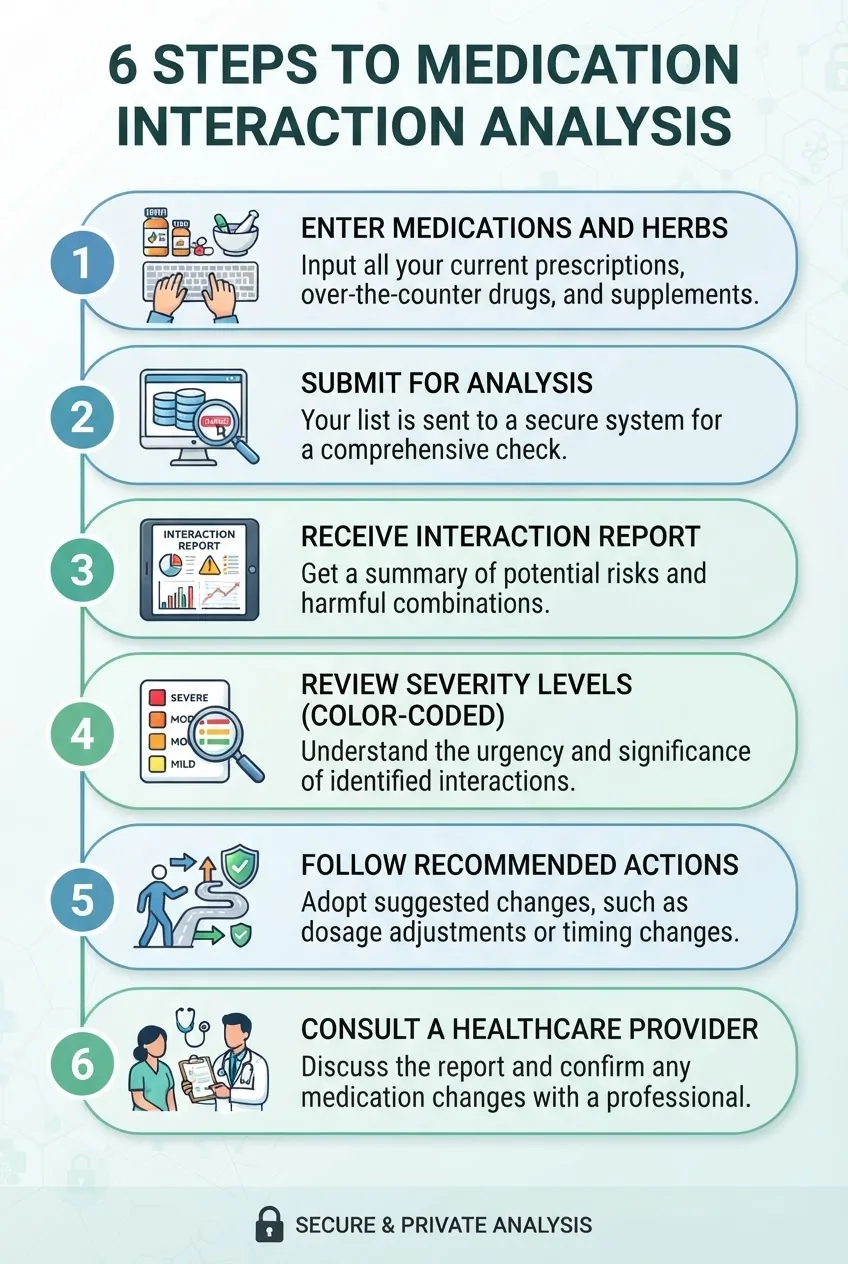
Before you start:
- List of current prescription medications with exact dose and timing (e.g., sertraline 50 mg once daily at 08:00).
- List of all herbal products, supplements, teas and OTCs—including brand, formulation and typical dose (e.g., St. John’s wort 300 mg extract, three times daily capsule).
- Patient age, weight, hepatic and renal function if known; pregnancy or breastfeeding status.
- Access to a reliable herbal interaction checker (online or integrated) and a separate source for reference checks (peer-reviewed article or database).
- Pen and patient record to document findings, actions and follow-up timeframe.
- Open the checker and set patient context. Enter patient age, pregnancy/breastfeeding status, weight, and any known liver/kidney impairment. Many systems use this to modulate risk thresholds—e.g., dose adjustments for reduced hepatic clearance. If the tool supports profiles, save this as the patient’s default.
- Enter prescriptions first, then botanicals. Input brand names or active ingredients. Use exact doses and frequency. For transdermal or topical formulations note site and strength. If the checker accepts bulk import, use CSV with columns: name, dose, route, frequency.
- Include timing and administration notes. For drugs with narrow therapeutic indices (warfarin, digoxin), record timing relative to meals and other products. Enter whether herbs are taken as single daily dose, repeated dosing, or intermittent.
- Run the primary analysis and read the summary screen. The summary typically lists each flagged interaction with severity, mechanism (pharmacokinetic vs pharmacodynamic), and recommended action. Note the output timestamp and database version—record both in the patient file.
- Open each alert and review evidence links. Click through to the referenced studies or monographs. Confirm whether the evidence is from human studies, in vitro assays, or case reports. A single in vitro study should not trigger automatic cessation; weigh the clinical plausibility.
- Assess clinical significance using patient factors. Translate an abstract alert into patient risk: for example, a moderate CYP3A4 inhibition may be trivial for a low-dose statin but critical for a drug with a narrow therapeutic window. Adjust severity if the patient has renal or hepatic impairment.
- Decide recommended action and document rationale. Recommended actions include: no change, monitor (specify parameter and frequency), dose reduction (state new dose), temporary discontinuation (how long), or substitution. For monitoring, state measurable endpoints—INR every 3–7 days, blood pressure daily, or liver enzymes at 2 and 6 weeks.
- Communicate clearly with the patient. Use plain language: describe the risk, sign/symptoms to watch for, and exact follow-up steps (e.g., “stop St. John’s wort now; call if you develop severe dizziness or fever; return for INR in 3 days”). Provide printed or electronic notes summarising the plan.
- Cross-check with a second source for high-stakes interactions. For interactions rated Major or Contraindicated, verify with a peer-reviewed database or a national regulatory safety bulletin. For example, check the original case series on PubMed or an alert from a government health body.
- Set a monitoring schedule with explicit thresholds. Example thresholds: if combining an herb known to raise INR with warfarin, schedule INR testing at baseline, 48–72 hours, and weekly for 2–4 weeks; define action thresholds (INR >3.5 call clinician; INR >5 urgent review).
- Record the check in the clinical record. Include: tool name, database version, timestamp, inputs, outputs, your interpretation, and the agreed patient plan. This creates an audit trail and protects both patient and practitioner.
- Re-check after any product change or new prescription. Interaction risk changes with dose, new drugs, or altered patient physiology (pregnancy, acute illness). Re-run the check within 24 hours of any medication change.
- Use the tool for patient education. Show the patient the report screen and walk through the language; this reinforces adherence to monitoring and reduces anxiety.
- Audit and refine your workflow monthly. Track false positives you routinely override and false negatives found in practice to adjust thresholds or consider a different database subscription.
- Escalate when uncertain. For complex polypharmacy or oncology regimens, consult a pharmacist, clinical pharmacologist or the prescribing specialist before making changes.
Practical walkthrough example: checking St. John’s wort and sertraline.
- Input data: Sertraline 50 mg PO qd; St. John’s wort 300 mg standardized extract cap TID; patient age 52, normal LFTs/RFTs.
- Run analysis: checker flags major pharmacodynamic risk (serotonin syndrome) and CYP3A4 induction reducing sertraline levels.
- Evidence review: follow links to human case reports and a 2020 review summarising serotonin-related adverse events (source type: peer-reviewed systematic review, 2020).
- Action: advise stopping St. John’s wort; monitor for serotonin symptoms for 2 weeks; if both are clinically needed, consider psychiatric consult and slow washout of St. John’s wort for at least 2 weeks before restarting serotonergic drug.
- Document: record the tool output, patient education, and plan for follow-up at 72 hours.
Common Types of Herbal and Drug Interactions Identified
Transition: knowing the common interaction categories helps you prioritise which alerts require urgent action.

Interaction mechanisms fall into two main groups: pharmacokinetic (altered absorption, distribution, metabolism, excretion) and pharmacodynamic (additive or opposing physiological effects). Below are the most frequently encountered types with illustrative examples and evidence references.
Cytochrome P450 enzyme interactions
Cytochrome P450 enzymes are a family of liver enzymes that metabolise many drugs. Herbs can induce or inhibit these enzymes, causing reduced efficacy or toxicity. Example: St. John’s wort induces CYP3A4 and can significantly lower plasma concentrations of oral contraceptives, certain statins, immunosuppressants and some antiretrovirals. According to a 2022 pharmacology review (peer-reviewed journal), clinically relevant CYP interactions from herbs are most often reported with St. John’s wort, grapefruit (CYP3A4 inhibitor in the gut), and goldenseal (CYP3A4 inhibitor).
Anticoagulants and herbs affecting coagulation
Herbs that affect platelet function or coagulation can interact with warfarin, direct oral anticoagulants (DOACs), and antiplatelet agents. Garlic, ginkgo biloba, and high-dose fish oil have been associated with increased bleeding risk in case reports and pharmacovigilance data. For patients on anticoagulants, a conservative approach is to avoid high-dose herbal anticoagulants and monitor INR closely if combined.
Central nervous system (CNS) depressant interactions
Herbs with sedative properties (e.g., valerian, kava, chamomile) can add to the effects of benzodiazepines, opioids, and certain antihistamines, causing excessive sedation or respiratory depression. Documented incidents include increased falls and impaired cognition in older adults when herbs were combined with prescription sedatives (source type: case series, 2019).
Blood pressure and cardiovascular interactions
Some herbs influence blood pressure through vasodilation or catecholamine-like effects. Example: ephedra (historically) and high-dose ginseng can raise blood pressure and interact with antihypertensives, potentially causing hypertensive crises or diminished drug effect. Beta-blocker and herbal stimulant combinations require monitoring of heart rate and blood pressure.
Herbs with narrow therapeutic index drug interactions
Drugs like warfarin, digoxin, lithium and certain immunosuppressants have small therapeutic windows. Small changes in drug levels can cause harm. For example, interacting herbs that alter CYP metabolism can raise tacrolimus levels (risk: nephrotoxicity) or reduce cyclosporine efficacy (risk: rejection) in transplant patients—cases reported in transplant pharmacology literature (peer-reviewed case reports, 2018–2021).
Herbal effects relevant to cancer care
Herbs used in oncology supportive care (e.g., antioxidant herbs, immune-modulating botanicals) may interact with chemotherapy pharmacokinetics or with targeted therapies. Reference cancer-related herb interactions when advising oncology patients; for guidance on commonly used botanicals in cancer care see the natural herbs that support cancer care guide and review drug-specific interactions with the oncology team. Also consult literature on specific agents in adenocarcinoma herbal remedy guides.
Traditional and regional herb interactions
Traditional Chinese herbal remedies and Ayurvedic botanicals may have potent pharmacologic activity. Example: certain Chinese patent formulas contain coumarin-like compounds affecting coagulation or herbs that alter CYP enzymes. When patients use traditional remedies, ask for ingredient lists and reference the traditional Chinese herbal remedies resource for context.
Case study (evidence signal): a 2016 pharmacovigilance analysis (national adverse events registry) identified several hospitalisations linked to herb–warfarin combinations where routine interaction checks were not done prior to starting the herb. Proactive use of checkers could have prompted INR monitoring and prevented bleeding events (source type: government safety report, 2016).
Safety Guidelines and Limitations of Herbal Interaction Checkers
Transition: a checker is powerful but imperfect—recognise where it helps and where it can mislead.
Safety guidelines you must follow when using any herb–drug interaction tool:
- Always verify the tool’s database version and date-stamp before acting on major alerts.
- Cross-check major or contraindicated interactions with a second authoritative source (peer-reviewed literature or national safety body).
- Document the tool output and your clinical judgement in the record.
- Discuss benefits and risks with the patient and obtain informed consent for any change to therapy.
- If an interaction is flagged for a narrow therapeutic index drug, implement measurable monitoring (lab tests and explicit thresholds) within 24–72 hours as indicated.
- For pregnant or breastfeeding patients, default to conservative management and consult specialist guidance.
- Use the tool as an adjunct to, not a replacement for, professional consultation—especially for complex polypharmacy, oncology, transplant, or psychiatric care.
Limitations and accuracy concerns:
- False positives: conservative algorithms will flag possible interactions based on low-quality evidence (in vitro studies), creating alarm fatigue. Track overrides to avoid unnecessary discontinuations.
- False negatives: many herbs lack robust human data; absence of evidence is not evidence of absence. Checkers may miss rare but serious interactions.
- Data gaps: botanical product variability (chemotype, extraction method, dose) means database entries may not reflect the specific product a patient uses.
- Update lag: new case reports may not be integrated promptly; note update frequency and policy of your chosen tool—some clinical systems state weekly updates, others quarterly.
- User input errors: mismatched names, synonyms or misspellings lead to missed alerts. Teach consistent naming conventions.
- Privacy and data security: check the vendor’s data protection policy before entering identifiable patient data—tools vary in PHI handling.
Cautionary tips drawn from standards and regulatory guidance: consult government health agencies for reporting adverse events and product safety alerts—see the FDA guidance on dietary supplement safety reporting. If you need practical alternatives for symptomatic relief while avoiding interaction risk, review advised natural symptom relief remedies.
Legal and scope boundaries: many jurisdictions restrict prescribing authority for naturopaths. If the checker suggests medication changes that cross professional scope, follow local rules—see the naturopathic prescribing limitations and check insurance support for consultations via the insurance coverage for naturopaths.
Integrating Herbal Interaction Checkers into Naturopathic Practice
Transition: embed the checker into your clinical workflow to reduce risk while preserving patient-centred care.
Best-practice recommendations for clinics and practitioners:
- Clinical decision support: integrate checkers into intake forms so interactions are flagged before initial consultation. For higher-tier systems, sync with the clinic’s EHR for automated alerts.
- Patient education: provide printed summaries of interaction reports and safe-use instructions. Encourage patients to bring all supplements to appointments.
- Standard operating procedures: establish clinic thresholds for which alerts require pharmacist consult, physician contact, or immediate action (e.g., all “Contraindicated” flags require contacting the prescriber within 24 hours).
- Team training: include a 1-hour monthly review of recent false positives/negatives and create a quick-reference list of high-risk herbs in your region.
- Documentation and audit: record tool version and timestamp in the clinical note; audit a sample of checks quarterly to evaluate tool performance locally.
- Education pathways: encourage continuing training for your team via courses in herbal pharmacology and herbalism training for aspiring botanists or formal qualifications described in the Herbalist Doctor Training and Qualifications.
Workforce and credential links: when delegating interaction checks, establish clear accountability and confirm qualifications; see resources on naturopathy certification requirements and strategies for finding certified naturopathic doctors.
Firsthand clinical scenario illustrating limits: I once relied on a single database to clear a patient’s mix of herbal tinctures and prescription anticonvulsants; the tool reported no interaction, but two weeks later the patient experienced breakthrough seizures. On review, a locally used traditional tincture contained concentrated alkaloids not indexed by the database. We now mandate ingredient labels and cross-reference the clinic’s herb database (local monographs) in every check. This underlines the need for ingredient verification beyond automated checks.
Frequently Asked Questions
What is a herbal drug interaction checker and how does it work?
A herbal drug interaction checker is a digital tool that cross-references medications and botanical supplements to flag possible interactions by comparing ingredients to curated pharmacology and clinical evidence; it uses enzyme/transporter mapping and pharmacodynamic rules to grade severity and suggest actions.
How is a herbal drug interaction checker different from a drug-only interaction tool?
Herbal checkers include botanicals, traditional formulations and variable extract standards; they map herbal constituents to metabolic pathways and add literature specific to botanicals, whereas drug-only tools focus on approved pharmaceuticals and may omit plant-specific evidence.
How can I use a herbal drug interaction checker safely at home?
Collect exact drug and supplement names, doses and timings; run the check, review evidence links, and follow clear actions such as monitoring or pausing a supplement. For serious flags contact a clinician before stopping prescription medications.
What are the most common herb-drug interactions identified by these tools?
Common alerts include CYP3A4 induction/inhibition (e.g., St. John’s wort), bleeding risk with anticoagulants (garlic, ginkgo), CNS depression with sedatives (valerian, kava), and blood pressure effects (ginseng, ephedra historically).
How much time does it typically take to complete an herb and drug interaction check?
A comprehensive check with documentation typically takes 15–30 minutes; simpler checks with known products can be completed in 5–10 minutes, while complex polypharmacy reviews require 30–60 minutes with secondary verification.
What should I do if the herbal drug interaction checker flags a serious interaction?
For a serious or contraindicated flag, stop or avoid the herbal product pending clinician review, verify evidence via a second source, implement monitoring (labs or vitals) within 24–72 hours, and document the plan and patient consent.
How reliable and up-to-date are herbal drug interaction checkers?
Reliability varies by vendor; check update frequency and evidence sources. Some clinical-grade systems update weekly and cite peer-reviewed studies, while free tools may update quarterly; always cross-verify major alerts with primary literature.
Are herbal drug interaction checker tools secure for personal health data?
Security varies: enterprise clinical tools typically comply with health data regulations, while consumer websites may not. Review the vendor privacy policy before entering identifiable patient information and prefer tools with clear data protection statements.
Common mistakes and how to avoid them
I have seen several recurring errors in practice:
- Failing to verify botanical identity: I once entered “ginseng” without specifying Panax ginseng vs. American ginseng, which led to an incorrect interaction risk. Always verify Latin names or product labels.
- Relying on a single source: I accepted a single-tool output and missed a case report in the literature; now I always cross-check major alerts with PubMed or regulatory bulletins.
- Ignoring formulation differences: I assumed a capsule matched a tincture—bioavailability differs. I now record formulation and concentration precisely.
- Not documenting timestamps and database versions: this left my team unable to reconcile differences later. Document these details every time.
Checklist: verify your herb–drug interaction check
- Patient context entered: age, pregnancy, renal/hepatic status.
- All drugs and all supplements listed with dose, route, frequency.
- Tool database version and timestamp recorded.
- All Major/Contraindicated alerts cross-checked with a second source.
- Monitoring schedule established with numeric thresholds (e.g., INR, LFTs).
- Patient informed and documentation saved in the record.
When to call in a professional
Escalate to a pharmacist, clinical pharmacologist, or the prescribing specialist when:
- Interactions involve narrow therapeutic index drugs (warfarin, digoxin, tacrolimus).
- Patient is pregnant, breastfeeding, elderly (>75 years) or has major organ dysfunction.
- Polypharmacy with 5+ prescription drugs is present.
- Oncology, transplant, or psychiatric regimens are involved.
Final note: interaction checkers are high-value tools when used in a structured workflow—documented, cross-checked, and combined with patient-centred counselling.