
Naturopathic doctor vs MD: NDs (naturopathic doctors) focus on holistic, prevention-oriented care using natural therapies and lifestyle medicine, while MDs (medical doctors) focus on evidence-based diagnostics, emergency and specialist care with pharmaceutical and procedural interventions; both can overlap in integrative settings depending on licensure and training.
Introduction to Naturopathic Doctors and Medical Doctors?
Answer: Naturopathic doctors (NDs) are clinicians trained in naturopathic medical schools emphasizing natural therapies, prevention, and whole-person care; medical doctors (MDs) are clinicians trained in allopathic medical schools emphasizing evidence-based diagnosis, pharmacology, and acute/specialist care.
Term: ND: a licensed or credentialed provider trained in naturopathic medicine, emphasizing natural therapies and lifestyle interventions.
Term: MD: a physician with a Doctor of Medicine degree trained in conventional medicine, diagnosis, pharmaceuticals, and procedures.
NDs and MDs both diagnose and manage illness, but they differ in training emphases, typical tools, and core philosophies. Below, the article compares credentials, training pathways, licensing, treatment authority, and practical roles so you can choose the right clinician for your goals.
Transitioning to the next section, we examine education and training in detail so the credential differences are clear.
Education and Training Pathways?
Answer: MDs follow an undergraduate degree, 4 years of medical school, and 3–7+ years of residency; NDs usually complete a 4-year accredited naturopathic medical program (postgraduate or graduate-entry) and may pursue residencies or post‑doctoral clinical training—timelines and requirements vary by jurisdiction.
Term: Residency: supervised postgraduate clinical training completed after graduation to prepare for independent practice or board certification.
Typical MD pathway (numbered list)
- Bachelor’s degree (3–4 years): pre-med coursework (biology, chemistry, physics, statistics).
- Medical school (4 years): basic sciences + clinical rotations; graduates earn MD or DO.
- USMLE/COMLEX or equivalent board exams during/after medical school for licensure eligibility.
- Residency (3–7+ years): specialty training (e.g., internal medicine 3 years, surgery longer).
- Fellowship (optional 1–3 years): subspecialty training (e.g., cardiology).
- State licensing, board certification exams (e.g., American Board specialties) and continuing medical education (CME).
Typical ND pathway (paragraph)
Naturopathic Doctor programs are professional doctoral programs generally requiring some undergraduate prerequisites. Accredited ND curricula (commonly 4 academic years) combine biomedical sciences, clinical diagnosis, botanical medicine, nutrition, homeopathy (in some programs), physical medicine, and counseling. Graduates take board exams (varies by country/state) and complete clinical internships; optional residencies or mentorships enhance clinical competence.
For additional herbal knowledge that complements ND education see
herbalism training and botany courses.
For readers in Canada exploring local credentialing and program choices, see
naturopathy schools and certification in Canada.

Comparison table: typical timelines
| Stage | MD (typical) | ND (typical) |
|---|---|---|
| Undergraduate | 3–4 years (pre-med) | 2–4 years (prereqs often required) |
| Professional program | 4 years medical school | 4 years naturopathic medical school |
| Postgraduate clinical training | Residency 3–7+ years | Optional residency or supervised internships 1–3 years |
| Board exams/licensing | Required board exams (USMLE/COMLEX) before licensure | NPLEX/NBNE or regional naturopathic board exams where applicable |
Credential verification steps you can follow:
- Check degree: request the school name and program length; cross-check with accredited program lists.
- Verify licensing: ask for the provider’s license number and confirm with the state/provincial board.
- Confirm exam credentials: for MDs look for board certification; for NDs check completion of naturopathic board exams (varies by jurisdiction).
- Review continuing education and clinical residency details if available.
Transition sentence: licensing and oversight determine what graduates may legally do in practice, which we explain next.
Licensing, Certification, and Regulatory Oversight?
Answer: Licensing and oversight differ widely: MDs are regulated by state/provincial medical boards with standard national exams; NDs are regulated variably—some jurisdictions license and require naturopathic board exams while others do not recognize ND licensure, so scope and title protection differ by location.
Term: Board certification: additional credential beyond licensure demonstrating specialty training and exam-based competence.
Key regulatory points:
- MDs: regulated by state/provincial medical boards; requirements usually include an MD degree, passing national exams (e.g., USMLE/COMLEX in the USA), residency completion, and ongoing CME.
- NDs: regulation ranges from full licensure with title protection and prescribing privileges (in some U.S. states, Canadian provinces, and countries) to limited or no legal recognition; many require naturopathic board exams or equivalent clinical licensing processes.
Key agencies and resources:
- National Board of Naturopathic Examiners (NBNE) — for information on naturopathic board exams and standards (where applicable).
- American Medical Association (AMA) — for physician licensing guidance and policy summaries.
- Peer-reviewed literature (PubMed) — research comparing outcomes, patient satisfaction, and integrative models.
According to a 2023 regulatory report from a naturopathic board, licensure and prescriptive authority vary considerably across jurisdictions; always verify local rules before assuming prescribing or hospital privileges are available.
Bullet points: what to ask when checking credentials
- Which licensing board issued the provider’s license?
- Is the license active and in good standing? (request license number)
- What board exams were completed (e.g., USMLE, NPLEX)?
- Is the provider board-certified in a medical specialty or a recognized naturopathic credentialing body?
- Are there supervised residency or clinical fellowship records available?
Transition sentence: licensing shapes what treatments each provider can legally perform—see the next section for scope of practice and authority.
Scope of Practice and Medical Authority?
Answer: Scope differs: MDs generally have broad authority for diagnostics, advanced imaging, surgery, and prescription of controlled medications; NDs may have prescribing privileges in some regions, order diagnostics, and use natural therapies, but limitations and referral rules depend on local regulation.
Term: Scope of practice: the legally defined procedures, treatments, and activities a clinician may perform in a given jurisdiction.
| Authority / Action | MD (Medical Doctor) | ND (Naturopathic Doctor) |
|---|---|---|
| Prescribe pharmaceuticals | Full authority including controlled substances (varies by jurisdiction and specialty). | Variable: some jurisdictions grant limited or full prescribing rights; others restrict or prohibit certain drug classes. |
| Order diagnostic tests (imaging, lab) | Yes, full ordering authority and interpretation. | Often yes, but access to some imaging or hospital privileges varies by regulation and institutional policy. |
| Perform surgery/procedures | Yes, after surgical training (residency/fellowship). | No major surgical privileges; some minor office procedures possible depending on jurisdiction. |
| Use botanical/herbal therapies | May recommend as adjunct but less emphasis in conventional training. | Core part of practice; many NDs prescribe and manage herbal medicine as primary modalities. |
| Referral authority | Yes—can refer to specialists, order consults, admit to hospital. | Can refer to MDs/specialists; hospital admitting privileges depend on local recognition. |
Elaboration: Prescription and medication authority is a frequent concern for patients. Where NDs have prescriptive authority they may be expected to follow formularies and collaborate with physicians for controlled substances or complex pharmacotherapy. For details on jurisdictional prescribing rules see
naturopathic prescription rights and licensing.
Example scenarios (experience signals):
Scenario A: A patient with chronic IBS sees an ND who orders stool testing, prescribes a botanical protocol and dietary plan, and coordinates with a gastroenterologist for advanced diagnostics. Scenario B: The same patient sees an MD who orders endoscopy, prescribes pharmaceuticals for symptom control, and refers for specialist care as needed.
Regulatory note: scope and authority are legally defined; always confirm local licensing. According to a 2024 industry summary of regulation, there is significant variability between states/provinces on hospital privileges and prescribing for NDs.
Transition sentence: philosophical differences inform how each clinician prioritises tests, treatments, and patient conversations; next we explore those approaches.
Philosophical and Treatment Approach Differences?
Answer: Naturopathy emphasizes prevention, treating “root causes,” and multimodal natural therapies (nutrition, herbalism, lifestyle), while conventional medicine prioritises evidence-based interventions for acute, severe, and life-threatening conditions with a focus on symptom control and disease-specific protocols.
Term: Holistic care: treating the person’s physical, emotional, and social contributors to health rather than only isolated symptoms.
Contrasts with examples:
- Approach to hypertension: MD may prioritise rapid blood-pressure control with medication to lower immediate risk; ND may prioritise diet, exercise, stress management, and targeted supplements as first-line when safe, escalating to pharmaceuticals when indicated.
- Approach to chronic fatigue: ND may investigate nutrition, sleep architecture, and environmental contributors with botanical, nutritional, and mind-body tools; MDs may focus on ruling out medical causes via testing and symptomatic management.
NDs commonly integrate botanical therapies. For a deeper understanding of how NDs use these products, see the pillar on
herbal supplements and natural medicine uses.
Examples of naturopathic-aligned resources:
- Examples of therapies NDs often provide—dietary interventions, lifestyle prescriptions, botanical medicine, nutritional supplements, physical modalities, and counseling.
-
For examples of herbal options used in serious illness contexts see
natural cancer treatments with herbs. -
For commonly recommended supplement formats and benefits see
capsule herbal supplements benefits. -
To explore botanical product overviews that align with naturopathic practice see
botanical dietary supplements. -
For cross-training in traditional systems that NDs may draw on, see
traditional herbal remedies including Chinese medicine.
Evidence and limits: peer-reviewed comparisons show mixed results—some studies report higher patient-centred outcomes and preventive gains in integrative naturopathic settings, while high-quality randomized trials remain limited for many botanical interventions (see PubMed summaries above). Always weigh evidence strength, interactions, and contraindications.
Transition sentence: clinicians often move between systems; next we outline what’s involved when an MD pursues ND training.
Transitioning from MD to ND: What to Know?
Answer: An MD seeking ND credentials must typically complete an accredited ND program or bridge curriculum, pass relevant naturopathic board exams where required, and meet additional licensing steps—expect coursework in botanical medicine, naturopathic therapeutics, and supervised naturopathic clinical hours plus regional credential checks.
Term: Bridge program: an accelerated or recognition pathway allowing credentialed clinicians to obtain an additional degree or license with credit for prior training.
How-to steps for an MD to become an ND
- Research accredited ND programs and eligibility for advanced standing or bridge credit—contact admissions offices for transfer/credit policies.
- Enroll in an ND program (full 4-year or accelerated format depending on prior training and program rules).
- Complete required naturopathic coursework: botanical medicine, naturopathic therapeutics, physical medicine, nutrition, and clinical internships.
- Pass naturopathic board examinations required by the jurisdiction (e.g., NPLEX/NBNE where applicable).
- Apply for ND licensure in the target jurisdiction, meeting any local supervised practice or residency requirements.
- Maintain both MD and ND licensing requirements if intending to hold dual credentials—this often means satisfying both CME and renewal processes.
Narrative explanation and challenges: MDs often have strong biomedical training but must learn botanical pharmacology, clinical naturopathic approaches, and practitioner-patient counselling styles emphasised by ND programs. Challenges include time commitment for additional schooling, jurisdictional acceptance of dual credentials, and possible duplication of coursework. Benefits include expanded therapeutic options and integrative practice pathways.
Case example (experience signal): A family physician (MD) with a 7-year practice decides to pursue an ND degree to better integrate botanical and lifestyle medicine into care. After two years of part-time coursework recognized by the ND school, the physician completes clinical internships, passes naturopathic boards where required, and launches an integrative clinic collaborating with local specialists.
Transition sentence: patients deciding between ND and MD should weigh goals, evidence needs, and practical considerations—next is a focused guide to help make that choice.
Patient Considerations: Choosing Between an ND and an MD?
Answer: Choose an ND if you prioritise prevention, lifestyle and botanical approaches and prefer longer consults; choose an MD for urgent, acute, surgical, or specialist needs; consider integrative care or collaboration when you want both natural and conventional strengths.
Key decision factors:
- Treatment goals: prevention and chronic care vs acute/surgical management.
- Evidence expectations: prefer modalities with robust randomized controlled trials for serious conditions—consult MD-led care; for lifestyle and preventive plans, NDs often excel.
- Access and availability: MDs are more uniformly licensed and available; ND availability varies by region.
- Prescription needs: if controlled medications or advanced interventions are needed, MDs typically have broader authority.
- Care style: NDs often offer longer appointments and multimodal plans; MDs may prioritise faster diagnostics and referral pathways.
Practical patient resources:
- When seeking local practitioners: see
finding certified naturopathic clinics near me. - For information on cost and reimbursement options see
insurance coverage for naturopathic doctors. - For complementary self-care options patients can try alongside professional care see
natural symptom relief remedies.
Consumer checklist before booking:
- Identify your primary care objective (prevention, chronic symptom management, acute condition).
- Verify the clinician’s license and scope for desired treatments.
- Ask about collaboration with specialists for complex conditions.
- Request clarity on expected timeline, monitoring, and exit criteria to conventional care if needed.
Transition sentence: after weighing these factors, a concise summary comparison helps lock in the key distinctions.
Summary Comparison Table and Final Thoughts?
Answer: In short: MDs provide comprehensive acute, diagnostic, surgical, and pharmacologic care with standardized licensing; NDs provide prevention-first, natural-therapy oriented care with variable licensing—choose based on clinical needs, evidence expectations, and local regulations.
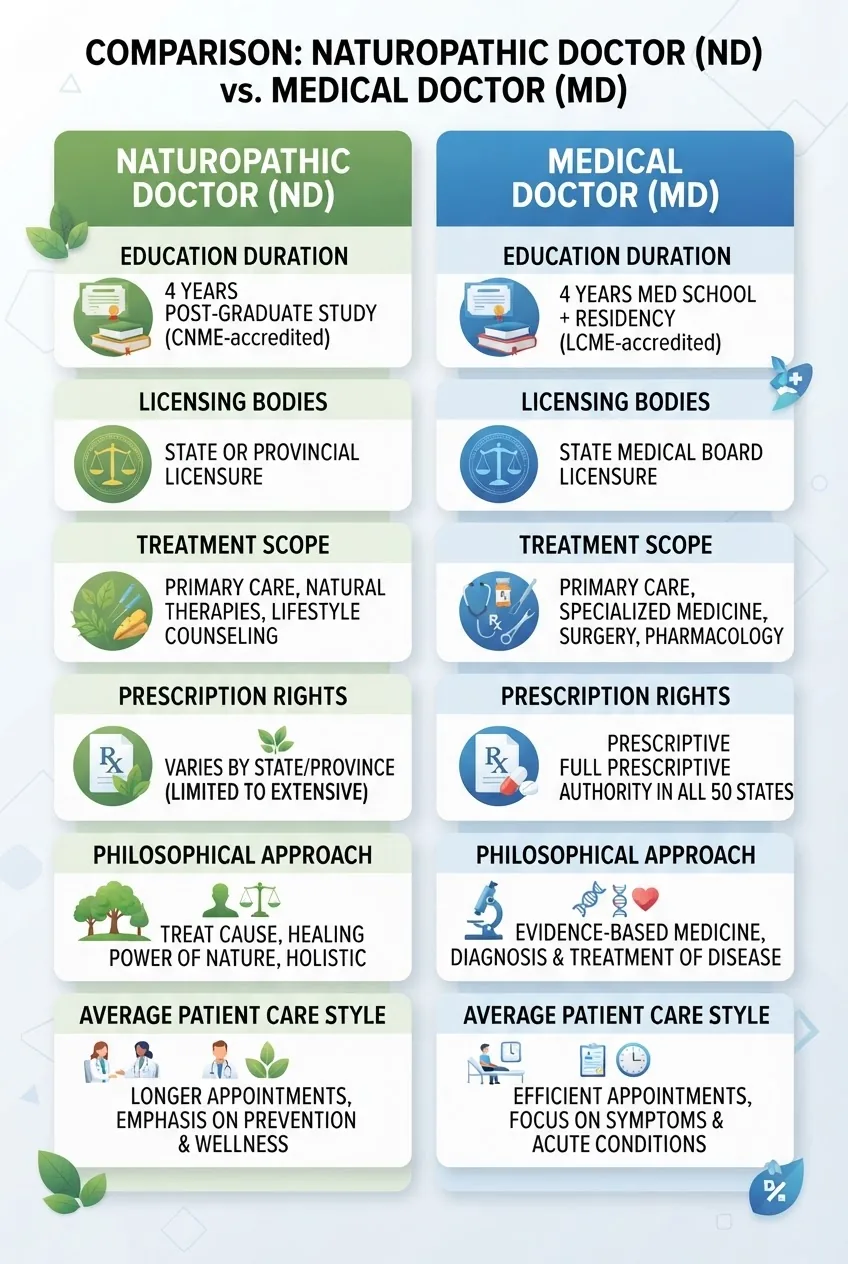
| Feature | Naturopathic Doctor (ND) | Medical Doctor (MD) |
|---|---|---|
| Primary training | 4-year ND program plus internships; emphasis on natural therapies | 4-year medical school + 3–7+ year residency; emphasis on biomedical diagnostics |
| Typical scope | Prevention, nutrition, herbal medicine, lifestyle prescriptions; variable prescribing | Acute care, surgery, subspecialty procedures, full prescribing rights |
| Licensing | Varies by jurisdiction; some states/provinces license NDs | Standardized state/provincial licensing nationally recognized |
| Care style | Longer visits, holistic, multi-modal | Problem-focused, diagnostics-driven, often shorter visits |
| Best for | Chronic preventive care and natural therapies | Acute, emergency, specialist or surgical needs |
Final thoughts: match the practitioner to your primary health goal, verify credentials with licensing agencies, and prefer collaborative integrative care when both natural and conventional tools are needed. If you want to explore more on treatment options, consult the linked resources and speak directly with providers to understand their approach and evidence base.
Call to action: If you’re weighing options for chronic or preventive care, request license verification and a brief consultation to see whether a naturopathic, medical, or integrative plan best fits your goals.