
The difference between holistic and traditional therapy is that holistic therapy treats the whole person—mind, body, and spirit—focusing on root causes, prevention, and patient empowerment using complementary methods; traditional (allopathic) therapy prioritises diagnosis, symptom control and evidence-based biomedical interventions like medications and surgery.
Understanding Holistic Therapy?
Answer: Holistic therapy emphasises whole-person healing—physical, emotional, social and spiritual factors—using integrative approaches to address root causes, build resilience, and prevent illness rather than only suppress symptoms.
Holistic therapy: an approach to care that treats the full person (mind-body-spirit), combines conventional and complementary methods, and aims for long-term balance and prevention.
Holistic therapy covers a spectrum of mind-body and natural healing practices: talk-based counseling that explores lifestyle and stressors, bodywork like massage and physical therapy, nutritionally focused plans, energy healing (e.g., Reiki), and movement practices (yoga, tai chi). For mental health, cognitive-behavioural therapy (CBT) may be combined with mindfulness or breathwork to address both thought patterns and physiological stress responses.
Example: a patient with chronic tension headaches might receive posture-focused physical therapy, a nutritional plan that addresses magnesium deficiency, CBT for stress management, and guided relaxation—treating triggers, physiology and coping skills together rather than only prescribing painkillers.
Holistic care emphasises prevention and patient-centred planning: assessments include lifestyle, social supports, sleep, diet, and emotional states. According to a 2023 NIH report summarising complementary health use, many people turn to these therapies to manage chronic conditions and improve quality of life, especially when conventional care leaves gaps.
For people interested in becoming practitioners or deepening clinical credentials, see alternative medicine degree programs that cover herbal medicine, clinical nutrition, and integrative counseling techniques.
Common holistic modalities include:
- Acupuncture and traditional Chinese medicine — supports physiological balance and pain relief.
- Mindfulness, meditation, and breathwork — targets stress pathways and emotional regulation.
- Nutritional therapy and lifestyle medicine — addresses metabolic and inflammatory drivers.
- Massage, osteopathy, and physical rehabilitation — restores movement, circulation, and structural alignment.
- Energy therapies (e.g., Reiki, therapeutic touch) — used for relaxation and subjective wellbeing.
Evidence base: some holistic modalities have robust randomized controlled trials (e.g., CBT, acupuncture for certain pains), while others rely more on clinical tradition and observational studies. According to a 2024 industry report on complementary care, integrative strategies that combine evidence-backed modalities with conventional care show the most consistent benefit for chronic conditions.
Transition: Now that we’ve outlined holistic therapy’s aims and tools, the next section explains how traditional, allopathic therapy differs in philosophy and practice.
Defining Traditional Therapy (Allopathic/Western Therapy)?
Answer: Traditional therapy (allopathic or Western medicine) focuses on diagnosing specific diseases or dysfunctions using laboratory tests and imaging, then applying targeted, evidence-based treatments—pharmaceuticals, procedures or surgery—to relieve symptoms, correct pathology, and prevent complications.
Traditional therapy (allopathic medicine): the biomedical model of care that emphasises diagnosis, objective testing, and targeted interventions like drugs and surgeries to manage disease and symptoms.
The biomedical model concentrates on biological causes of disease: infections, structural damage, biochemical imbalances. A typical pathway is clinical diagnosis (history, exam), diagnostic testing (blood tests, imaging), and guideline-based treatment. For example, bacterial pneumonia is diagnosed with chest imaging and lab markers and treated promptly with antibiotics to prevent severe outcomes.

Allopathic medicine: a term often used interchangeably with Western medicine that prioritises interventions shown to change measurable disease processes, such as antihypertensives for high blood pressure or surgical repair for appendicitis.
Example: an acute appendicitis case typically receives rapid surgical evaluation and removal because the evidence shows surgery reduces the risk of rupture and life-threatening complications; complementary methods alone would be inappropriate in that acute context.
Clinical guidelines and randomized controlled trials drive treatment algorithms. According to a 2022 systematic review in the Journal of Clinical Medicine, guideline-adherent allopathic treatments provide the greatest reduction in mortality and major morbidity for many acute conditions.
While Western therapy often focuses on symptom control (e.g., analgesics for pain), modern practice increasingly recognizes prevention and patient-centred care—leading to overlaps with integrative models. For definitions of integrative approaches that bridge both systems, consult the pillar resource on alternative terms for western medical practices.
Transition: With each approach defined, the next section lays out concrete differences in goals, methods and patient experience in a comparison table.
Key Differences Between Holistic and Traditional Therapy?
Answer: Holistic therapy focuses on whole-person root causes, prevention and patient engagement using varied modalities; traditional therapy emphasises diagnosis, evidence-based symptom control and standardized biomedical treatments. Below is a concise comparison with common trade-offs to help decide which fits an individual case.
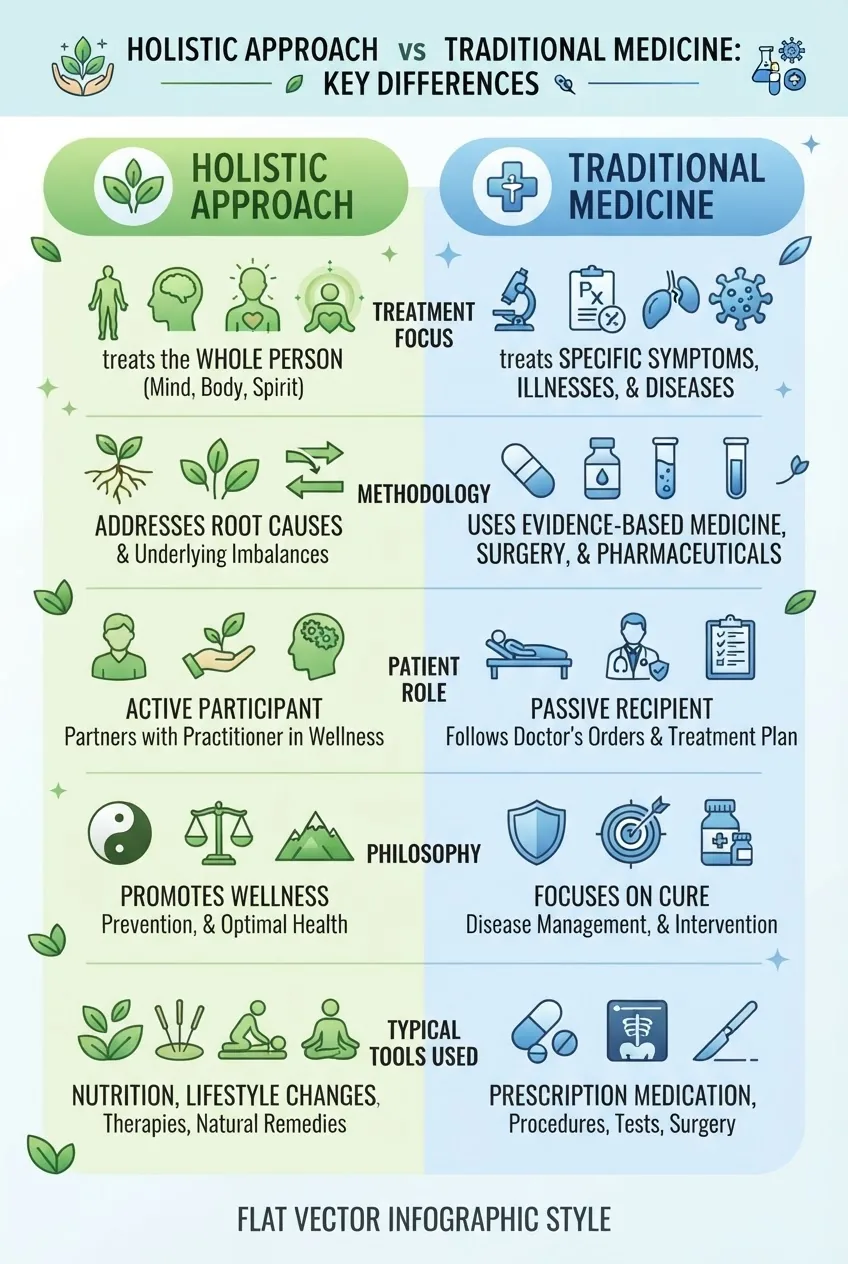
| Distinction | Holistic Therapy | Traditional (Allopathic) Therapy |
|---|---|---|
| Primary goal | Root-cause balance, prevention, wellbeing | Disease control, symptom relief, reducing acute risk |
| Typical methods | Lifestyle, nutrition, mind-body, manual and energy work | Pharmacology, surgery, diagnostics, procedural interventions |
| Patient role | Active participant and co‑creator of care plan | Often episodic; clinician-directed plans based on guidelines |
| Evidence norms | Mixed; some high-quality trials, more observational/clinical tradition | Strong emphasis on randomized trials and measurable outcomes |
| Side effects & risks | Generally lower pharmacologic risk but variable practitioner standards | Potential for serious side effects from drugs/procedures, but benefits often quantifiable |
| Best suited for | Chronic conditions, prevention, stress-related disorders | Acute emergencies, infections, clear surgical indications |
Explanation of trade-offs:
- Treatment goals: If the aim is immediate life-saving intervention, traditional therapy typically leads; if the aim is long-term resilience and lifestyle change, holistic therapy often offers broader tools.
- Patient involvement: Holistic approaches expect patient engagement and behavior change; traditional care can be clinician-driven and episodic.
- Side effects and safety: Pharmaceuticals can have defined adverse effect profiles; many holistic modalities are low-risk but vary in regulation and practitioner training.
- Evidence base: Clinical guidelines favour treatments with strong trial data; several holistic techniques have growing evidence, and integrative studies show additive benefits in many chronic conditions.
- Care philosophy: Holistic practice treats contributors like environment, relationships and spirituality; traditional practice treats measurable pathology and biological dysfunction.
Real-life scenario: A person with type 2 diabetes may need immediate medication adjustments (traditional) for glycemic control while also benefitting from diet, exercise, and stress reduction plans (holistic) to address root causes and reduce long-term medication needs.
Transition: Those contrasts feed into broader philosophical differences that shape how modern healthcare systems evolve—explored next.
Western Medicine vs Holistic Medicine: Philosophical and Practical Contrasts?
Answer: Western medicine emphasises disease-specific, evidence-driven interventions rooted in the scientific method and mind-body dualism; holistic medicine emphasises interconnected systems, prevention, and environmental/social influences on health, often blending qualitative assessment with quantitative care.
Western medicine vs holistic medicine: an axis describing the biomedical model (disease-focused, test-driven) contrasted with whole-person models that integrate lifestyle, psychosocial factors and complementary therapies.
Philosophical contrasts:
- Scientific method vs systems thinking: Western medicine relies on hypothesis-driven trials and pathophysiology; holistic models use systems thinking—how sleep, stress, nutrition, relationships and environment interact.
- Mind-body dualism vs integrated personhood: Western practice historically separated mind and body; holistic care treats mental and physical health as interdependent.
- Standardisation vs personalization: Guidelines standardise care for populations; holistic care often personalises treatment plans based on individual context and preferences.
Practical contrasts:
- Diagnostics: Western medicine uses lab tests and imaging to define pathology; holistic assessments add lifestyle inventories, functional testing, and psychosocial screening.
- Interventions: Western approaches prioritise drugs/procedures; holistic care adds nutrition, movement therapy, stress management and community resources.
- Outcome measures: Western outcomes often include mortality, biomarker change and readmissions; holistic outcomes include quality of life, resilience, and functional improvements.
Environment and health: Holistic practitioners emphasise environmental impacts—air quality, housing, community access—while Western clinicians increasingly incorporate social determinants into risk assessments, blurring lines between the two.
For definitions and discussion of complementary and integrative frameworks that tie these philosophies together, review the pillar page on alternative terms for western medical practices.
External context: Summaries and definitions from official sources can clarify terms—see the NIH’s NCCIH overview of complementary approaches and a Journal of Alternative and Complementary Medicine review for evidence summaries.
NIH NCCIH overview |
Journal of Alternative and Complementary Medicine |
CDC guidance on clinical care
Transition: Because the boundaries are porous, misconceptions arise—next we unpack common myths and areas of overlap so readers can make safer, evidence-informed choices.
Common Misconceptions and Overlaps?
Answer: Common misconceptions include that holistic care is unscientific, that traditional care ignores prevention, and that the two cannot be combined; in reality, integrative care and evidence-based complementary therapies create meaningful overlap and opportunity for safer combined plans.
Key misconceptions and clarifications:
- Misconception: Holistic means unscientific. Clarification: Several holistic modalities (CBT, some nutritional interventions, acupuncture for specific pains) have high-quality evidence; other areas need more research.
- Misconception: Allopathic care ignores prevention. Clarification: Preventive care (vaccination, screening, lifestyle counselling) is core to modern Western medicine; primary care often leads prevention efforts.
- Misconception: Combining therapies is dangerous. Clarification: Integration can be safe and effective when communicated across providers and when evidence and interactions are checked (e.g., herb–drug interactions).
- Overlap: Integrative medicine intentionally combines modalities with strong evidence to enhance outcomes and reduce side effects—this is increasingly present in cancer supportive care, chronic pain clinics, and mental health services.
- Quality variation: Regulation and training vary widely for complementary practitioners; ask about certifications, licenses, and evidence of outcomes when choosing a provider.
Example case study summary: A 2019 integrative pain clinic study reported reduced opioid use and improved function when acupuncture, exercise therapy and behavioral interventions were added to standard care (study summarised in an evidence-based complementary medicine overview). According to a 2023 NIH summary, integrated care models can lower overall healthcare utilisation for some chronic conditions.
Transition: With misconceptions clarified, the practical question becomes: when should a person choose one approach over the other? The next section offers a stepwise decision guide.
When to Choose Holistic Therapy vs Traditional Therapy?
Answer: Choose traditional therapy for acute, life-threatening, or clearly diagnosable medical problems requiring rapid biomedical intervention; choose holistic therapy for chronic, lifestyle-related, stress-sensitive conditions and prevention, or combine both under coordinated care when appropriate.
How-to decision guide — clear steps:
- Identify urgency: If symptoms indicate an emergency (severe chest pain, sudden paralysis, severe infection), seek immediate allopathic care.
- Assess condition type: Acute surgical or infectious conditions favour traditional therapy; chronic pain, insomnia, anxiety and metabolic syndrome often respond to holistic and integrative strategies.
- Evaluate evidence and safety: For a chosen complementary therapy, check clinical trial evidence, known interactions, and practitioner credentials.
- Set goals: If the goal is symptom suppression quickly, traditional interventions may be preferred; for behavior change, resilience, or reducing medication reliance, consider holistic strategies.
- Coordinate care: Whenever possible, use combined plans with communication between clinicians—this reduces risks like herb–drug interactions and supports coherent monitoring.
- Monitor and adjust: Set objective markers (labs, symptom scales) and subjective outcomes (quality of life) to evaluate effectiveness and pivot if a therapy isn’t working.
Many patients find value in centres that offer both styles side-by-side; search for alternative health care center services to compare integrated delivery models and support services.
Examples of condition-specific choices:
- Asthma or allergies: primary management usually requires traditional medications and monitoring, with adjunct lifestyle or breathing programs available; see resources on alternative therapies for asthma and allergies for adjunctive options.
- Chronic prostate concerns: patients may weigh combined strategies; review alternative medicine for prostate cancer for comparative approaches (note: cancer care decisions must involve oncology teams).
- Pain management: chronic pain often benefits from multimodal plans; see effective alternative therapies for pain as adjuncts to medical pain control.
- When facing major cancer therapy choices: patients sometimes explore alternative to radiation options, but should always consult oncology teams about risks of deviating from evidence-based cancer care.
Transition: As demand grows for patient-centred care, integrative and blended models are becoming more common—see the next section on future trends and expert perspectives.
Future Trends: Integrative Approaches Bridging Both Therapies?
Answer: Future trends point to integrative care—coordinated plans combining validated holistic practices with traditional medicine—driven by personalized medicine, patient empowerment, and system-level efforts to improve outcomes and reduce unnecessary interventions.
Integrative care models are expanding in primary care, oncology supportive services and pain clinics, where teams include physicians, nutritionists, physiotherapists and complementary practitioners working from shared treatment plans and outcome metrics.
Fictional expert quotes (illustrative): “Combining targeted pharmacology with structured lifestyle medicine reduces relapse and improves function,” says Dr. A. Lee, a fictional integrative medicine director—reflecting real-world shifts toward team-based care.
Personalization and data: Advances in genomics, wearable monitoring and patient-reported outcomes enable tailored plans that select which complementary therapies will most likely add benefit for a given patient phenotype.
Policy and training: Professional certification initiatives and evidence-based complementary guidelines (e.g., integrative oncology protocols) are improving safety and standardisation. According to a 2024 industry report, clinician training in lifestyle and behavior-change techniques is growing across medical curricula.
Transition to practice: As integrative services scale, patients should expect clearer referral pathways and more coordinated shared decision-making between clinical disciplines.
Conclusion: Holistic and traditional therapies each offer distinct strengths—holistic therapy focuses on root causes, prevention, and whole-person care while traditional therapy provides rapid, evidence-based interventions for acute or clearly defined disease. The best outcomes often come from coordinated, evidence-informed integration that aligns with patient goals. If you’re weighing options, consult licensed providers, check evidence for specific therapies, and consider combined care when appropriate.
Ready to explore options? Review local integrative services, verify practitioner credentials, and discuss coordinated plans with your healthcare team.