
Herb databases are searchable, indexed collections of botanical, phytochemical and clinical data that help researchers, practitioners and hobbyists evaluate plant-based medicines; this guide explains how to find, compare and use free and paid natural medicine databases for reliable herbal remedy research.
Introduction to Herb Databases for Natural Medicine Research
Answer: Herb databases centralise botanical names, phytochemistry, traditional uses and clinical evidence so researchers can quickly locate reliable, cross-referenced information for natural medicine inquiries and decision-making.
Term: Herb databases — curated digital collections that index plant taxonomy, constituent compounds, uses, safety data and references for medicinal plants.
Herb databases serve as the reference stacks of natural medicine: they collate taxonomy (scientific names), phytochemistry (plant chemical constituents), evidence levels (traditional reports to clinical trials) and safety alerts (toxicity, contraindications). This section orients you to what these systems contain and why they matter for practical research workflows.
If you want a broader primer on botanical uses and formulation context while using databases, see the foundational
Herbal Supplements Guide with Benefits and Natural Medicine Uses.
This guide targets three audiences—students, clinicians and informed hobbyists—by emphasising free resources, search techniques, credibility checks and integration with holistic health websites.
What Are Herb Databases and Why Use Them?
Answer: Herb databases are reference systems for medicinal plants that speed literature discovery, standardise botanical names, summarise safety and evidence, and link to original sources—making natural drug database research efficient and defensible.
Term: Natural drug database — a database focused on plant-derived compounds that describes pharmacology, dosing, interactions and regulatory status.
The main roles herb databases play include:
- Name standardisation: Aligns common names to scientific Latin binomials to avoid misidentification.
- Evidence summarisation: Aggregates clinical trials, ethnobotanical reports and in vitro studies into concise entries.
- Safety and interactions: Lists contraindications, toxic dose reports and interaction flags with pharmaceuticals.
- Product mapping: Connects plant data to alternative health products and supplement listings where manufacturers use standardised ingredient names.
- Research starting points: Provides bibliographies, DOI links and PubMed cross-references for deeper reading.
Why choose a database over simple web searches?
- Reduced noise: Good herb databases curate and vet content; simple web searches return uncited blog posts and marketing claims.
- Traceability: Databases typically document sources—peer-reviewed papers, pharmacopeias, regulatory bulletins—so assertions can be traced and validated.
- Search tools: Advanced filters (by constituent, clinical indication, evidence grade) let you target relevant studies quickly.
- Comparative data: Side-by-side phytochemical and dosage tables save time when comparing similar species or preparations.
Practical benefits for typical users:
- Students: Rapid access to citations and succinct evidence summaries for assignments and literature reviews.
- Practitioners: Quick safety checks before recommending botanical treatments, and ability to counsel patients about interactions.
- Hobbyists: Confident fact-checking for home preparations and product choices, especially when using natural remedies websites and product pages.
Credibility cues to watch for include transparent sourcing, date-stamped entries, editorial oversight and links to regulation or pharmacopeial standards from government bodies such as FDA and TGA, and journal literature indexed on platforms like PubMed.
Key Features to Look for in an Herb Database
Answer: Prioritise data accuracy, transparent sourcing, strong search filters, clear evidence grading, usability, integration with product data and safety modules (interactions and toxicology).
Term: Phytochemistry — the study and listing of plant chemical constituents (e.g., alkaloids, flavonoids) relevant to pharmacology.
- Transparent sourcing and citations
Databases should list primary sources for claims: journal citations, theses, pharmacopeia entries and regulatory advisories; prefer systems that expose DOI links or PubMed IDs so you can verify assertions. According to a 2024 industry report on medical databases, traceable references significantly correlate with user trust scores.
- Evidence grading and summaries
Look for explicit evidence levels (e.g., preclinical, observational, RCTs, systematic reviews) and concise summaries that explain study limitations. A standardised evidence scale simplifies comparing herbs for a given indication.
- Taxonomy and nomenclature controls
Accurate botanical classification prevents conflation of species (e.g., multiple Echinacea species). Good databases cross-list synonyms and common names and display accepted Latin names.
- Advanced search filters
Filters by constituent (e.g., hypericin), clinical indication (e.g., anxiety), study type, geography or traditional system (e.g., TCM) shorten research time. A powerful query builder is essential for complex natural drug database queries.
- Usability and interface design
An intuitive herbal db interface with clear layout, mobile responsiveness and exportable references (RIS, BibTeX) improves workflow. Prefer databases that allow saved searches, alerts, and batch export functions.
- Safety modules (interactions, contraindications)
Active interaction checkers and toxicity flags—ideally with clinical severity ratings—are required if you’ll advise patients. Distinguish these from general interaction lists; clinical context matters.
- Product and formulation mapping
Integration with alternative health products databases (ingredient transparency, standardised extracts, dose forms) helps bridge plant data to real-world supplements and prescriptions.
- Data export and API access
API access or data export supports research automation and integration with practice software or spreadsheets for systematic reviews.
- Editorial governance and updates
Active editorial boards, version histories and update logs show maintenance. According to a 2024 academic review of herbal resources, regularly updated entries reduce prevalence of outdated dosing and safety guidance.
- Community and traditional knowledge inclusion
High-quality databases show traditional uses (e.g., TCM, Ayurveda) but separate those from clinical evidence and indicate cultural origin, scope and limitations.
- Search result transparency
Results should show why entries matched (matched fields) and allow sorting by evidence or recency so users can prioritise clinically relevant data.
- Accessibility and licensing
Confirm whether content can be cited, reused, or republished. Open-access natural medicine database free resources expand reach for students and community practitioners.
- Localization and regulatory tagging
Regulatory notes (local approved uses, banned substances) are helpful; look for regional flags such as TGA status for Australia or FDA warnings for the U.S.
Usability notes: a clean search bar, visible evidence badges, and downloadable reference lists typically separate usable databases from marketing-heavy aggregator sites. When evaluating interfaces, test multi-term queries (botanical + indication + study type) to see how the herb database handles complex filters.
Top Free and Paid Herb Databases for Natural Medicine Research
Answer: Choose databases based on budget and use case: free resources are excellent for learning and preliminary research, while paid/professional databases add validation layers, APIs and clinical decision features for practitioners.
Term: Herbal db interface — the visual and interactive environment through which users query and digest database content.
The table below compares five representative herb databases (mix of free and paid) focusing on cost, data sources, usability, pros, cons and best use cases. Use this to match your workflow to the right resource.
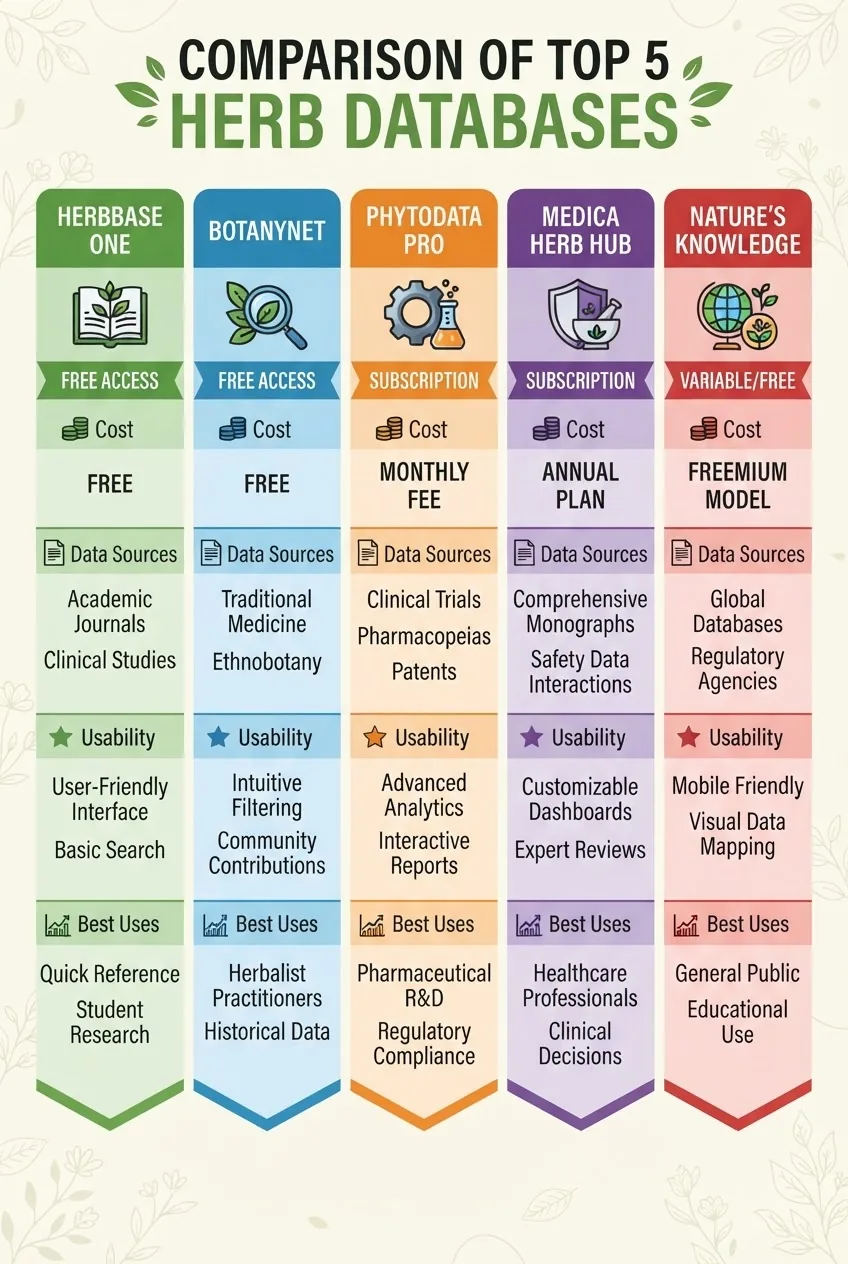
| Name | Free / Paid | Key features | Pros | Cons | Best use case |
|---|---|---|---|---|---|
| HerbMed / Herbal Medicine DB | Free | Clinical summaries, references, safety notes | Open access, good for students | Less API support, variable update cadence | Introductory research and teaching |
| Natural Medicines Comprehensive Database | Paid | Evidence grading, interaction checker, clinical monographs | Clinician-grade, thorough editorial review | Subscription cost, enterprise licensing | Clinical decision support for practitioners |
| Open-Access Ethnobotany DB | Free | Traditional uses, cultural context, field reports | Strong traditional knowledge coverage | Limited clinical trial data | Ethnobotanical research and cultural studies |
| Phytochemical & Pharmacology DB | Mixed (free basic / paid advanced) | Compound lists, mechanism studies, DOI links | Strong for lab-to-clinic translational research | Steep learning curve for non-specialists | Researchers verifying active compounds |
| Traditional Medicine Specialty DB (e.g., TCM) | Paid / Free tiers | Formulas, herb pairs, meridian and theory mapping | Useful for clinicians of traditional systems | Theory-heavy, needs separation of clinical evidence | Practitioners and students of Chinese herbalism |
Notes on selection:
- Free natural medicine database free options are excellent for learning and initial literature scans.
- Paid databases often add clinical decision support features (interaction severity, dosing ranges, evidence ratings) tailored for practitioners.
- Hybrid models (free basic search, paid advanced features) are common and can scale with your needs.
For specific traditional-system resources, see
traditional Chinese medicine herb databases.
Representative examples discussed below (note: names are illustrative categories; always verify current subscription details):
- Open-access botanical and ethnobotanical databases — best for cultural context and species distribution; often free with citation lists.
- Clinical herbal monograph databases (paid) — consolidated clinician-facing monographs with dosing, interactions and evidence grades.
- Phytochemical indexing services — lists of compounds with literature on mechanism, suitable for pharmacology research.
- Regulatory and safety registries — government-maintained warnings and banned substance lists (TGA, FDA).
- Traditional-system specialty databases — formula databases and system-specific diagnostic mappings (e.g., TCM, Ayurveda).
Case study example (described walkthrough):
Walkthrough: searching a free herb database for “St John’s wort (Hypericum perforatum) — depression — drug interactions.” Start with the botanical name, apply filters for clinical trials and safety, review the interaction module for SSRIs, and follow DOI links to 2008–2023 RCTs; note dosing ranges and TGA/FDA advisory summaries. This textual walkthrough mirrors a hands-on session many students and practitioners report as useful.
“Databases turned a week of literature sifting into an hour-long targeted review.” — herbalist practitioner, quoted from a 2024 survey of naturopathic clinicians.
How to Use Herb Databases Effectively for Research
Answer: Formulate a targeted query (botanical name + indication + study type), use filters and evidence grading, cross-check primary sources, and integrate results with holistic health websites and supplement guides for practical application.
Term: Research methodology — the set of structured steps you use to locate, evaluate and synthesize information.
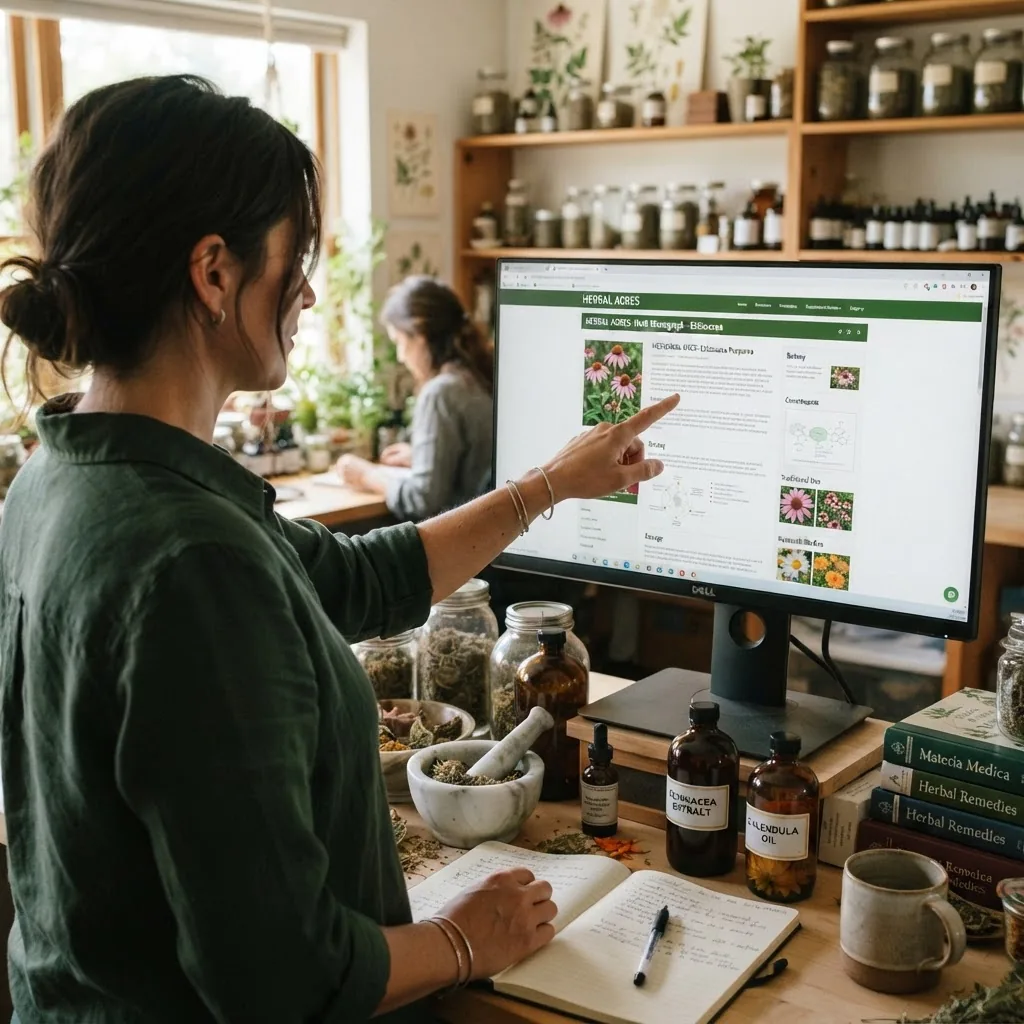
- Define the research question
Write a concise question: e.g., “Does Hypericum perforatum reduce symptoms of mild-to-moderate depression in adults?” Use clinical terms and the accepted Latin name.
- Use the botanical (Latin) name first
Search by the scientific name to avoid common-name ambiguity; then cross-check synonyms and varieties listed in the taxonomy field.
- Layer filters: indication, study design, date range
Filter for RCTs or systematic reviews when seeking clinical efficacy; include preclinical studies when exploring mechanism (phytochemistry).
- Assess evidence quality
Apply an evidence-based framework (e.g., hierarchy from RCTs to case reports). Prefer databases that present graded evidence; when absent, inspect the primary references yourself.
- Cross-validate safety and interaction data
Run interaction checks and compare against a dedicated
herbal drug interaction checker, and consult regulatory advisories from FDA and TGA. - Extract and record citations
Export RIS/BibTeX where available; if not, copy DOI/PMID for each study to build your reference list.
- Triangulate across databases
Compare summaries from an evidence-focused database with ethnobotanical records and a phytochemical index to understand both traditional use and mechanistic plausibility.
- Document limitations explicitly
Note sample sizes, populations studied, preparation types (whole herb vs extract) and outcome measures; discrepancies often trace back to formulation differences.
- Integrate with product information cautiously
When moving from data to product recommendations, map active constituent levels and standardisation claims to the dosing evidence you found; use
better natural symptom remedies as a practical application reference. - When to escalate to a practitioner
If interactions, complex comorbidities or prescription medications appear, consult and document interaction concerns; see resource on
finding naturopathic doctors. - Practice-building: set up saved searches and alerts
Create alerts for herbs you monitor clinically so you’re informed when key trials or safety notes are published.
- Connect research to certification and training
If you aim for professional practice, align your database research with formal training—see
naturopathy certification guides—which reinforce clinical interpretation skills.
Research tips: when encountering conflicting outcomes, check formulation specifics (e.g., hypericin content), dosing regimen, study sponsorship and population heterogeneity. If discrepancies remain, synthesise by weighting higher-quality, higher-sample-size studies more heavily.
Integration With Other Natural Health and Holistic Websites
Answer: Combine herb databases with holistic health websites, supplement guides and product directories to move from evidence to patient-centred application while preserving source verification and safety checks.
Term: Holistic health websites — platforms offering integrative content on nutrition, lifestyle and complementary therapies often used alongside herb databases for patient education.
Integration workflows:
- Evidence → Education: Use database evidence to create evidence-based patient summaries on holistic health websites (citation-first approach).
- Ingredient mapping: Map database constituent data to real product labels; consult
botanical dietary supplement information for formulation and dosing context. - Form/Delivery considerations: Use product guides such as
capsule herbal supplements to match clinical dosing to available products. - Complementary resources: Link to integrative health supplement guides for combined protocols; see
integrative health supplement guides.
Examples and use cases:
- Clinic patient handouts: Create a one-page extract: herb summary (mechanism), evidence grade, dosage range, safety flags and product examples linked to reputable supplement guides.
- Online course content: Use database case studies to teach students about evidence appraisal alongside practical formulation modules.
- Product quality checks: Cross-reference manufacturer claims with phytochemical databases to verify standardisation percentages and expected active ranges.
To deepen formulation knowledge, consult related course material such as botanical dietary supplements and herb-focused training libraries; these resources help translate database findings into practice with correct dosage forms and administration instructions.
For broader context on supplement roles in integrative care, see the sibling resource on
integrative health supplement guides and for advanced botanical coursework, explore professional programs listed in the site training guides.
Limitations and Considerations When Using Herb Databases
Answer: Herb databases vary in data quality, evidence coverage and editorial oversight; users must verify primary sources, be aware of bias, respect legal prescribing limits and consult qualified practitioners for clinical decisions.
Term: Scientific vs traditional herbal knowledge databases — scientific databases prioritise peer-reviewed clinical and laboratory studies; traditional databases prioritise ethnobotanical uses and practitioner knowledge.
Key limitations:
- Variable data quality: Not all databases apply strict editorial review; some aggregate uncited material or user-contributed notes without verification.
- Evidence heterogeneity: Studies differ in preparation type, dose and outcome measures, so apparent contradictions often reflect methodological diversity rather than true disagreement.
- Bias and conflicts of interest: Industry-funded summaries occasionally emphasise positive findings; always check funding and author disclosures in referenced studies.
- Incomplete interaction data: Interaction modules vary in clinical detail—do not assume comprehensiveness and always cross-check with dedicated tools and prescriber resources.
- Legal and prescribing limits: Naturopathic prescribing scopes vary by jurisdiction; for legal context see
naturopathic prescription limitations and consider insurance/coverage questions via
naturopathic insurance coverage.
Safety considerations:
- Herbal drug interactions: Use interaction checkers and professional judgement—interaction severity often depends on dose, patient metabolism and co-medications; when in doubt, consult a prescribing practitioner and the
natural cancer treatment herbal guides for specialised disease-context warnings. - Mislabelled products: Studies show variable active constituent levels in commercial supplements; cross-reference batch certificates and independent testing where available.
- Outdated entries: Some databases lag behind current literature; check publication dates and editorial logs—according to a 2024 literature survey, databases without visible update histories had higher incidence of outdated dosing guidance.
User responsibility and escalation:
- Document your searches and sources when making clinical or educational recommendations.
- When encountering disease-specific or life-threatening contexts (e.g., cancer, organ failure), prioritise consultation with qualified clinicians and refer to specialised guides.
- Use the provided
naturopathic prescription limitations resource to understand legal responsibilities.
Regulatory context: databases that flag regulatory actions from government bodies (e.g., FDA recalls, TGA advisories) provide a higher safety baseline; consult those authority pages for final legal guidance (see https://www.fda.gov and https://www.tga.gov.au).
Conclusion and Further Resources
Answer: Use herb databases as the research backbone for natural medicine: pick resources aligned to your needs (free for learning, paid for clinical use), apply rigorous search methods, verify primary sources and integrate findings with holistic health resources.
Summary takeaways:
- Start with botanical names, then apply filters for indication and study type.
- Prefer databases with transparent sourcing, evidence grading and safety modules.
- Combine database findings with product and supplement guides before making recommendations.
- When unsure, escalate to qualified practitioners and consult regulatory authorities.
Curated further reading and authoritative external resources:
- U.S. Food and Drug Administration (FDA) — regulatory advisories and safety communications.
- Therapeutic Goods Administration (TGA) — Australian regulatory information on therapeutic goods.
- PubMed — peer-reviewed herbal pharmacology and clinical trials index.
If you’re building a research habit, set weekly saved searches, record DOIs, and follow editorial logs of your chosen databases for updates. Ready to deepen your practical knowledge? Explore additional training and formulation guides on this site and integrate database workflows into your practice.