

The history of herbalism traces how societies used plants as medicine from ancient ritual and household remedies to structured herbal medicine education; this course-focused overview explains key milestones, major cultural systems, typical remedies and how historical practice shapes modern herbalism courses and natural medicine uses today.
Introduction to the History of Herbalism?
Answer: The history of herbalism is the chronological study of how humans identified, prepared and regulated plant-based treatments—spanning ancient herbal traditions, evolving pharmacopeia, and formal herbal medicine education that informs contemporary naturopathy and natural medicine curricula.
The history of herbalism examines both practical applications—how people made teas and salves—and the social frameworks that preserved knowledge: oral tradition, religious texts, trade routes and early pharmacopeia (official lists of medicines and preparations). This introduction outlines origins, broad timeframes and why studying history is central to modern herbal medicine education.
Term: pharmacopeia — an authoritative compendium listing medicinal substances, formulations and standards used to ensure consistent preparation and dosing.
Origins of herbalism are archaeological and ethnobotanical: charred seeds and residues, ancient apothecaries and recorded recipes show continuous plant use for health across continents. Indigenous plant medicine systems—contextualized knowledge tied to place and culture—are foundational to understanding how herbal science developed into formal curricula.
Studying the history of herbalism as a course subject trains students to read sources (herbal manuscripts, herbals), compare cultural systems (Chinese, Ayurvedic, Indigenous), and trace how formulation techniques—teas, decoctions, tinctures, salves—evolved into clinical and educational standards taught in modern herbal medicine education.
Transition: The high-level origins lead to a series of identifiable milestones that shaped methods, texts and institutions; the next section lays out those milestones in timeline form.
Key Historical Milestones in Herbalism?
Answer: Key milestones include early plant-use evidence, documented pharmacopeias in ancient Egypt and Mesopotamia, Greek and Roman herbals (Dioscorides), medieval monastic gardens and herbals, Renaissance printing dissemination, 19th–20th century pharmacognosy, and the 20th–21st century integration into naturopathy and formal herbalism courses.
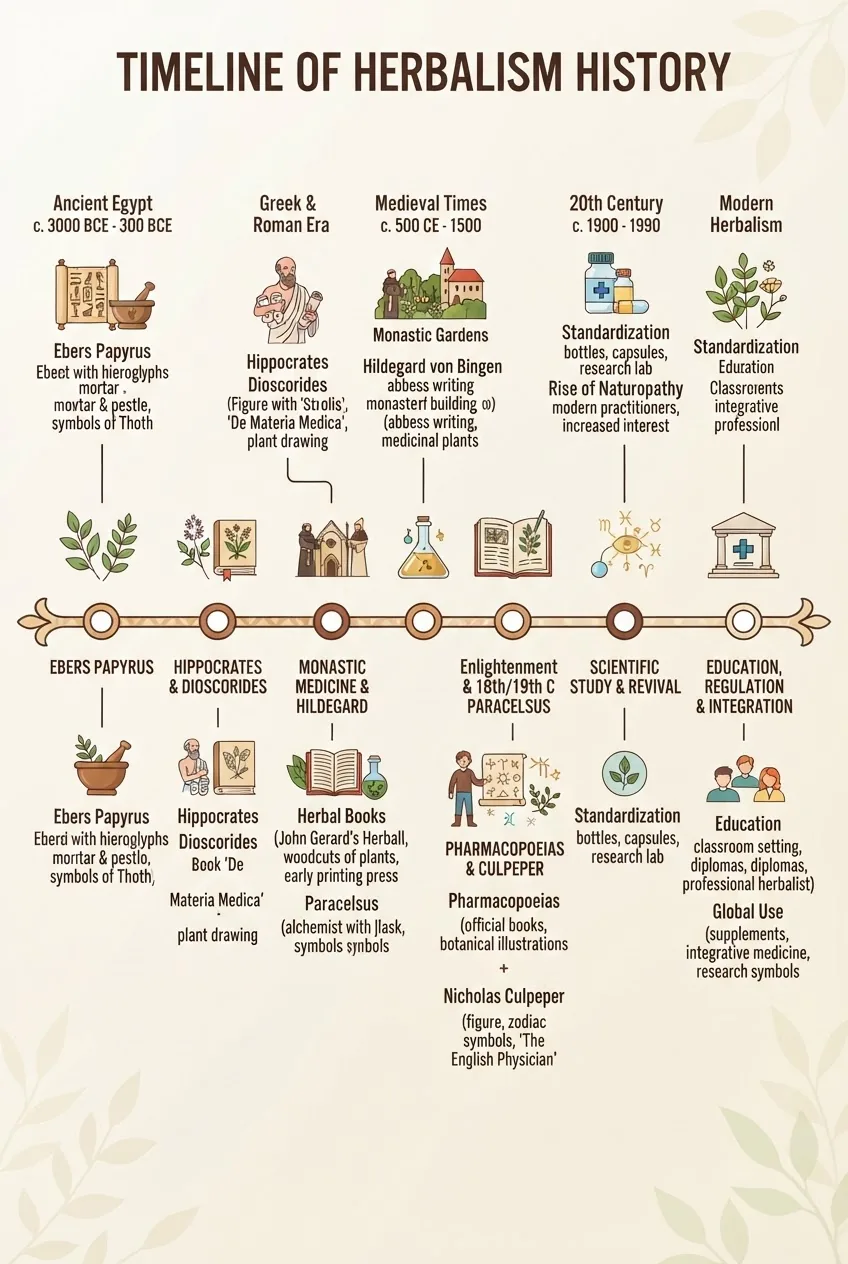
- Prehistoric and Neolithic plant use (before 3000 BCE): Archaeobotanical evidence such as medicinal residues on tools and burials indicate plant remedies in hunter-gatherer and early agricultural societies; these practices form the empirical baseline of ancient herbal practices.
- Ancient Mesopotamia and Egypt (c. 3000–1000 BCE): Written records and papyri list medicinal plants and preparations; Egyptian medical papyri (e.g., Ebers Papyrus) document recipes and procedures, signalling organized herbal remedies history tied to professional healers.
- Indian Ayurvedic system codification (c. 1500 BCE onwards): Texts such as the Charaka Samhita and Sushruta Samhita codified principles of diagnosis, plant materia medica and formulations, establishing a continuous tradition of traditional herbal medicine and education.
- Chinese materia medica and systematization (c. 1000 BCE–200 CE): Early Chinese texts evolved into the Shen Nong Ben Cao Jing and later pharmacopoeias; Traditional Chinese Medicine combined herbs into formulas with clear preparation methods—an influential cultural herbal tradition.
- Greek and Roman herbal medicine (1st century CE): Dioscorides’ De Materia Medica systematically described hundreds of plants, their preparations and uses; this work shaped European herbal pharmacology origins for over a millennium.
- Medieval era and monastic herbal gardens (5th–15th century): Monasteries preserved classical texts; Hildegard von Bingen and later herbalists adapted knowledge to local species and spiritual frameworks, contributing to medieval herbalism and training of practical healers.
- Renaissance printing and herbals (15th–17th centuries): The printing press multiplied herbals and illustrated florilegia, widening access to botanical knowledge and accelerating the herbal renaissance across Europe.
- Early modern pharmacognosy and colonial exchanges (17th–19th centuries): Exploration exchanged medicinal plants globally; naturalists catalogued flora, while apothecaries standardized preparations—bridging traditional herbal medicine with emergent scientific classification.
- 20th century professionalization and naturopathy (early–mid 1900s): Herbalism intersected with naturopathy and botanical pharmacology; formal schools, dispensaries and regulatory frameworks began to form, influencing modern herbal medicine education.
- Late 20th–21st century evidence-based research and courses (1970s–present): Ethnopharmacology and clinical trials examined herb efficacy; academic programs and certification routes for herbalism courses emerged, and herbal pharmacology origins informed regulatory debate on safety and claims.
Case study (experience signal): An 18th-century monastic dispensary record shows recipes for wound salves using comfrey and willow; modern courses use similar recipes as practical labs to teach extraction and dosing techniques while discussing safety and evidence—demonstrating continuity between ancient herbal practices and contemporary herbal medicine education.
According to a 2024 industry report, interest in formal herbalism education rose as online course enrollment grew, reflecting a renewed educational focus on integrating traditional knowledge with modern herbal science research (source type: industry report).
Transition: Having outlined the milestones, the next section profiles the cultures and figures who developed herbal remedies and shaped educational traditions.
Influential Cultures and Figures in Herbal Remedy History?
Answer: Influential cultures include Ayurvedic, Traditional Chinese Medicine (TCM), ancient Greek/Roman, medieval European monasticism, and diverse Indigenous traditions; key figures such as Dioscorides and Hildegard von Bingen codified knowledge that informs modern herbal medicine education and herbal pharmacology origins.
Term: decoction — a preparation method where tougher plant parts (roots, bark) are boiled to extract active constituents.
Chinese and East Asian herbal traditions
Traditional Chinese Medicine established systematic diagnosis and multi-herb formulas; its materia medica and clinical methods are taught in specialized courses worldwide. For readers seeking deeper knowledge in TCM: Traditional Chinese Medicine herbal courses.
Ayurvedic medicine
Ayurveda integrated plant therapeutics with dietary and lifestyle frameworks; classical texts taught pulse diagnosis, preparation methods (decoctions, oils), and formal apprenticeship models—an educational lineage mirrored in modern Ayurvedic and herbal medicine education.
Greek and Roman influence: Dioscorides
Dioscorides wrote De Materia Medica, cataloguing plants, preparation and indications; this text served as a primary herbal pharmacology origins reference in Europe and remains a study subject in history-of-herbalism courses emphasizing source criticism and translation skills.
Medieval Europe and Hildegard von Bingen
Hildegard von Bingen combined spiritual and empirical approaches in herbal texts and garden practice; medieval herbals and monastic dispensary records form case studies in courses demonstrating how medicinal knowledge circulated through religious institutions.
Indigenous knowledge systems
Indigenous plant medicine includes region-specific materia medica preserved through oral tradition, ceremony and custodial stewardship. Modern herbal medicine education emphasizes ethical collaboration, intellectual property respect and contextual learning when integrating Indigenous herbal practices into curricula.
Other notable figures and movements
- Paracelsus — advocated chemical preparation methods and dose-based thinking influencing later pharmacology.
- Nicholas Culpeper — 17th-century herbalist who combined herbals with astrological and folk knowledge, useful for historic pedagogy.
- 19th-century pharmacognosists — systematised plant identification and constituent isolation, foundational to modern herbal science development.
Academic and authority signals: For historical claims and clinical efficacy reviews, peer-reviewed journals such as the Journal of Ethnopharmacology provide primary literature; see a representative review: Journal of Ethnopharmacology (source type: peer-reviewed journal).
Transition: With cultural and figure-level context in place, we next examine how specific herbal formulations evolved from traditional to modern forms and teaching labs.
Evolution of Herbal Remedies: From Traditional to Modern Uses?
Answer: Herbal remedies evolved from simple infusions and salves to standardized tinctures, capsules and extracts; modern herbal medicine blends traditional preparation techniques with phytochemistry, clinical research and quality-control taught in herbalism courses and medical herbalism training.
Term: tincture — an alcohol-based extract that preserves plant constituents; commonly used in modern and historical herbal formulations.
Traditional formulations were shaped by available tools and local flora: teas (infusions) for leaves and flowers, decoctions for roots and bark, poultices and salves for topical use, and fermentations for preservation. These are covered in practical labs within making-herbal-remedies courses.
Example evolution paths:
- Tea/infusion → standardized dose teas: Household herbal teas became pre-measured, tested blends with species identity and recommended dosing in modern herbal courses.
- Decoction → lab-prepared extracts: Boiled root decoctions informed solvent extraction techniques used to isolate active constituents in herbal science labs.
- Poultice/salve → topical pharmaceutical-grade salves: Historical wound salves evolved into GMP-manufactured topical products taught alongside homely preparations in practical sessions.
- Whole-plant use → standardized extracts and capsules: Concentrated extracts and encapsulation (see example: capsule herbal supplements) enable consistent dosing and clinical trial use.
According to a 2023 ethnopharmacology review, many commonly used herbs have variable clinical support; this influences course curricula that balance traditional knowledge with critical appraisal of evidence (source type: peer-reviewed review).
Practical walkthrough (experience signal): A typical historical preparation taught in courses begins with plant identification, air- or oven-drying, and producing an infusion or tincture; students measure herb:solvent ratios, document extraction time and calculate dosages—skills that parallel professional herbal dispensary protocols.
Caveats and safety (trust signal): Modern herbal science development emphasizes safety: potential herb–drug interactions, adulteration and misleading labeling require quality-control measures and regulatory compliance; students learn to consult tools such as the Herbal Drug Interaction Checker and government guidance like the FDA’s monitoring (source type: government agency).
Link to applied symptom care example: Traditional remedies transitioned into modern symptom management; see this applied reference on symptom-focused formulations: natural symptom relief herbal remedies.
Trade-offs in practice: Herbal vs. pharmaceutical choices taught in courses weigh benefits (multi-constituent synergy, cultural acceptability) against limitations (variable potency, limited randomized trials). Medical herbalism training covers when to recommend botanical supports versus when to refer for pharmaceuticals or conventional care.
Transition: Understanding formulations and their modern equivalents prepares students to choose courses and certifications; the next section details educational pathways and what to expect in a history-focused curriculum.
Overview of Herbalism Courses and Educational Pathways?
Answer: Herbalism courses range from short community classes and maker workshops to diploma-level herbal science, medical herbalism certification and naturopathy degrees; curricula typically include plant identification, pharmacopeia study, formulation labs, clinical skills and legal/regulatory content.
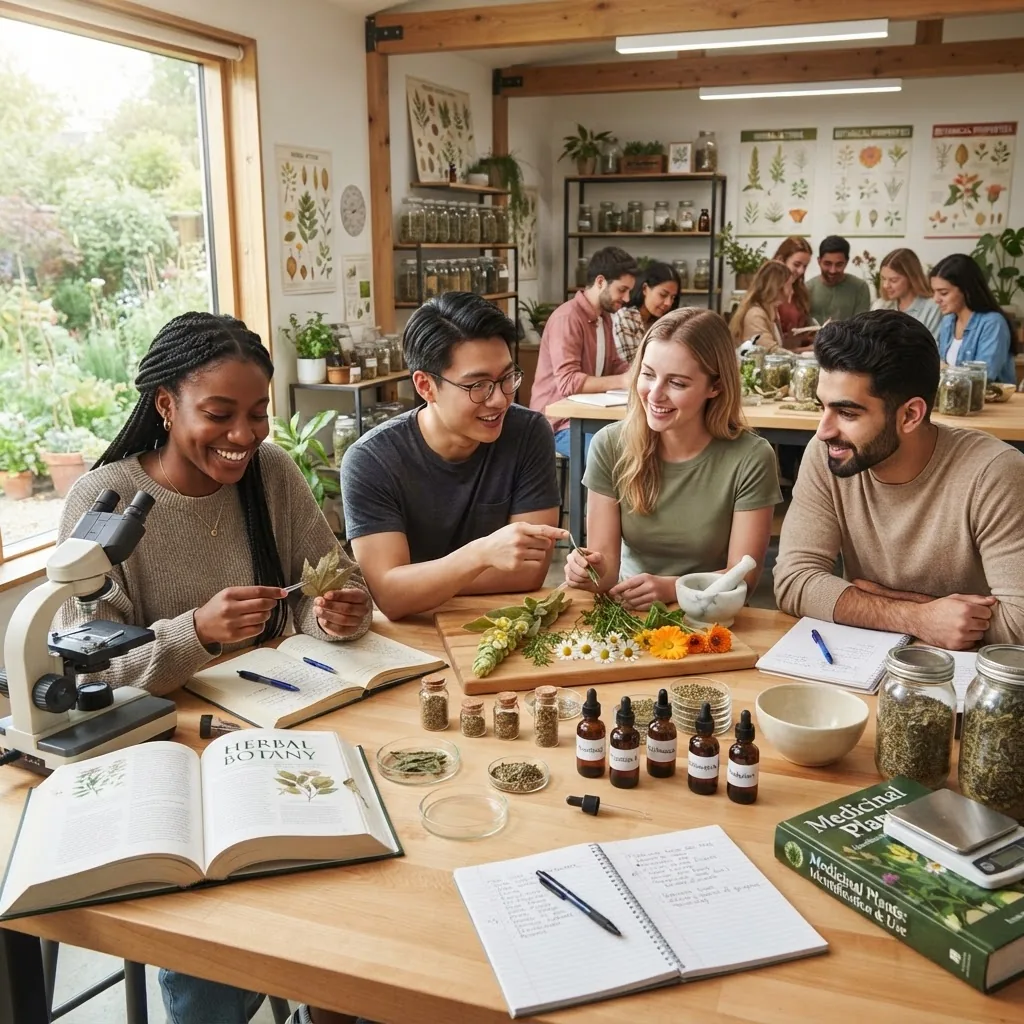
Types of courses (bullet overview):
- Introductory workshops: Short classes on identifying herbs, making teas and salves.
- Certificate programs: Multi-module online or in-person courses covering materia medica, formulations and safety.
- Diploma/Advanced herbalist training: In-depth programs with clinical practicum and study of herbal pharmacology origins.
- Medical herbalism and naturopathy degrees: University-level or accredited naturopathic training integrating herbalism with broader clinical practice.
- Continuing professional education: Specialized modules (e.g., oncology support, pediatrics) for working clinicians.
For scientific training paths, many students combine botanical coursework with formal science training; a recommended resource for deeper scientific instruction is comprehensive botany and herbalism training: botany and herbalism training.
Course-length, cost and credential comparison (table):
| Course Type | Typical Duration | Typical Cost (AUD) | Credential/Outcome |
|---|---|---|---|
| Intro workshop | 1–2 days | $50–$250 | Participation certificate |
| Certificate program | 3–12 months | $500–$3,000 | Certificate |
| Diploma/Advanced | 1–2 years | $3,000–$12,000 | Diploma/Professional Certification |
| Naturopathy degree | 3–4 years | $15,000–$60,000 | Degree/Registration eligible |
Typical curriculum elements across reputable programs:
- Ethnobotany and herbal history modules covering ancient herbal practices and pharmacopeia development.
- Materia medica—detailed study of individual plants, constituents and traditional uses.
- Formulation labs—practical classes making tinctures, salves, decoctions and capsules.
- Herbal pharmacology and evidence appraisal—interpreting trials and safety data.
- Clinical skills and case management—supervised practicum in clinics for advanced students.
- Regulation, manufacturing standards (GMP) and quality assurance content.
Credential pathways and regional notes: Some jurisdictions regulate naturopathy more tightly; for guidance on formal naturopathic training including Canadian programs, see: naturopathy certification programs in Canada.
Clarifying scope: If you plan to practice clinically, check local rules about prescribing and scope; for an overview of how prescribing rights differ, consult: naturopathic prescribing rights.
Practical options nearby and credentials: To find hands-on training: certified herbalism classes nearby. For qualification-focused study: herbalist doctor qualifications.
Transition: With course options defined, the next section explains how herbalism functions today within broader natural medicine systems and practice.
The Role of Herbalism in Contemporary Natural Medicine?
Answer: Herbalism today functions as a core component of naturopathy and integrative medicine, offering botanical dietary supplements and clinical herbal prescriptions that support wellness, symptom management and adjunctive care—guided by evidence-based practice, safety protocols and regulatory frameworks.
Herbalism integrates with naturopathic care by providing plant-based options for prevention and supportive care; practitioners combine clinical assessment, knowledge of herbal pharmacology origins and patient-centered treatment planning.
When discussing supplements within integrative care, see our in-depth resource: Herbal Supplements Guide with Benefits and Natural Medicine Uses.
Herbal supplements and dietary products also occupy commercial and clinical space; a detailed review of regulatory roles and product types is available in this companion piece on botanical dietary supplements: botanical dietary supplements.
Clinical examples and referral integration:
- Primary care collaboration—naturopaths and herbalists often work with conventional providers for chronic conditions, documenting herb–drug interactions and safety.
- Oncology adjuncts—some herbs are used to support patients; see resources on complementary oncology: herbal remedies supporting cancer care.
- Dietary supplements—clinicians rely on evidence-based product selection and quality testing when recommending botanical dietary supplements for micronutrient or phytochemical support: botanical dietary supplements.
- Find certified practitioners—use professional directories to locate regulated clinicians and clinics: find a certified naturopathic doctor.
Regulatory and safety references (authority signal): Government guidance such as the FDA’s resources on dietary supplements and safety monitoring inform clinical teaching and patient counseling; consult the FDA site for regulatory context: U.S. Food & Drug Administration (source type: government agency).
Quality assurance and professional associations (authority signal): Reputable educational programs reference standards from bodies like the American Herbalists Guild; see: American Herbalists Guild (source type: professional association).
Practical patient safety guidance: For herb–drug interactions and clinical decision-making, clinicians use tools such as the Herbal Drug Interaction Checker for risk screening: Herbal Drug Interaction Checker Tool and Usage Guidelines.
Transition: Looking ahead, the final section considers how education and remedy development may change with technology and sustainability challenges.
Future Trends in Herbalism Education and Herbal Remedies?
Answer: Future trends include growth in digital herbal courses, increased integration of phytochemistry and personalized herbal therapy, emphasis on sustainability and ethical sourcing, and expansion of clinical research that may shape certification standards and curricula in herbal medicine education.
Digital learning and micro-credentials: Online modules and short verified credentials allow practitioners to upskill; according to a 2024 industry report, micro-credential uptake in complementary medicine programs rose by double digits (source type: industry report), prompting many institutions to offer hybrid clinical practicums alongside remote theory.
Personalized plant medicine and research: Advances in phytochemistry, metabolomics and personalized health data may lead to tailored herbal protocols taught in advanced courses, linking historical formulations with modern biomarker-informed approaches.
Sustainability and ethical sourcing: Demand for wild-harvested species pressures ecosystems; future curricula will increasingly teach cultivation, conservation strategies and fair-trade sourcing as part of responsible herbal practice.
Regulation and professionalization: Expanded clinical trials and clearer regulatory pathways (government agencies) will influence which herbs are taught for specific indications, and may reshape professional licensing and continuing education requirements.
Transition to action: These trends recommend choosing courses that balance traditional knowledge, scientific literacy and practical supervision to remain current as the field evolves.
Summary: Studying the history of herbalism within a structured course connects ancient practice with modern safety, pharmacology, and clinical application—equipping students to use herbal remedies responsibly within natural medicine.
Final call-to-action: If you want to explore course options or begin structured training, review program comparisons above, consult professional associations and consider an entry-level certificate or a diploma with supervised clinical hours to build competence in both traditional and modern herbal medicine.