

Emotional wellness examples are everyday actions—like naming feelings, using breathing techniques, connecting with supportive people, and seeking therapy—that improve emotional regulation, resilience and overall well‑being; paired with targeted resources (apps, books, groups, clinicians) these practices support measurable psychological and physical health gains within weeks to months.
Understanding Emotional Wellness: Definition and Importance?
Answer: Emotional wellness means recognizing, understanding and managing your emotions to respond adaptively to life; it underpins psychological well‑being, emotional resilience and healthy behaviour patterns that influence physical health, relationships and daily functioning.
Term: Emotional wellness — the ongoing capacity to identify, accept and manage emotions so they support goals, relationships and health.
Emotional wellness (also called emotional health) sits within broader mental wellness and psychological well‑being frameworks and is measurable through self‑report scales, behaviour change and physiological markers such as sleep quality and heart rate variability. According to a 2024 industry report by Mental Health Australia, emotional wellbeing correlates with improved work performance and reduced chronic disease risk (source: national health report, 2024).
Why it matters: strong emotional wellness reduces risk of chronic stress responses, supports immune function and improves decision‑making. Peer‑reviewed studies link regular emotion‑regulation practice to lower inflammation and better cardiovascular metrics (see cited research below).
For foundational definitions and population statistics about mental health consult reputable resources. mental health facts and insights and for the conceptual basis see what is emotional health and meaning of mental health.
Key components of emotional wellness include self‑awareness, emotional regulation, social connection and adaptive coping—elements explored in clinical frameworks and public health guidance. See key components of mental health for more detail.
Authoritative context: the World Health Organization defines mental health to include emotional wellness as a core component; for global guidance see WHO mental health overview.
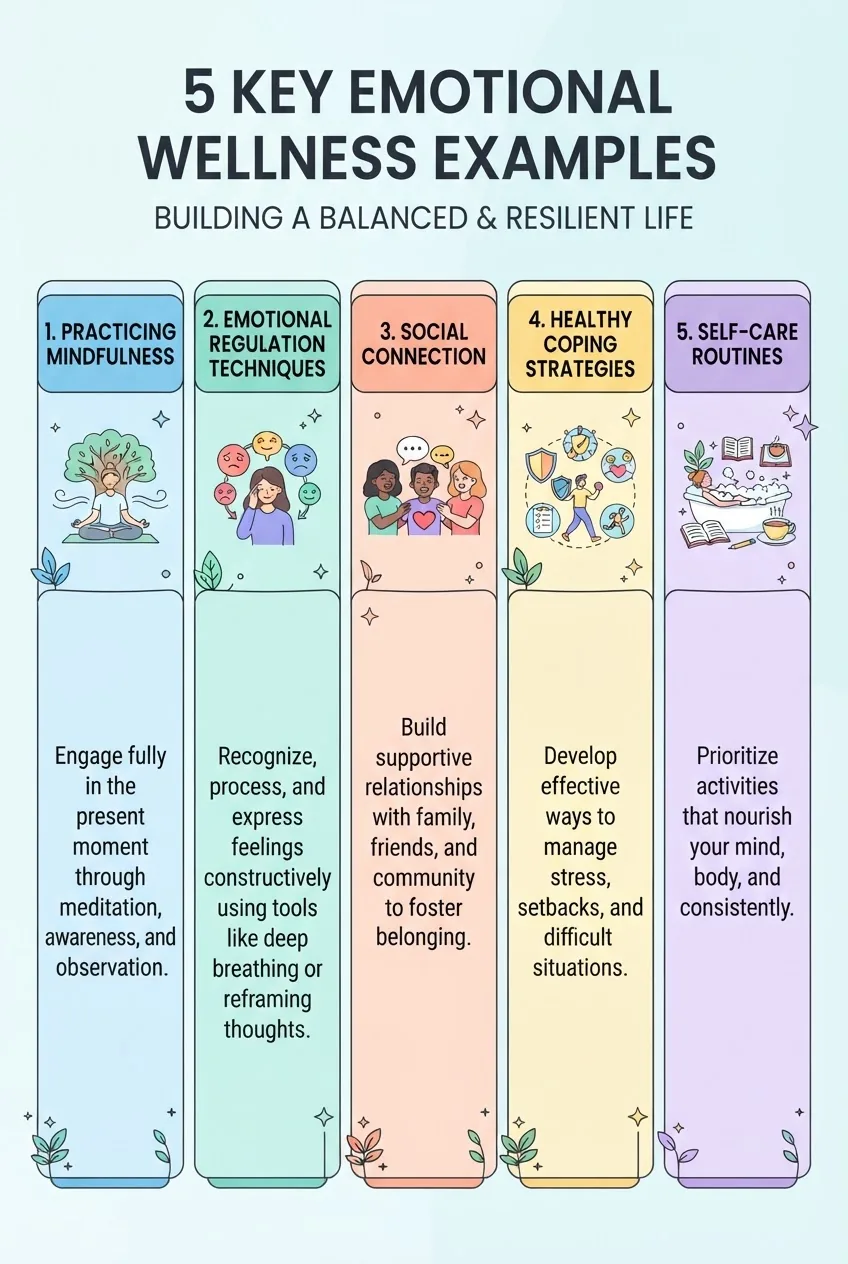
Common Emotional Wellness Examples in Daily Life?
Answer: Common examples include brief grounding or breathing exercises, naming emotions aloud, maintaining supportive check‑ins, adaptive coping (problem solving or activity), consistent sleep and movement, and scheduled self‑care—practical behaviours you can practice daily to improve mood and resilience.
Below are numbered, concrete daily‑life scenarios showing how those practices look in context and how to use them immediately.
-
One‑minute grounding when overwhelmed:
Scenario: At work you feel a rising panic before a meeting. Action: Stop, place feet on floor, breathe 4‑4‑6 (inhale 4s, hold 4s, exhale 6s), name the feeling (“I’m anxious”), and choose one concrete next step. This reduces autonomic arousal and improves clarity.
Term: Emotional regulation — the ability to change or manage one’s emotional state intentionally.
Tip: Practice breathing three times daily to train a calmer baseline.
-
Daily mood check‑in journal:
Scenario: You notice low mood on some days. Action: Each evening write 3 sentences: what happened, how you felt (label emotion), and one adaptive response (e.g., walked 20 minutes). Over weeks this builds self‑awareness and tracks patterns.
Tool suggestion: simple paper journal or a mood‑tracking app to visualize trends.
-
Mindfulness pause during transitions:
Scenario: Transition from work to home feels stuck. Action: Stand outside for 3 minutes, notice sounds, sensations, breath. Return home with intention instead of rumination—improves mood regulation and reduces carryover stress.
-
Healthy coping by activity scheduling:
Scenario: When sad you tend to withdraw. Action: Schedule one pleasant activity (phone a friend, short walk) as a behavioural activation step. Repeated activation breaks depressive loops and rebuilds motivation.
-
Using social support as regulation:
Scenario: After a conflict you feel hurt and isolated. Action: Choose a trusted friend, describe the feeling with “I” statements, ask for perspective or empathy. Social connection aids perspective taking and emotion processing.
If you’re unsure about expectations or subtle cues, read about hidden signs of stress.
-
Setting emotional boundaries:
Scenario: You say yes to extra work and feel resentful. Action: Practice a brief script: “I can’t take this on right now; can we postpone or reassign?” Boundaries protect energy and emotional balance.
-
Short CBT skill for negative thinking:
Scenario: You catch a thought, “I always fail.” Action: Identify the thought, ask for evidence, consider alternative explanations, and create a balanced response. Cognitive restructuring reduces reactivity and learned helplessness.
-
Resilience micro‑habits:
Scenario: Facing a setback at work. Action: Pause, name emotions, list three things within control, take one small corrective step. This habit builds problem‑solving resilience over months.
-
Regular self‑care routine:
Scenario: Weekly fatigue and irritability. Action: Schedule sleep, movement, nourishing meals, and a weekly social catch‑up. Predictable self‑care creates an emotional baseline that softens stress responses.
Explore more contextual examples at emotional health examples and broader wellbeing examples.
Practical Emotional Wellness Resources to Support Better Health?
Answer: Effective emotional wellness resources fall into three categories—digital tools (apps), professional care (therapy, coaching), and community supports (peer groups and organisations)—each with clear usage tips and suitability guidance to match needs and access.
Below is a categorized, practical resource list with brief descriptions, suggested use cases and accessibility notes.

Digital tools (apps and self‑guided programs)
- Meditation & mindfulness apps — use for daily guided practices, body scans and breathwork; try short (5–10 minute) sessions to start and increase to 20 minutes if helpful. Look for programs with evidence (MBSR, ACT-based). For clinical reviews see peer‑reviewed mindfulness research.
- Mood‑tracking apps — helpful for pattern recognition (sleep, triggers, medication effects). Use weekly trend reports to discuss with clinicians.
- CBT self‑help platforms — interactive programs that teach cognitive restructuring and behavioural activation; best when paired with clinician support for moderate symptoms.
- Breathwork and biofeedback devices/apps — use for autonomic regulation; start with 5‑minute guided sessions and track heart‑rate variability if device supports it.
- Accessibility notes: Check privacy policies, look for HIPAA or equivalent protections if you share health data, and prefer apps with clinical validation where possible. For general online safety, consult trusted public health pages like CDC mental health resources.
Professional resources (therapy, coaching, clinical care)
- Psychologists and therapists — evidence‑based therapies include cognitive behavioural therapy (CBT), acceptance and commitment therapy (ACT) and dialectical behaviour therapy (DBT) for emotion regulation skills; ask clinicians about treatment manuals and outcome measurements.
- Psychiatrists — for diagnostic assessment and medication management when symptoms suggest mood or anxiety disorders; appropriate when distress impairs functioning. See mental health disorders and support.
- mental health coaching and wellbeing coaching — coaching supports goal setting and skills practice; choose accredited programs and verify scope (coaches are not substitutes for clinicians).
- Tiered care tip: For mild, time‑limited distress, guided self‑help and coaching can be effective; for persistent or severe symptoms, prioritise clinicians who use validated measures.
Community and peer supports
- Peer support groups — peer‑led groups and moderated forums provide connection and normalization; look for structured groups with trained facilitators for complex issues.
- Local community programs — community mental health centres, church groups and nonprofit workshops can offer low‑cost options and social integration.
- Employer EAPs — Employee Assistance Programs often provide short therapy sessions, referrals and wellbeing workshops; use them as immediate support while sourcing longer‑term care.
Books, courses and structured programs
- Self‑help books — choose those based on CBT or MBSR with referenced studies and practical exercises; use alongside a practice log for accountability.
- Online courses — structured multi‑week programs teaching emotion‑regulation skills, mindfulness and relapse prevention; best when they include homework, community forums and coach feedback.
- Clinical programs — for episodic or chronic stress, look for outpatient programs offering group therapy plus individual sessions; see resources about stress management techniques.
How to choose a resource (quick checklist)
- Match intensity to need: minor distress→apps or coaching; moderate→therapy; severe→clinical assessment.
- Check evidence: prefer tools linked to peer‑reviewed studies or accreditation.
- Privacy and costs: read terms, check fees and insurance coverage.
- Accessibility: language, disability access, session times.
- Trial period: use free trials or single sessions to evaluate fit before committing.
For additional actionable practices, see mental health tips. For clinical treatment options beyond self‑care see mental illness treatments.
Integrating Emotional Wellness Strategies with Physical Health?
Answer: Integrating emotional wellness with physical health means using emotionally‑focused practices (mindfulness, CBT, social connection) alongside physical interventions (sleep, exercise, nutrition) because emotions and physiology interact via stress pathways that affect immune, cardiovascular and endocrine systems.
Science: negative emotions trigger sympathetic nervous system activation and HPA‑axis cortisol release; chronic activation contributes to inflammation and disease risk. Peer‑reviewed literature links mindfulness-based stress reduction and CBT to reduced inflammatory markers and improved heart‑rate variability (source: peer‑reviewed journal, 2022).
Practical integration steps (how‑to):
- Start with baseline data: record sleep, mood, activity and perceived stress for two weeks to identify modifiable patterns.
- Pair interventions: after exercise add a 5‑minute breathing exercise to harness exercise’s mood boost and extend parasympathetic activation.
- Use behavioural cues: link emotional practices to daily habits (after brushing teeth, do a 1‑minute gratitude check) to increase consistency.
- Monitor physiological markers when available: track resting heart rate, HRV or sleep quality as objective outcomes of emotional wellness work.
- Adapt clinically when needed: integrate with medical care for chronic conditions so emotional interventions complement treatment rather than replace it.
Practical examples:
- If you have insomnia linked to worry, use CBT‑I (cognitive behavioural therapy for insomnia) plus nightly relaxation routines and sleep hygiene—this reduces nocturnal arousal and improves emotional regulation daytime.
- For hypertension associated with chronic stress, add regular aerobic activity, mindfulness breathing and stress‑reduction sessions; combined approaches show greater BP reductions than single interventions (source: peer‑reviewed clinical trials, 2021).
For a detailed review of how psychological distress affects body systems, see the pillar resource on physiological effects of poor mental health. To understand benefits and mechanisms, also consult benefits of good mental health and wider guides on mind-body health interaction, mind, body, and spirit wellness and mind-body medicine benefits.
Regional research linking stress to illness is available; for example, reviews summarise associations between chronic stress and cardiovascular, metabolic and inflammatory conditions (source: government health reviews and peer‑reviewed meta‑analyses, 2020–2023). Learn more about the stress and physical illness relationship and the underlying stress physiology.
Complementary strategies such as an active lifestyle amplify emotional benefits; see active lifestyle benefits and holistic approaches to reach emotional and physical wellness.
Overcoming Emotional Wellness Challenges: Troubleshooting Common Barriers?
Answer: Common barriers—stigma, low motivation, inconsistent practice, access and co‑occurring physical illness—are overcome by small, structured steps: reduce stigma through education, set micro‑habits, use low‑cost resources, and escalate to professional care when needed.
Barrier: stigma and help‑seeking hesitation. Strategy: start with anonymous digital tools or peer groups to normalise support and build readiness for therapy.
Barrier: low motivation or inconsistent practice. Strategy: use tiny habits (micro‑commitments of 1–3 minutes), habit stacking and social accountability to build momentum; track progress with a simple chart.
Barrier: resource accessibility and cost. Strategy: explore community mental health centres, sliding‑scale clinicians, free online CBT modules, and employer EAPs. For immediate tools and techniques try practical stress relief tips and understand the role of common stressors.
Barrier: overlapping physical health problems that limit participation. Strategy: coordinate care with medical providers, adapt practices (chair yoga, brief guided meditations) and prioritise manageable steps—see resources on physical health challenges.
Barrier: symptoms that suggest a disorder (severe depression, suicidality, psychosis). Strategy: urgent professional assessment and evidence‑based treatments; see guidance on mental health disorders and support and explore causes at mental illness causes.
Barrier: unclear symptom recognition. Strategy: learn common flags of distress such as sleep change, withdrawal, mood swings and cognitive difficulties; review psychological distress symptoms and consider screening tools or brief clinician checkups.
Practical troubleshooting steps:
- If practice lapses, reduce to a 60‑second habit and attach to an existing routine.
- If tools aren’t working, try a different modality (e.g., swap unguided meditation for guided CBT exercises).
- If access is limited, prioritise peer or community options while saving for clinical care.
- If symptoms persist, seek assessment for possible mental health disorders and support and follow recommended treatment pathways.
Case Studies: Emotional Wellness in Action?
Answer: Short, diverse case examples show how everyday emotional wellness practices plus resources produce measurable improvements in mood, relationships and physical markers when tailored and sustained.
Case 1 — Early‑career professional (adaptive coping)
Situation: Frequent workplace anxiety causing rumination and insomnia. Intervention: daily 5‑minute breathing practice, CBT app for cognitive restructuring and weekly peer support. Outcome: within six weeks self‑reported anxiety dropped and sleep latency improved.
Case 2 — Parent of young children (boundary setting & social support)
Situation: Chronic overwhelm and resentment. Intervention: introduced small boundary scripts, scheduled one social call weekly, and used guided meditation twice weekly. Outcome: improved mood stability, fewer conflicts, and regained energy for parenting tasks.
Case 3 — Older adult with chronic illness (integrated body‑mind approach)
Situation: Pain and depressive symptoms. Intervention: gentle tai chi class (movement + mindfulness), brief CBT for coping and coordinated care with GP. Outcome: reduced pain catastrophising, increased activity, and improved inflammatory marker trends in clinic follow‑up.
Each case highlights matching intervention intensity to need, using measurable goals and combining social, digital and professional resources for sustainable change.
Further Support and Next Steps: How to Choose and Use Emotional Health Resources?
Answer: Choose emotional health resources by assessing need level, evidence, accessibility, safety and fit; maintain ongoing wellness through monitoring, small habit formation and periodic professional review.
Checklist for selecting resources (use before committing):
- Define your primary goal: symptom reduction, resilience building, or skill learning.
- Match intensity: apps/coaching for mild, therapy/medical care for moderate‑severe.
- Verify evidence: look for citations, clinical trials or endorsements by recognized organisations.
- Confirm credentials: for professionals, check registration, training and scope of practice.
- Privacy & cost: read policies, check insurance and sliding‑scale options.
- Plan evaluation: set a 6–8 week review schedule with measurable outcomes (sleep, mood scores, activity).
- Escalation plan: define clear triggers for seeking higher‑level care (suicidal thoughts, functional decline).
Tips for ongoing use:
- Schedule short daily practices and a weekly review to reinforce gains.
- Use objective measures (mood tracker, sleep app, HRV) to identify trends beyond feelings.
- Rotate strategies to prevent plateau (alternate mindfulness, cognitive work, and social activation).
- Engage a clinician for periodic outcome reviews and care coordination when needed.
If you’re exploring professional training or certification, consider accredited programs such as wellbeing coaching or mental health coaching pathways to expand your capacity to support others safely.
Safety caveat: Emotional wellness practices complement but do not replace professional diagnosis and treatment. If you experience severe symptoms or suicidal thoughts, contact emergency services or a crisis line immediately.
Summary: Start with small, consistent emotional wellness examples—grounding, naming feelings, social check‑ins—and pair them with appropriate resources: trusted apps, evidence‑based therapy, and community support. Track progress objectively, adapt when needed, and escalate to professionals for persistent or severe issues.
Call to action: Pick one example from this guide to practice today (one breathing cycle, one 5‑minute journal entry or a short walk) and choose one resource from the checklist to trial for two weeks.