

Common stressors are external events or internal demands that challenge a person’s ability to adapt; they include psychological triggers, physical threats, and social pressures that can produce short-term alarms or long-term strain and directly influence mental and physical health.
Understanding Stressors: Definition and Psychological Meaning?
Answer: In psychology, stressors are identifiable stimuli or situations that tax a person’s coping resources; they range from acute external events to persistent internal pressures and are defined by their context, timing, and perceived threat to well-being.
Stressors: in psychology, an identifiable internal or external stimulus that provokes a stress response, varying by intensity, duration and personal meaning.

Psychologists treat stressors as part of a broader stress context: an interaction between the person and environment where demands exceed perceived resources. Stressor meaning in psychology depends on appraisal (how someone interprets an event) and coping capacity (skills, support, prior experience).
Key psychological concepts that shape the meaning of stressors:
- Primary appraisal: immediate evaluation of whether an event is a threat, challenge or benign.
- Secondary appraisal: assessment of available coping resources and options.
- Perceived controllability: whether a person believes they can influence or change the stressor.
- Allostatic load: cumulative wear on the body from repeated stress responses.
When a situation is appraised as threatening and resources are judged insufficient, the stimulus functions as a stressor and triggers cognitive, emotional and physiological responses. This psychological framing explains why the same event is stressful for one person but not another.
For current prevalence and contextual data about mental health that support these definitions, see mental health insights and statistics and for definitions that ground emotional meaning, see meaning and role of mental health.
Brief case example: A mid-career nurse faces increased workload (objective demand) and worries about infection risk (perceived threat). If their appraisal is “I can’t cope” and organisational support is low, routine shift changes become recurring stressors leading to sustained activation of stress pathways.
Transition: Knowing what stressors are and how psychology defines them helps when we group them into categories to see patterns and real-world examples.
Categories of Common Stressors: Psychological, Physical, and Social?
Answer: Common stressors fall into psychological, physical and social categories—each with distinct mechanisms and examples—plus environmental and occupational subtypes that often overlap.
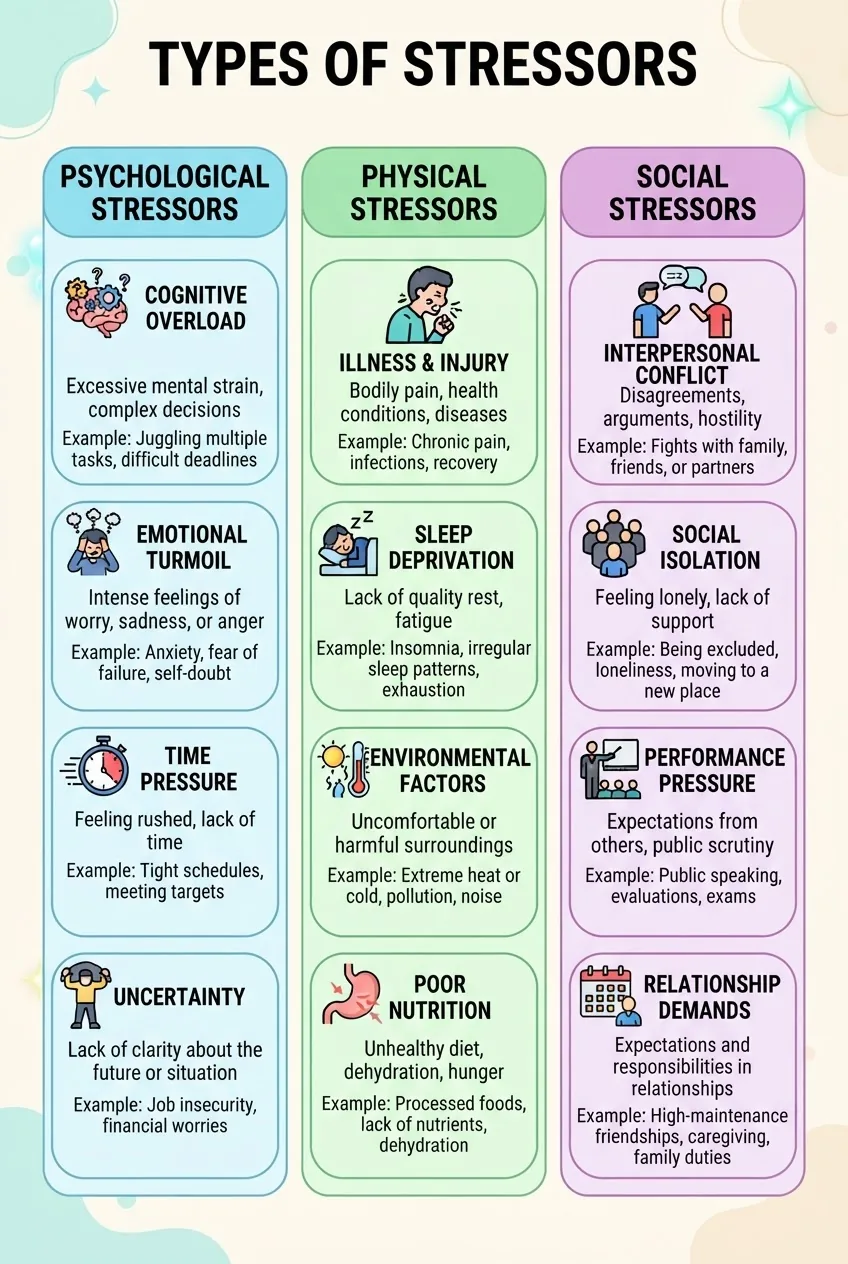
Below are systematic categories with concise psychological and practical examples to show how stressors appear in everyday life. Where relevant, psychosocial stressors (stress arising from social factors such as relationships and social status) are defined on first use.
-
Psychological stressors — internal or cognitive demands such as worry, perceived failure, perfectionism, anticipatory anxiety.
- Examples: high self-expectations, rumination about past mistakes, intrusive thoughts about future risks.
- Why they matter: they alter appraisal and can sustain HPA axis activity through persistent worry.
-
Physical stressors — direct physical challenges or bodily threats such as pain, injury, sleep deprivation, extreme temperatures, infection.
- Examples: chronic pain conditions, sleep loss from shift work, acute injury, prolonged exposure to loud noise.
- Why they matter: they activate neural and endocrine responses and increase inflammatory signalling.
-
Psychosocial stressors — social or interpersonal pressures that combine psychological appraisal and social context; first use defined here: Psychosocial stressors: stressors arising from relationships, role demands, social status or community context.
- Examples: workplace bullying, social isolation, caregiving burden, discrimination.
- Why they matter: they often reduce perceived social support, which moderates biological stress responses.
- See emotional support options: emotional wellness resources.
-
Environmental stressors — external physical or built-environment features that impair comfort or safety.
- Examples: overcrowded housing, unsafe neighbourhoods, pollution, extreme weather events.
- Why they matter: they create chronic background strain and amplify other stressors.
-
Occupational and work-related stressors — job demands, role conflict, job insecurity, shift work, performance pressure.
- Examples: excessive workload, unclear expectations, long hours, precarious employment.
- Why they matter: jobs combine psychosocial, temporal and physical elements that can be chronic.
These categories often overlap: caregiving (psychosocial) can involve physical strain (lifting, sleep loss) and psychological strain (worry, guilt). Mapping stressors across categories clarifies intervention targets and helps prioritise support.
Transition: With categories in place, we can examine how these stressors show up in different everyday contexts—home, workplace and social life—using concrete examples.
Examples of Common Stressors in Daily Life?
Answer: Daily stressors include financial pressure, relationship conflict, heavy workloads, health worries and logistical hassles that repeatedly challenge coping and can compound into larger problems when persistent.

Below are specific, varied real-life examples grouped by context (home, work, social) to show typical sources of strain and how they mix psychological and physical elements.
Home and family context
- Financial stress: mounting bills, unexpected medical costs, or housing insecurity—creates ongoing anticipatory worry and concrete resource constraints.
- Caregiving demands: looking after an ill relative can cause sleep disruption, physical exhaustion and feelings of helplessness.
- Parenting pressures: balancing child care, school logistics and discipline leads to time scarcity and guilt-driven cognitive strain.
- Domestic conflict: repeated arguments or divorce proceedings act as psychosocial stressors that undermine perceived safety at home.
Work and school context
- High workload and tight deadlines: episodic peaks can trigger acute stress responses; constant overload becomes chronic.
- Job insecurity and performance evaluation: uncertainty about employment status elevates chronic worry and rumination.
- Shift work and irregular schedules: disrupt circadian rhythms, compromise sleep and increase vulnerability to infection and metabolic change.
- Bullying or harassment: sustained interpersonal threat with strong mental and physiological consequences.
Social and community context
- Loneliness and social isolation: lack of supportive ties is a psychosocial stressor that lowers resilience and increases inflammatory markers.
- Discrimination and minority stress: repeated exposure to prejudice creates chronic psychosocial strain with measurable health impacts.
- Care responsibilities in community roles: volunteering combined with personal demands can tip into overload.
Health and bodily context
- Chronic illness management: ongoing symptoms and treatment complexity are continuous physical stressors.
- Acute medical events: sudden diagnosis or injury produces an intense, immediate stress response.
- Sleep deprivation and poor nutrition: everyday neglect of restorative behaviours amplifies sensitivity to other stressors.
Hypothetical case: Sarah, a single parent working night shifts, faces financial strain, sleep deprivation, and limited childcare. Each of these is a stressor—together they compound, producing greater allostatic load than any single factor.
Transition: The real-world examples show how stressors trigger biological pathways that affect both body and mind; the next section explains those mechanisms and the health consequences in depth.
How Stressors Impact Physical and Mental Health?
Answer: Stressors activate neural and hormonal systems (sympathetic nervous system, HPA axis), raise inflammation and alter behaviour, which together increase risk for mental disorders and stress-related illnesses.
Physiological stress response: a coordinated set of neural and endocrine reactions—fast sympathetic activation and slower hypothalamic–pituitary–adrenal (HPA) axis signalling—designed to mobilise energy for immediate threat.
Walkthrough: Perceived threat → amygdala signals hypothalamus → sympathetic nervous system releases adrenaline (fast) → hypothalamus releases CRH triggering ACTH and cortisol release from adrenal cortex (slow) → systemic metabolic, immune and cardiovascular effects.
Biological mechanisms explained:
- Sympathetic-adrenal-medullary (SAM) axis: immediate release of adrenaline/noradrenaline increases heart rate, blood pressure and glucose availability.
- HPA axis: hypothalamus–pituitary–adrenal signalling elevates cortisol, adjusting metabolism and immune activity over minutes to hours.
- Inflammatory pathways: repeated activation increases pro-inflammatory cytokines (e.g., IL-6, TNF-α), linking stress to chronic disease.
- Autonomic imbalance: chronic stress reduces heart rate variability and parasympathetic tone, increasing cardiovascular risk.
- Behavioural mediators: stress often changes sleep, diet, activity and substance use, which magnify physiological effects.
Evidence and authoritative context: According to a 2023 WHO report on mental health and chronic disease, prolonged psychosocial stress contributes to elevated risk of cardiovascular disease and depressive disorders (WHO report, 2023) — see external source below for details.
Peer-reviewed synthesis: A 2021 meta-analysis of prospective studies (peer-reviewed, PubMed-indexed) found that chronic psychological stress and job strain were associated with a 1.2–1.5x higher risk of coronary heart disease, mediated by inflammation and behavioural change (source: PubMed meta-analysis, 2021).
Mental health outcomes:
- Acute stressors can precipitate panic attacks, acute anxiety and transient mood changes.
- Repeated or chronic stressors increase risk for major depressive disorder, generalized anxiety disorder, PTSD and burnout.
- Stress exposure can impair cognitive function (memory, attention), especially under sleep loss and sustained cortisol elevation.
Physical health outcomes:
- Cardiometabolic: higher blood pressure, dysregulated glucose metabolism, increased risk of type 2 diabetes and coronary disease.
- Immune function: acute stress transiently mobilises immune cells; chronic stress dysregulates immunity, reducing vaccine responses and increasing infection susceptibility.
- Gastrointestinal: stress affects gut motility and microbiota, contributing to IBS and functional disorders.
- Musculoskeletal: stress-related muscle tension increases risk of chronic pain and tension headaches.
Stress and immune system connection: acute stress temporarily enhances certain immune functions to prepare for injury; chronic stress elevates cortisol and pro-inflammatory markers while impairing adaptive immune responses. For clinical implications of these pathways, see physiological effects of poor mental health and consult authoritative summaries such as American Psychological Association resources on stress.
Hidden or unrecognised impacts: Many people experience gradual declines in health without clear attribution to stress. To learn more about subtle presentations, see hidden signs of stress.
Protective and moderating factors: social support, adaptive coping, physical activity and secure employment moderate stress effects. For evidence on protective influences, see factors influencing good mental health, and for the physiological perspective see physiological health and stress response.
Limitations and variation: individual responses vary by genetics, developmental history and concurrent health conditions; research continues to refine causal pathways. According to a 2024 industry report on workplace mental health (industry report, 2024), interventions that reduce exposure to workplace stressors deliver measurable improvements in absenteeism and health claims.
Transition: To clarify how timing and duration shape outcomes, the next section compares acute versus chronic stressors and their specific health implications.
Acute vs Chronic Stressors: Differences and Health Implications?
Answer: Acute stressors are short-lived events that trigger brief physiological activation; chronic stressors persist or recur over months to years and cause sustained biological wear (allostatic load) with greater long-term health risk.
Key distinctions: duration, predictability, controllability and recovery time determine whether a stressor is acute, episodic or chronic. Episodic stress (repeated acute events) sits between single acute incidents and persistent chronic strain.
| Feature | Acute stressor | Chronic stressor |
|---|---|---|
| Duration | Minutes to days | Weeks to years |
| Physiological profile | Rapid sympathetic activation; transient cortisol rise | Sustained HPA activation, persistent inflammation |
| Health implications | Transient anxiety, temporary cardiovascular strain | Elevated risk for chronic disease, depression, immune dysregulation |
| Recovery | Fast recovery if no repetition | Slow or incomplete recovery, cumulative burden |
Episodic stress: repeated acute events (e.g., frequent performance crises) which can act like chronic stress due to insufficient recovery. For practical approaches to episodic patterns, see episodic stress and management.
Trade-offs and nuances:
- Short-term stress enhances focus and performance for many tasks (adaptive).
- Chronic activation impairs immunity, increases metabolic risk and predisposes to mood disorders (maladaptive).
- Individual resilience, recovery practices and social support determine whether a stressor transitions from acute to chronic impact.
Transition: Reducing the health impacts of stressors involves identifying exposure patterns and using targeted coping strategies—below is a concise overview linking to more detailed sibling resources.
Identifying and Managing Exposure to Common Stressors (brief overview)?
Answer: Identify stressor frequency, duration and controllability; manage exposure by modifying demands, enhancing resources and using targeted coping strategies—see sibling guides for detailed symptom recognition and relief.
- Map stressors: list daily demands, note timing, duration and personal appraisal; mark which are controllable versus unavoidable.
- Prioritise changeable stressors: reduce workload, renegotiate role expectations, or adjust environment where possible.
- Enhance resources: build social support, access practical help, improve sleep and nutrition to increase coping capacity.
- Use brief behavioural tactics: time blocking, boundary setting, micro-breaks and task delegation to lower immediate burden.
- When to seek help: if stressors are persistent and undermine daily function, consult health professionals for assessment and care.
For readers seeking detailed guidance on signs and practical relief, consult sibling resources on symptoms and structured relief strategies: symptoms and relief tips for stress and for emotional-wellness approaches see emotional health improvement tips.
Practical short checklist to reduce exposure (brief):
- Identify the top three recurrent stressors this week.
- Assess controllability: can you change the demand, your response, or the environment?
- Apply one small modification (delegate, delay, decline) and observe effects for one week.
- Reassess and scale successful changes.
Transition: The final section summarises the core points and offers quick takeaways to apply immediately.
Summary and Key Takeaways on Common Stressors and Health?
Answer: Common stressors span psychological, physical and social domains; their health impact depends on duration, appraisal and recovery—reducing exposure and strengthening resources lowers long-term risk.
Key takeaways:
- Definition: Stressors are stimuli or demands that prompt a stress response based on appraisal and coping resources.
- Categories: psychological, physical, psychosocial, environmental and occupational stressors often overlap.
- Examples: financial strain, caregiving, workload, isolation, sleep loss and acute injury illustrate typical stressors in life.
- Mechanisms: SAM and HPA activation, inflammation, autonomic imbalance and behavioural changes link stressors to disease.
- Timing matters: acute stress can be adaptive; chronic stress causes allostatic load and increases chronic disease risk.
- Action: map stressors, prioritise modifiable exposures and strengthen supports; consult detailed guides for symptom recognition and relief.
For a deeper clinical and physiological perspective, consult professional resources such as the American Psychological Association (APA) and the World Health Organization (WHO), and consider evidence summaries in medical literature (peer-reviewed meta-analyses). WHO fact sheets on mental health and chronic disease PubMed meta-analyses on stress and disease.
Final CTA: Use the quick checklist above, map your primary stressors this week, and if persistent health changes occur, seek professional assessment. Protecting resilience now lowers long-term risk and supports well‑being.