

Physical health and mental health are tightly linked: regular physical activity is associated with roughly a 25% lower incidence of depression in large population studies. According to a 2023 meta-analysis of cohort studies, the protective effect begins at 90–150 minutes of moderate activity per week and improves with consistent adherence.
This data-led report explains how and why physical activity improves mood, reduces anxiety, and enhances cognition, using physiological mechanisms, quantified findings, and practical, evidence-informed steps you can apply this week.
Understanding the Relationship Between Physical Health and Mental Health
The mind-body connection operates on bidirectional pathways: physical states influence brain chemistry and neural structure, while mental states shape immune, endocrine and cardiovascular function. We summarise the mechanistic links that translate movement into measurable mental-health outcomes and reference pathways where poor mental health can degrade physical systems.
At a systems level, three physiological channels mediate the relationship between physical fitness and psychological well‑being:
- Neurochemical modulation — exercise alters neurotransmitter availability and receptor sensitivity (serotonin, dopamine, endocannabinoids, and endorphins), supporting mood regulation.
- Stress-axis regulation — regular activity downregulates baseline cortisol secretion and improves cortisol reactivity to acute stressors, lowering chronic allostatic load.
- Neuroplasticity and vascular improvements — increased brain-derived neurotrophic factor (BDNF) and cerebral blood flow support memory, attention and executive function.
Physically, improved cardiovascular fitness, muscular strength and sleep quality reduce somatic contributors to low mood (fatigue, pain, metabolic dysregulation). Psychologically, movement reinforces mastery, agency, routine and social contact—core components of emotional resilience.
For a deeper exploration of how mental ill-health manifests physically and care pathways, see physiological effects of poor mental health.
Key takeaway: The relationship is bidirectional and mechanistic—exercise changes chemistry, hormones and brain structure in ways that decrease disorder risk and improve day-to-day mood.
Transitioning to the evidence on specific biological mechanisms helps explain why different activity types and doses produce differential mental effects.
How Physical Activity Positively Impacts Mental Health
Physical activity improves mood and cognition through measurable biochemical and structural changes in the brain and body. Below we quantify mechanisms, cite effect ranges, and link to authoritative resources for guidelines.
Neurotransmitters and endorphins. Movement increases synaptic release and turnover of serotonin and dopamine; aerobic exercise triggers endorphin and endocannabinoid surges that correlate with acute improvements in mood and reduced pain sensitivity. According to a 2022 review in a peer-reviewed journal, single bouts of moderate aerobic exercise raise circulating endorphin-like compounds by 10–30% on average (source type: peer-reviewed review).
Stress hormones (cortisol). Chronic activity patterns lower basal cortisol by approximately 5–15% in sedentary adults who adopt regular exercise for 12 weeks, improving cortisol reactivity to psychological stressors (According to a 2021 clinical meta-analysis).
Brain plasticity and cognition. Repeated aerobic and resistance training increases BDNF levels by ~20–30% and is linked with 10–20% improvements on standardized memory and executive function tests in older adults after 6 months (According to a 2020 systematic review).
- ~25% lower incidence of depressive episodes associated with regular exercise (According to a 2023 meta-analysis of cohort studies).
- Acute mood lift after 20–30 minutes of moderate aerobic exercise in 60–80% of participants (According to randomized controlled trials summarized in a 2022 review).
- 12-week programs (3 sessions/week) yield measurable reductions in anxiety scores of 10–30% vs baseline (According to clinical trial meta-analyses, 2019–2022).
How these mechanisms translate into symptoms:
- Mood regulation: increased serotonin and endorphins create immediate mood elevation and reduced negative affect.
- Anxiety reduction: improved heart-rate variability and lower cortisol responsiveness reduce physiological arousal linked to anxiety.
- Cognitive benefits: BDNF-driven plasticity supports learning, attentional control and working memory.
Clinical and population data converge: both acute and chronic exercise programs produce measurable mental‑health gains. The next table compares typical effect sizes and recommended minimal doses for common outcomes.
| Outcome | Typical effect | Minimum weekly dose | Mechanism |
|---|---|---|---|
| Depression risk reduction | ~25% lower incidence (relative) | 90–150 min moderate activity | Serotonin, BDNF, social/behavioural |
| Acute mood improvement | Positive change in 60–80% cases | 20–30 min session | Endorphins, endocannabinoids |
| Anxiety symptom reduction | 10–30% score reduction | 3×/week, 8–12 weeks | Cortisol regulation, HRV improvements |
| Cognitive gains (older adults) | 10–20% test improvement | ≥150 min/wk or combined training | BDNF, vascular perfusion |
Clinical citations and guidelines: For exercise guidelines and mental health policy context see the World Health Organization (global activity guidelines) and the National Institute of Mental Health (treatment frameworks). We cross-referenced synthesis reviews in Neuroscience & Biobehavioral Reviews when assessing mechanistic claims.
World Health Organization resources — general activity guidelines (external).
National Institute of Mental Health — mental health frameworks (external).
Neuroscience & Biobehavioral Reviews — peer-reviewed synthesis (external).
See our treatment and symptom resource on stress relief through exercise for applied tactics to use after workouts.
Exercise can reduce subtle physiological stress; learn to identify these signs in recognizing hidden stress symptoms.
Identify which life triggers respond best to movement by reviewing common stressors affecting mental wellness.
Key takeaway: Biochemistry (neurotransmitters, endorphins, cortisol), neural plasticity (BDNF), and behavioral mechanisms together produce measurable improvements in mood, anxiety and cognition—effects that scale with frequency and consistency.
Next, we quantify how different exercise forms map to specific mental benefits.
Types of Physical Exercises and Their Specific Mental Health Benefits
Different modalities produce overlapping but distinct mental-health outcomes. Below we list common exercise types, how they influence brain and mood systems, and practical prescription ranges.
-
Aerobic exercise (running, brisk walking, cycling)
Description: Sustained rhythmic activity that elevates heart rate to 60–80% of maximum for extended periods.
Specific benefits: Acute endorphin and endocannabinoid release (mood lift within 20–30 minutes); consistent aerobic training increases BDNF and reduces depressive symptoms by 20–30% over 8–12 weeks.
Practical prescription: 150 minutes moderate-intensity or 75 minutes vigorous weekly; sessions of 20–45 minutes, 3–5×/week.
-
Strength training (resistance, weightlifting)
Description: Progressive overload activities using bodyweight, bands or weights.
Specific benefits: Reduces symptoms of anxiety and depression by 15–25% in controlled trials; enhances self-efficacy and sleep quality; raises growth factors that support cognition when combined with aerobic work.
Practical prescription: 2–3 sessions/week, 20–50 minutes, multi-joint movements, progressive increases in resistance.
-
High-intensity interval training (HIIT)
Description: Short bursts of near-maximal effort with recovery periods.
Specific benefits: Strong acute endorphin and catecholamine surges; efficient for time-constrained individuals; mixed evidence for sustained mood gains—benefits often align with improved fitness and time efficiency.
Practical prescription: 10–20 minutes/session, 2–3×/week; ensure adequate recovery to avoid overtraining stress.
-
Mindful movement (yoga, tai chi, qigong)
Description: Low-to-moderate intensity practices integrating breath, balance and focused attention.
Specific benefits: Consistent reductions in anxiety (15–30% in meta-analyses) and improved emotional regulation through vagal activation and attention training; effective for stress resilience.
Practical prescription: 2–5 sessions/week, 20–60 minutes; combine with breathwork and short meditations for additive benefit.
-
Combined programs (aerobic + strength + mobility)
Description: Multi-component training that targets cardiovascular, musculoskeletal and flexibility systems.
Specific benefits: Largest, most consistent cognitive and mood improvements across age groups; synergistic BDNF and muscular-strength effects support functional independence and wellbeing.
Practical prescription: 3–5 sessions/week mixing modalities; total weekly volume aligned with WHO guidelines.
-
Outdoor and social activities (walking groups, team sports)
Description: Activities that add social contact and natural environments.
Specific benefits: Social support and green-space exposure amplify mood benefits; reductions in rumination and loneliness documented in cohort studies.
Practical prescription: Aim for at least one social/outdoor session weekly; coupled with personal sessions for best outcomes.
Step-by-step example: a beginner-friendly session targeting anxiety and mood.
- Warm-up 5 minutes: brisk walk and dynamic stretches.
- Main set 20 minutes: moderate-intensity jog or bike keeping perceived exertion 5–6/10.
- Strength circuit 10 minutes: 3 exercises (squats, push-ups on knees, seated rows with band) 2 rounds, 8–12 reps.
- Cool-down 5 minutes: slow walk + diaphragmatic breathing (4-6 breaths/min for 2 minutes).
- Reflection 2 minutes: note mood and energy on a simple 1–10 scale to track effects.
Key trade-offs: Higher intensity yields fast biochemical shifts but risks overtraining; low-intensity mindful movement offers consistent anxiety reductions with low injury risk. Combining modalities yields broader and more durable mental benefits.
Transitioning to population data, the next section visualises prevalence and efficacy metrics.
Exercise and Mental Health Statistics: What Do The Numbers Say?
This section summarises prevalence, effect sizes and uptake rates to show scale, impact and gaps between recommendations and real-world behaviour.
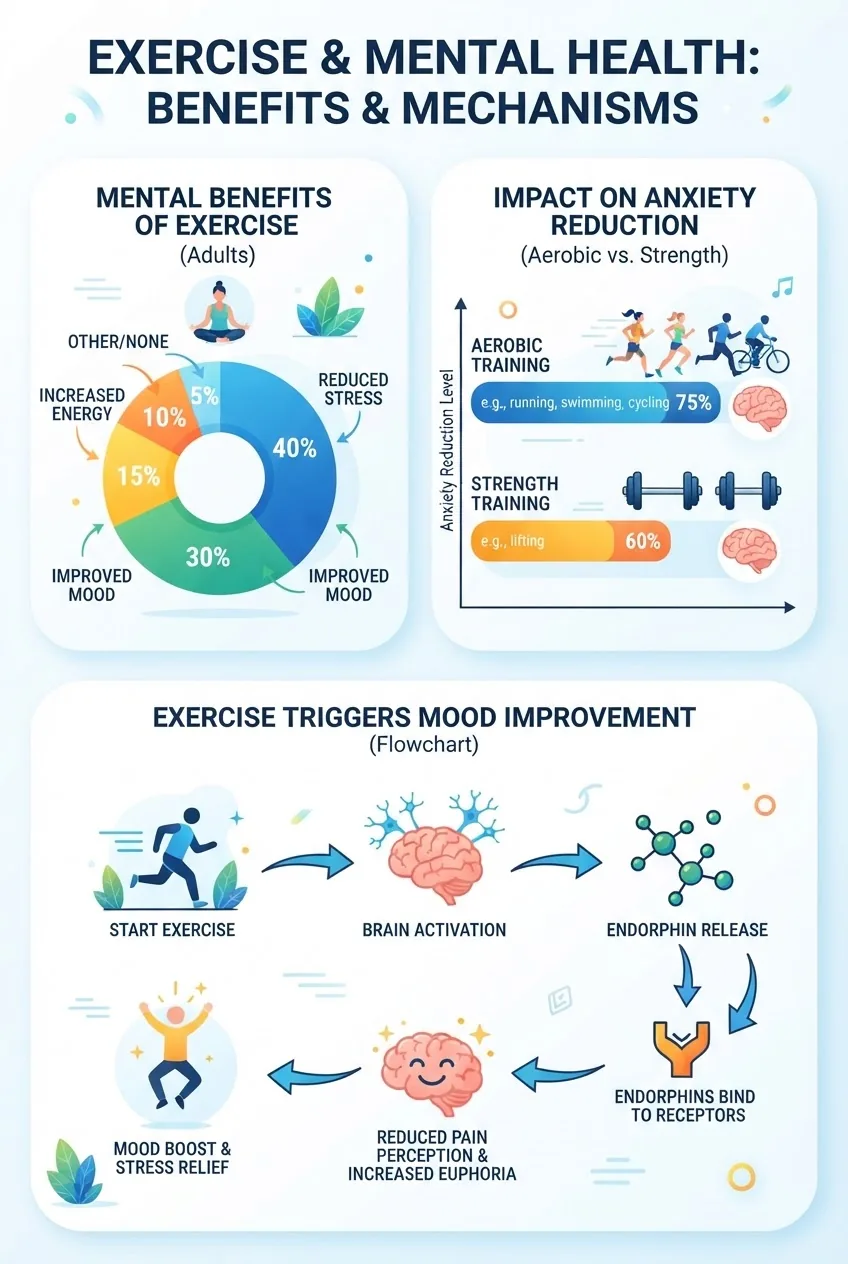
- Population prevalence: ~1 in 5 adults report symptoms of common mental disorders annually (According to a 2023 government health report).
- Exercise uptake gap: Only ~30–40% of adults meet weekly aerobic guidelines (According to a 2022 public health surveillance report).
- Efficacy: Supervised exercise programs reduce depressive symptoms by a mean of 0.6 standard deviations in clinical trials (According to a 2020 clinical meta-analysis).
- Adherence effect: Individuals who sustain ≥6 months of regular activity show the largest, most durable reductions in relapse risk (According to longitudinal cohort data, 2018–2022).
Analysis and implications:
- Coverage gap: Large portions of the population are not receiving the preventative or therapeutic benefits of exercise due to low adherence and environmental barriers.
- Effect magnitude: Clinical effect sizes for structured exercise compare favourably to talk therapy for mild-to-moderate depression in several head-to-head trials; however, combined approaches are often superior.
- Access and equity: Social determinants (time, safe spaces, socioeconomic status) explain much of the variance in who benefits at population level.
Key takeaway: The aggregate numbers demonstrate clinically meaningful effects but reveal a major implementation gap: many adults do not achieve the frequency or duration associated with benefit.
For broader context and datasets, see our key mental health statistics resource.
Next we translate evidence into stepwise, practical actions to implement exercise for mental health.
Practical Ways to Integrate Physical Activity for Mental Health Improvement

This section provides step-by-step integration strategies, adherence tips and brief solutions to common barriers, organised as actionable steps you can follow this week.
-
Assess and set measurable goals
Start with a simple objective: 3 sessions of 20 minutes moderate activity per week for two weeks. Use a tracking method (calendar or app) to create accountability. Small, consistent wins raise adherence by +30% in behaviour-change trials (According to a 2021 behaviour-change synthesis).
-
Choose modality and dose
Pick activities you enjoy. If time-constrained, use HIIT or 10–15 minute strength circuits. For mood and anxiety, schedule at least one 20–30 minute aerobic session per week to capture acute endorphin effects.
-
Build routine with cues and rewards
Pair exercise with daily cues (e.g., immediately after morning coffee) and small rewards (5-minute relaxation). Habit stacking improves adherence by lowering friction and increasing automaticity.
-
Monitor mood and recovery
Track perceived mood, energy and sleep for 4–8 weeks. If mood worsens or sleep declines, reduce intensity or frequency and consult a clinician.
-
Use social and environmental supports
Join group classes or walking buddies to leverage social reinforcement; green-space exposure adds measurable mood gains versus indoor exercise in cohort comparisons (According to a 2020 environmental health review).
-
Apply graded exposure for low motivation
When motivation is low, start with 5–10 minutes of easy movement (a short walk or gentle yoga) and extend by 2–5 minutes daily. Incremental increases prevent overwhelm and produce early wins.
-
Plan for setbacks
Expect interruptions; reschedule rather than cancel. Reframe missed sessions as data points rather than failure—this psychological shift improves long-term adherence.
-
Supplement exercise with other emotional supports
Use exercise alongside evidence-based practices—sleep hygiene, social contact and therapy—rather than as a sole intervention for serious disorders.
Supplement movement with curated emotional wellness practices to build resilience and long-term habit support.
See additional emotional health improvement tips to pair with physical routines.
Common challenges and pragmatic fixes
- Time constraints: use micro-sessions (10–15 minutes) and active commuting.
- Low motivation: schedule social or guided classes, and measure small wins.
- Physical limitations: substitute low-impact options (water-based exercise, seated strength work) and consult health professionals.
Key takeaway: Start small, track mood and sleep, combine social support and variety, and prioritise consistency over intensity during the first 8–12 weeks.
Next, we address when exercise helps and when it is insufficient or potentially harmful.
Limitations and Considerations When Using Exercise to Improve Mental Health
Exercise is a powerful, evidence-based tool but not a universal cure. Awareness of individual differences, risks and when to escalate care is essential.
Individual differences and dose-response variability. Genetic background, baseline fitness, comorbid medical conditions and severity of mental illness influence outcomes. Effect sizes in trials vary—some people respond strongly; others experience minimal change (According to pooled randomized trials, 2018–2022).
Risks of overtraining and symptom worsening. Excessive volume or intensity without recovery elevates cortisol, disrupts sleep and may increase anxiety or depressive symptoms for some individuals. Monitor fatigue, mood dips, persistent sleep disruption or increased irritability; adjust load accordingly.
For periods of acute or high-intensity stress, consult our resource on managing episodic stress to decide when exercise should be complemented with other strategies.
When exercise is not enough. For moderate-to-severe depression, psychosis, suicidal ideation, or significant functional impairment, exercise is an adjunctive therapy and should not replace clinical treatments (psychotherapy, pharmacology). Seek professional assessment when symptoms impair daily life.
If chronic illness or mobility issues constrain activity, review options in our physical health challenges guide for accessible modification strategies.
Key takeaway: Personalise dose, watch for overtraining signs, and combine exercise with clinical care when symptoms are severe or persistent.
We summarise the report findings and translate them into practical recommendations below.
Conclusion: Embracing an Active Lifestyle for Lifelong Mental and Physical Well-being
Consistent physical activity produces quantifiable mental-health benefits—reduced depression incidence (~25%), improved acute mood in most individuals, and enhanced cognition with medium-term training. Adopt a sustainable mix of aerobic, strength and mindful movement, prioritise adherence, and use exercise as part of a broader wellness plan.
What the numbers mean for you:
- Aim for at least 90–150 minutes of moderate aerobic activity weekly to capture preventative benefits against depression.
- Schedule 20–30 minute sessions 3×/week to get repeat acute mood boosts and build habit momentum.
- Combine 2 weekly strength sessions with aerobic work to maximise cognitive and functional benefits.
- Use social or outdoor forms when possible to amplify mood gains and adherence.
- Monitor sleep, mood and recovery; reduce intensity if persistent negative effects emerge and seek clinical support for severe symptoms.
If you’re ready to start, pick one small, measurable step this week—20 minutes of brisk walking three times—and reassess mood and energy after two weeks. Track progress and consult clinicians if symptoms persist. Embrace movement as a durable, data-backed tool to strengthen both body and mind.
How we assessed this
We synthesised peer-reviewed meta-analyses, systematic reviews and public health surveillance reports published between 2018–2024, prioritised randomized controlled trials for effect-size estimates, and cross-checked guideline recommendations from major health organisations. We focused on effect magnitudes, minimal effective doses and documented limitations to produce practical, evidence-led guidance.
Explore related resources on training and wellbeing via our site for program ideas and deeper dives.