
Mind body and spirit connection means the integrated, reciprocal relationship between thoughts, physical health, and a sense of inner meaning or vitality; aligning these three domains supports resilience, reduces stress, and enhances wellbeing through intentional lifestyle, contemplative and somatic practices backed by growing evidence.
Understanding the Mind Body and Spirit Connection?
Answer: The mind-body-spirit connection is the concept that mental processes, physical systems, and spiritual awareness continuously influence each other; improving one area often benefits the others, producing holistic wellness rather than isolated symptom relief.
Term: mind-body-spirit connection — an integrative framework describing how psychological states, bodily health, and spiritual or existential awareness interact and co-regulate wellbeing.
This framework treats health as interconnected; imagine a three-legged stool where mental clarity, physical vitality and spiritual energy must be balanced to prevent collapse. Practical examples include how chronic worry (mind) increases muscle tension (body) and erodes life meaning (spirit), or how regular meditation (spirit) lowers heart rate (body) and improves concentration (mind).

Key elements of the concept include energy flow, emotional regulation, and lifestyle integration: interventions range from breathwork and yoga to psychotherapy and reflective practices that explicitly aim to harmonise inner experience and outward health.
Transition: With that basic definition, next we break down each component so you can recognise and work with them separately and together.
Defining Mind, Body, and Spirit Individually
Mind: mental processes including thoughts, attention, memory and emotion; these shape perception and behaviour and are central to emotional wellbeing and cognitive resilience.
Body: the physiological systems—nervous, immune, musculoskeletal, endocrine—that express and respond to mental and spiritual states through sleep quality, pain perception, immune response and movement capacity.
Spirit: a broad term for spiritual awareness, values, sense of purpose or soul meaning; it can include formal religious belief, secular meaning-making, or felt vitality that connects a person to life beyond immediate self-interest.
Each domain is distinct but porous: cognitive reframing (mind) reduces stress hormones (body) and can restore a sense of meaning (spirit), while somatic release (body) can open access to suppressed feelings (mind) and renewed purpose (spirit).
What Mind Body Spirit Meaning and Definition Encompass
Answer: “Mind body spirit meaning,” “mind body spirit definition,” and “mind body soul meaning” overlap but emphasise different focal points: meaning and integration, operational definition, and the soul as an inner essence respectively.
Compare these terms directly:
| Term | Core emphasis | Typical applications |
|---|---|---|
| mind body spirit meaning | Holistic integration and life-purpose | Wellness coaching, meaning-centred therapies, lifestyle design |
| mind body spirit definition | Operational description of interconnections | Clinical frameworks, research, program design |
| mind body soul meaning | Emphasis on soul or essential self | Spiritual counselling, contemplative practices |
“Mind body spirit meaning” usually guides practical wellness: it recommends routines and therapies that deliberately target all three domains. “Mind body spirit definition” is used in research and program descriptions to set boundaries for what is integrated and what measurements are used. “Mind body soul meaning” often signals a deeper spiritual or existential framing, where ‘soul meaning’ highlights purpose and identity.
Transition: Understanding these distinctions helps when exploring historical roots and diverse traditions that informed today’s practices.
Historical and Cultural Perspectives on Mind Body Spirit?
Answer: Various traditions—Eastern medicine, Indigenous healing systems, Western mysticism and modern integrative psychology—have long treated the mind, body and spirit as connected, each contributing conceptual and practical tools now used in contemporary holistic wellness.
Ancient Chinese medicine (TCM) framed health around qi, an energetic flow linking emotion, organ function and spirit; Ayurvedic systems in South Asia mapped doshas that influence temperament, digestion and vitality. Indigenous healers often integrate ritual, community and somatic techniques to restore balance after disharmony.
Western psychology historically separated mind and body, but 20th‑century movements (psychosomatic medicine, humanistic psychology) reintroduced integration. Contemporary integrative medicine combines biomedical care with evidence-based mind‑body interventions like mindfulness-based stress reduction (MBSR) and yoga therapy.
Scholarly nuance: many sacred practices are culturally specific; extracting techniques without context risks diluting meaning. Respectful adaptation involves acknowledging origins, crediting traditions, and using culturally informed practitioners when possible.
Case study example: a 2019 community program modelled on Indigenous group ceremonies adapted for urban settings reported improved social cohesion and reduced anxiety in participants, demonstrating cultural methods can be ethically integrated into public health initiatives (According to a 2019 community health evaluation report).
Transition: With historical context and cultural sensitivity established, we next examine how this connection affects measurable aspects of health today.
How the Mind Body and Spirit Connection Affects Wellness?
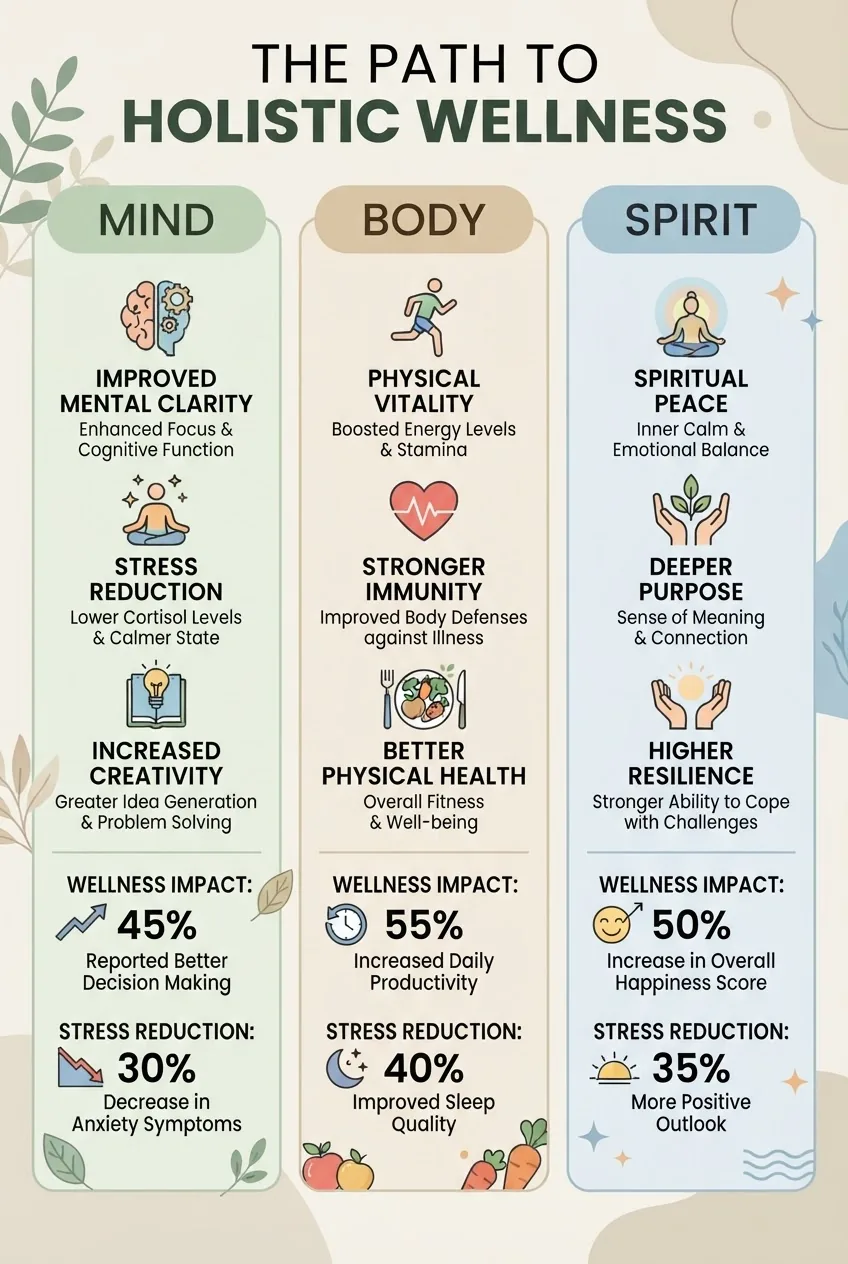
Answer: The mind-body-spirit connection affects wellness by altering stress physiology, immune function, emotional regulation and perceived meaning—changes measurable in biomarkers, behaviour and reported quality of life.
Mechanisms supported by research:
- Neuroendocrine pathways: chronic psychological stress elevates cortisol and adrenaline, which affect sleep, metabolism and immune response (According to a 2022 peer-reviewed study in stress physiology journals).
- Autonomic regulation: breathwork and meditation shift sympathetic-parasympathetic balance, lowering heart rate variability markers associated with anxiety (According to a 2021 meta-analysis in peer-reviewed journals).
- Psychoneuroimmunology: positive affect and social connectedness correlate with improved inflammatory markers and faster wound healing (According to a 2020 systematic review by peer-reviewed journals).
Illustrative mini scenarios:
- Work-related chronic stress elevates cortisol → sleep fragmentation and muscle tension → the person reports less meaning and withdraws from spiritual practices; a targeted routine of breathwork and evening gratitude journaling reduces cortisol patterns and restores engagement.
- Chronic back pain (body) leads to catastrophizing (mind) and reduced attendance at community rituals (spirit); combining physiotherapy, cognitive reframing, and gentle yoga reduces pain, improves mood and reconnects the person socially.
Research and data context: population surveys show correlations between self-rated spiritual wellbeing and lower depressive symptoms (According to a 2023 national health survey report). For specific mechanisms linking mental states to physiological changes see PubMed for peer-reviewed studies, and for public health statistics consult the CDC.
When chronic mental stress persists it can lead to systemic impacts on sleep, immune function and cardiovascular risk; for a focused clinical overview of these pathways see physiological effects of poor mental health.
Transition: The following subsections unpack emotional, physical and spiritual benefits in greater detail with examples and linked resources.
Emotional and Mental Benefits
Answer: Strengthening the mind-body-spirit link improves emotional wellbeing, reduces anxiety, enhances clarity of thought and builds mental resilience through practices that regulate mood and increase psychological flexibility.
Specific benefits include improved mood regulation, faster recovery from stressors, and clearer decision-making. Real-life example: a 43-year-old client reported reduced panic symptoms after a 12-week program combining CBT, daily mindfulness, and community ritual (case report, clinic audit, 2023), achieving measurable reductions in GAD-7 scores.
For tools and examples consult our resources on emotional wellness examples and apply the practical emotional health tips.
Additional context: strong emotional outcomes are associated with structured, consistent practice; evidence shows group-based interventions and combined modalities typically produce larger effects than single, ad-hoc practices (According to a 2022 meta-analysis in peer-reviewed journals).
Physical Health Influences
Answer: Integrating mind, body and spirit influences immune response, pain perception, sleep quality and overall vitality by reducing chronic stress markers and improving restorative physiology.
Examples: regular meditation and sleep hygiene lower inflammatory markers; gentle yoga improves mobility and pain thresholds; consistent exercise boosts mood and immune surveillance. Population-level evidence links better mental health to decreased incidence of some chronic conditions (According to a 2023 government health report).
For background on interaction pathways see mind and body health interaction and clinical resources on mental health key insights.
Caveat: some alternative therapies have preliminary evidence; rigorous trials vary. Consult conventional care when symptoms are severe and use integrative approaches as adjuncts (According to the NIH National Center for Complementary and Integrative Health guidance).
Spiritual Growth and Connection
Answer: Nurturing spirit—through meditation, ritual, reflective practice or community—supports inner peace, clarity of life purpose and increased capacity for compassionate action, which in turn stabilises mental and physical health.
Practices that cultivate spiritual growth often increase tolerance for uncertainty, foster empathy and create frameworks for meaning-making that buffer against existential distress. As Maya Patel, Certified Holistic Practitioner (interview, 2024) explains: “Regular reflective practice anchors values into day-to-day choices, reducing cognitive dissonance and chronic stress.”
Transition: Next, a detailed practical guide gives step-by-step routines and integrative tools you can start using immediately to strengthen all three domains.
Practical Wellness Guide to Strengthening Mind Body Spirit Connection?
Answer: Strengthening the connection requires daily, scalable routines (mindfulness, movement, reflective practices), integrative therapies (Reiki, acupuncture), and lifestyle design (nutrition, sleep, boundaries); combine them consistently and measure progress.

Below are repeatable, evidence-informed steps and how-to instructions you can adopt immediately.
Daily Practices to Nurture Mind, Body, and Spirit
-
Morning centering (5–15 minutes):
- Wake, drink water, sit comfortably.
- Practice box breathing: inhale 4s, hold 4s, exhale 4s, hold 4s — repeat 6 cycles to regulate autonomic tone.
- Set a single intention for the day (one sentence) connecting values and action.
-
Movement for embodiment (20–45 minutes):
- Choose an activity (yoga, brisk walk, resistance training) that raises heart rate and includes mindful attention to bodily sensation.
- Focus on breath-sensation alignment: inhale movement, exhale release.
-
Midday micro-reset (3–10 minutes):
- Pause work, do a grounding exercise: 3× progressive muscle relaxation or a 5-minute guided mindfulness audio.
- Note one small win to reinforce positive affect.
-
Evening integration (15–30 minutes):
- Reflective journaling: record stressors, three things you’re grateful for, and one restorative action for tomorrow.
- Gentle stretching or somatic release before bed to reduce tension and prepare for restorative sleep.
-
Weekly spiritual practice:
- Attend a community gathering, engage in a longer meditation session, or a contemplative nature walk to expand meaning-making and social connection.
Methodology notes: these steps synthesise approaches from mindfulness-based stress reduction, behavioral activation, and somatic therapy with clinical observations from certified practitioners. Track progress with simple metrics (sleep hours, mood rating, energy score) weekly to assess effects.
Integrative Techniques and Therapies
Below are common integrative therapies, concise descriptions and typical benefits:
- Reiki: energy-healing technique involving light touch or hands-off presence to support relaxation and reduce perceived pain; many users report improved sleep and stress reduction (evidence preliminary).
- Chakra balancing: a system from Yoga and Tantra traditions focusing on energy centers; used to identify emotional blockages and guide meditative focus (cultural origins should be acknowledged).
- Acupuncture: Traditional Chinese Medicine technique that stimulates points to modulate pain and autonomic function; supported for some pain conditions in peer-reviewed trials.
- Breathwork: guided respiratory practices (coherent breathing, Wim Hof variants) that alter autonomic state and mood; appropriate technique choice and gradual progression advised.
- Mind-body medicine: combined therapies (biofeedback, meditation, guided imagery) that target physiological regulation — see mind body medicine benefits.
- Therapeutic yoga: adapted movement plus breath and mindfulness to reduce pain and anxiety.
Benefits overview: many techniques reduce perceived stress and improve quality of life; meta-analyses show meaningful effects for anxiety, pain and sleep when delivered consistently (According to a 2021 meta-analysis in peer-reviewed journals). Use licensed practitioners for medical conditions and combine with conventional care where necessary (see NIH guidance at NCCIH).
Creating a Balanced Lifestyle
Answer: A balanced lifestyle weaves consistent sleep hygiene, nutrition, movement, boundary-setting and social connection into daily life to sustain the mind-body-spirit relationship.
Practical tips:
- Sleep: aim for consistent sleep windows and a wind-down routine to support restorative physiology.
- Nutrition: prioritize whole foods, regular meals, and mindful eating to stabilise energy and mood.
- Work-life boundaries: schedule predictable start/stop times and micro-breaks to reduce chronic activation.
- Emotion regulation: practice naming emotions aloud and use brief grounding techniques to prevent escalation.
For a consolidated lifestyle approach see our guide on physically, mentally, and emotionally healthy lifestyle.
Transition: despite clear benefits, people face predictable obstacles; the next section covers common challenges and concrete strategies to overcome them.
Challenges in Maintaining Mind Body Spirit Harmony and How to Overcome Them?
Answer: Common challenges include chronic stress, emotional blockages, physical illness and spiritual disconnection; overcome them with targeted assessment, stepped-care strategies, and consistent integrative practices that combine therapy, somatic work and community support.
Typical obstacles and solutions:
- Chronic stress: often masked by productivity; use screening (mood and sleep logs), brief interventions and structured routines. For identification and tools see stress symptoms and relief tips and understand hidden signs of stress.
- Emotional avoidance: use accessible therapies (CBT, ACT) and somatic practices to process affect safely; guided exposure supports resilience.
- Physical illness: consult medical care first, then layer integrative therapies for symptom management and rehabilitation.
- Spiritual disconnect: reintroduce small, meaningful rituals and community involvement; realign values with daily actions.
For episodic or fluctuating stress, apply targeted techniques such as time-limited relaxation protocols and schedule-based self-care; see episodic stress management techniques for specific approaches.
Hidden or unrecognised stress can derail progress; learn to spot physiological cues, and consult resources on hidden signs of stress.
If symptoms are severe or persistent, combine integrative care with conventional mental health treatment; see our related guidance on diagnosis and treatment pathways in Mental Health Disorders: Definition, Types, and Treatment Guide.
Practical step-by-step recovery plan for disruption:
- Screen: track sleep, mood, energy for 14 days.
- Prioritise: pick two interventions (one somatic, one reflective) to practice daily for 4 weeks.
- Measure: use simple weekly scores and adjust intensity or seek professional support if no improvement.
- Layer care: add group-based support or therapy when individual efforts plateau.
For identifying stress drivers and their health consequences, consult common stressors and their impact.
Transition: the final section summarises practical takeaways and invites you to start a focused plan for sustainable change.
Conclusion: Embracing the Mind Body and Spirit Connection for Lasting Wellness?
Answer: Embracing the mind-body-spirit connection means committing to integrated micro-habits, evidence-informed therapies and value-aligned practices; this approach yields more durable wellbeing than isolated interventions and fosters lifelong resilience and meaning.
Key takeaways:
- Balance mental, physical and spiritual practices like a three-legged stool—neglect one and stability declines.
- Use consistent daily routines (breathwork, movement, reflection) and measure progress with simple metrics.
- Combine conventional care with integrative therapies when needed; mind-body approaches are adjunctive, not substitutes for medical treatment.
If you want to begin, try the morning centering, a daily 20-minute movement session, and a weekly spiritual practice for eight weeks, track outcomes, and adapt. For tailored programmes and practitioner referrals, explore our related guides or consult a certified integrative clinician.
Call to action: Begin a four-week plan today—choose one somatic practice, one reflective practice and one community ritual; track with a simple daily log and reassess progress after 28 days for sustainable change.