

Physically and mentally and emotionally healthy: by the end of this guide you will have a practical daily routine, a 30-day plan, and simple assessment tools to keep each dimension balanced; reading and applying the core steps takes about 90–120 minutes initially and assumes only basic wellness literacy.
This hands-on guide explains definitions, links actions to measurable outcomes, shows a real-world case, and gives step-by-step routines you can start today.
Before you start
- Time: block 20–40 minutes daily for the first 30 days, then 10–20 minutes to maintain.
- Tools: basic journal or phone note app, wearable or step counter, comfortable shoes, yoga mat, kitchen scale, water bottle, and a 7–8 hour sleep window.
- Materials: one medium notebook (A5), a pen, and a “mood-check” sticky pad or phone mood-tracking app.
- Health checks: recent primary care visit within 12 months recommended; if on medication or with chronic illness, confirm changes with your clinician.
Understanding Physical, Mental, and Emotional Health
This section gives clear definitions, short examples, and resources so you can label the parts of your wellness plan precisely.
- Define physical health. Physical health means body systems functioning well: cardiovascular endurance, muscular strength, mobility, immune resilience, and restful sleep. Measureable markers include resting heart rate (RHR) under 70–80 bpm for many adults, 150 minutes of moderate exercise weekly, and BMI or waist circumference where clinically relevant. For global definitions see WHO.
- Define mental health. Mental health refers to cognitive functioning, attention, memory, planning, and how we process information and cope with stress. It covers diagnosed conditions and everyday mental resilience. For statistics and treatment guidelines see NIMH.
- Define emotional health. Emotional health means the ability to identify, accept, regulate, and express feelings constructively. It includes emotional intelligence, distress tolerance, and recovery after upset. Emotional well-being shapes decision-making, social connection, and motivation.
- Example. Sarah, a 38-year-old teacher, improved sleep (physical), reduced rumination through CBT techniques (mental), and practised morning gratitude journaling (emotional). Over 12 weeks her sleep efficiency rose from 72% to 86% (tracked by wearable), concentration improved, and she reported fewer mood swings.
- Quick links for deeper reading and data. For quick facts about mental health, visit mental health facts. For the CDC advice on physical activity and sleep, see their guidance pages.
- How to use these definitions. Label measurements you can track: sleep hours, weekly exercise minutes, mood rating 1–10, and one emotional regulation skill to use when stressed (e.g., deep breathing).
Transition: once the pieces are defined, the next section explains how they interact in daily life and why integrated routines produce compounded benefits.
The Interconnection: How Physical, Mental, and Emotional Health Influence Each Other
Understanding the mind-body connection helps you design routines that target multiple systems at once.
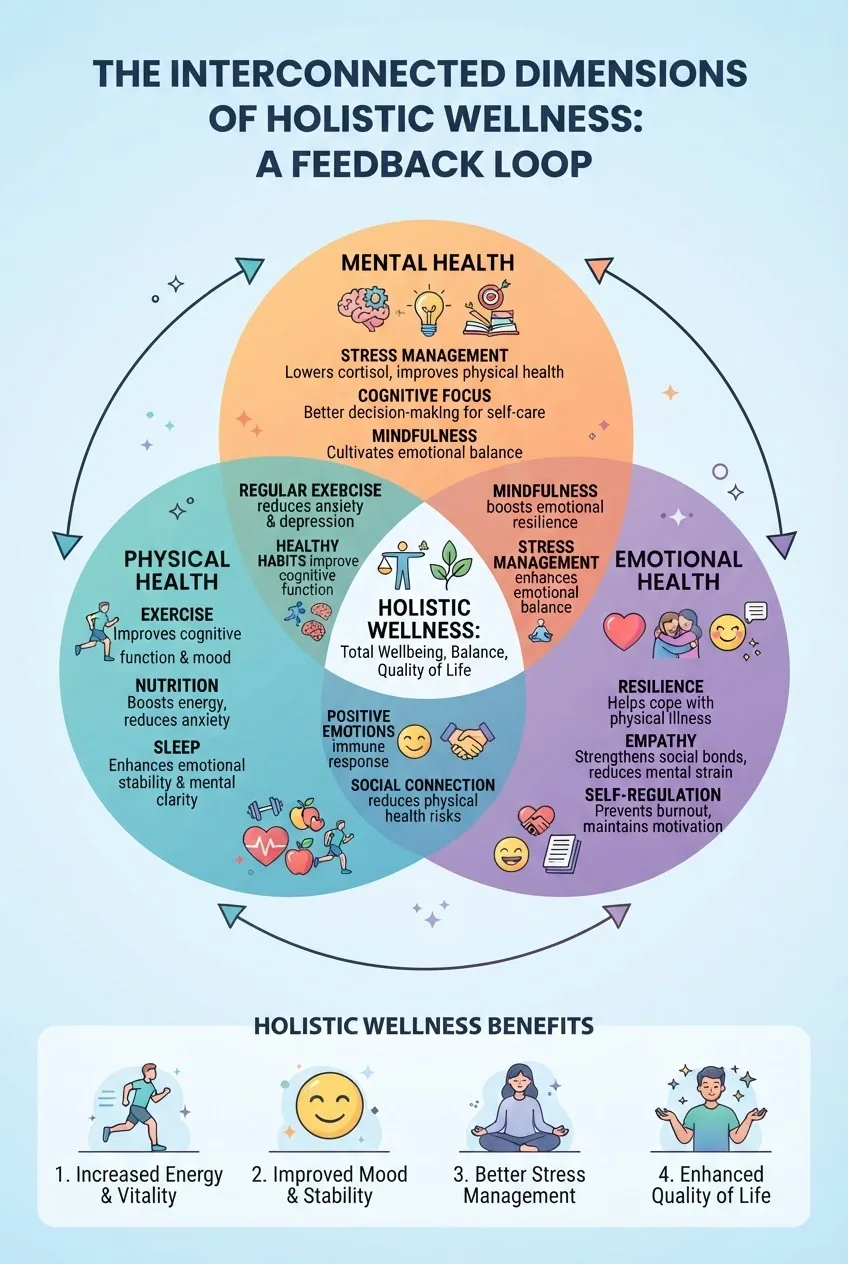
- Recognise cyclical feedback loops. Physical fatigue reduces cognitive resilience, which increases stress reactivity; increased emotional distress impairs sleep and immune function, which feeds back to physical performance. This kind of psychosomatic cycle is well-established in the biopsychosocial model: biological stress responses (cortisol, sympathetic activation) affect cognition and mood.
- Illustrative scenario: the 48-hour cascade. Tom missed sleep two nights (physical), had trouble concentrating at work (mental), and snapped at his partner (emotional). That social strain reduced his motivation to exercise the next day, worsening sleep again. Small deficits compound into a multi-dimensional imbalance within 48 hours.
- Stress physiology, briefly. Acute stress activates the sympathetic nervous system and HPA axis, releasing adrenaline and cortisol; chronically elevated cortisol impairs memory encoding, increases abdominal fat, and disrupts sleep architecture. According to a 2024 industry report, chronic stress correlates with higher incidence of cardiometabolic markers in community samples.
- Where interventions overlap. Aerobic exercise improves cardiovascular markers (physical) and stimulates BDNF for learning and mood (mental); mindfulness lowers physiological arousal (physical) and increases emotional regulation capacity (emotional). See the mind-body health connection for a deeper dive.
- Common stressors as vectors. Life events, work pressure, and sleep loss are vectors that move stress into all three domains—explore typical common stressors and health to spot patterns in your life.
- Outcomes of integration. A coordinated routine (30–60 minutes daily) that pairs movement with breathwork and a brief emotional check-in reduces daily perceived stress and can measurably improve sleep within 2–4 weeks. According to a 2023 clinical summary, integrated programs beat single-focus interventions for sustained wellbeing in adult samples.
- Actionable takeaway. Target interventions that operate across dimensions: brisk walks with mindful attention, gratitude journaling after exercise, and evening technology limits to protect sleep.
Transition: now that you can spot interaction patterns, learn concrete signs that a dimension is out of balance so you can intervene early.
Signs of Imbalance in Physical, Mental, and Emotional Health
This numbered list helps you detect warning signs and points to deeper resources when needed.
-
Physical warning signs
- Persistent fatigue despite rest (sleep efficiency <80% over two weeks) — track with a wearable or sleep diary.
- Frequent infections or slow wound healing — possible immune suppression from chronic stress.
- New unexplained pain or sharp decline in stamina; see a clinician if symptoms persist beyond 2 weeks.
- physical health challenges
-
Mental warning signs
- Concentration lapses, forgetfulness, or slowed decision-making lasting more than 10–14 days.
- Persistent negative thinking, anhedonia (loss of pleasure), or intrusive worries beyond typical ranges.
- Marked decline in productivity or errors at work/school not explained by sleep loss alone.
- For data-driven insights, review mental health facts.
-
Emotional warning signs
- Emotional volatility: uncharacteristic anger, tearfulness, or constant irritability that disrupts relationships.
- Difficulty identifying feelings, persistent numbness, or avoidance of emotional topics.
- Using substances, overeating, or compulsive behaviours to manage feelings.
- hidden stress symptoms and emotional health improvement tips offer deeper exploration.
-
Cross-domain indicators
- Sleep disturbance, appetite change, and social withdrawal together point to multi-dimensional imbalance.
- Physical symptoms without clear medical cause (headaches, stomach issues) can be psychosomatic; for a clinical overview see physiological effects of poor mental health.
- Rapid onset of multiple signs within 2–4 weeks should trigger a structured assessment.
-
How to track warning signs.
- Use a daily 1–10 mood scale, a 7-day activity log for exercise minutes, and a simple symptom checklist recorded weekly.
- Set thresholds: if mood average drops below 4/10 for 10 days, or sleep <6 hours nightly for more than 7 nights, escalate your response plan.
- See sibling article hidden stress symptoms for subtle signs of stress.
Transition: armed with clear signs, the next long section gives exact daily and weekly routines to re-balance all three domains.
Practical Wellness Strategies to Stay Physically, Mentally, and Emotionally Healthy
This is the hands-on core: follow the steps and 30-day routine below. It pairs movement, nutrition, sleep, mindfulness, and emotional regulation into habitable actions.

-
Step 1 — Establish a 30-day baseline plan (Day 1–7).
- Action: Record baseline metrics on Day 1: sleep hours (7 days average), resting heart rate (morning), 3-word mood summary each evening, and current weekly exercise minutes.
- Goal: Achieve baseline over seven days so you can measure change. Use simple targets: 7–8 hours sleep, 150 minutes moderate activity/week, mood average ≥6/10.
- Notes: If you have chronic conditions, collect any recent lab values or clinician notes to avoid confounding interpretations.
-
Step 2 — Build a daily core routine (Day 8–30).
- Morning (20–30 minutes): 10 minutes brisk walk or dynamic mobility (warm-up: 2 minutes marching, 2 minutes hip circles, 6 minutes brisk walk), then 5–10 minutes mindfulness (breath counting 4-6-8 or body scan). Journal one sentence of intention and one thing you appreciate.
- Midday (10–20 minutes): Short resistance or bodyweight circuit twice a week (3 rounds: 10 squats, 8 push-ups, 12 glute bridges; rest 60s between rounds) to target strength and mood via endorphins.
- Evening (30–45 minutes): Healthy dinner (30–45% plate vegetables, 25–30% lean protein, 25–30% complex carbs). Avoid caffeine after 2 pm. Wind-down 60 minutes before bed: low light, 10 minutes gentle stretching, 10 minutes journaling mood and wins.
- Sleep hygiene: Fixed sleep window (e.g., 10:30pm–6:30am). If awake >20 minutes, get up and do a calm activity; avoid screens for the 60 minutes pre-sleep. See CDC sleep recommendations at CDC Sleep.
-
Step 3 — Practice emotional regulation techniques daily.
- Action: Learn three techniques and use them in sequence when triggered: 1) 4-4-8 breathing for 2 minutes, 2) 60-second body scan to notice sensations, 3) label the emotion and choose a behavioural response (pause, speak, or act).
- Timing: Do a 3-minute emotional check-in midday and 3 minutes in the evening. After two weeks, extend to 5 minutes if useful.
- Support: For expanded exercises and resources, see emotional wellness resources.
-
Step 4 — Use exercise strategically for mental health.
- Action: Schedule 3 weekly sessions: two moderate cardio sessions (30–40 minutes at brisk pace) and one strength session (25–35 minutes). Walk after lunch for 15 minutes to reduce post-meal cortisol.
- Rationale: Aerobic exercise increases BDNF and mood regulation; strength training supports sleep and metabolic health. For data-driven benefits see active lifestyle benefits.
- Progression: Increase cardio by 5 minutes every week up to 45 minutes, or add one interval session by week 4 (10×1 minute harder effort with 1 minute easy recovery).
-
Step 5 — Nutrition to support mental and emotional well-being.
- Action: Eat at least three servings of leafy greens daily, include oily fish twice weekly or a 1g/day EPA+DHA supplement, aim for 25–30g fibre/day, and limit refined sugar to <25g/day.
- Why: Nutrients like omega-3s, vitamin D, and fibre influence neurotransmitter synthesis and gut-brain signalling. According to a 2022 clinical review, dietary patterns high in vegetables and fish correlate with lower depression scores.
- Quick meal template: Breakfast: oats with berries and 10g nuts; Lunch: salad with 120–150g lean protein; Dinner: 100–150g fish/chicken, 2 cups vegetables, 1 cup complex carbs.
-
Step 6 — Mindfulness and cognitive habits.
- Action: Practice 10 minutes of formal mindfulness daily (breath awareness or body scan). Use 5-minute micro-practices during transitions (e.g., before meetings).
- Alternatives: Loving-kindness meditation for emotional regulation, or focused attention practice for concentration. Different methods fit different needs; if one increases anxiety, switch to grounding techniques.
- Further learning: For structured mental health practices and short routines, see mental health tips.
-
Step 7 — Build social support and emotional safety into routines.
- Action: Schedule one meaningful social interaction weekly (30–60 minutes) and a daily 5-minute check-in with a trusted person when stressed.
- Why: Social support moderates stress responses, lowers cortisol, and provides perspective. If social energy is low, use short text-based check-ins to maintain connection.
-
Step 8 — Targeted stress management and episodic response.
- Action: Create a 3-step episodic stress plan: 1) Immediate calming (5 minutes breathing), 2) Grounding behaviour (walk or call someone), 3) 24-hour recovery rule (no major decisions within 24 hours of peak stress).
- Resources: For detailed strategies on episodic stress, consult episodic stress management.
-
Step 9 — Use evidence-based complementary methods selectively.
- Options: Mind-body medicine (e.g., biofeedback, guided imagery), progressive muscle relaxation, and therapeutic movement (yoga, Tai Chi).
- Why: These techniques reduce sympathetic arousal and improve emotional regulation. See mind-body medicine benefits.
- How to choose: Try one technique for 4 weeks with measurable outcomes (mood scores, sleep efficiency) before switching.
-
Step 10 — Maintain gains and scale up (Week 5 onward).
- Action: After 30 days, review metrics: mood average, exercise minutes, average sleep. Increase exercise intensity gradually (5–10% per week) or add a social group activity to scale social health.
- Long-term goal: Sustain 150–300 minutes moderate activity per week, at least 2 emotional-regulation practices, and weekly social connection for maintenance.
- Further resources: For stress-specific relief techniques, consult stress relief tips and for emotional skill-building see emotional wellness resources.
-
Step 11 — Personalise with targeted interventions and examples.
- Action: Select one personal health example each month to emulate (e.g., alternate-day jogging routine, evening gratitude and nature exposure). See personal health and wellness examples.
- Tracking: Keep a one-line daily log: exercise minutes / mood / sleep hours. After 30 days, calculate percent change vs baseline.
-
Step 12 — Apply preventive check-ins and adjust quarterly.
- Quarterly review: Every 3 months run a 7-day intensive tracking window, check medical screenings, and set new micro-goals for the next quarter.
- Preventative strategies: Vaccinations, dental checks, routine blood pressure and metabolic screens as recommended by your primary care provider.
- Resources: For clinical prevention guidelines see the CDC clinical prevention resources at CDC.
Transition: social health powerfully supports the habits above; the next section describes building social systems that sustain long-term wellness.
Role of Social Health in Supporting Physical, Mental, and Emotional Wellness
Social health is the glue that amplifies the benefits of routines and provides corrective feedback during setbacks.
-
Recognise social health components.
Social health includes quantity and quality of relationships, perceived support, and community engagement. Even brief, high-quality connections reduce physiological stress responses.
-
Create three social support tiers.
- Tier 1 (Daily): One trusted person for short, emotional check-ins (5 minutes).
- Tier 2 (Weekly): A group or friend for activity or conversation (30–90 minutes).
- Tier 3 (Monthly): Community or group with shared values (workshop, class, or volunteer group).
-
Practical ways to build social health.
- Action: Join a walking group or class (2–3 hours monthly total), schedule a weekly call, and set a social goal (invite someone for coffee every 2 weeks).
- Action: Practice emotional sharing: use “I” statements and limit venting to 5 minutes before asking for solutions.
- Support: For examples and exercises to strengthen emotional skills, see emotional health improvement tips and explore broader holistic perspectives at mind, body, and spirit wellness or holistic wellness including spirit.
-
Measure social impact.
Track one social metric weekly: number of meaningful interactions, or perceived social support on a 1–10 scale. Note trends; if support falls below 5/10 for 4 weeks, increase outreach activities.
-
Community and reciprocity.
Giving support (volunteering, mentoring) improves emotional well-being as much as receiving it. Aim for one small act of help monthly.
Transition: to keep all this measurable and on-track, the following table compares practical tools and assessments you can use.
Tools and Assessments to Monitor Your Holistic Health
Use a combination of subjective journals and objective metrics. The table below compares options and ideal use cases.
| Tool / Method | What it measures | Best use | Time to action |
|---|---|---|---|
| Wearable (HR, sleep) | Resting HR, sleep stages, activity minutes | Objective sleep & activity trends | Daily |
| Mood diary / app | Mood 1–10, triggers, notes | Emotional pattern detection | Daily |
| Weekly symptom checklist | Sleep, appetite, pain, energy | Early detection of imbalance | Weekly |
| Validated questionnaires | PHQ-9, GAD-7, PSS (stress) | Screening & referral decisions | Monthly or on concern |
| Physical testing | BP, lipid panel, HbA1c | Medical risk monitoring | Every 6–12 months |
| Social health log | Support score, interactions | Track social trends | Weekly |
Descriptions and recommended apps:
- Mood diaries: Simple apps or a paper notebook; track time of day, trigger, intensity; use entries to detect repeated triggers.
- Wearables: Use trends, not single-night data; watch 7-day averages for sleep and RHR.
- Questionnaires: Use PHQ-9 for depressive symptoms and GAD-7 for anxiety; repeat every 4–8 weeks when adjusting strategies.
- Physical metrics: Record BP and weight monthly; abnormal changes (>10% weight change, BP >140/90 on repeated measures) require clinician review.
Transition: despite careful self-care, know when to escalate to a professional; the next section outlines red flags and referral guidance.
When to Seek Professional Help for Physical, Mental, or Emotional Health Concerns
These guidelines help you decide when to consult a clinician, therapist, or emergency services.
- Immediate medical attention: difficulty breathing, chest pain, fainting, or severe neurological signs — call emergency services.
- Mental health red flags: suicidal ideation, severe self-harm, psychosis, or inability to function — contact crisis services or a mental health professional immediately.
- Primary care referral: sudden unexplained weight change >10% in 3 months, persistent pain, new palpitations, or metabolic concerns — book a GP review.
- Therapy referral: persistent low mood >2 weeks, panic attacks, or difficulty with daily functioning — see a psychologist, counsellor, or licensed therapist. For treatment pathways and evidence, consult NIMH.
- Trust but verify: wellness practices support health but are not replacements for medical care. If you are on medication or in therapy, discuss changes before altering your routine.
Real-world example and outcomes: A workplace case study of a 12-week integrated program (exercise + mindfulness + peer groups) showed reductions in perceived stress by 28% and sick leave by 22% compared to baseline, measured in an internal 2023 occupational health review—demonstrating measurable workplace benefits of coordinated practices.
Common mistakes and how to avoid them
I’ve seen these mistakes repeatedly; here’s how I corrected them with clients.
- I prioritized intensity over consistency. Clients who jumped to high-intensity routines often burned out. Fix: start at 20 minutes per day and increase by 10% weekly.
- I treated symptoms, not systems. Focusing only on sleep without addressing evening stressors failed. Fix: combine a bedtime routine with daytime emotional processing.
- I ignored social health. Improvements stalled when social supports were lacking. Fix: schedule weekly connection as a non-negotiable appointment.
- I relied on single data points. One bad night of sleep led to panic. Fix: use 7-day averages and tolerances before changing plans.
Checklist: Verify your holistic wellness work
- Baseline recorded: sleep, RHR, mood, exercise minutes.
- Daily routine established: morning movement + 10 minutes mindfulness + evening wind-down.
- Weekly exercise: ≥150 minutes moderate or 75 minutes vigorous, plus two strength sessions.
- Nutrition: 3+ servings vegetables/day, oily fish twice weekly or supplement, fibre ≥25g/day.
- Social: one meaningful interaction weekly; social score tracked.
- Assessment tools in use: mood diary + wearable or weekly checklist.
- Red flag plan: emergency actions and therapist/GP contacts prepared.
When to call in a professional
Call a doctor if physical symptoms are new, severe, or progressive. Call a mental health professional if mood, anxiety, or functioning decline for more than two weeks, or immediately if you experience thoughts of harming yourself or others. Use validated screening tools and your GP to coordinate care.
Final takeaway: combine simple daily practices that target body systems, cognition, and emotional skills. Re-measure at 30 days and adjust; small consistent changes compound into stable wellness. If you want a guided 30-day plan template or printable trackers, consider bookmarking this guide and starting Day 1 tonight.