

By the end of this hands-on guide you will be able to identify 10 clear examples emotional health, apply 12 practical daily techniques, and follow a 4‑week plan to improve emotional wellness; expect to spend 10–30 minutes per day, and this guide assumes beginner to intermediate self-care experience.
Before you start
- Time: commit 10–30 minutes daily for 4 weeks.
- Tools: notebook or journaling app, timer, quiet space, smartphone for guided mindfulness.
- Baseline: note your current mood patterns for 7 days (morning, midday, evening ratings 1–10).
- Safety: if you are experiencing severe distress, see the “When to Seek Emotional Help and Support” section below now.
Core steps to improve emotional health — a practical sequence
- Learn the basics: Spend 20–30 minutes reading definitions and noticing current emotional patterns. Write one sentence defining what emotional wellness means to you (use the prompts in Step 3).
- Track your emotional weather: For 7 days log three daily mood scores (1–10) and one trigger or positive event. This creates a baseline for progress and helps build emotional self-awareness.
- Practice a 5‑minute grounding exercise daily: Sit, sense your breath for five cycles, name three sensations, and label one emotion (e.g., “I notice tension, I feel anxious”). This trains emotional labeling and regulation.
- Use a simple journaling prompt each evening: Spend 8–10 minutes on “What happened today? What did I feel? What helped?” — aim for one specific action to repeat tomorrow.
- Apply one small behavioral experiment weekly: Test a new coping strategy (e.g., a 15‑minute walk when upset) for 7 days to measure impact on mood ratings.
- Build a micro-support plan: Identify two people you can call for a brief check-in (name, phone, and typical times). Commit to contacting one person at least once per week.
- Schedule pleasurable activities: Add 2–3 low-effort pleasurable items to your calendar weekly (10–30 minutes each). Track their effect on positive emotion ratings.
- Learn a basic CBT reframing tool: When a negative thought appears, write the thought, list evidence for and against, and note a balanced alternative; practice this twice a week.
- Practice progressive muscle relaxation twice weekly: Spend 10–15 minutes tensing and releasing major muscle groups to strengthen mind-body signaling for relaxation.
- Review and iterate every Sunday: Spend 15–20 minutes reviewing logs, rating the week’s emotional stability, and picking one habit to keep or adjust.
Common mistakes and how to avoid them
I’ve seen people try to overhaul everything at once and burn out: start with one 5–10 minute habit (grounding or journaling) and make it daily for two weeks before adding another. I’ve watched clients skip tracking because it felt tedious; when they recorded three mood points daily for a week the patterns became actionable and motivating.
Understanding Emotional Health and Its Importance
Emotional health describes the ability to understand and manage feelings, maintain emotional stability, form positive relationships, and respond adaptively to life events. It sits alongside physical and social wellness as part of overall mental wellness. Emotional symptoms—like persistent low mood, frequent irritability, or emotional numbness—signal that attention is needed before patterns harden.
Good emotional health supports decision-making, relationships, and resilience. According to a 2023 WHO report on mental wellbeing (government/agency report), populations with stronger emotional regulation skills show better long-term physical outcomes. For those wanting data, WHO mental health resources provide authoritative context.
Stressors shape emotional experience—learn to spot common stressors and their influence on daily mood.
For readers who like numbers: according to a 2024 industry report on mental health trends (industry report), workplace and caregiving demands remain primary contributors to emotional strain. If you want deeper data sets, review national summaries like mental health statistics.
The biology matters: stress affects heart rate, sleep, and inflammation—read about stress and body response and the nervous system stress effects to understand how feelings show up physically.
10 Clear Examples of Good Emotional Health
Below are ten concrete, relatable examples that differentiate strong emotional functioning from emotional distress. Each example includes a short behavioral signal and one quick practice to strengthen that area.
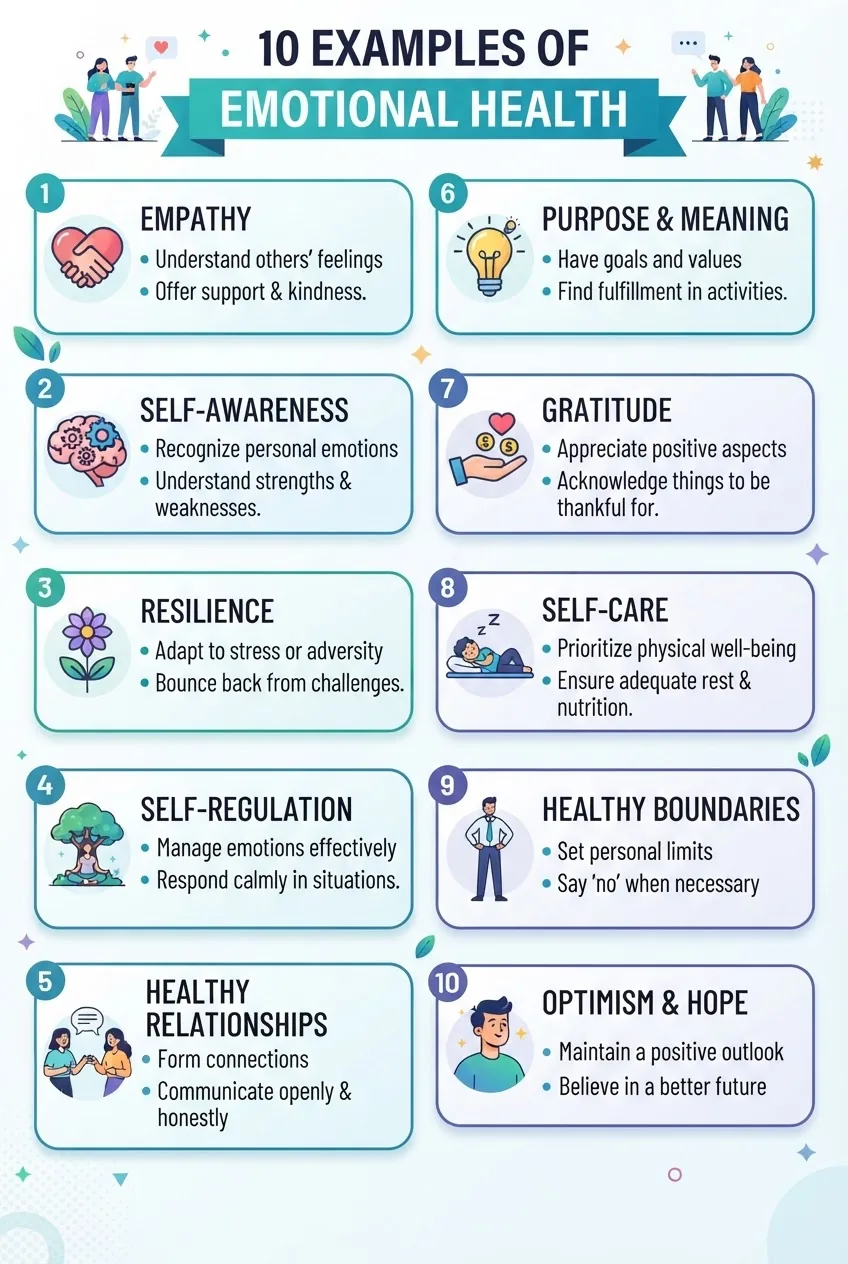
-
Recognizes and names emotions: Signal — openly says “I’m feeling frustrated” versus unexplained irritability. Quick practice — label one emotion aloud each time you sit for five breaths.
Why it matters: Naming reduces physiological arousal and supports regulation (basic emotional regulation example).
- Accepts emotions without over-identifying: Signal — notices sadness but avoids “I am my sadness” thinking. Quick practice — use the phrase “I am noticing sadness” to create separation.
- Recovers from setbacks (emotional resilience example): Signal — experiences disappointment but resumes routine within days. Quick practice — schedule a “bounce-back” plan with one restorative activity within 48 hours.
-
Shows empathy and attuned listening: Signal — asks follow-up questions and validates others’ feelings. Quick practice — in one conversation, mirror back what you heard before responding.
This supports social bonds, a core of emotional wellbeing.
- Uses healthy coping strategies: Signal — chooses a walk or talk with a friend over avoidance or substance use. Quick practice — choose and rehearse two coping options for common triggers.
-
Maintains steady daily routines: Signal — sleeps, eats, and exercises with reasonable consistency; emotional balance often follows. Quick practice — set consistent sleep/wake times (±30 minutes).
Related: see well-being examples for lifestyle anchors.
- Sets and defends healthy boundaries: Signal — can say “no” without guilt when overloaded. Quick practice — script a 10‑word “no” that feels truthful and polite.
- Practices self-compassion: Signal — treats self kindly after mistakes. Quick practice — write a short supportive note to yourself when you make an error.
- Seeks connection when needed: Signal — asks for help rather than isolating. Quick practice — identify one trusted contact and message them once this week.
-
Constructively manages negative thoughts: Signal — reframes catastrophic thinking into manageable steps. Quick practice — use a five‑sentence CBT reframing template twice in stressful week.
For more examples and tools see emotional wellness examples and resources.
How to Be Emotionally Healthy: Core Principles
Being emotionally healthy relies on consistent habits and a few core principles. Below are concise principles with practical explanations you can adopt immediately.
- Emotional self-awareness: Notice feelings early and objectively; tracking mood ratings is a direct way to build this skill. See the key components of mental health to understand where emotional factors fit.
- Active regulation: Use short tools (breathing, labeling, grounding) to reduce reactivity. Practices from mindfulness-based stress reduction and core CBT work well here.
- Adaptive coping: Replace avoidance with approach strategies (problem-solving, social support). Emotional resilience develops with repeated adaptive coping wins; learn the benefits of good mental health for motivation.
- Mind-body integration: Honor the interplay of sleep, movement, and affect; small changes in physical health reliably influence emotional state.
- Consistent micro-practices: Daily 5–15 minute routines (breathing, journaling, short walks) have measurable effects over 4 weeks.
- Social nourishment: Prioritise at least one meaningful social interaction weekly to buffer stress and reinforce emotion regulation.
Transition: now that you understand principles, the next section provides step-by-step, evidence-backed techniques to put them into daily practice.
Practical Emotional Wellness Tips to Improve Your Emotional Health

The tips below are arranged as practical actions with step-by-step guidance so you can implement them immediately. Each tip includes timing, frequency, and measurable thresholds to judge progress.
- Daily 5‑minute grounding (every morning): Sit upright, set a timer for 5 minutes, inhale for 4 counts, exhale for 6 counts, repeat 5 times while naming one present sensation. Track subjective calm after each session (0–10). Aim for a 2‑point improvement in 2 weeks.
- Evening reflective journaling (8–10 minutes nightly): Use prompts: “What went well?”, “What was hard?”, “One intention for tomorrow.” Keep entries to 3–6 sentences. Expect clearer emotional patterns after seven entries.
- Micro-exposure to avoidant triggers (weekly): If avoidance is common, pick one small trigger, plan a 10–20 minute controlled exposure with a coping strategy ready. Repeat 2–3 times; measure distress before/after on a 0–10 scale.
- 5‑4‑3‑2‑1 grounding (as needed): Name 5 things you see, 4 you can touch, 3 you hear, 2 you smell, 1 you taste. Use once during spikes of intense emotion to interrupt escalation.
- CBT reframing template (twice weekly): Write the automatic thought, evidence supporting it, evidence against it, realistic alternative, and one small next step. This practice strengthens cognitive flexibility over 4–6 weeks.
- Short movement bursts (3× per week): 15 minutes of brisk walking or bodyweight movement elevates mood and lowers anxiety. Watch for a 10–20% boost in subjective wellbeing within two weeks. See physical activity and mental health for guidance.
- Social micro-checks (once weekly): Send a 2‑sentence check-in to a friend or schedule a 15‑minute call. Social contact reduces loneliness and improves emotion regulation.
- Structured worry time (10 minutes daily): Allow yourself 10 minutes to list worries and assign action vs acceptance; defer unresolved worries to the next day’s 10‑minute slot to limit rumination.
- Progressive muscle relaxation (twice weekly, 10–15 mins): Tense each muscle group 5 seconds, release 10 seconds, progress head-to-toe. Track sleep quality impact over two weeks.
- Increase pleasant activities (3× week): Schedule activities that produce small pleasures (tea ritual, short read). Use ratings (0–10) to monitor uplift and adjust frequency.
-
Use guided mindfulness (daily, 5–20 minutes): Select a 5–10 minute guided practice, stick to one teacher for 2 weeks to build familiarity. Meta-analyses show consistent short practices reduce emotional reactivity (peer-reviewed study).
For longer stress-focused sets, consult episodic stress management.
- Mind-body medicine techniques (2–3× week): Try guided body scans or breathwork for 10–20 minutes; measure heart rate or self-reported calm to track effect. See top resources on mind body medicine benefits.
- Leverage stress-relief toolkits: Keep a short list of “first response” tools (breathing, call friend, 5‑minute walk). If stress is a frequent trigger, use targeted stress relief tips in that toolkit.
Real-life case (fictionalized): “Maya”, a teacher, logged morning and evening moods and added a 5‑minute grounding exercise. Within three weeks her average daily mood rose from 5.1 to 6.8 (scale 1–10); she reported fewer evening ruminations and better sleep. Small, consistent habits produced measurable change.
Transition: these daily techniques strengthen the mind-body loop; the next section explains how emotional care fits into overall wellbeing.
The Role of Emotional Care in Overall Wellbeing
Emotional care is the practice of actively tending to feelings as you would exercise or nutrition. The mind-body connection means emotions change physiology: chronic emotional strain can alter sleep, inflammatory markers, and cardiovascular function. For a deeper look at the physiological impact, see the pillar resource on the physiological effects of poor mental health.
Emotional care examples include short daily practices (breathwork), relational care (checking in), and structural care (schedules and sleep). These interact with broader frameworks like meaning in mental health and the idea of mind, body and spirit wellness to support long-term resilience.
Integrating spirituality or personal meaning can be helpful for many people; review approaches in a holistic wellness context if that resonates.
When to Seek Emotional Help and Support
Self-help has limits. Seek support when emotional distress disrupts daily function, safety, or relationships.
- Persistent mood changes lasting >2 weeks that interfere with work or relationships.
- Frequent panic, overwhelming anxiety, or suicidal thoughts — seek immediate professional care.
- Using substances to cope or withdrawing from all social contact.
- Feeling unable to perform basic tasks like personal care, child care, or work.
Recognizing subtle cues can help: if you notice unnoticed stress symptoms are present alongside low mood, consult a professional.
If you’re considering options, explore mental health coaching and evidence-based therapies. For clinical conditions, review mental health disorders and treatment pathways.
For professional credentials or training routes, consider wellbeing coaching certification.
If clinical care is needed, read about treatment options in mental illness remedies and consult a licensed clinician rather than relying on self-help alone.
Summary and Daily Practices for Sustained Emotional Wellness
Sustained emotional wellness comes from small, repeatable actions: noticing emotions, short daily regulation practices, weekly social contact, and schedule consistency. Use the checklist below to verify your daily and weekly habits.
Checklist — daily and weekly
| Practice | Frequency/Target |
|---|---|
| Grounding or breathwork | Daily, 5 minutes |
| Reflective journaling | Nightly, 8–10 minutes |
| Pleasurable activity | 3× weekly, 10–30 minutes |
| Physical activity | 3× weekly, 15 minutes or more |
| Social check-in | Weekly, 15 minutes |
When to call a professional
If you experience safety concerns, persistent impairment >2 weeks, increased substance use, or suicidal thoughts, contact a licensed mental health professional or emergency services. For exploration of clinical causes, review causes of mental illness and consult a clinician.
Final takeaways: focus on short daily practices, track measurable changes, and lean on social supports. If you want a structured 4‑week starter plan, try the step sequence at the top of this guide for a clear path to improvement.
Ready to start? Pick one 5‑minute practice today and commit to it for 14 days. If you’d like more tailored support, consider exploring certification or coaching pathways described earlier or seek a licensed clinician.
Disclaimer: This article is informational and not a substitute for professional medical advice. If symptoms are severe or persistent, please contact a qualified health professional. For authoritative definitions see American Psychiatric Association resources or your local health department like Australian Government Health.