

Mind body medicine is a clinical approach that uses evidence-based behavioral, psychological and physical practices—like meditation, breathwork and movement—to intentionally influence physiological systems and improve health outcomes across chronic pain, anxiety, immunity and cardiovascular function within conventional care. It treats mind and body interactions as measurable, modifiable pathways.
What Is Mind Body Medicine?
Answer: Mind body medicine is a medical field that applies behavioral and mind-centered techniques to prevent and treat illness by targeting interactions among the nervous, endocrine and immune systems, improving physical and mental health through structured therapies integrated with conventional care.
Mind body medicine: a clinical approach using intentional mental and behavioral techniques to influence bodily systems and clinical outcomes.
As a defined discipline, mind body medicine distinguishes itself from general wellness, emotional coaching or spiritual healing by operating within medical and research frameworks: it selects interventions with measurable physiological effects and clinical evidence, integrates with standard treatments, and is delivered by trained clinicians or therapists where appropriate.
Historically, practices coupling mental training and physical outcomes date back millennia (yoga, tai chi, contemplative traditions). Modern mind body medicine crystallized in the 20th century as biomedicine adopted behavioral science and the biopsychosocial model—an integrative framework that views biological, psychological and social factors as co-determinants of health.
Biopsychosocial model: a medical framework positing that biological, psychological and social factors jointly influence health and disease.
Key distinguishing features of mind body medicine:
- Clinical orientation: aims for measurable health outcomes and often studied in trials.
- Physiological targets: interventions selected for effects on the autonomic nervous system, neuroendocrine signaling and immune modulation.
- Integration: used alongside pharmacology, surgery or psychotherapy, not as exclusive replacements.
- Standardizable techniques: protocols like mindfulness-based stress reduction (MBSR) or biofeedback that can be trained and audited.
Mind body medicine uses a language of mechanisms—how thoughts, attention and behavior alter physiology—rather than purely subjective wellness claims. That is why clinical research and translational science are central to the field’s development and acceptance in mainstream care.
Transition: Understanding these clinical claims requires a clear look at the scientific foundations that explain how mind and body interact.
Scientific Foundations of Mind Body Medicine
Answer: The science behind mind body medicine centers on psychoneuroimmunology, neuroplasticity, autonomic nervous system regulation and placebo mechanisms, with the biopsychosocial model linking psychological states to measurable physiological change.
Psychoneuroimmunology: the study of how psychological processes influence nervous system and immune function.
Research shows several consistent pathways through which mental and behavioral interventions exert effects:
-
Autonomic nervous system regulation. The autonomic nervous system (ANS) balances sympathetic (fight/flight) and parasympathetic (rest/digest) tone; mind body practices commonly reduce sympathetic arousal and increase parasympathetic activity, measurable by heart rate variability (HRV) improvements.
-
Neuroendocrine modulation. Stress signaling pathways—principally the hypothalamic-pituitary-adrenal (HPA) axis—change cortisol and catecholamine profiles in response to chronic stress; interventions can lower baseline cortisol reactivity and blunt harmful downstream effects.
-
Psychoneuroimmunology (PNI). PNI documents how mental states alter immune cell distribution, inflammatory cytokine levels and antibody responses. For example, mindfulness training has been associated with reductions in pro-inflammatory markers in multiple studies.
-
Neuroplasticity. Repeated mental training alters brain networks—strengthening regulatory circuits (prefrontal cortex, anterior cingulate) while reducing default-mode hyperactivity—supporting durable changes in emotion regulation and pain perception.
Neuroplasticity: the brain’s ability to reorganize neural connections in response to experience or training.
-
Placebo and expectancy effects. The placebo effect reflects how beliefs and treatment context mobilize endogenous healing pathways—endorphins, dopamine, and immune modulators—demonstrating that expectation itself carries measurable physiological consequences.
Placebo effect: physiological changes that occur due to positive treatment expectations rather than the specific active component of an intervention.
Illustrative examples linking mechanisms to outcomes:
- Example: HRV improvement after paced breathing. Slow diaphragmatic breathing at 4–6 breaths per minute raises HRV and parasympathetic activity, which is associated with reduced anxiety and improved cardiovascular markers.
- Example: Mindfulness and inflammation. A systematic review found mindfulness-based interventions reduced markers like CRP and IL-6 in several populations, suggesting immune modulation (source: PubMed literature).
- Example: Neuroplastic change in chronic pain. Neuroimaging studies demonstrate altered connectivity after pain-targeted mind body programs, paralleling reported pain reduction and functional gains.
Population and epidemiologic context help explain demand for mind body medicine: stress-related disorders and chronic conditions are highly prevalent, creating a clinical need to attenuate physiological stress pathways. For background data, see stress and physical illness relationship.
Psychological stressors—work demands, caregiving, trauma—produce predictable endocrine and autonomic responses; readers seeking a breakdown can review common stressors and their health impact.
Evidence synthesis and authority: The National Center for Complementary and Integrative Health (NCCIH) provides summaries of mind-body practices (NCCIH mind-body overview), and peer-reviewed trials on PubMed show reproducible physiological effects across diverse interventions (PubMed).
Clinical researchers quantify effects using objective measures—HRV, cortisol, cytokines, neuroimaging—so mind body medicine occupies a translational niche: mechanistic science informs clinical protocols, and clinical outcomes feed back into mechanistic refinement.
Transition: With mechanisms clarified, consider the specific practices clinicians and patients use to produce these measurable effects.
Core Practices and Techniques Used in Mind Body Medicine
Answer: Core mind body medicine techniques include meditation and mindfulness, yoga and tai chi, breathing and stress-reduction methods, biofeedback, guided imagery, and movement therapies—each selected for reproducible physiological effects and clinical applicability.

-
Meditation and mindfulness — Structured attention training (focused attention, open monitoring) that reduces rumination and increases regulatory brain activity; used in programs like MBSR and MBCT.
- Mechanism: strengthens prefrontal control, decreases amygdala reactivity.
- See stress relief tips for practical mindfulness entry points.
-
Yoga and tai chi — Mindful movement practices combining posture, breath, and attention that improve autonomic regulation, flexibility, and pain tolerance.
- Mechanism: reduces sympathetic tone, enhances circulating endorphins.
-
Breathing and paced respiration — Techniques like diaphragmatic breathing and cyclic sighing that directly shift ANS balance and lower physiological arousal.
- Mechanism: vagal afferent stimulation increases parasympathetic activity.
- For targeted protocols, see episodic stress management techniques.
-
Biofeedback and neurofeedback — Technology-assisted training that gives real-time data (HRV, muscle tension, EEG) so patients learn to self-regulate physiological states.
- Mechanism: operant learning accelerates autonomic control and symptom reduction.
- Guided imagery and relaxation training — Directed visualization and progressive muscle relaxation that reduce sympathetic activation and improve sleep and pain control.
- Cognitive-behavioral techniques integrated with mind body practice — Reframing, exposure, and activity scheduling combined with mindfulness to change illness behavior and perception.
- Movement therapies and somatic approaches — Feldenkrais, Alexander technique, and sensorimotor psychotherapy emphasizing body awareness to reduce chronic tension and pain.
-
Self-care education and empowerment — Teaching pacing, sleep hygiene, and lifestyle adjustments that sustain practice effects and enhance patient activation.
- Professionals may pursue wellbeing coaching certification to support patients.
- Integrative protocols — Multi-component programs (e.g., MBSR, MBCT, Mind-Body Skills Groups) that combine several methods for synergistic effects.
For strategies addressing acute stress, see evidence-based episodic stress management techniques and broader stress relief tips.
Comparison table: common techniques, primary targets, and typical clinical uses.
| Technique | Primary physiological target | Common clinical uses |
|---|---|---|
| Mindfulness meditation | Prefrontal regulation, reduced amygdala reactivity | Anxiety, depression relapse prevention, chronic pain |
| Yoga / Tai Chi | ANS balance, musculoskeletal flexibility | Pain syndromes, hypertension, mobility |
| Breathing exercises | Vagal tone, HRV | Panic attacks, acute stress, insomnia |
| Biofeedback | Autonomic markers, muscle tension | Headache, pelvic pain, anxiety |
Transition: Knowing techniques helps evaluate benefits—both physiological and psychological—that patients commonly experience.
Physiological and Psychological Benefits of Mind Body Medicine
Answer: Mind body medicine produces measurable physiological benefits (immune modulation, reduced inflammation, improved cardiovascular markers, pain reduction) and psychological benefits (reduced anxiety and depression, improved mood and resilience), supported by clinical trials and systematic reviews.
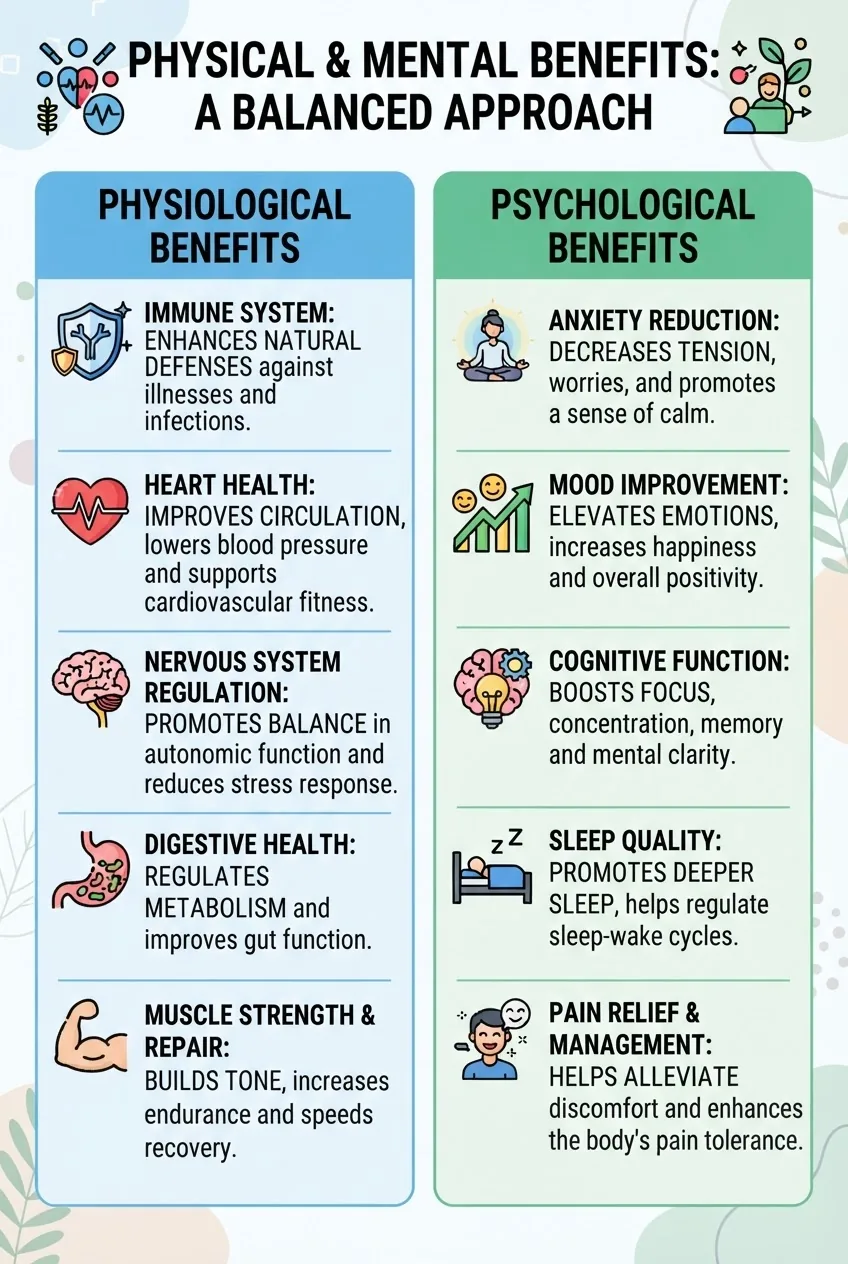
Physiological benefits
Answer: Physiological benefits include immune system modulation, reduced inflammatory markers, improved cardiovascular measures, nervous system regulation, and better pain processing.
- Immune system modulation: Mind body interventions can lower pro-inflammatory cytokines (e.g., IL-6) and modify immune cell profiles; a 2018 systematic review reported modest reductions in inflammatory markers after mindfulness-based programs (source type: peer-reviewed meta-analysis).
- Reduced inflammation: Reductions in C-reactive protein (CRP) and other markers have been observed following consistent practice, reflecting decreased chronic stress signaling.
- Cardiovascular improvements: Measures such as blood pressure, resting heart rate, and HRV commonly improve after yoga, meditation and breathing protocols, contributing to lower cardiovascular risk in cohorts (source type: controlled trials).
- Nervous system regulation: Increased vagal tone and improved HRV indicate stronger parasympathetic regulation, which is linked to better stress resilience and metabolic outcomes.
- Pain modulation: Mind body techniques change pain perception and central sensitization; randomized trials of MBSR and mindfulness-based interventions show clinically meaningful pain reduction in chronic low back pain and other conditions (source type: randomized controlled trials).
Read more about the physiological effects of poor mental health to see how mind body medicine targets those pathways.
Psychological benefits
Answer: Psychological benefits include reduced anxiety and depressive symptoms, improved mood and emotion regulation, greater resilience and coping, and enhanced cognitive focus and sleep quality.
- Reduced anxiety and depression: Meta-analyses report clinically significant decreases in anxiety and depressive symptoms after structured mind body programs such as MBSR and MBCT (source type: peer-reviewed meta-analysis).
- Improved mood and resilience: Strengthened top-down regulation supports quicker recovery from negative moods and prevents depressive relapse in high-risk groups.
- Enhanced sleep: Relaxation training and mindfulness improve sleep latency and quality in patients with insomnia and comorbid conditions.
- Better cognitive function: Attention and working memory show small-to-moderate improvements following sustained practice, consistent with neuroplastic changes.
- Patient empowerment: Self-regulation skills increase perceived control over symptoms and encourage proactive health behaviors, amplifying long-term benefits.
Psychological benefits are interdependent with physiological ones: reduced sympathetic arousal lowers inflammation, and improved mood enhances adherence to healthy behaviors—creating positive feedback loops.
Recognising stress signs and symptoms can guide timely mind body interventions.
For practical ways to support psychological gains, see emotional health improvement tips and emotional health definition.
Complementary benefits arise from an active lifestyle benefits that often accompany mind body practice.
Transition: These physiological and psychological effects make mind body medicine useful in several clinical contexts; next we review evidence-based applications.
Clinical Applications and Evidence-Based Uses
Answer: Mind body medicine is applied in chronic pain, anxiety and depressive disorders, cancer supportive care, cardiovascular risk reduction and as an adjunct for various physical health challenges; randomized and controlled trials support its use in specific conditions.
Clinical use cases and evidence examples:
- Chronic pain: Multiple randomized controlled trials show mindfulness and yoga reduce pain severity and improve function in chronic low back pain; one pragmatic trial found MBSR produced greater functional improvement versus usual care (source type: randomized controlled trial).
- Anxiety disorders: Mindfulness-based and breathing-focused interventions reduce panic and generalized anxiety symptoms and are effective adjuncts to CBT and pharmacotherapy (source type: systematic review).
- Depression prevention: Mindfulness-based cognitive therapy (MBCT) reduces relapse risk in recurrent depression compared with usual care (source type: randomized controlled trials and guideline statements).
- Cancer supportive care: Mind body programs alleviate fatigue, sleep disturbance and mood symptoms in cancer survivors and are recommended as complementary supportive treatments by oncology symptom management guidelines (source type: clinical guidelines).
- Cardiometabolic health: Programs that reduce blood pressure, sympathetic activity and stress-related behaviors support cardiovascular risk reduction as adjunctive strategies.
Case example (brief): A 52-year-old with chronic low back pain enrolled in an 8-week MBSR program embedded in primary care. Over 6 months the patient reported a 30% reduction in pain intensity, increased walking tolerance, and decreased opioid use; objective measures showed improved HRV. This mirrors outcomes reported in controlled studies and illustrates combined self-management and clinical oversight.
Study highlight: According to a 2022 systematic review in peer-reviewed journals (source type: peer-reviewed systematic review), mindfulness-based interventions produced small-to-moderate effects on anxiety and depression and modest effects on inflammatory markers across clinical populations.
For integration with psychiatric care, see options in mental health disorders treatment and consult multidisciplinary teams.
Mind body medicine can be part of strategies addressing physical health challenges when coordinated with medical treatments.
Guidelines and authoritative bodies: The American Psychological Association and NCCIH provide position statements and evidence summaries recommending certain mind body approaches as adjunctive treatments for specific conditions (NCCIH, APA: Stress).
Limitations in clinical evidence occur for heterogenous study designs, variable intervention fidelity, and short follow-up intervals—areas where ongoing research is clarifying effect sizes and mechanisms.
Transition: Practical application requires clear steps for individuals and clinicians; below are how-to recommendations and a brief guided technique to begin.
How to Incorporate Mind Body Medicine Into Daily Life
Answer: Incorporate mind body medicine by selecting evidence-based techniques, starting with short daily practices, tracking outcomes, seeking qualified instruction for clinical conditions, and integrating practices into routines for sustainable change.
Step-by-step starter plan:
- Select a simple, evidence-based practice: begin with 10 minutes of guided mindfulness, 10 minutes of diaphragmatic breathing, or 20 minutes of gentle yoga three times per week.
- Set measurable goals: track sleep quality, pain scores, mood ratings, or HRV where available to monitor physiological and psychological responses.
- Use structured programs when possible: enroll in MBSR, MBCT, or clinician-led biofeedback for targeted conditions.
- Combine practices with lifestyle changes: sleep hygiene, physical activity, and nutrition amplify effects—see mental health wellness tips and personal health examples.
- Seek professional guidance for clinical issues: consult primary care, pain specialists or mental health providers when symptoms are severe or persistent.
Mini guided breathing walkthrough (step-by-step):
- Sit upright comfortably with both feet on the floor and hands resting on your lap.
- Place one hand on your chest and one on your belly; breathe naturally for two cycles to feel baseline movement.
- Inhale gently through the nose for a count of four, letting the belly expand (not the chest).
- Pause for a count of one, then exhale slowly through the nose for a count of six, drawing the belly in.
- Repeat for 6–10 minutes while keeping attention on the breath; if the mind wanders, label the thought and return to counting.
- Finish by noticing heart rate and any changes in tension; log perceived calmness and physical markers if tracking progress.
For additional tools, consult emotional wellness resources and consider training in mental health coaching or wellbeing coaching certification if you plan to support others.
Practical tips:
- Start small and build consistency.
- Pair practice with daily cues (after morning coffee, before sleep).
- Use apps or group programs for adherence and teacher feedback.
- Track outcomes to maintain motivation and guide adjustments.
Transition: While accessible, mind body medicine also has limitations—knowing when to seek professional care is essential.
Limitations, Considerations, and When to Seek Professional Help
Answer: Mind body medicine is a complementary approach with evidence for specific conditions but has limitations including variable study quality, not substituting for urgent medical care, and potential contraindications for certain physical practices; seek professional guidance when symptoms are severe or progress.
Primary limitations and cautions:
- Evidence gaps: heterogeneous trials, small sample sizes, and short follow-ups limit certainty for some indications; long-term effects require more research (source type: peer-reviewed reviews).
- Not a replacement for medical care: mind body medicine should complement, not replace, indicated pharmacologic or surgical treatments—discuss integration with your clinician.
- Contraindications and safety: vigorous movement practices or certain breathwork may be contraindicated in unstable cardiac or respiratory disease; adapt intensity and consult providers.
- Expectation management: benefits vary by individual; the placebo and expectancy components can contribute but do not guarantee outcomes.
- Scope distinction: mind body medicine focuses on clinically measurable effects rather than spiritual claims—contrast this with broader mind body and spirit connection when spiritual practice is primary.
When to seek professional help:
- If pain, mood disturbance or functional impairment is severe, worsening or accompanied by red-flag symptoms (unexplained weight loss, neurological signs, suicidal thoughts), contact medical services immediately.
- If mind body techniques produce increased distress or symptoms, pause practice and consult a clinician or qualified therapist for tailored modification.
- Coordinate care: inform your primary care clinician about your mind body program so it can be safely integrated with medications and other treatments.
For broader perspectives on holistic integration, review the holistic wellness guide and weigh clinical priorities against spiritual aims.
Final summary: Mind body medicine offers evidence-based tools to modulate physiology and improve mental health; used wisely and in coordination with conventional care, it can expand treatment options and empower patients.