

What is emotional health? Emotional health means having awareness, understanding, and effective management of your feelings so they support rather than undermine daily functioning, relationships and long-term wellbeing; it combines self-awareness, emotional regulation, resilience and adaptive coping to maintain balance across life’s demands.
This guide moves from a clear definition into practical distinctions, examples, and step-by-step ways to improve emotional health, linking scientific evidence and trusted resources throughout.
Understanding Emotional Health: Definition and Explanation?
Answer: Emotional health is the state of recognizing, understanding and managing emotions so they aid decision-making, relationships and physical wellbeing rather than impair them; it’s a dynamic, learnable capacity that supports adaptive behaviour, social connection and long-term resilience.
Term: Emotional health—the ability to perceive, use, understand and regulate emotions in ways that promote wellbeing and functioning.
Define emotional health simply as “fitness for feelings”: like physical fitness trains muscles, emotional health trains awareness and response patterns so emotions help you perform and connect. Historically, emotion was separated from clinical mental health; modern integrative models (biopsychosocial and affective neuroscience) place emotions centrally in health, learning and behaviour.
Emotional health draws on related concepts:
- Emotional regulation — conscious and automatic processes that influence when and how you experience and express emotions.
- Emotional intelligence — the set of skills for perceiving, reasoning about and managing emotions.
- Psychological resilience — the capacity to recover and adapt after setbacks.
Clinical and public-health definitions matter for measurement. For an authoritative global framing, see the World Health Organization (WHO), which situates emotional wellbeing within broader mental-health frameworks and population health efforts (source: WHO informational page).

Measuring emotional health typically uses validated tools (self-report scales for mood regulation, emotion-labelling, social functioning). Maintaining emotional health is not absence of negative feelings but competence in responding when those feelings arise.
Emotional Health vs. Emotional Wellness: What’s the Difference?
Answer: Emotional health is a measurable capacity to manage emotions; emotional wellness is a broader, ongoing practice and state that includes lifestyle, supports and values that sustain emotional health over time.
Term: Emotional wellness—an active pursuit of habits, environments and supports that nurture emotional health and life satisfaction.
| Emotional Health | Emotional Wellness |
|---|---|
| Skill-based: awareness, regulation, resilience, measured clinically. | Habit-based: routines, relationships and environments that support emotions. |
| Focus on functioning: decision-making, work, social life. | Focus on quality of life: purpose, values, self-care. |
| Clinically relevant: assessed by psychologists or tools. | Community & lifestyle: wellness programmes, peer supports. |
| Target for interventions like therapy or emotion-skills training. | Target for public health, workplace wellbeing and habit formation. |
Both terms overlap: emotional health skills are the building blocks; emotional wellness is the environment and habits that keep those skills active. Think of emotional health as cardiovascular fitness and emotional wellness as the lifestyle (sleep, diet, social support) that preserves it.
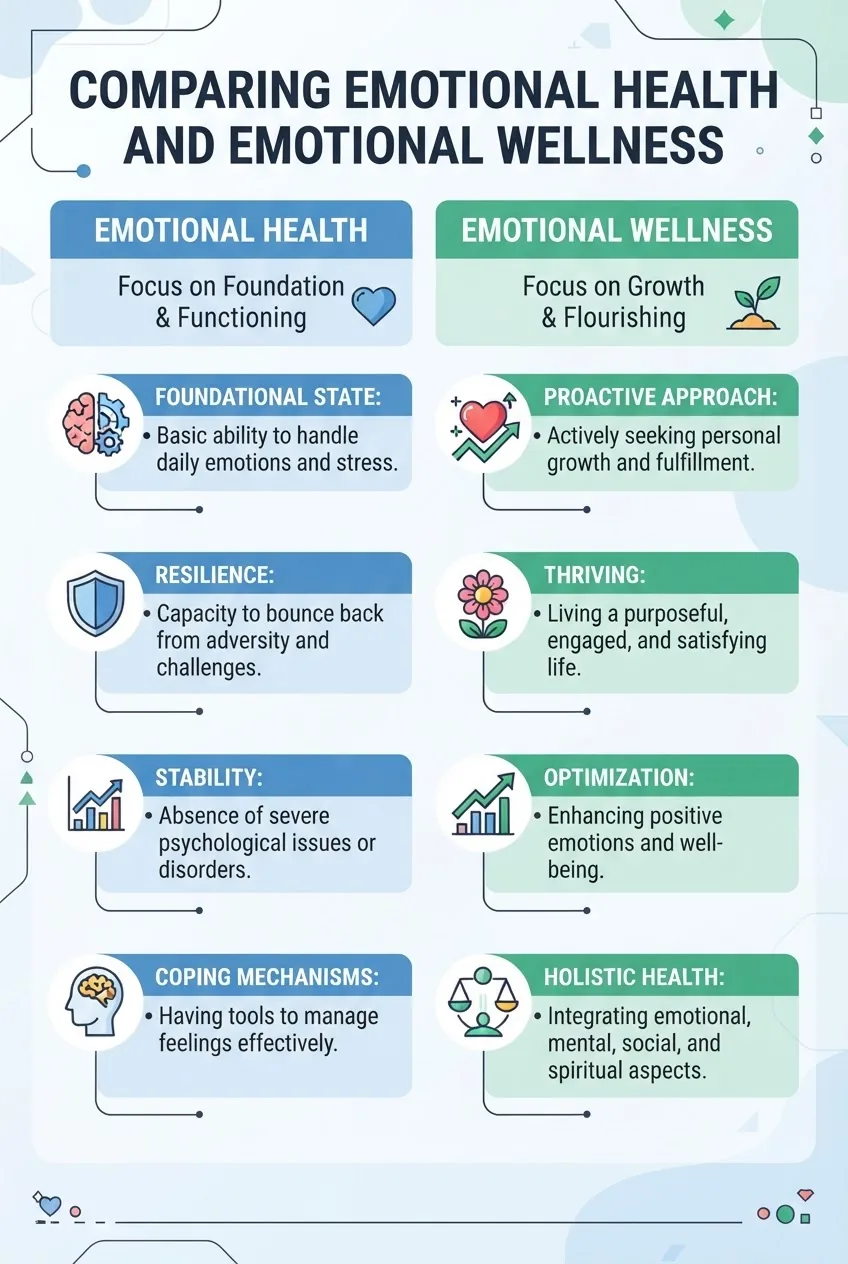
Practical implication: interventions often blend skill training (emotion regulation, CBT) with wellness supports (social connection, routines) to produce lasting benefits.
Why Is Emotional Health Important?
Answer: Emotional health underpins decision-making, relationships, physical health and recovery from adversity; strong emotional health lowers risk of chronic illness, improves productivity and strengthens social bonds, making it central to overall wellbeing.
Key benefits and impacts:
- Better physical health: Adaptive emotional responses reduce allostatic load and inflammation associated with chronic illness; see links on stress effects on physiological health.
- Improved relationships: Emotionally healthy people communicate needs and set boundaries more effectively.
- Work and learning: Emotional regulation supports concentration, problem-solving and creativity.
- Faster recovery: Resilience aids recovery from setbacks, illness and loss.
- Lower risk of mental disorders: Strong emotion skills reduce escalation into persistent depression or anxiety in many cases.
According to a 2023 systematic review published in a peer-reviewed journal, interventions that improve emotional regulation showed moderate effects on reducing depressive symptoms (source type: peer-reviewed meta-analysis).
Emotional health is tightly linked to stress exposure: research summarised in public health resources shows common stressors create physiological burdens that erode emotion capacity — explore common stressors and their health impact for examples.
For evidence on population-level benefits, see benefits and key factors of good mental health and integrative models like mind, body, and spirit wellness.
Lifestyle actions that preserve emotional health also preserve physical health — for evidence-based programs combining movement and emotion support, see benefits of physical activity on emotional health and integrative care models like mind–body medicine (definition and benefits of mind-body medicine).
Signs and Examples of Good Emotional Health?
Answer: Signs of good emotional health include accurate self-awareness, consistent emotional regulation, healthy boundaries, constructive coping under stress, social reciprocity and quick recovery from setbacks.
Term: Emotional self-awareness—recognising and naming your emotions accurately as they arise.
- Accurate self-awareness: You can name feelings (sad, frustrated, proud) and link them to events. Example: after missing a deadline, you notice frustration and choose to ask for help rather than self-blame. For more relatable lists see examples of emotional health and wellness tips.
- Adaptive regulation: You calm yourself when overwhelmed and let yourself feel joy without guilt. Example: using a short breathing routine before a difficult conversation.
- Constructive coping: You use problem-solving or support-seeking rather than avoidance. Case scenario A: A teacher feeling burnout schedules brief daily restorative breaks and seeks peer supervision, reducing irritability within weeks.
- Healthy relationships: You maintain reciprocal support and set boundaries. Example: declining a social request when you need rest, then explaining why.
- Resilience: You recover after setbacks and adapt plans. Case scenario B: After job loss, one person reframes the event as transition, updates skills and finds new employment in months.
- Consistent functioning: Emotions rarely prevent day-to-day tasks; mood fluctuations are proportional to events.
For additional curated examples and resource lists, explore emotional wellness examples and resources and personal health and wellness examples.
Relationship Between Emotional Health and Mental Health?
Answer: Emotional health is a component and predictor of broader mental health; they overlap but differ—mental health includes diagnosed conditions and cognitive functioning, while emotional health focuses on emotional skills and regulation that influence mental disorder risk and recovery.
Define mental and emotional overlap: mental health covers mood, cognition, behaviour and psychiatric diagnoses; emotional health covers the moment-by-moment management of feelings that feed into those domains. Both are integrated in the biopsychosocial model: emotions influence physiology, cognition and social behaviour.
Scientific nuance: poor emotional regulation increases vulnerability to depression and anxiety via pathways like chronic stress, sleep disruption and inflammatory processes. According to a 2022 peer-reviewed meta-analysis, emotion-regulation interventions reduce symptom severity for anxiety and depression (source type: peer-reviewed meta-analysis).
Trade-offs of neglect: prolonged emotional dysregulation contributes to allostatic load, raising risk for cardiovascular, metabolic and immune issues; see the pillar discussion on physiological effects of poor mental health.
For data-driven background, consult key mental health facts and statistics and foundational overviews like definition and role of mental health, which clarify the components that support emotional wellbeing.
How to Improve and Maintain Emotional Health?
Answer: Improve emotional health by building self-awareness, practicing emotional regulation techniques (mindfulness, journaling, breathing), strengthening social supports, maintaining healthy routines and, when needed, engaging evidence-based therapies or coaching for skills training.

Define an actionable plan: combine daily micro-practices (5–20 minutes) with weekly habits (exercise, meaningful social time) and periodic skill trainings (CBT-based emotion work, coaching).
- Step 1 — Track emotions: Keep a simple daily log for two weeks: note situation, emotion (label), intensity (1–10) and response. This builds emotional self-awareness fast.
- Step 2 — Practice a regulation tool (walk-through): Breathing and grounding technique — 1) Sit comfortably for 2–5 minutes. 2) Breathe in for 4 seconds, hold 4, out for 6 (repeat 6–8 times). 3) Name one physical sensation, one thought and one need. This sequence calms the autonomic response and clarifies action.
- Step 3 — Use cognitive techniques: Brief cognitive reappraisal: identify an automatic negative thought, test its evidence, generate a balanced alternative. Evidence-based cognitive strategies reduce mood symptoms (source type: peer-reviewed clinical trials).
- Step 4 — Build social supports: Schedule weekly connection and practice asking for help; social reciprocity protects emotional health.
- Step 5 — Lifestyle supports: Prioritise sleep, movement and nutrition; these modulate mood and resilience — see benefits of physical activity on emotional health.
- Step 6 — Skill training or coaching: Consider short courses or coaching if you want guided skill acquisition. Explore certification and training resources such as mental health coaching training and certification or wellbeing coaching certification for structured learning.
Real-life example: Maria used two weeks of emotion tracking plus daily 5-minute breathing to notice a pattern of evening anxiety linked to caffeine and late work; after adjusting habits and practicing reappraisal she reported fewer racing thoughts within three weeks.
Evidence-based practices include mindfulness-based interventions, CBT emotion skills training and structured coaching models; these show measurable improvements in regulation and wellbeing across randomized controlled trials (source type: peer-reviewed clinical trials).
For practical tip lists and ongoing routines, see effective mental health tips and examples in examples of emotional health and wellness tips. If you aim for holistic balance, check resources on being being physically, mentally, and emotionally healthy.
Challenges to Emotional Health and When to Seek Help?
Answer: Challenges include chronic stress, unresolved trauma, persistent dysregulation and social isolation; seek professional help when symptoms impair daily functioning, persist for weeks, or include suicidal thoughts, severe withdrawal, or substance misuse.
Common challenges and troubleshooting tips:
- Hidden stress: Unnoticed chronic stress undermines emotion capacity; review signs and symptoms of unnoticed stress and symptoms and relief tips for stress.
- Episodic overload: Repeated acute stress can escalate — consider coping plans in episodic stress types and management.
- Biological contributors: Physical illness or hormonal changes can mimic or worsen emotional symptoms; see physical health challenges impacting emotional health.
Red flags to seek professional care:
- Severe functional decline at work/school or with family.
- Persistent suicidal thoughts or self-harm.
- Substance dependence to manage emotions.
- Symptoms lasting several weeks despite self-care.
According to a 2024 national health report (source type: government health report), many people delay care because they minimise symptoms—early intervention improves outcomes. For treatment options see mental illness treatment and remedies and symptom guides like definition and symptoms of psychological distress.
If physiology is suspected, consult resources on the biological stress response such as nervous system and hormone impacts of stress and the authoritative American Psychological Association (APA) for guidance on therapy options (source type: professional association).
If you’re unsure whether to seek help, talk to a trusted health professional, or use a brief screening tool; many clinicians and coaches offer initial consultations and stepped-care options to match need with intensity of support.
Caveat: Research and practice evolve; individual needs vary. Professional assessment is the reliable route to diagnosis and tailored care.