
By the end of this hands-on guide you will have practiced and memorised a set of reproducible, timed routines to reduce immediate anger and a weekly plan to lower angry reactivity over 6–8 weeks; total active practice time: 10–25 minutes daily; skill level: beginner to intermediate with clear, step-by-step instructions.
Before you start
- Quiet space or a chair/cushion, free of distractions for 5–20 minutes
- Timer or phone (use airplane mode if needed)
- Notebook and pen for mindful journaling
- Water bottle and comfortable clothing
- Knowledge that mindfulness is an adjunct to therapy—not a replacement for acute care
Understanding Anger and Mindfulness
This section explains what anger is biologically and how mindfulness engages the mind-body pathways that modulate it. You will see why targeted exercises—distinct from generic stress-relief—work for anger specifically.
Anger arises from a chain: an external or internal stimulus, appraisal of threat or injustice, activation of the autonomic nervous system (the fight-or-flight response), and action tendencies (shout, withdraw, strike). The brain regions most involved are the amygdala (fast threat detection), the anterior cingulate cortex and prefrontal cortex (emotion regulation and decision-making). This mind-body connection explains why somatic exercises—breath work, body scanning and grounding—can quickly change how anger feels and how it is expressed.
Mindfulness is typically defined as sustained, non-judgmental awareness of present-moment experience. Formal programmes such as Mindfulness-based stress reduction (MBSR) teach attention training, body awareness and acceptance skills over 8 weeks. Clinical studies show that MBSR and similar programmes strengthen prefrontal control over limbic reactivity, improving emotional regulation—the same capacity needed to manage anger.
According to a 2023 peer-reviewed meta-analysis published in a psychology journal, mindfulness-based interventions reduce anger expression and increase emotional awareness in clinical and non-clinical samples (peer-reviewed psychology journals provide the primary evidence base). For accessible clinical guidance on anger and management strategies, see the American Psychological Association’s resources on anger management.
American Psychological Association: Anger
MBSR and similar trainings (MBCT, acceptance-based protocols) emphasise three mechanisms relevant to anger: (1) increased breath awareness exercises and capacity to shift attention, (2) enhanced interoceptive awareness via body scan meditation, and (3) cultivation of non-judgmental awareness and acceptance that reduce rumination after an episode. These capacities work together to interrupt the trajectory from trigger to outburst.

Brief case example: a 42-year-old teacher reported frequent angry outbursts after staff meetings. After a 6-week practice combining brief breath awareness, a 10-minute nightly body scan, and weekly mindful journaling, she reported fewer instances of shouting and clearer signalling before reacting. Clinically, we track frequency (baseline: 3–4 outbursts/week) and intensity (self-rated 1–10). Her frequency halved by week 6 and intensity dropped from 8 to 4 on average—consistent with controlled trials showing practical benefits for anger control.
Definitions of technical terms used here: cognitive defusion means noticing thoughts as passing events in the mind rather than literal commands; non-judgmental awareness refers to observing feelings without adding criticism; emotional regulation is the set of processes that alter which emotions we have and how we experience/express them.
If you want to explore related anxiety-focused practice techniques, see the pillar on mindfulness exercises for anxiety.
How Mindfulness Exercises Help Manage Anger
Transition: now that you understand the biology and theoretical mechanisms, this section shows how targeted mindfulness practices change the anger process in everyday moments.
Mindfulness creates two immediate capacities relevant to anger management: stronger emotional awareness (recognising the rise of anger early) and improved self-regulation (choosing a response rather than reacting). When an anger trigger occurs—an unfair comment, a traffic jam—the brain originally moves quickly from perception to arousal. Mindfulness introduces a brief interruption: a deliberate attention shift (for example, a breath) that reduces physiological arousal and opens the window for cognitive reappraisal.
Example scenario: You get cut off in traffic. The automatic response is an adrenaline surge and the thought “What an idiot”—a trigger loop. A simple breath awareness routine cuts the loop: inhale for 4 counts, exhale for 6 counts, focus attention on the chest for 30 seconds. This breath shift lowers heart rate and reduces amygdala reactivity, producing a measurable drop in subjective anger and an increased chance of a constructive response.
Mechanisms in plain language: breath control regulates the vagus nerve and parasympathetic tone; body scanning detects where anger tightens the body (jaw, shoulders) and releases it; grounding techniques re-orient attention to sensory input—reducing catastrophic thinking. These physiological shifts align with the neurobiology of anger: increasing top-down prefrontal influence, damping limbic hyper-reactivity, and reducing the fight-or-flight cascade.
For a focused summary of the broader physiological and psychological benefits of meditation that extend to anger control, see the benefits of meditation guide.
Top Mindfulness Exercises Specifically for Anger Management
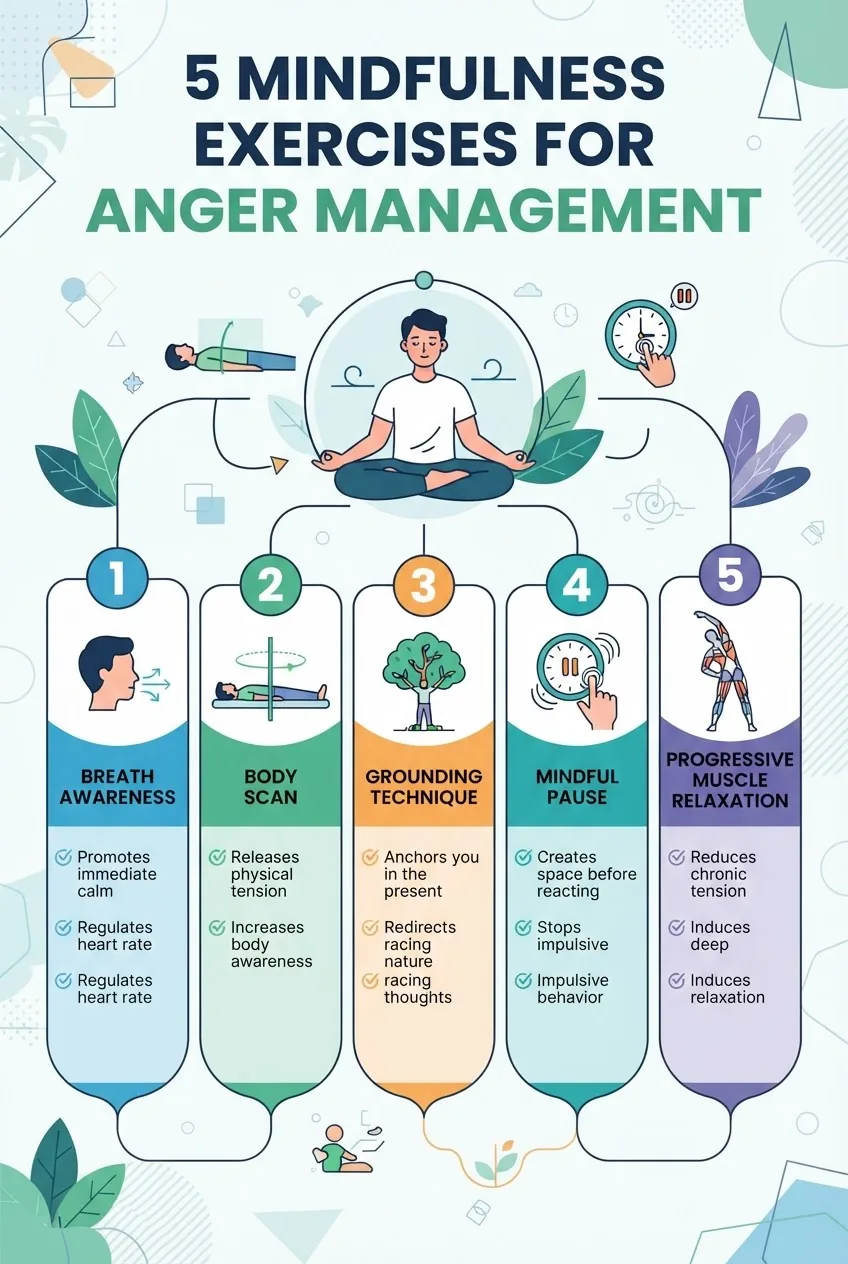
Transition: below are practical, timed routines you can do in the moment (acute anger) or as a daily practice to reduce baseline reactivity. Each numbered exercise is a step-by-step routine with posture, timing, focus points and expected effects.

-
Acute Breath Reset — 90 seconds
- Posture: Sit upright or stand, feet flat, shoulders relaxed.
- Timing: Set a timer for 90 seconds.
- Procedure: Inhale for 4 counts, hold 1 count, exhale for 6 counts. Repeat 10 cycles. Focus attention on the sensation of air at the nostrils and the rise/fall of the chest.
- Focus points: Count rhythm, chest movement, and the difference between inhale and exhale. If the mind wanders, gently return to counts.
- Why it helps: Breath awareness exercises activate the parasympathetic nervous system, lowering heart rate and softening the fight-or-flight response within 60–120 seconds.
- Tip: Use this as an immediate replacement for reacting—press an internal pause before speaking.
-
2-minute Grounding Anchors — 2 minutes
- Posture: Standing or seated.
- Timing: 2 minutes, with a 30-second countdown visible if possible.
- Procedure: Name silently: 5 things you can see, 4 things you can feel (texture, pressure), 3 sounds, 2 smells (or remembered smells), 1 breath. Keep words short and sensory-focused.
- Focus points: Sensory detail rather than narrative about the event.
- Why it helps: Grounding techniques pull attention from cyclical thoughts about injustice to present-moment sensory data, reducing rumination and physiological arousal.
- External resource: For more grounding scripts, see Guided Grounding Meditation Guide for Stress Relief Practice.
-
Full Body Scan for Tension Release — 10–12 minutes
- Posture: Lie on your back or sit with a straight spine.
- Timing: 10–12 minutes (5–6 minutes for a short version).
- Procedure: Starting at the toes, spend ~20–30 seconds noticing sensations (tingling, heat, pressure). Move attention slowly up the legs, hips, abdomen, chest, hands, shoulders, neck and face. Where you find tension, breathe into it for 3–4 breaths, imagining the exhale releasing tightness.
- Focus points: Naming sensations non-judgmentally: “tight,” “warm,” “numb.” Avoid story; simply label and move on.
- Why it helps: Body scan meditation increases interoceptive accuracy and reduces sympathetic activation tied to anger; it’s particularly effective for chronic irritability.
- Variations: A short 3-minute body-scan focused only on shoulders, jaw and chest works well during the day.
-
Mindful Pausing Protocol — 30 seconds
- Posture: Any.
- Timing: 30–60 seconds.
- Procedure: On noticing a trigger or rising anger, place a gentle hand on your chest, breathe deeply in for 4, out for 6, and silently ask: “What is happening? Where is the feeling?” Label it: “anger—tightness—heat.” Then choose your next action.
- Focus points: Simple labels and the physical anchor (hand on chest) to create cognitive defusion.
- Why it helps: Mindful pausing creates an opportunity for cognitive defusion—distancing from automatic thoughts—and allows top-down regulation to re-engage.
- Quick scripts: Keep a short mantra: “Pause, breathe, choose.”
-
Progressive Muscle Relaxation (PMR) — 8–12 minutes
- Posture: Lying or seated.
- Timing: 8–12 minutes.
- Procedure: Tense each muscle group for 5–7 seconds, then release for 15–20 seconds. Sequence: feet, calves, thighs, hips, abdomen, chest, hands, arms, shoulders, neck, face. Focus on the contrast between tension and release.
- Focus points: Notice how anger-related tension feels and how release changes breathing and heart rate.
- Why it helps: PMR reduces somatic arousal and interrupts the muscular patterns that sustain angry feelings.
- Resources: For structured PMR scripts, see Muscle Relaxation Meditation Guide with Progressive Techniques.
-
Short Cognitive Defusion Exercise — 3–4 minutes
- Posture: Seated.
- Timing: 3–4 minutes.
- Procedure: Take a specific angry thought (e.g., “They never listen”) and repeat it silently until it loses meaning (20–30 seconds). Then say: “I’m having the thought that they never listen.” Notice distance between thought and self.
- Focus points: Use language that separates thought from identity—”I notice I’m thinking…” rather than “They are awful.”
- Why it helps: Cognitive defusion reduces the believability of automatic judgments, lowering the emotional charge and creating room for alternative responses.
- Further reading: Cognitive defusion is used in acceptance and commitment therapy (ACT) and complements mindfulness practices.
-
Mindful Journaling for Trigger Mapping — 10 minutes, 3× weekly
- Posture: Seated with notebook.
- Timing: 10 minutes, three times a week.
- Procedure: After an episode or daily reflection, write: 1) trigger description, 2) physical sensations, 3) thoughts, 4) action/response, 5) alternative skill to try next time. Keep entries factual and time-stamped.
- Focus points: Track patterns of anger triggers and bodily signatures.
- Why it helps: Mindful journaling improves trigger recognition and supports long-term habit change by creating objective records of progress.
- Related resource: For templates and short prompts, see Guided Meditation Script Guide with Free Mindfulness Templates.
-
Self-compassion Practice — 5 minutes
- Posture: Seated, hand on heart.
- Timing: 5 minutes.
- Procedure: Notice the pain under anger and silently repeat: “May I be kind to myself in this moment. May I accept what I cannot change.” Breathe slowly and allow warmth in the chest.
- Focus points: Replace self-criticism with curiosity and kindness.
- Why it helps: Self-compassion practices reduce shame-driven anger and encourage repair-oriented responses rather than aggression.
-
Short Walking Meditation — 5–10 minutes
- Posture: Comfortable shoes, walk at a slow pace.
- Timing: 5–10 minutes.
- Procedure: Focus on the sensation in the feet and legs with each step. Breathe naturally and return attention to steps when the mind wanders.
- Why it helps: Walking meditation grounds the body and diffuses angry energy through movement instead of rumination.
-
Chair-based Grounding for Work — 60–90 seconds
- Posture: Seated in a chair, both feet on the floor.
- Timing: 60–90 seconds.
- Procedure: Press the soles into the floor, feel the chair supporting your weight, exhale fully and relax the jaw. Repeat a 4-6 breath cycle while focusing on feet and pressure.
- Why it helps: Minimal and discrete; suitable for workplace incidents when anger surfaces suddenly.
- Related: For short guided practices, check the quick mindfulness meditation resource.
-
Evening Reflective Practice — 8–12 minutes
- Posture: Seated with a notebook.
- Timing: 8–12 minutes nightly.
- Procedure: Recount one incident and write down sensations, trigger chain, and alternative responses you would try next time. End with one self-compassion statement.
- Why it helps: Consolidates learning and builds emotional regulation over time via repetition and reflection.
-
3-minute Quick Reset — 3 minutes
- Posture: Any.
- Timing: 3 minutes.
- Procedure: Follow a single cycle: 1 minute breath awareness, 1 minute body scan of shoulders/jaw, 1 minute grounding (5–4–3–2–1). Use when you need a fast recalibration.
- Why it helps: Compact and effective—pair this with the 3 minute meditation practice for a scripted version.
-
Breath Awareness and Longer Relaxation — 15–20 minutes
- Posture: Seated upright or lying.
- Timing: 15–20 minutes.
- Procedure: Combine 5 minutes breath counting (inhale 1, exhale 1 up to 10, then repeat), 5–10 minutes body scan, finish with 5 minutes of self-compassion phrases. This is a weekly in-depth practice to lower baseline reactivity.
- Why it helps: Longer sessions produce cumulative changes in brain connectivity associated with improved emotion regulation.
- Further reading: For deeper breath scripts, see breath awareness and relaxation exercises.
Common mistakes and how to avoid them
I’ve watched people expect instant transformation and then abandon practice. I learned to set measurable micro-goals: practice the 90-second breath reset daily and log frequency. Another common error is pushing for “no anger”—instead, I coach clients to aim for “less reactivity” and quick recovery. Finally, rushing exercises reduces effect; always time them and stick to the durations above.
Transition: with these concrete practices mastered, the next section covers how to make them part of your daily routine to reduce anger long-term.
Integrating Mindfulness into Daily Life to Reduce Anger
Transition: practical integration techniques turn sporadic use into steady habit formation, which is essential to lowering baseline anger and preventing relapse.
-
Schedule short daily sessions — 10–20 minutes total
Block two daily windows: a morning 5–10 minute breath/body practice and an evening 5–10 minute reflective practice. Consistency builds skill; aim for at least 5 days per week for 6–8 weeks to notice changes.
-
Use cues to form habits
Attach a 60–90 second grounding or breath reset to an existing habit (e.g., after brushing teeth or before lunch). Habit-stacking makes practice automatic and reduces friction.
-
Keep a trigger and response log (mindful journaling)
Record triggers, intensity (0–10), and the skill you used. Review weekly to detect patterns and choose targeted practices. Use the mindful journaling routine above at least three times per week.
-
Combine with movement practice
Pair mindfulness with a complementary physical routine such as a 30 day yoga challenge or brief daily stretching to regulate the nervous system and lower bodily tension that fuels anger.
-
Plan for high-risk moments
Identify times or people that regularly trigger you and pre-plan which 30–90 second skill to use (breath reset or grounding). Having a pre-committed response reduces impulsive behaviour.
-
Build social supports
Share your plan with one trusted person who can remind you or debrief with you after a difficult event; accountability increases adherence.
-
Measure and iterate
Track frequency and intensity of angry episodes weekly. Aim for a 25–50% reduction in frequency by week 6 as a reasonable benchmark; adjust practices if progress stalls.
-
Use additional resources for skills
Short guided scripts and classes accelerate learning. For short guided meditations, see the quick mindfulness meditation and the 3 minute meditation practice.
-
Pair with lifestyle supports
Prioritise sleep, moderate caffeine/alcohol, and regular movement. Yoga and aerobic exercise reduce baseline arousal—see research on yoga benefits for emotional health.
Additional Mindfulness Techniques to Complement Anger Management
Transition: the following complementary techniques extend core practices when you need deeper or different tools.
- Cognitive defusion — short scripts that label thoughts as “mental events” to reduce fusion with anger; useful after acute resets.
- Visualization — rehearse a calm response to a real trigger for 5 minutes; strengthens prefrontal planning.
- Emotional distancing — practice observing intense feelings from a third-person perspective for 1–2 minutes to reduce immediacy.
- Mindful communication — use “I” statements and a 10-second breath before speaking to avoid escalation.
- Relaxation exercises — timed PMR or breathing sequences for 8–20 minutes to lower physiological set-points.
- Advanced tools — biofeedback, paced breathing devices and HRV training for users needing measurable autonomic feedback; learn more in the advanced stress relief tools.
Common Challenges When Practicing Mindfulness for Anger and How to Overcome Them
Transition: obstacles are normal. Below are common resistance points and precise strategies I use with clients to keep practice intact.
Impatience and expecting immediate change: I recommend setting micro-goals (three 90-second resets daily) and tracking them. If relapse to old habits occurs, use it as data not failure—log the trigger and attempt a different skill next time. Practice obstacles often include forgetting to practice; use habit-stacking and phone reminders only for initiation, then fade them.
Mindfulness resistance—thoughts like “this doesn’t work” are common. Apply cognitive defusion: repeat the thought aloud until it feels silly, then return to a breath. If physical agitation prevents sitting, switch to walking meditation or progressive muscle relaxation to meet the body first.
Relapse after progress: expect fluctuations. If anger intensity or frequency increases, increase practice dose temporarily (add one 10–12 minute body scan and two daily breath resets) and review triggers in your journal for targeted intervention.
Troubleshooting tips: use shorter practices when motivation is low, combine practices with enjoyable routines, and seek group classes to restore momentum.
When to Seek Professional Support in Anger Management
Transition: mindfulness is a powerful self-help route but has limits. This section clarifies when to escalate care to professionals and which options exist.
Mindfulness is not a substitute for professional treatment when anger leads to violence, self-harm, legal problems, or severe impairment. Seek clinical support if you experience frequent uncontrollable outbursts, violent impulses, or persistent functional decline. Recommended therapy options include cognitive-behavioural therapy (CBT) for anger, acceptance and commitment therapy (ACT) for defusion skills, and specialist anger management programmes offered by qualified clinicians.
For information on medication or pharmacologic interventions that may accompany therapy for severe agitation or co-occurring anxiety/depression, consult resources on medication options for anxiety and anger.
If you want to explore counselling pathways, see counseling options for anger management.
Official clinical guidance and summaries are available from the NHS and Mayo Clinic for evidence-based anger management approaches; these organisations provide trusted, practical frameworks for when to seek help.
Checklist: Verify your practice
- Practiced a 90-second breath reset daily this week
- Logged at least three trigger-response journal entries this week
- Used a 30–60 second mindful pause at least once during a triggered event
- Completed one 8–12 minute body scan or PMR session this week
- Shared plan with one accountability partner
When to call in a professional instead
Call a mental health professional if you have violent impulses, risk of harm to others or self, persistent uncontrollable rage, legal consequences from anger, or no improvement after 8–12 weeks of consistent practice. For medication considerations and clinical pathways, consult trusted medical resources and a prescribing clinician.