

Therapy for anxiety combines evidence-based psychological treatments, professional assessment, and optional medication to reduce symptoms, prevent relapse, and restore daily functioning; choosing CBT, exposure therapy, or ACT with the right psychiatrist, psychologist, or licensed therapist depends on diagnosis, severity, and personal preferences.
Understanding Anxiety and When to Seek Therapy
Answer: You should seek therapy for anxiety when persistent worry, panic attacks, or avoidance interfere with daily life, relationships, work or sleep, or when symptoms last several weeks despite self-care.
Term: Generalized Anxiety Disorder (GAD) is a diagnosable condition marked by excessive, hard-to-control worry about multiple areas of life for at least six months.
Anxiety disorders are a group of conditions—such as generalized anxiety disorder (GAD), panic disorder, and specific phobias—that produce excessive fear, worry, or avoidance. Term: Panic attack is a sudden surge of intense fear with physical symptoms (heart racing, chest pain, breathlessness) that peaks within minutes.
Typical symptoms include persistent worry, trouble concentrating, sleep disturbance, muscle tension, irritability, panic attacks, and avoidance of triggers. When these symptoms reduce your functioning at work, school, or relationships or cause frequent panic attacks, therapy is recommended.
Diagnosis commonly follows a clinical interview using DSM-5 criteria and may include questionnaires (e.g., GAD-7, PHQ-9) and medical evaluation to rule out physical causes. Term: DSM-5 is the Diagnostic and Statistical Manual of Mental Disorders, Fifth Edition, used by clinicians to classify anxiety disorders.
Practical decision points for seeking care:
- Symptoms persist beyond a few weeks or worsen despite self-help.
- Frequent panic attacks occur or you fear losing control in public.
- Avoidance limits daily activities (work, school, relationships).
- Substance use or risky coping strategies are emerging.
Real-case example: A 32-year-old experiencing daily excessive worry for nine months, insomnia, and missed work deadlines saw a psychologist; after assessment, a 12-week CBT plan plus skills for panic-management reduced symptoms and returned them to full-time work (illustrative, de-identified).
Risk signals that warrant urgent care: suicidal ideation, severe panic with chest pain and fainting, or inability to care for daily needs—seek emergency services or immediate contact with your GP or an anxiety attack doctor if these occur.

According to a 2024 industry report from the National Institute of Mental Health (NIMH), anxiety disorders affect a substantial portion of adults and often co-occur with depression, increasing the importance of early assessment and evidence-based treatment (source type: government report, 2024).
Care note: Self-diagnosis risks missing medical causes of anxiety (thyroid, cardiac, medication effects); always consult a licensed professional for assessment and personalized planning.
Transition: After understanding when therapy is needed, the next section compares the primary therapy types you’ll likely encounter and their respective benefits and trade-offs.
Types of Therapy for Anxiety — Overview and Benefits
Answer: The main therapy types for anxiety—Cognitive Behavioral Therapy (CBT), Exposure Therapy, and Acceptance and Commitment Therapy (ACT)—each use structured, evidence-based techniques to reduce symptoms, change responses to anxiety, and improve functioning.
Term: Cognitive Behavioral Therapy (CBT) is a structured, time-limited psychotherapy that identifies and changes unhelpful thoughts and behaviors contributing to anxiety.
Term: Exposure Therapy is a behavioral technique that reduces fear through repeated, controlled contact with feared situations or sensations.
Term: Acceptance and Commitment Therapy (ACT) is a therapy focusing on psychological flexibility by teaching acceptance of internal experiences and values-based action.
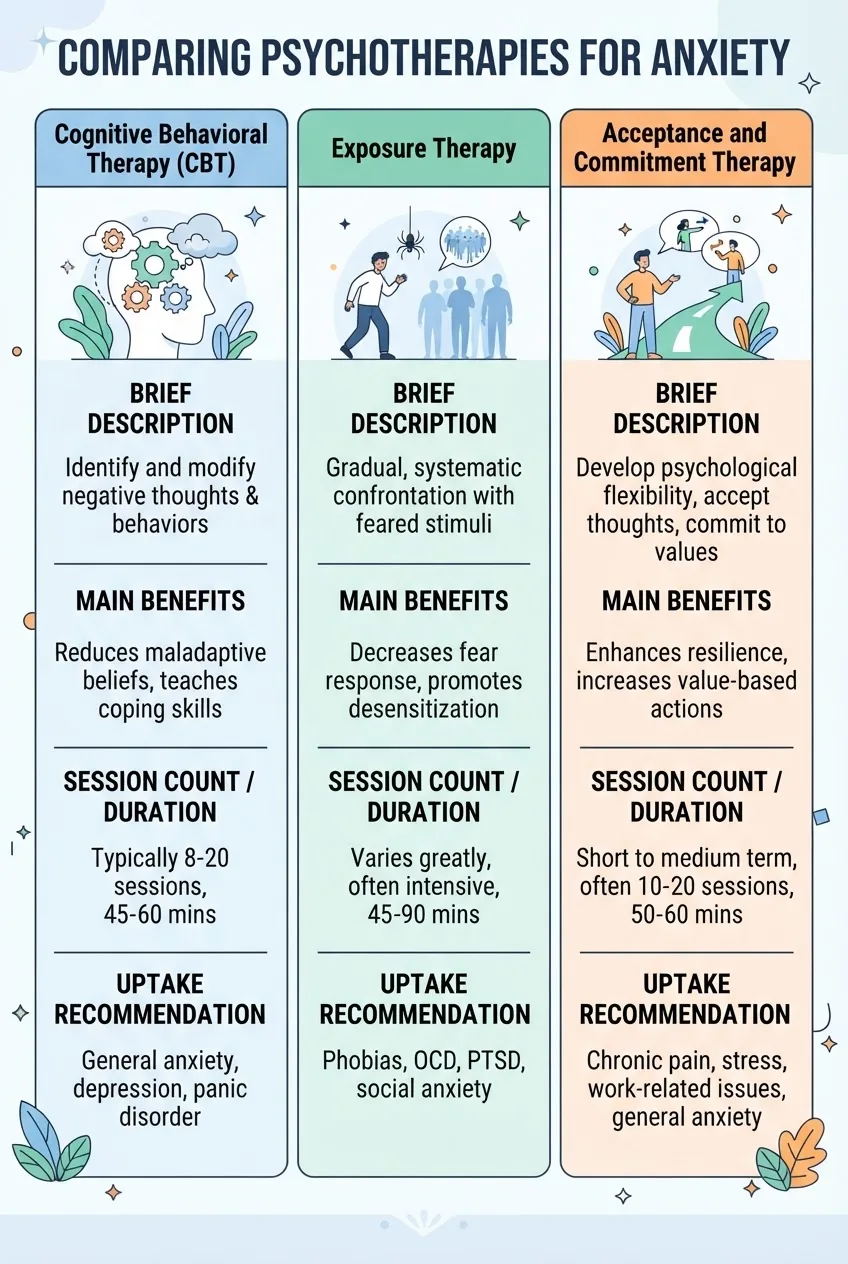
| Therapy | Core focus | Benefits | Typical duration |
|---|---|---|---|
| CBT | Cognitive restructuring and behavioral experiments | Fast symptom reduction, skill-building, relapse prevention | 8–20 weekly sessions |
| Exposure Therapy | Systematic desensitization to feared stimuli | High efficacy for phobias, panic disorder, OCD when applied correctly | 6–16 sessions (varies by intensity) |
| ACT | Accepting internal experiences, values-driven action | Improves functioning when symptoms persist despite symptom-reduction focus | 8–24 sessions |
| Counseling / Talk Therapy | Supportive processing and coping strategies | Helpful for mild-to-moderate anxiety, life transitions | Variable |
How therapies compare in practice:
- CBT is often first-line for GAD and panic disorder due to robust evidence and structured skill training.
- Exposure therapy is essential for specific phobias and panic disorder (interoceptive exposure for sensations).
- ACT offers alternative strategies when symptom control is incomplete or when values-based functioning is a priority.
- Counseling and supportive psychotherapy help with coping, adjustment, and when comorbid life stressors dominate the clinical picture.
Choosing between these depends on diagnosis (e.g., specific phobia vs GAD), symptom severity, prior treatment response, and personal preference. Many clinicians combine elements: CBT skills, exposure exercises, and acceptance strategies in a tailored program.
Evidence on typical outcomes:
- CBT shows large effect sizes for anxiety symptoms in randomized controlled trials (RCTs).
- Exposure has some of the highest response rates for phobias and PTSD when delivered intensively and consistently.
- ACT has moderate-to-large benefits for anxiety and improves quality of life metrics in trials.
For deeper practical guidance on counseling approaches, see:
counseling options for anxiety
Transition: With an overview of therapy types in hand, next we examine what research and clinical trials show about which treatments work best for specific anxiety disorders.
Evidence-Based Treatments for Anxiety: What Works Best?
Answer: Research supports CBT and exposure therapy as the most consistently effective first-line treatments for many anxiety disorders; medication and combined approaches are similarly supported depending on diagnosis and severity.
Key evidence summary:
- Meta-analyses show CBT produces large reductions in anxiety symptoms across GAD, panic disorder, and social anxiety (source type: peer-reviewed meta-analysis, 2022).
- Exposure therapy yields very large effects for specific phobias and strong effects for panic disorder when interoceptive exposure is used (source type: randomized controlled trials summary, 2021).
- Medication (SSRIs/SNRIs) demonstrates moderate-to-large symptom reduction in short-term RCTs; combined therapy (medication + CBT) often yields faster symptom relief though long-term relapse prevention may favor CBT alone (source type: clinical trial pooled analysis, 2020).
Data highlights / stat blocks:
CBT response: ~50–70% show clinically significant improvement in trials (source type: systematic review, 2022).
Exposure outcomes: ~60–90% reduction in avoidance behaviors for specific phobias when fully completed (source type: RCT summaries, 2021).
Medication response: ~40–60% respond to SSRIs/SNRIs in short-term trials; side effects and discontinuation must be considered (source type: controlled trials meta-analysis, 2020).
Clinical outcome measures commonly used to track progress include the GAD-7 (Generalized Anxiety Disorder 7-item), Panic Disorder Severity Scale (PDSS), and disorder-specific functional assessments. Regular measurement guides adjustment of therapy and medication.
Quality-of-life and functional outcomes: Trials increasingly report improvements in work attendance, sleep quality, and social functioning alongside symptom reduction. Long-term follow-ups show relapse risks decrease with skill-based therapies like CBT that teach relapse prevention strategies.
Research caveats: Individual response varies due to comorbidities (e.g., depression), trauma history, and social determinants of health; randomized controlled evidence may not fully reflect outcomes in complex, real-world clinical settings (source type: commentary in psychiatric literature, 2023).
Transition: Understanding evidence for different treatments helps when you’re choosing a clinician—next we explain who can provide care and how to select the right anxiety doctor or therapist.
Professional Options: Choosing the Right Anxiety Doctor or Therapist
Answer: Choose a psychiatrist for medication and complex diagnoses, a psychologist for psychological testing and psychotherapy, and a licensed therapist (counsellor) for evidence-based talk therapies; qualifications, licensure, and treatment focus should guide selection.

Roles and qualifications (quick reference):
- Psychiatrist — medical doctor (MD/DO) who can prescribe medications and manage complex psychiatric conditions; can provide psychotherapy but often focuses on pharmacotherapy. Requirements: medical degree + psychiatry residency, board certification.
- Psychologist — typically has a Doctorate (PhD/PsyD) or Master’s (in some regions) and provides psychological testing, diagnosis, and psychotherapy (e.g., CBT, ACT). Requirements: advanced degree + supervised clinical hours + licensure.
- Licensed therapist / counsellor — includes LPC, LCSW, clinical counselors; provides evidence-based psychotherapy and skills training. Requirements vary by jurisdiction: master’s degree + licensure and supervised experience.
- Clinical nurse specialist / psychiatric nurse practitioner — can prescribe in many regions and provide medication management and collaborative care.
Walkthrough for selecting a clinician:
- Define your primary goal: symptom reduction, managing panic attacks, or skills training.
- Confirm licensure and specialties (anxiety, trauma, OCD, panic disorder).
- Ask about treatment approach (CBT, exposure, ACT), outcome monitoring, and collaboration with other providers.
- Check availability for crisis contact, session formats (in-person, telehealth), and insurance/fees.
Professional resources and standards:
- Practice guidelines and definitions are provided by the American Psychological Association. APA (source type: professional association).
- For treatment recommendations and patient resources, see the Anxiety and Depression Association of America. ADAA (source type: patient-education non-profit).
Practical tips to prepare for intake:
- Bring a symptom timeline, a list of medications and medical history, and recent stressors.
- Prepare questions about treatment targets, expected timeline, and how progress will be measured.
- Confirm confidentiality and limits (mandated reporting, emergencies).
Transition: Medication can be an important adjunct in many cases—see the next section for a clear pros-and-cons guide and options.
Do I Need Anxiety Medication? Considerations and Options
Answer: Medication may be recommended when anxiety is moderate-to-severe, causes marked impairment, or when psychotherapy alone is insufficient; choice depends on diagnosis, side-effect profile, pregnancy status, and personal preference.
Pros:
- Can provide faster symptom relief, especially for severe anxiety or panic disorder.
- Useful when biological factors contribute (e.g., neurochemical imbalances, severe panic).
- Often combined with CBT for additive benefit and faster functional gains.
Cons:
- Side effects (nausea, sexual side effects, sleep change) can reduce adherence.
- Some medications require weeks to reach full effect and tapering can be needed.
- Medication alone may not teach long-term relapse-prevention skills offered by therapy.
Common medication classes and considerations:
- SSRIs (selective serotonin reuptake inhibitors) — first-line for many anxiety disorders; generally well-tolerated but can cause gastrointestinal symptoms and sexual dysfunction.
- SNRIs (serotonin–norepinephrine reuptake inhibitors) — effective for GAD and panic disorder in many patients.
- Benzodiazepines — effective for short-term relief of severe anxiety or acute panic but risk dependence; typically not recommended for long-term management.
- Buspirone — an anxiolytic for chronic anxiety with lower sedation/dependence risk but slower onset.
Shared decision factors to discuss with your prescriber:
- Diagnosis type and severity (e.g., panic disorder vs specific phobia).
- Pregnancy, breastfeeding, or plans for pregnancy.
- Current medications and medical conditions that may interact.
- Preferences about medication vs therapy-only or combined approaches.
For a detailed review of pharmacology, dosing, and prescription considerations, see:
anti-anxiety medication options
Authoritative clinical guidance: For medication summaries and safety considerations, consult the National Institute of Mental Health resources or discuss with a psychiatrist to personalise choices (source type: government resource and clinical consultation, 2024).
Transition: Non-pharmacological complementary approaches—mindfulness and yoga—can integrate with therapy to enhance outcomes without replacing core treatment.
Integrating Therapy with Mindfulness and Yoga for Anxiety Relief
Answer: Mindfulness and yoga are evidence-supported complementary approaches that reduce stress and amplify therapy gains when used alongside, not instead of, evidence-based psychotherapy.
How mindfulness and yoga complement therapy:
- Mindfulness strengthens attentional control and reduces rumination, enhancing CBT skill application.
- Yoga integrates breath regulation and gentle movement to reduce physiological arousal that fuels anxiety.
- Both approaches support relapse prevention by providing daily self-regulation practices.
Practical 3-step integration tips:
- Coordinate with your therapist: tell them you want to add mindfulness or a 30 day yoga challenge to ensure compatibility with exposure or CBT homework.
- Start small: use quick mindfulness methods or short effective meditation practices daily (2–3 minutes) to build consistency without overwhelming your schedule.
- Track the effect: use symptom measures (GAD-7) and note how mindfulness/yoga affects panic frequency, sleep, and stress tolerance over 4–8 weeks.
Recommended starting resources:
mindfulness exercises for anxiety,
quick mindfulness methods,
30 day yoga challenge,
short effective meditation practices,
mental health benefits of meditation.
Clinical note: Trials indicate mindfulness-based interventions reduce anxiety symptoms modestly and improve stress resilience, particularly as adjuncts to CBT (source type: randomized trials meta-analysis, 2022). These approaches are low-risk, but avoid substituting them for indicated medication or therapy when symptoms are severe.
Transition: Preparing well for your first session amplifies therapy effectiveness—read the next section for step-by-step preparation and what to expect.
How to Prepare for Your First Therapy Session and What to Expect
Answer: Prepare by listing symptoms, medical history, medications, key stressors, and goals; expect an intake interview, symptom questionnaires, risk screening, and a collaboratively developed treatment plan.
Step-by-step preparation:
- Write a concise symptom timeline: onset, triggers, frequency, severity.
- List current medications, supplements, and recent medical diagnoses.
- Record sleep, appetite, substance use, and any emergency contacts.
- Set 2–3 therapy goals (e.g., reduce panic attacks, improve sleep, return to work).
- Prepare questions about treatment style, session frequency, progress measures, and emergency contact procedures.
What to expect during intake:
- Clinical interview covering symptoms, past treatment, and family history.
- Standardized measures (GAD-7, PHQ-9) to quantify baseline severity.
- Risk assessment for suicide or self-harm and safety planning if needed.
- Discussion of treatment options (CBT, exposure, medication) and a tentative plan.
Experience-based tip: Be honest about avoidance and safety behaviours—therapists need this to tailor exposure or CBT tasks. If telehealth, ensure a private, quiet space and test your connection beforehand.
Transition: Knowing preparation and expectations reduces anxiety about starting therapy; the following section explains cost, timelines, and access options.
Cost, Duration, and Accessibility of Anxiety Therapy
Answer: Costs vary widely by clinician type, insurance coverage, and region; expect weekly 45–60 minute sessions for 8–20 weeks typically, with alternatives like sliding-scale clinics and telehealth improving accessibility.
- Session length and frequency: Most therapy sessions are 45–60 minutes weekly; intensive options (e.g., concentrated exposure) shorten calendar time but increase session intensity.
- Typical treatment timeline: Short-term CBT courses run 8–20 weeks; ACT or longer-term psychotherapy may extend to 6+ months depending on goals.
- Costs and insurance: Private pay rates differ by profession and location; many insurers cover mental health visits—verify coverage, copay, and limits. Public health services and community clinics often offer reduced-fee or subsidised care.
- Affordable options: university clinics, non-profit mental health centers, and teletherapy platforms can reduce costs; some clinicians offer sliding-scale fees based on income.
- Accessibility: Telehealth increases reach for rural or mobility-limited clients and often has similar effectiveness for CBT-based therapies (source type: systematic review, 2021).
Transition: For immediate symptom relief and acute panic, therapists recommend specific in-the-moment techniques covered in the next section.
Managing Anxiety Attacks: Immediate Therapy-Based Techniques
Answer: Use grounding, paced breathing, cognitive reframing, and brief behavioral exposure strategies to interrupt panic cycles; these techniques reduce intensity within minutes and are teachable by therapists.
How-to steps (numbered) with examples:
- Grounding 5-4-3-2-1: Identify 5 things you can see, 4 you can touch, 3 you can hear, 2 you can smell, and 1 you can taste to reorient attention and lower physiological arousal; practice in safe settings first.
- Paced breathing / box breathing: Inhale 4 seconds—hold 4—exhale 4—hold 4; repeat 4 times. This reduces hyperventilation and vagal tone disruption. For guided patterns, therapists often recommend breathing meditation exercises as daily practice.
breathing meditation exercises - Interoceptive exposure (short form): Under therapist guidance, intentionally evoke mild panic sensations (e.g., spinning, breathing through a straw) to learn they are tolerable and transient; use only with clinician supervision.
- Cognitive reframing: Name the catastrophic thought (e.g., “I’m dying”) and generate two alternative, realistic interpretations (e.g., “This feels awful but is not life-threatening”).
- Behavioral action: Step toward a mildly feared situation rather than avoiding it (graded approach); even small approach steps interrupt avoidance learning and reduce future panic frequency.
When attacks escalate or chest pain is severe, seek medical evaluation to rule out cardiac or respiratory causes before attributing symptoms solely to anxiety. For additional acute tools, see:
advanced stress relief tools
Transition: With immediate strategies and long-term plans clarified, this article now concludes with key takeaways and next steps.
Conclusion
Therapy for anxiety is a tailored blend of evidence-based psychotherapy (CBT, exposure, ACT), professional assessment, and selective medication—often combined—to reduce symptoms, restore functioning, and prevent relapse. Start by defining goals, selecting a qualified clinician, and using complementary mindfulness or yoga practices to support progress. Reach out to a licensed provider for personalized planning and to begin measurable treatment steps.
Call to action: If anxiety limits your life, schedule an initial assessment with a qualified clinician, prepare the intake items listed above, and consider adding brief mindfulness practice to support early gains.