

Being spiritually, mentally and physically healthy means intentionally nurturing purpose and meaning, cognitive balance, and bodily fitness together; adopt regular spiritual practices, evidence-based psychological routines and consistent movement to build an interlinked, sustainable wellness system that improves resilience, focus and vitality.
Understanding Spiritual, Mental, and Physical Health: Definitions and Distinctions?
Answer: Spiritual, mental and physical health are three distinct but overlapping domains: spiritual health concerns meaning, values and connectedness; mental health covers cognition and psychological functioning; physical health refers to bodily function, fitness and physiology. Balanced care across all three forms the basis of holistic wellness.
Spiritual health: a sense of meaning, purpose, connection to something greater and practices that cultivate inner life (e.g., prayer, ritual, meditation).
Mental health: the capacity for cognition, concentration, decision-making and psychological wellbeing that allows effective coping and daily functioning.
Physical health: functional integrity of body systems, fitness, nutrition and sleep supporting activity and longevity.
Term: holistic wellness — care that addresses multiple interacting domains (biological, psychological, social and spiritual) rather than a single symptom or organ system.
These definitions reflect different measurement targets and interventions: spiritual well-being is often assessed through meaning and connectedness scales; mental health via screening tools and diagnostic frameworks; physical health via clinical markers and functional tests. All three use behaviour-based interventions (practices, therapy, exercise) to produce durable outcomes.
According to WHO, health is a state of complete physical, mental and social well‑being, which many integrative frameworks extend to include spiritual wellbeing; different disciplines prioritise distinct outcomes and measurement approaches.
Practical distinctions matter because interventions map to outcomes: meditation and ritual primarily influence spiritual indicators (sense of meaning, values alignment) while psychotherapy and cognitive training target mental functioning; exercise and nutrition target physical markers. Yet single interventions frequently cross domains (e.g., exercise improves mood and cognitive clarity).
- Measurement: spiritual — scales of purpose/connectedness; mental — diagnostic/screening tools and cognitive tests; physical — vitals, labs, performance tests.
- Typical providers: spiritual — chaplains, spiritual counsellors, faith leaders; mental — psychologists, psychiatrists, therapists; physical — physicians, physiotherapists, exercise professionals.
- Common practices: spiritual practices (prayer, ritual, meditation), mental strategies (CBT, MBSR), physical practices (strength, cardio, sleep hygiene).
Defining terms clearly helps avoid conflation with emotional health: while emotional experience is tightly coupled with mental health, emotional health itself describes regulation and expression rather than the broader spiritual domain of meaning and purpose. Later sections explore overlaps and a comparison table clarifying characteristics.
Is Spiritual Health Part of Mental Emotional Health? Clarifying Overlaps and Differences?
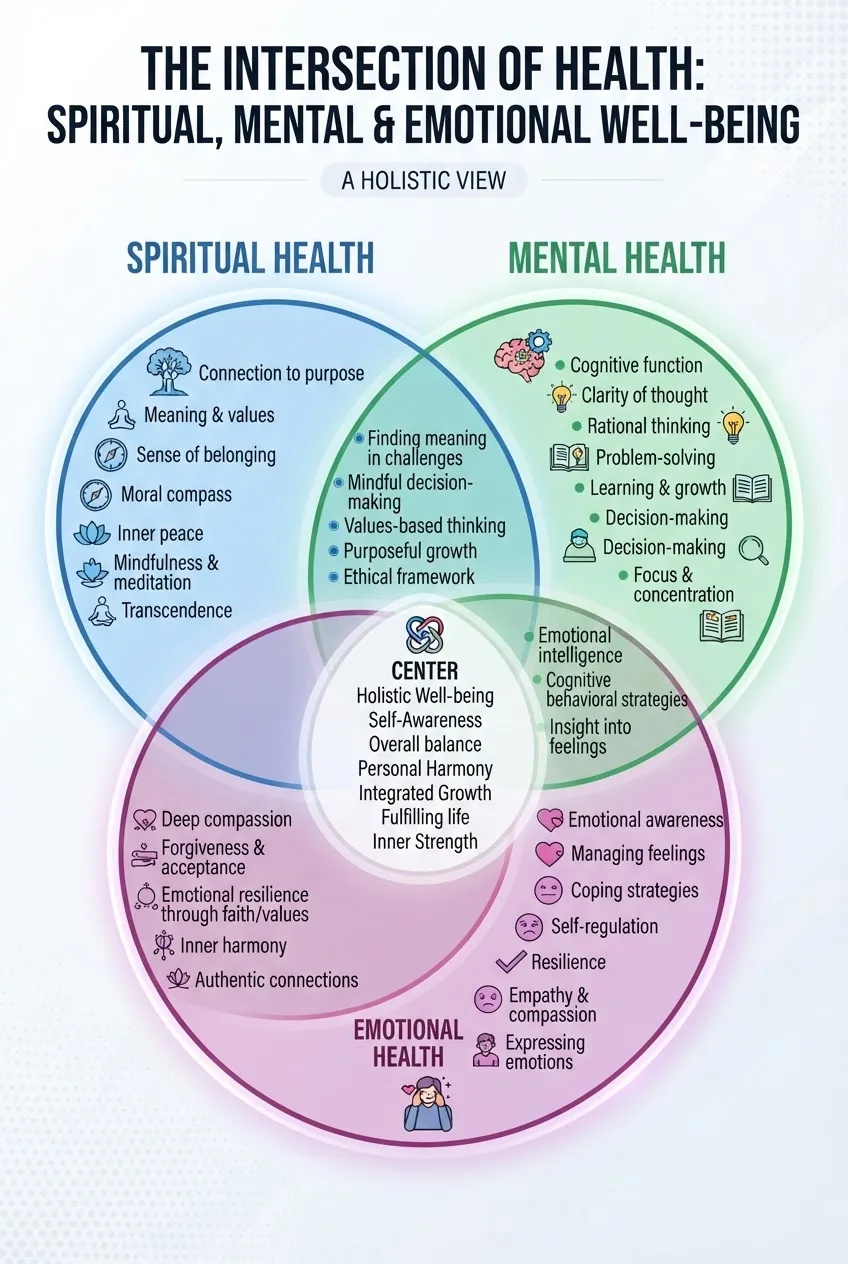
Answer: Spiritual health overlaps with mental and emotional health but is not wholly a subset; it is a distinct domain centered on meaning, values and transcendence that can influence psychological wellbeing and emotional regulation without being identical to them.
To clarify, here is a side-by-side comparison showing core characteristics and where domains overlap; this helps practitioners and individuals target interventions with precision.
| Domain | Core Focus | Common Measures | Primary Practices |
|---|---|---|---|
| Spiritual Health | Meaning, purpose, connection to values/transcendence | Purpose-in-life scales, spiritual well‑being inventories | Prayer, meditation, ritual, service |
| Mental Health | Cognition, mood, behaviour, psychiatric symptoms | Screening tools (PHQ-9, GAD-7), diagnostic interviews | Therapy (CBT, ACT), medication, MBSR |
| Emotional Health | Regulation, expression and resilience of feelings | Emotion regulation scales, affect measures | Emotion-focused therapy, mindfulness, journalling |
Overlap areas:
- Spiritual practices often reduce anxiety and depressive symptoms (mental health outcomes) by providing a sense of meaning and community.
- Emotional health mediates how spiritual beliefs translate into daily coping—adaptive beliefs support emotion regulation while rigid beliefs may worsen distress.
- Clinically significant mental disorders require professional assessment; spiritual care complements but does not replace clinical interventions.
For statistical context on mental health prevalence and trends, see mental health facts.
Term: psychological wellbeing — a multi-faceted construct including positive affect, purpose, autonomy and personal growth; used in research as an outcome distinct from symptom-focused measures.
Caveats: spiritual health is culturally and personally defined; practices meaningful to one person may not support another’s mental health. When spiritual beliefs contribute to distress (e.g., guilt, rigid dogma), clinical mental health interventions are essential alongside spiritual support.
The Interconnectedness of Spiritually, Mentally, and Physically Healthy Living?
Answer: The three domains interact bidirectionally: spiritual practices influence psychological resilience, mental health shapes behaviours that affect physiology, and physical health status alters mood and cognitive function — creating a dynamic, mutually reinforcing triangle of health.
Think of the three domains as a “three‑legged stool” or triangle—weakness in any leg destabilises the whole. Integrative models such as the biopsychosocial-spiritual model explicitly incorporate spiritual dimensions alongside biological and psychological ones for comprehensive care planning.
Term: biopsychosocial-spiritual model — an expansion of the biopsychosocial model that adds spiritual factors to biological, psychological and social determinants of health.
Practical examples show the synergy:
- Regular meditation (spiritual/mental) reduces rumination and improves sleep, which enhances immune markers and recovery times (physical).
- Consistent exercise (physical) increases neurotrophic factors and improves executive function (mental), often enhancing feelings of self-efficacy and purpose (spiritual).
- Participating in community service (spiritual) increases social support and reduces loneliness, which lowers inflammation markers associated with chronic disease (physical).
Case study summary 1 — “A clinician-integrated routine”: A primary care clinic introduced brief spiritual screening plus MBSR referrals and tailored exercise prescriptions; within six months patients reported improved mood scores and reduced primary care visits. According to a 2024 NIH review, integrated care models show improved patient-reported outcomes in mixed-method studies (NIH).
Case study summary 2 — “Individual pathway to balance”: A 42-year-old client combined weekly therapy (CBT), daily 20-minute meditation, and progressive resistance training; over 12 weeks they reported reduced anxiety, clearer life goals and improved sleep duration. Peer-reviewed mind-body research (published in integrative health journals) documents similar cross-domain benefits (PubMed).
For a focused view of how mental health physiology affects the body, see the pillar piece on physiological effects of poor mental health.
Physical stress responses (HPA axis activation, sympathetic arousal) feed back into mood and cognition; according to a 2024 industry review of psychoneuroimmunology, chronic stress and poor mental health are associated with altered immune markers and metabolic risk (peer-reviewed evidence).
Integrative practices that target multiple domains produce multiplicative effects rather than simple additive gains: a combined programme of movement, mindfulness and values work often yields greater outcomes than any single modality alone because each practice addresses different mechanisms (physiological regulation, cognitive reframing, meaning-making).
For practical insight into the physiological pathways linking psychological states and body function, read more about the mind-body connection and research on physiological stress effects.
Positive mental health supports immune function, adherence to healthy routines and social engagement, which all improve long-term physical outcomes; see the review on benefits of good mental health for evidence and mechanisms.
Practical Strategies for Achieving and Sustaining Spiritual, Mental, and Physical Health?
Answer: Build a daily, scalable routine combining short spiritual practices (reflection, meditation), evidence-based mental health maintenance (structured therapy techniques, cognitive tools) and consistent physical activity, supported by sleep, nutrition and social connection; measure progress with simple self-assessments.
Term: MBSR — mindfulness-based stress reduction, an 8-week structured program combining mindfulness meditation and gentle movement used to reduce stress and improve psychological wellbeing.
-
Design a foundational daily routine (minutes matter).
- Morning: 5–15 minutes of focused spiritual practice — breath meditation, prayer, gratitude journaling focused on values and intention.
- Midday: 10–20 minutes of cognitive reset — brief mindfulness break or cognitive reframing exercise from CBT techniques.
- Evening: 20–40 minutes of movement — brisk walk, yoga sequence, or resistance sets to support sleep and mood.
-
Adopt evidence-based mental health maintenance.
- Use brief CBT techniques for unhelpful thoughts and MBSR for stress reduction; for practical tips see mental wellness tips.
- Schedule regular check-ins with a mental health professional when symptoms persist or interfere with function; consider certification-backed coaches for lifestyle support via mental health coaching if you prefer a coaching model.
-
Make spiritual practice practical and measurable.
- Choose one primary spiritual practice (daily meditation, prayer, ritual, service) and commit to a minimum weekly dose and a reflective log.
- Use prompts: “What mattered today?” or “Where did I notice connection?”—track entries to link practice with outcomes.
-
Prioritise physical health foundations.
- Exercise: aim for 150 minutes moderate aerobic activity weekly plus two strength sessions; see benefits in active lifestyle benefits.
- Sleep: set consistent sleep-wake times and a 30–60 minute pre-bed wind-down; poor sleep undermines all three domains.
- Nutrition: prioritise whole-food meals with adequate protein, healthy fats and fibre to stabilise energy and mood.
-
Combine practices for synergy.
- Try a morning routine that pairs 10 minutes of meditation with a 20-minute walk — this supports mood, cognition and meaningful reflection simultaneously.
- Use group-based practices (yoga classes, faith communities, group therapy) to add social support and accountability.
-
Use targeted psychological tools and resources.
- Track mood and behaviours with journalling prompts tied to values; adopt brief CBT worksheets for automatic thought records.
- Access curated resources for emotional health via emotional wellness resources and complement them with emotional health improvement tips.
-
Integrate mind-body medicine techniques.
- Biofeedback, paced breathing, progressive muscle relaxation and guided imagery are evidence-based tools — review mind-body medicine benefits for therapeutic applications.
-
Build a social and values-based support network.
- Regularly engage with community or peers sharing your values; volunteer or join group practices to enhance belonging and meaning.
- When needed, consider structured coaching or certification-backed wellbeing support via wellbeing coaching.
-
Measure progress with simple frameworks.
- Use weekly habit checks, mood ratings and a monthly reflective review (meaning, mood, energy) to adjust practices.
- Adopt validated screening tools for mental health when symptoms change; keep a symptom log to share with clinicians if needed.

These practical steps emphasise small, repeatable actions and measurement. If you need structured learning, consider training paths like the mental health coaching program or accredited MBSR courses to deepen skills.
Overcoming Common Challenges in Maintaining Holistic Health?
Answer: Common barriers include time scarcity, inconsistent motivation, hidden or chronic stressors, physical illness, and lack of supportive community; address them with troubleshooting strategies, realistic habit design and professional referrals when symptoms meet clinical thresholds.
Common barriers and tactical responses:
- Limited time: use micro-practices (5–10 minute rituals) and integrate movement into daily routines (walking meetings, active commuting).
- Motivation dips: set identity-based goals (e.g., “I am someone who moves daily”) and use habit pairing (attach a new practice to an existing one).
- Hidden stress or burnout: recognise subtle signs—sleep changes, irritability, reduced concentration—and use accessible resources; review stress relief strategies for stepwise relief.
- Unnoticed chronic stress: learn to spot hidden stress symptoms and add short resets to interrupt physiological arousal.
- Multiple concurrent stressors: identify and prioritise exposure reduction; see common stressors affecting health for framing and mitigation tactics.
- Physical illness limiting practice: adapt routines (gentle movement, seated meditation), consult providers and view guidance in physical health challenges.
- Clinical mental health conditions: seek assessment—see mental health disorders overview and, for treatment options, mental illness treatments when appropriate.
When stress or symptoms escalate beyond self-help, professional assessment is essential. For targeted episodic patterns or recurrent crises, structured therapies and clinical supports reduce risk and restore functioning.
Troubleshooting tips:
- Start with stabilising sleep, hydration and nutrition before layering advanced practices.
- Use short, measurable practices that fit your day rather than idealised routines—consistency beats intensity.
- Connect with peers or communities for accountability and meaning; group practice often sustains long-term engagement.
- When in doubt, consult a clinician — early intervention prevents chronicity; for crisis resources consult local services.
How to Assess Your Spiritual, Mental, and Physical Health Levels?
Answer: Use a simple mixed-method assessment: brief validated screening tools for mental health, checklists and markers for physical health, and reflective scales or questionnaires for spiritual wellbeing; combine self-rated weekly tracking with periodic professional screening.
Step-by-step self-assessment framework:
- Mental screening: use validated brief tools (PHQ-9 for depression, GAD-7 for anxiety) and symptom checklists to detect clinically significant issues; repeat monthly or when symptoms change.
- Physical markers: track resting heart rate, sleep duration, energy levels, functional measures (e.g., number of stairs climbed, timed walk) and annual clinical checks (blood pressure, basic labs).
- Spiritual indicators: use self-report questions: “Do I have a clear sense of purpose?” “Do my practices support my values?” Standardised scales (spiritual well‑being scale) help quantify progress.
- Composite weekly review: create a one-page wellness checklist: sleep (hours), mood rating (1–10), movement (minutes), spiritual practice (minutes), social connection (yes/no). Review trends monthly.
- When to seek help: declines in daily functioning, persistent mood disturbances, or physical symptoms that do not improve with basic self-care — consult primary care or mental health specialists.
Recommended tools and questionnaires:
- PHQ-9, GAD-7 (mental screening) — easily self-administered and validated.
- Simple sleep logs and activity trackers for physical monitoring.
- Spiritual well‑being scales and values clarification worksheets for spiritual assessment.
For a structured self-assessment workflow and downloadable checklists, create a monthly template that captures one numeric score for each domain (spiritual, mental, physical) and a narrative reflection on what improved or blocked progress. Share this with a clinician or coach when seeking guidance.
Conclusion: Integrating Spiritually, Mentally, and Physically Healthy Practices into Daily Life?
Answer: Integrate short, reliable practices across spiritual, mental and physical domains that fit your lifestyle; measure outcomes, iterate weekly, and seek professional support when needed to create durable holistic wellbeing. Start small, be consistent, and link practices to your core values.
Key takeaways: design a simple daily routine, combine evidence-based mental health techniques with spiritual practices, prioritise movement and sleep, measure progress with short checklists, and use community or professional supports for accountability. For inspiration, review relatable personal wellbeing examples.
If you found this guide useful, choose one small practice from the “Practical Strategies” section and schedule it on your calendar for the next seven days. Consistency builds integration; small wins compound into lasting holistic health.