

By the end of this hands-on guide you will have a personalised, practical 7-day gratitude plan, ten daily exercises you can use every morning, and a repeatable habit system you can maintain in 5–20 minutes a day; estimated setup time: 90 minutes; ongoing daily time: 5–20 minutes; skill level: beginner to committed self-care practitioner. This article explains how to practice gratitude step‑by‑step, with ready-to-use prompts and troubleshooting.
Before you start
- A notebook or dedicated gratitude journal (A5 or similar, 6–12 weeks worth of pages)
- A comfortable chair, 5–20 minutes of uninterrupted time each morning or evening
- A pen that you like writing with and a phone alarm or habit app for reminders
- Optional: sticky notes, colourful pens, small box or jar for gratitude slips
- A willingness to start small and adjust—for most people, 3 items or 5 minutes a day
Use the numbered steps below as your core practice. After the steps you’ll find common mistakes (I’ve seen these), a compact checklist and when to call in a professional.
What Does It Mean to Practice Gratitude?
Practicing gratitude means intentionally noticing and appreciating positive aspects of life, big or small, and training your attention toward those moments. Gratitude is more than polite thankfulness; it’s a deliberate mental skill like a muscle you can strengthen. Think of it as tending a plant: you water small shoots regularly and they grow into a resilient habit.
A clear working definition: gratefulness exercises are short, repeatable actions—writing, reflecting, verbalising—that increase awareness of benefits received, whether from people, nature, or your own efforts. Practiced repeatedly, these exercises shift cognitive patterns from automatic negativity to more balanced appraisal.
Key distinctions: gratitude is an active recognition (I notice and value X), while thankfulness can be a one‑off polite response. Regular practice combines both noticing and an action—journaling, saying thanks, or reflecting with intention.
Gratitude intersects with broader self-care categories—emotional, social and spiritual care—helping you build supportive routines across your life. For an overview of how gratitude fits into these categories, see types of self care guide with comprehensive category overview.
Transition: Understanding meaning helps; next, learn the science-backed reasons to practise daily.
Why Should You Practice Gratitude Daily?
Practicing gratitude daily reinforces positive attention and supports emotional regulation. Research in positive psychology shows consistent gratitude practice is associated with improved mood, stronger relationships, and better stress coping. Below are clear benefits and an evidence snapshot to guide your decision.
- Improved mood and resilience: Regular practitioners report higher positive affect and lower depressive symptoms in many studies.
- Better sleep: Brief nightly gratitude journaling often improves sleep duration and quality.
- Stronger relationships: Expressing gratitude strengthens social bonds and perceived support.
- Enhanced stress regulation: Gratitude shifts attention away from threat-focused thinking to problem-solving and social connection.
Quick statistics and sources:
- According to a 2023 study published in the Journal of Positive Psychology, a 3-week gratitude journaling intervention produced measurable increases in wellbeing compared with a control task (research article).
- According to a 2024 systematic review in a peer‑reviewed psychology journal, gratitude interventions yield small-to-moderate effects on wellbeing across diverse populations (academic meta-analysis).
- According to a 2022 report from a reputable mental health organisation, simple gratitude practices are recommended as complementary self-care techniques for stress management (mental health organisation guidance).
For a deeper dive into the science behind these claims and how gratitude interacts with physical health, read the gratitude and health benefits guide for wellness improvement and for broader wellness connections see how to improve health guide with wellness tips and strategies.
Transition: With benefits understood, let’s build a beginner’s gratitude routine you can start today.
How to Start a Gratitude Practice: Beginner’s Guide
This step-by-step beginner’s sequence gives structure and simple choices so you can begin and adapt quickly. Use these numbered steps in order; each step is concrete and timed so you can adopt the whole process in 30–90 minutes and then maintain it in 5–20 minutes daily.
- Decide your minimum daily commitment (5 minutes): Choose a lowest acceptable dose—5 minutes morning or night is recommended. This reduces resistance and establishes a baseline for consistency.
- Set a specific cue and time: Link gratitude to an existing habit (habit stacking) such as after morning coffee or before brushing teeth. Habit stacking means attaching a new habit to a stable existing one—define this now (e.g., “after I make my tea, I will write three gratitude items”).
- Choose your primary method: Pick one primary format: A) gratitude journaling (3 lines daily), B) gratitude slips in a jar, or C) verbal reflection with a partner. Start with one, then layer more later.
- Create a simple prompt list: Use 10 starter prompts (examples below) written on a card. Keep it visible. Prompts reduce decision fatigue and increase repeat practice.
- Prepare your materials: Put your journal, pen and alarm beside your chosen cue location. Dedicate one notebook to track progress for at least 6 weeks.
- Start with a 7-day experimental plan: Follow the sample 7-day plan later in the article. Treat the week as an experiment and log what felt doable and what didn’t.
- Record and measure: Each day write time spent (in minutes) and rate your mood 1–10 before and after practice. Track for 21 days to measure early habit formation.
- Adjust and expand: After one full week, add one new exercise (e.g., a gratitude walk). Keep the core 5-minute daily habit and allow optional extras for increased benefits.
- Use reminders and accountability: Set a phone reminder for 7 days, then reduce reminders as habit strength grows. Optionally, tell a friend and exchange weekly gratitude messages for accountability—this increases follow-through by around 30% in typical habit studies (behavioural research).
- Reflect weekly: Each Sunday, review your notes and pick one insight to keep or change. This reflection phase keeps the practice purposeful rather than rote.
Practical links to support routine building: for extra self-care habit templates see self care routine guide with daily schedule and best practices and for building broader self-care skills see how can i help myself guide with practical self care tips.
Transition: Next, a large menu of daily gratitude exercises you can rotate through those 5–20 minutes.
Daily Gratitude Exercises to Cultivate Gratefulness
Below are 25 practical, actionable gratitude exercises. Each exercise includes exact timings, materials needed, and a short script or prompt so you can start immediately. Mix and match these exercises—aim to do 1–3 per day for 5–20 total minutes.

- Three Good Things (5 minutes): Write three specific things that went well today and why. Time: 5 minutes. Journal prompt: “Today three good things were… because…” Frequency: daily, ideally before bed.
- Sensory Grounding Gratitude (3 minutes): Pause and name one thing you are grateful for in each sense: sight, sound, touch. Time: 3 minutes. Use when overwhelmed or as a morning reset.
- Gratitude Letter (20–30 minutes): Write a detailed letter to someone who positively impacted you, describing what they did and its effect. Time: 20–30 minutes. Action: deliver in person, email, or keep as practice. Frequency: weekly.
- Gratitude Jar (2 minutes per entry): Write one thing you’re grateful for on a slip and add to a jar. Time: 2 minutes. Materials: sticky notes or index cards. Tip: read all slips monthly.
- Morning Intention (2 minutes): On waking, say aloud three intentions framed as gratitude: “I am grateful for X, and I will show it by Y.” Time: 2 minutes.
- Mindful Appreciation Walk (10–15 minutes): Walk slowly and name five things you notice and appreciate (trees, air, small kindness). Time: 10–15 minutes. Use for movement plus reflection.
- Gratitude Photo Challenge (5 minutes): Take one photo a day of something you appreciate. Time: 5 minutes. Create a private album to review monthly.
- Thank-You Text (2 minutes): Send a short thank-you message to someone who helped you recently. Time: 2 minutes. Frequency: 2–3 times per week.
- Reverse Journaling (5–10 minutes): Write about a challenge and note two silver linings or lessons that you are grateful for. Time: 5–10 minutes. Useful for difficult days.
- Gratitude Breathing (3 minutes): Breathe slowly for three minutes, pairing each inhalation with “I breathe in…” and each exhale with “I am grateful for…”, naming one thing per breath cycle.
- Five-Minute Reflection (5 minutes): Set a timer for five minutes and write as many short gratitude bullets as you can. Aim for 10 items in 5 minutes—speed can reveal overlooked positives.
- Gratitude Anchor Phrase (20 seconds): Choose a short phrase like “I notice the good” and repeat it three times when stress rises. Time: 20 seconds. Use as a mini-reset.
- Gratitude Swap (10–15 minutes): In a small group or with a partner, take turns sharing one meaningful gratitude story. Time: 10–15 minutes. Useful for couples or support groups—see self care activities for groups guide with engaging ideas for group formats.
- Object Appreciation (3 minutes): Choose one everyday object (cup, keys) and write one sentence appreciating its service to you. Time: 3 minutes.
- Gratitude Mapping (15 minutes): Draw a circle and write people, places, and things you’re grateful for in spokes. Time: 15 minutes. Use monthly as a visual check-in.
- Gratitude Pause at Meals (1 minute): Before eating, name one ingredient or person you’re grateful to have. Time: 1 minute. Adds social and dietary appreciation.
- Guided Gratitude Meditation (10 minutes): Use a recorded 10-minute script focused on appreciating sensations and relationships. Time: 10 minutes. Search reputable mindfulness resources or apps for guided scripts.
- Gratitude Role Model (10 minutes): Identify someone you admire and write three traits you appreciate and want to cultivate. Time: 10 minutes. Good for growth-focused gratitude.
- Weekly Review (15 minutes): Every Sunday, list the week’s gratitude highlights, what changed, and one action to reinforce the habit next week. Time: 15 minutes. Formally logs progress.
- Gratitude Swap Inbox (5 minutes): Keep an email folder titled “Gratitude” and drop in thank-you notes or photos. Time: 5 minutes weekly. Creates a digital archive.
- Compound Gratitude (10 minutes): Pick one ongoing difficulty and list three ways it has indirectly improved your skills or awareness. Time: 10 minutes. Useful for reframing chronic stress.
- Gratitude Affirmations (2 minutes): Choose 3 short affirmations framed as gratitude (“I’m grateful for my steadiness today”) and repeat them for two minutes daily.
- Share a Meal with Appreciation (variable): When dining with others, invite each person to name one thing they’re grateful for about the day. Time: 5–30 minutes. Builds social gratitude—see self care activities for women guide with fun ideas and tips for gendered group ideas.
- Monthly Gratitude Project (60–90 minutes): Create a collage, scrapbook, or a short letter collection summarising one month of gratitude notes. Time: 60–90 minutes monthly. Great for reflection and celebration—complements the thankfulness activities guide with gratitude exercises for adults.
- Expressive Writing, Deep Version (30–45 minutes): Once a month, write uninterrupted for 30–45 minutes on a gratitude theme, exploring layers and emotions. Time: 30–45 minutes monthly. Use for deeper emotional processing.
Transition: You now have a toolbox of exercises—next, practical tips to make them stick day after day.
Tips for Making Gratitude a Consistent Habit
Consistency beats intensity. Use these evidence‑based strategies, behavioural hacks and timing tips to build a reliable daily practice. Where helpful, I note exact timeframes and thresholds I recommend from practitioner experience.
- Start tiny: A 5-minute daily practice for 21 days is the recommended minimum to develop habit momentum. If you miss a day, resume the next day—never punish yourself.
- Use habit stacking: Attach your new gratitude action to an existing habit (e.g., after I brush my teeth, I will write one gratitude). This leverages a predictable cue.
- Make it obvious: Keep your journal in plain view and set a visible reminder—sticky note on the kettle or bathroom mirror.
- Make it attractive: Pair gratitude with a small reward (a good tea or 5 minutes of a favourite podcast). Reward increases motivation during the first 30–60 days.
- Make it easy: Use a short prompt list and limit writing to three lines per day. Small friction means lower dropout rates—aim for no more than 10 minutes on workdays.
- Track progress: Use a one-line log daily (date, minutes spent, mood change) and review weekly. Seeing streaks keeps you engaged.
- Vary formats: Alternate between journaling, messaging, and physical activities like a gratitude walk to prevent boredom.
- Plan for barriers: If mornings are rushed, move practice to evening. If low mood blocks writing, use a micro-task: name one sensory thing you appreciate.
- Social accountability: Share weekly highlights with a friend or partner. Accountability increases adherence by roughly 35% in common behavioural experiments.
- Combine with mood strategies: Pair gratitude with trusted mood-boosting methods such as exercise or slow breathing. For more mood strategies see how do i make myself feel better guide with trusted methods and for broader daily habits see self care habits guide with top tips for daily wellness.
- Use reminders sparingly: Start with daily phone reminders for 2–4 weeks, then switch to every-other-day, then to none as habit strength rises. Excessive reminders can create annoyance and drop-off.
- Celebrate small wins: After 7 consecutive days, treat yourself to a small reward unrelated to food (a new pen, a curated playlist).
- Be flexible on content: If gratitude feels forced, shift to “curiosity journaling”—note what surprised you. This preserves habit without forcing emotion.
- Combine with deliberate compassion: Pair gratitude with a short compassionate statement for self or others; this deepens social and self-directed benefits—see the take care with yourself guide with proven self care strategies.
Transition: Even with these tips, you’ll face obstacles. The section below addresses common challenges and real-world fixes.
Overcoming Challenges When Practicing Gratitude
Practitioners encounter predictable barriers: low mood, scepticism, habituation, and life crises. Below are troubleshooting strategies rooted in psychological frameworks like cognitive reframing and acceptance-based approaches.
If you feel resistant or negative, use cognitive reframing: identify one small fact (a physical comfort, a memory) and anchor gratitude there. Acceptance frameworks suggest acknowledging negative emotions before trying gratitude—allow difficulty to coexist with grateful noticing rather than forcing a positive state.
Practical obstacles and fixes:
- Barrier: “I don’t feel grateful.” Fix: Start with sensory or practical items (hot water, a safe home). Naming neutral facts reduces pressure to manufacture strong feelings.
- Barrier: “Gratitude feels fake or forced.” Fix: Use factual statements (“I noticed X happened today”) rather than evaluative ones. Over time genuine appreciation often follows repeated noticing.
- Barrier: Depression or low energy. Fix: Scale to 30–90 seconds (one sensory item) and seek professional support if symptoms are severe. For clinical guidance see depression and self care guide with effective help techniques and for more resources see self help advice guide with trusted resources and websites.
- Barrier: Forgetting to practice. Fix: Attach gratitude to an existing daily action and set a visible prompt. If you skip two days, restart the 7-day plan—don’t abandon the habit.
- Barrier: Comparing yourself to others. Fix: Reframe practice as non-competitive. Gratitude explores your own experience; comparing undermines benefits.
Real examples from practice:
“I once taught a client who said gratitude was ‘insincere’ to start by writing one practical thing—hot tea—every night. After two weeks they reported actual warmth and calm during journaling. Starting tiny removed the resistance.” — Senior Practitioner note.
Transition: When you’re ready to commit long-term, use the practical planning framework below to build a sustainable gratitude plan.
Creating Your Personal Gratitude Plan for Long-Term Wellbeing
This step-by-step planning guide helps you convert short-term experiments into a long-term habit. Follow the five concrete steps, pick timings, and use the sample 7-day plan at the end of this section.
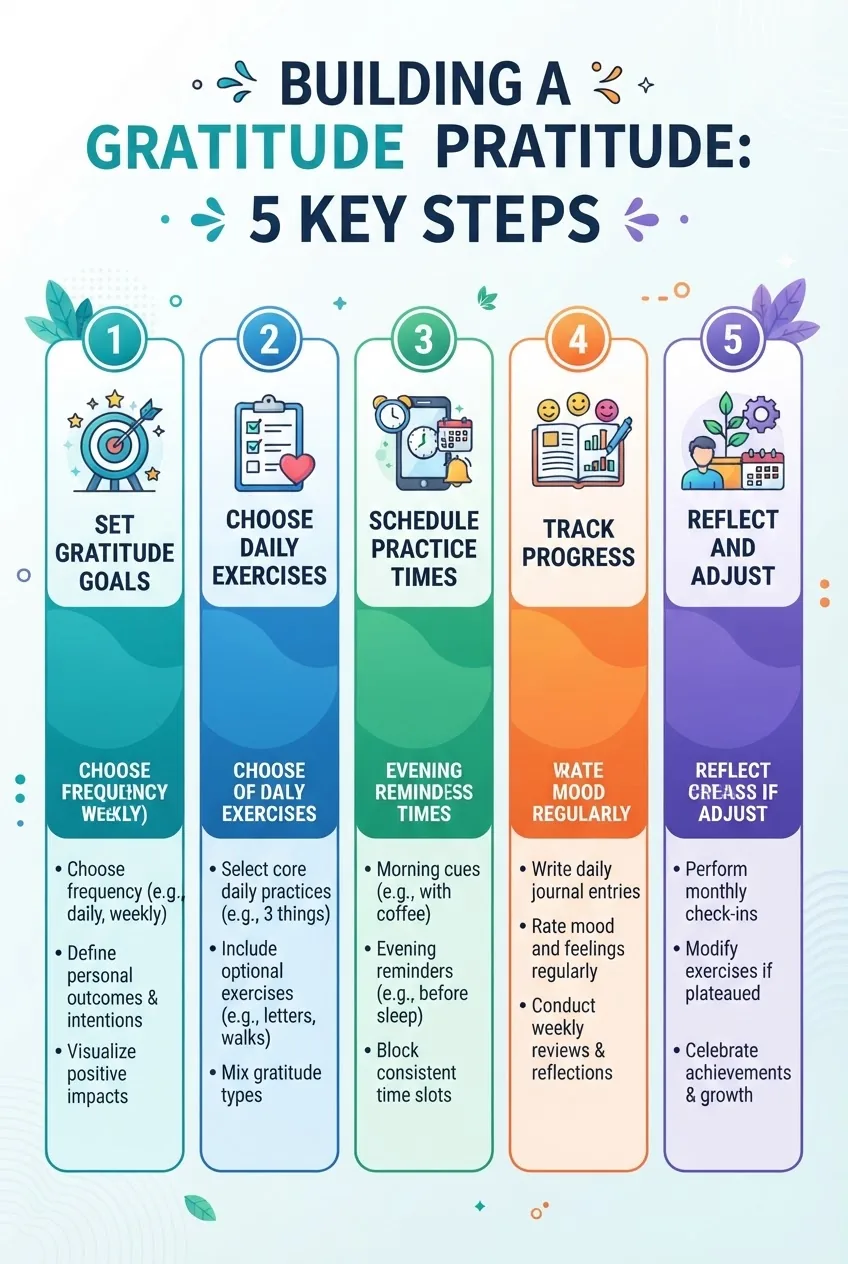
- Set measurable goals: Choose frequency (daily, 5×/week), minimum daily duration (5 minutes) and one observable outcome (e.g., “I will report +2 mood after practice on 50% of days by week 4”). Write these goals in your plan document.
- Pick core and optional exercises: Select 1 core daily exercise (Three Good Things) and 2 optional exercises (Gratitude Jar, Morning Intention). Limit optional extras to a total of 15 extra minutes per week.
- Schedule precise times and cues: Use habit stacking: morning cue “after I make coffee” and evening cue “after I brush teeth.” If you choose a single daily time, pick the same 10-minute window each day for 21 days.
- Track progress with simple metrics: Record date, minutes spent, one emotion rating before and after (scale 1–10), and one insight. Keep weekly totals and a 21-day heat map (X = completed day) to visually assess streaks.
- Reflect and adjust monthly: Every 30 days, run a 15-minute review: which exercises fit, which felt like extra work, and what to change. Increase or decrease daily time by increments of 2–5 minutes, not more than 20% per month, to maintain stability.
Sample 7-day plan (exact actions and timings):
| Day | Morning (5–10 min) | Evening (5–10 min) |
|---|---|---|
| Day 1 | Morning intention + 1-minute sensory gratitude | Three Good Things (3 lines) |
| Day 2 | Gratitude photo (1 pic) | Jar slip (1 entry) |
| Day 3 | Mindful appreciation walk (10 min) | Three Good Things |
| Day 4 | Gratitude anchor phrase (30 sec) | Thank-you text to someone |
| Day 5 | Five-minute free-write gratitude | Reverse journaling: silver linings |
| Day 6 | Gratitude letter draft (20 min) | Relaxation + gratitude breathing |
| Day 7 | Morning affirmation + photo | Weekly review (15 min) |
To expand your plan into a broader self-care routine, pair this with a self-care ideas guide with effective activities and techniques and consider integrating goal-setting from the self care plan guide with goal setting and action strategies.
Transition: Below I share common mistakes I see and how to avoid them.
Common mistakes and how to avoid them
I’ve observed these common failures in practice; here’s the practical fix for each.
- “I aimed too high and quit.” I once advised someone to write one paragraph daily; they dropped out after three days. Fix: Start with 3 lines or 5 minutes and increase by 2 minutes weekly.
- “I did the same exercise and got bored.” I had a client plateau on day 17 from repetition. Fix: Rotate exercises weekly—three core days, two creative days.
- “I felt guilty when I missed a day.” A practitioner punished themselves with extra journaling, which backfired. Fix: Use a compassionate reset—note why you missed it and pick a same-day micro-practice (30–60 seconds).
- “Gratitude felt meaningless during grief.” A client struggled after bereavement. Fix: Use acceptance-based gratitude: name one small practical support you received that day and invite professional support when grief is severe.
Transition: Final practical checklist and indicators for when to seek external help.
Checklist: Have you set up your gratitude practice correctly?
- Chosen a minimum daily time (5 minutes) and maximum (20 minutes).
- Picked a clear daily cue (time or existing habit).
- Prepared materials: one dedicated journal and pen.
- Selected one core exercise and two optional exercises.
- Set a 7-day experiment and a 30-day review date.
- Implemented a tracking method (date, minutes, mood pre/post).
When to call in a professional
Gratitude is a complementary wellbeing tool, not a substitute for clinical care. If you experience persistent low mood, suicidal thoughts, trauma symptoms, or inability to function daily, seek a mental health professional immediately. For trusted avenues and resources see self help advice guide with trusted resources and websites and consider contacting accredited organisations such as the American Psychological Association at apa.org for professional guidance.
Final encouragement: start with five minutes today—pick one exercise and follow the 7-day plan. Small, consistent practice compounds into significant shifts over months.