
By the end you will have a personalised set of self care ideas, a 10–30 minute daily routine, and a one-day self care plan you can follow immediately; allow 90–120 minutes to set everything up and this guide assumes a beginner to intermediate familiarity with wellness techniques.
Self care ideas in this hands-on guide are organised, practical and tested so you can pick and apply activities at home or during brief breaks at work.
Before you start
- Time: 90–120 minutes to assemble a routine; 10–30 minutes daily to maintain.
- Tools: notebook or journal, pen, phone timer, comfortable clothes, mat (optional), a kettle or mug for tea.
- Materials: water bottle, a simple resistance band or pair of dumbbells (optional), reading material or playlist.
- Mindset: expect trial-and-error; track results for 2–4 weeks before judging effectiveness.
Introduction to Self Care Ideas and Their Importance
This hands-on guide defines what you will be using and why it matters: self care ideas are specific activities, routines and techniques that protect and improve your mental, emotional and physical well-being. Using a biopsychosocial framework (biological, psychological, social factors), this guide treats self care as routine maintenance—like servicing a car or tending a garden—so small, regular inputs prevent breakdowns and improve performance.
What you’ll read here: categorized practices for immediate use; practical how-to steps for mindfulness, movement and emotional regulation; at-home and busy-adult adaptations; troubleshooting and a mini case study showing measurable benefits.
Quick data/stat block:
| Metric | Source & year |
|---|---|
| Regular self care linked to reduced stress | According to a 2023 peer-reviewed review available via PubMed |
| Sleep hygiene and exercise improve mood and cognition | According to a 2024 government health advisory from the Australian Department of Health |
Practical cross-reference: if you want a concise list of tested, core approaches see proven self care strategies which complements this guide with evidence-based foundations.
Transition: next, a comprehensive categorized list arms you with dozens of actionable ideas to choose from.
Comprehensive List of Self Care Ideas and Activities
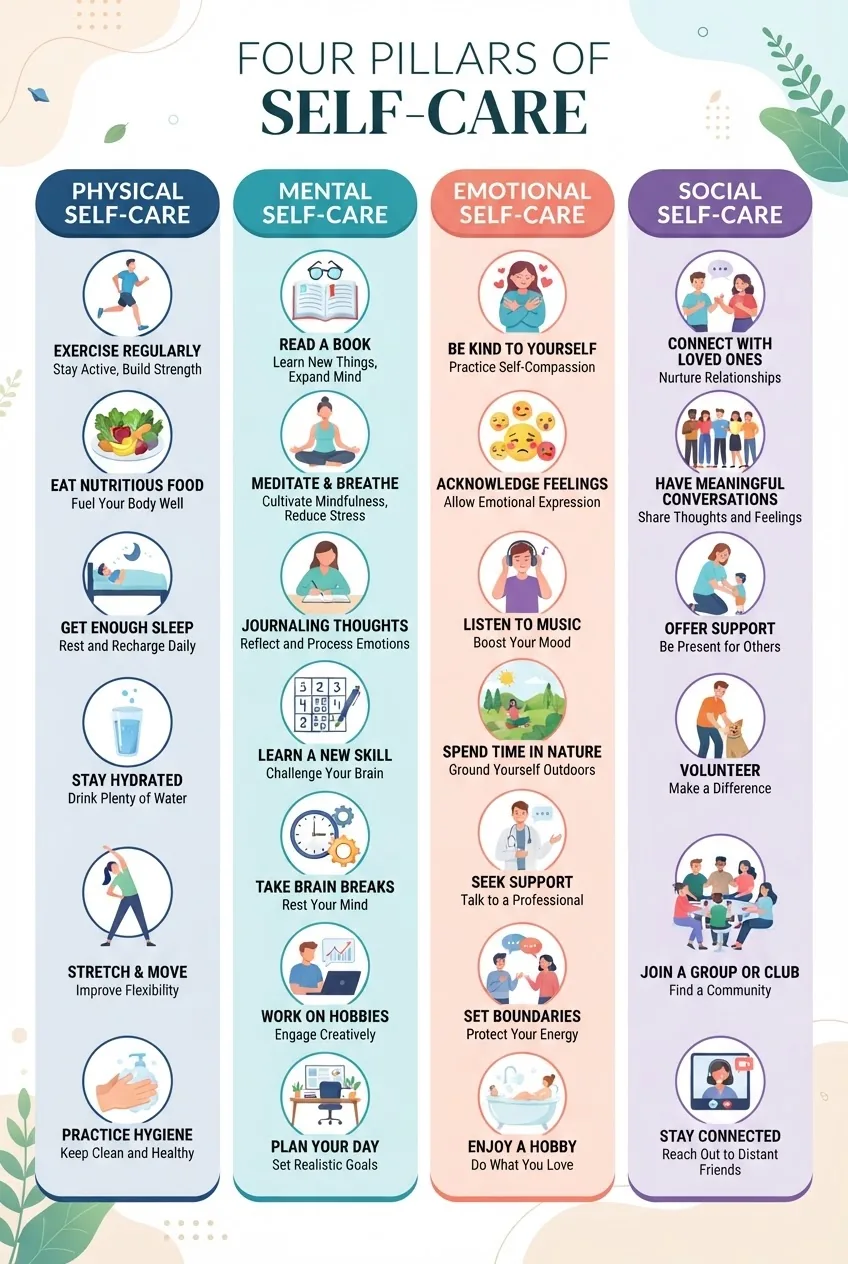
This section is a numbered, categorized self care list for adults: pick 2–3 items from each category and mix them into daily or weekly routines. Below each item is a short why and a quick how.
-
Mental self care (choose 1–3 daily)
- Short mindfulness breaks — 3–10 minutes breathing: reduces reactivity; set a timer and follow the breathing steps in the Mental & Emotional section.
- Focused reading — 20 minutes of a non-work book to boost cognitive engagement and relaxation.
- Brain challenges — puzzles, language apps, or 5-minute logic games to keep cognitive flexibility high.
- Structured journaling — a 10-minute reflection using prompts (see walkthrough later) to process thoughts.
- Digital boundary setting — a daily 60–90 minute “phone-free” block for mental recovery.
-
Physical self care (choose 3–5 weekly)
- Gentle aerobic movement — brisk walking, cycling 20–45 minutes, 3–5x week to support mood and sleep.
- Strength micro-sessions — 2× a week resistance band or bodyweight circuits, 15–25 minutes.
- Sleep hygiene — consistent bed/wake times, screens off 60 minutes before bed, plus a 20-minute wind-down ritual.
- Nutrition check-ins — add one extra vegetable serving per day for micronutrient support.
- Hydration and movement breaks — 250–350 ml water every 2–3 hours and a 3-minute standing/stretch break each hour.
-
Emotional self care (choose weekly and crisis practices)
- Emotional labelling — name feelings aloud for 30–60 seconds to reduce intensity and build clarity.
- Adaptive expression — 10-minute letters you don’t send, or safe vocal release (singing, shouting into a pillow) for catharsis.
- Boundary setting rehearsals — prepare scripts for saying no; practice aloud twice per week.
- Gratitude and positive re-appraisal — see the Mental & Emotional section for prompts and links to deeper gratitude exercises and thankfulness activities.
-
Social self care (choose per week)
- Meaningful check-ins — schedule two 15–30 minute calls a week with friends or family; choose listening over problem-solving when someone needs support.
- Community contribution — volunteer micro-shifts (1–2 hours/month) or a one-off favor; helps build purpose.
- Set social energy limits — plan one social outing per week and one quiet evening; alternation helps recharge.
- Connect with a peer or mentor — a monthly 45-minute chat to share goals and perspective.
- Group self care option — for group ideas, see self care activities for groups.
-
Practical rituals and one-day plans
- Micro-routine — morning 10 minutes (breathing + planning) and evening 10 minutes (journaling + wind-down).
- Self care day ideas — dedicate 4–8 hours once monthly: gentle movement, nourishing meals, digital detox, hobby time, and an early night.
- Quick resets — 5-minute desk reset: hydrate, stretch, breathe, re-prioritise.
-
Audience-specific picks
- Adults seeking targeted ideas — low-equipment strength, scheduled social check-ins, and structured bedtime routines.
- Women-focused suggestions — tailored self care activities emphasising social support, hormonal-cycle-aware exercise options and creative expression — see self care activities for women.
-
Types and categories for deeper study
If you want a taxonomy of the approaches covered here, consult categories of self care for a full overview.
For quick mood interventions, pair emotional and physical items — see methods to improve mood.
Transition: now we unpack physical self care with examples, trade-offs and a comparison table so you can select the right intensity and rest balance for your circumstances.
Physical Self Care: Activities and Examples
Physical self care includes movement, sleep, nutrition and functional habits that support brain and body. The underlying principle: balance stimulus and recovery. Exercise raises mood but requires sleep and nutrition to deliver gains. I use the wellness wheel and biopsychosocial framing to choose activities based on energy, time and recovery capacity.

Key practical tips:
- Start small. 10 minutes of walking counts; aim for 150 minutes of moderate activity per week as a target baseline (break into 20–30 minute segments).
- Mix intensities. Two sessions of strength (15–25 min) and 3–4 sessions of moderate aerobic work (20–45 min) deliver broad benefits without overtraining.
- Respect sleep thresholds. Target 7–9 hours nightly; implement a 30–60 minute wind-down: low light, no screens, a hot shower or herbal tea.
- Nutrition micro-goals. Add 1–2 vegetable servings at each main meal; use 250–350 ml water goals every 2–3 hours to reduce fatigue.
- Progress and rest trade-offs. If you increase intensity (e.g., adding HIIT once weekly), add 1–2 extra rest days or reduce volume the following week.
Table: exercise intensity, practical session design and recovery guidance.
| Intensity | Session design | Recovery guidance |
|---|---|---|
| Low (walking, gentle yoga) | 20–45 min, conversational pace | Same-day or next-day active recovery; light stretching |
| Moderate (brisk walk, steady cycling) | 20–40 min, slightly breathy but sustainable | Sleep 7+ hours; hydrate and refuel within 60 minutes |
| High (HIIT, heavy lifting) | 10–25 min intervals or 30–45 min resistance | 48–72 hours for full recovery depending on load; reduce volume next session |
If you want a deeper dive into structured physical health plans and broader wellness and health improvement strategies, review that guide after picking the core activities you’ll trial this month.
Transition: physical inputs matter, but mental and emotional techniques often decide whether physical plans stick — next we cover those techniques and step-by-step instructions.
Mental and Emotional Self Care Techniques
Mental and emotional self care focuses on thought regulation, stress reduction and building emotional literacy. Key methods here are mindfulness, journaling, cognitive reframing and behavioural activation. These techniques are grounded in recognized methodologies: mindfulness-based stress reduction (MBSR), cognitive-behavioural techniques (CBT) and expressive writing research.

Practical walkthrough — Mindful breathing (3–10 minutes):
- Sit or lie comfortably. Set a 3- to 10-minute timer. Keep feet grounded or legs uncrossed.
- Anchor to the breath. Breathe in for 4 seconds, hold 1 second, breathe out for 6 seconds. Repeat.
- Notice sensations. When the mind wanders, label the distraction (“thinking”) and return to breath without judgment.
- Finish with an intention. After the timer, set a short intention: “I will take one clear decision after a 5-minute pause.” Use daily.
Journaling prompt (10 minutes): a stepwise method
- Set 10 minutes on a timer. Write without editing.
- Start with a fact sentence. “Today I noticed…” (30–60 seconds).
- List emotions. Write 3 feelings and a brief sentence about each: where you feel it in the body and what might have triggered it.
- Choose a reframe. For one negative thought, write one balanced alternative (CBT-style) and one action you can take in 10–30 minutes.
Gratitude and positive re-appraisal are effective emotional self care techniques. For deeper exercises and structured programs see gratitude exercises and daily gratitude practice.
If you or someone you know is experiencing depressive symptoms, combine these techniques with specialised approaches found in the self care for depression resource and seek professional support when needed.
Practical stress-management methods with timing:
- Immediate (1–5 min): box breathing or 5-4-3-2-1 grounding to reduce acute arousal.
- Short-term (10–30 min): walk or 10-minute journaling to shift mood and cognition.
- Medium-term (1–3 days): schedule a restorative sleep window and reduce stimuli; track sleep hours and mood.
Trade-offs and nuance: cognitive reframing helps with anxiety and low-level rumination, but persistent symptoms—intense low mood, suicidal thoughts, or marked functional decline—need clinical treatment. Self care techniques are supportive, not substitutes for therapy.
Transition: after mental/emotional practices, social and spiritual self care restores meaning and connection—covered next with activities and resource pointers.
Social and Spiritual Self Care Ideas
Social and spiritual self care focuses on relationships, belonging, meaning and reflection. Social self care strengthens support networks; spiritual practices increase purpose and can be formal (meditation, prayer) or secular (nature immersion, creative ritual).
Illustrative activities:
- Meaningful connection — a 20–30 minute weekly conversation with a friend where you practice active listening and curiosity.
- Volunteer micro-shifts — 1–2 hours monthly to connect with causes; contributes to a sense of purpose.
- Nature ritual — 30–60 minutes weekly walk in a park with intention (notice, name, appreciate) to restore perspective.
- Solo reflection — 15–30 minute evening reflection on values and choices; use a prompt like “What nourished me today?”
Tools and trusted resources: if you want curated web-based support and recommended reading see trusted self help resources which lists reputable websites and organisations.
Group activities can magnify benefits; for structured group self care activities and facilitation ideas, see that guide.
Transition: you now have a wide menu. Next, we build your routine step-by-step using a practitioner-tested process with troubleshooting and a compact case study.
Creating Your Own Self Care Routine: Tips and Tricks
What follows is a practical, step-by-step method to design a personalised routine you can test for 2–4 weeks. The core of this section is the hands-on numbered procedure; follow each step in order and record outcomes.
-
Identify your baseline and constraints (30 minutes)
Record current sleep times, two typical workdays, energy peaks and weekly commitments. Note one medical or physical constraint (e.g., knee pain) and any mental-health flags. This creates realistic boundaries for activity choice.
-
Choose anchor actions (20–30 minutes)
Select one morning anchor (3–10 minutes breathing or light stretching) and one evening anchor (10 minutes journaling and wind-down). Anchors should total 10–30 minutes daily.
Tip: anchor actions are non-negotiable; schedule them as calendar events with notifications.
-
Pick 3 weekly physical items (15–20 minutes)
From the physical list, choose two moderate sessions (20–40 minutes) and one strength session (15–25 minutes). If your week has two rest days, fit sessions into remaining days so the body has 48–72 hours recovery from high loads.
-
Pick 3 emotional/mental practices (15–25 minutes)
Choose: a daily 5-minute breathing practice, a 10-minute journaling slot 4x weekly, and a weekly gratitude or re-appraisal exercise. If you want expanded gratitude methods, review daily gratitude practice and gratitude exercises.
-
Map social/spiritual supports (10–20 minutes)
Schedule two check-ins: one social (15–30 mins) and one restorative (nature, meditation or volunteer micro-shift) per week. Use these to anchor purpose and belonging.
-
Set measurable micro-goals (15 minutes)
Write 2–4 micro-goals: “I will walk 20 minutes Monday/Wednesday/Friday” or “I will journal for 10 minutes after dinner 4x weekly.” Use the SMART approach: specific, measurable, achievable, relevant, time-bound.
For structured planning and targets see goal setting for self care.
-
Commit and test for 2–4 weeks (5 minutes to set; ongoing)
Track sessions in a simple habit tracker: checkmark each completed anchor or session. After 2 weeks, review and tweak: drop what drains you and keep what increases energy by +10–20%.
-
Iterate using short measurement (weekly review 20 minutes)
Each Sunday, note sleep hours, three wins, and one barrier. Adjust the next week’s micro-goals. For habit support, see daily self care habits and daily self care schedule.
-
Add structure as needed: plan or keep flexible (10–20 minutes)
If you prefer structure, build a simple weekly plan using the micro-goals and review practical self help tips. If flexibility works better, keep two anchors and a rotating menu of activities to prevent decision fatigue.
For long-term planning, reference goal setting for self care again.
Mini case study — how one adult applied these steps (realistic example):
Anna, a 34-year-old part-time teacher, logged baseline constraints (kids’ drop-off, 8–4 work cycle) and picked anchors: morning 5-minute breathing, evening 10-minute journaling. She added three weekly sessions: two 30-minute walks and one 20-minute resistance band session. After 4 weeks she reported 1 hour earlier sleep onset, a decrease in afternoon anxiety by self-report, and a clearer work-life boundary. She kept the two anchors and rotated physical sessions to avoid burnout.
For a complete reference and this article’s full menu of options see Self Care Ideas Guide with Effective Activities and Techniques which is the cornerstone resource for building from the lists above.
Common mistakes and how to avoid them
I often observe these failures in practice and how I correct them:
- Starting impossibly large. I once recommended daily 60-minute workouts to a busy client; they stopped after three days. Avoid this by beginning with 10–20 minute sessions and scaling up by 10% weekly.
- Mixing too many new habits at once. I’ve seen people add four new nightly tasks and then abandon all. Stick to one anchor and one new weekly activity for two weeks before adding more.
- Neglecting recovery. I advised a high-intensity block without rest and it led to burnout. Schedule at least one full rest day and monitor sleep for declines.
- Using vague goals. I used “exercise more” and wasn’t accountable. Replace with “walk 20 minutes on Mon/Wed/Fri at 7:00 am”.
Checklist to verify your routine
- Two daily anchors set and calendared (check).
- Three weekly physical/mental activities chosen and scheduled (check).
- Micro-goals written in SMART format (check).
- Tracking method active (paper or app) for 2–4 weeks (check).
- One troubleshooting plan for barriers (time, energy, access) (check).
When to call a professional
Contact a GP, psychologist or emergency services if you experience suicidal ideation, sudden severe mood shifts, marked functional decline, or symptoms that don’t improve after 2–4 weeks despite self care. Self care supports wellness but does not replace medical or psychiatric care.
Transition: the final practical section provides short, easy at-home ideas for busy adults to use immediately.
At-Home Self Care Ideas for Busy Adults
These items require minimal equipment and can be completed in 5–30 minutes. Use them as daily anchors or quick resets.
- Two-minute box breath reset — Sit, inhale 4s, hold 1s, exhale 6s for 2–3 minutes.
- 10-minute body scan — Lie or sit and scan from toes to head, noticing tension and relaxing each area.
- 5-minute journaling — One sentence: “Today I will…” then write one actionable small step.
- 20-minute walk — Outdoor or around the block; phone on do-not-disturb.
- Quick strength circuit — 3 rounds: 10 squats, 8 push-ups (knees ok), 30-second plank; 12–15 minutes total.
- Tea ritual — Brew herbal tea, sit without screens for 10 minutes and notice taste and warmth.
- Micro-declutter — 10 minutes: clear one surface; visible order reduces cognitive load.
- Evening wind-down checklist (15 minutes) — lights dimmed, screens off 60 minutes pre-bed, journal entry, and 5–10 minutes stretching.
For busy adults, consistency beats intensity: 10 minutes daily delivers more sustained benefit than sporadic long sessions. Tailor to energy windows (e.g., before work, lunchtime, or after-dinner). If you need practical habit support, review practical self help tips and daily self care habits for micro-implementation ideas.
External authority and further reading: for clinical evidence on the benefits of routine and sleep, refer to the Australian Department of Health advisory — Australian Department of Health. For general mental health guidance, see Mental Health Australia — Mental Health Australia. For peer-reviewed literature on self-care interventions, see recent reviews and clinical summaries via PubMed — PubMed search: self-care intervention review.
Conclusion
Key takeaways: 1) Build around two short daily anchors and a small weekly menu of mental, emotional and physical activities. 2) Start small, measure for 2–4 weeks, and iterate. 3) Use targeted techniques—mindful breathing, journaling, gentle movement—to reduce stress and improve mood. This Self Care Ideas Guide with Effective Activities and Techniques equips you with dozens of practical options to create a personalised routine today. Ready to start? Schedule your anchors in the next 10 minutes and test for two weeks; if you want structured planning, see the linked planning guides above and reach out to a health professional for persistent concerns.