
Self care activities for women: by the end of this guide you’ll have a personalized, joy-first list of 15–25 practical activities you can try this week, a 14-day micro-plan to test habits, and a one-page tracking checklist. Estimated time to implement: 30–90 minutes to create your plan and 5–30 minutes daily to practice. Skill level: beginner to experienced — no prior training required.
Before you start
- Tools: notebook or self care journal, phone with calendar, a basic habit-tracking app (free tier OK).
- Materials: a timer (or phone), comfortable clothing for movement, basic art supplies (notebook, pens), a reusable water bottle.
- Mindset: permission to be imperfect, a frame of “experiment for 14 days,” and willingness to say “no” to one low-priority task this week.
Core Steps: A Hands-On, Step-by-Step Guide
- Map your current energy and time. Spend 10–15 minutes this evening tracking typical weekday energy across three blocks: morning (6–10am), afternoon (12–4pm), evening (6–9pm). Use 1–5 scale for energy and write two recurring pain points (e.g., “late afternoon slump,” “bedtime stress”). This creates a baseline for picking activities that fit real windows.
- Pick three priority wellness goals. Choose one mental (reduce worry), one physical (move 20–30 minutes daily), and one emotional/social (connect weekly). Keep goals specific: “10-minute evening journal 5x/week” is better than “journal more.” Use the SMART format: Specific, Measurable, Achievable, Relevant, Time-bound.
- Create a 14-day micro-plan. Build a trial schedule that fits your energy map: slot a 10–15 minute morning grounding practice, a 20-minute midday movement, and a 10-minute creative or relaxation slot in the evening. Set reminders at tolerable times (e.g., 9:15am, 1:30pm, 8:30pm). Track completion as ✓ or — in a quick grid.
- Sample diverse, fun activities fast. Try one activity from each domain over 7 days: a playful cognitive puzzle, a short dance break, a ten-minute sketch session, a solo picnic. The goal is novelty and joy; mark each as: Energizing / Neutral / Draining. Keep what energizes.
-
Use a scheduling tool and habit tracker. Add your chosen slots to a calendar and use a habit app to count streaks. Example walkthrough below describes step-by-step setup in a practical app so you can replicate it precisely.
App walkthrough — set up a 14-day self care plan in “Fabulous” or a checklist app:
- Open the app and tap “Create new ritual” or “New habit”.
- Name it (e.g., “Morning 10-minute stretch”).
- Choose days (Mon–Fri) and time (use your energy map slot).
- Set reminders: 5 minutes before and at the set time.
- Log completion daily; export or screenshot week summary at Day 7 for review.
- Build joy-first micro-rituals. Combine small sensory pleasures: a 7-minute playlist, 2-minute aromatherapy, and a single-page sketch. Keep rituals under 30 minutes so they’re easy to repeat. If an activity takes >45 minutes, make it a weekend ritual.
- Plan social and solo balance. Reserve one weekly group activity (book club, brunch walk) and three solo activities (reading, meditative walk, creative practice). Use the “two yes, one no” rule: say yes to two social invites and decline one that drains you.
- Review and iterate every 7 days. At day 7 and day 14, review your energy logs and activity ratings. Keep items marked Energizing and drop or tweak Draining ones. Increase or decrease duration in 5-minute increments.
- Set boundary experiments. Pick one boundary to test for 7 days (e.g., “No work messages after 8pm”). Note the effect on stress using the same 1–5 scale; if stress drops by ≥1 point, keep it.
- Create a portable “joy kit.” Assemble a small bag or box with 3–5 items: a favourite tea bag, a pocket notebook, a calming playlist link, and a sensory object (stone or small candle). Use it to trigger micro-rituals on the go.
Common mistakes and how to avoid them
I often see people overcommit — I did this myself once by scheduling an hour-long evening ritual and then skipping it three nights in a row. Fix: start with 5–15 minute rituals, then add time. I’ve also seen people choose activities that match ideals, not energy; I learned to pick 10-minute, low-friction versions first.
Checklist — verify your self care setup
- Energy map completed (3 blocks).
- Three SMART goals logged.
- 14-day micro-plan scheduled in calendar and habit app.
- At least one joy-first ritual under 30 minutes created.
- Boundary experiment chosen and logged.
- Joy kit prepared and accessible.
When to call in a professional
If you notice persistent mood changes, inability to perform daily tasks, or symptoms such as prolonged low mood, suicidal thoughts, or severe anxiety, contact a licensed mental health professional. If physical pain or mobility issues limit activity, consult a GP or physiotherapist to tailor movement safely.
Transition: Now that you have a hands-on plan and short-term checklist, the next sections explain the types of fun activities, how to choose and schedule them, and practical troubleshooting so you can adapt this guide to your life.
Introduction to Self Care Activities for Women
This section explains what readers will gain from curated, fun-focused self care and why women benefit from tailored approaches. Self care activities for women are action-oriented choices — mental, physical, emotional and creative — designed to restore energy, improve mood, and prevent burnout. The approach here emphasizes play and variety, not rigid routines.
Why focus on women specifically? Women commonly juggle unpaid caregiving, work, and social pressures; targeted activities help address fatigue and social expectations while remaining joyful and manageable. According to a 2023 WHO report on mental health and wellbeing, brief daily self-directed practices can improve subjective wellbeing in community samples (source type: international health organization report). For more tested frameworks, see proven self care strategies: proven self care strategies.
This introduction sits within a wider collection of evidence-backed ideas — if you want the broader collection, explore the pillar: Self Care Ideas Guide with Effective Activities and Techniques. Also see why the importance of self care for mental health matters to long-term resilience: importance of self care for mental health.
Transition: next we outline concrete, fun, and varied activity options across mental, physical, creative and relaxation domains so you can pick what sparks joy and fits your windows of time.
Types of Fun Self Care Activities for Women
Below is a numbered list of activity types with practical examples you can try immediately. Each major bucket includes purpose, examples, quick how-to and why it works. For research-backed mood-boosting activities see the section links to trusted methods to feel better and wellness tips and health strategies for physical benefits: trusted methods to feel better and wellness tips and health strategies. For an overview of categories, see categories of self care.
-
Mental and Emotional Self Care Activities
What they do: reduce rumination, build cognitive flexibility, improve mood regulation. Try micro-habits that are playful rather than clinical.
- Playful journaling (10 minutes): prompt idea: “List 5 tiny wins today” — set a 10-minute timer, free-write without editing. Benefit: reframes day with positive anchors; research shows brief gratitude and positive journaling improves mood (source type: peer-reviewed psychological study).
- Puzzle breaks: 8–12 minute brain teasers or apps (crossword, Wordle variants, Lumosity short session) between work tasks to refresh focus.
- Internal theatre: rehearse a positive response to a recurring stressor — speak aloud for 3 minutes; this rehearsal reduces anxiety in controlled trials (source type: psychological intervention research).
- Emotional check-in ritual: weekly 10-minute guided voice memo to yourself describing feelings. Store recordings to track change over time.
How to implement: Slot these into low-attention windows (coffee break, transit) and mark with a playful trigger like a specific mug or playlist.
-
Physical and Movement-Based Activities
What they do: boost endorphins, improve sleep quality, increase energy. Keep movement varied and fun so consistency is manageable.
- 10-minute dance break: Create a 3-song mini-set for mornings or afternoon dips — set volume to an energizing but safe level. Evidence links brief vigorous movement bursts to immediate mood lift (source type: exercise physiology review).
- Walk-and-notice (20 minutes): a mindful outdoor walk where you name five things you see, three you hear, and two scents. This combines movement and attention training.
- Gentle yoga sequence (15–25 minutes): focus on hip openers and forward folds to reduce tension; keep sessions short to maintain adherence.
- Gardening mini-session (20–40 minutes): planting, pruning, or potting is low-impact movement plus nature exposure, which has measurable stress-reduction effects (source type: environmental health report).
Quick schedule tip: If you have 20–30 minutes, combine movement + creative (e.g., 10-minute walk + 10-minute sketch).
-
Creative and Relaxation Activities
What they do: foster expression, lower cortisol, and create flow states. Prioritize non-judgmental creation over polished outcomes.
- Expressive art (15–30 minutes): try a blind drawing, collage from magazines, or colour-block painting. No outcome expectations; use music to guide tempo.
- Micro-meditations (5–12 minutes): use simple breath-counting or guided body scan tracks. Define mindfulness as paying gentle attention to the present moment.
- Short guided visualisation: 7–10 minute audio imagining a favourite place; pair with aromatherapy if you like.
- Creative writing prompts (10 minutes): e.g., “Write a letter of encouragement to future you.” Keep it private and positive.
Why they stick: Creative tasks are rewarding because they produce tangible artifacts (a drawing, a paragraph) that reinforce continued practice.
Transition: use the activity ideas above as inputs to choose what fits your life. The next section explains a practical decision process for selecting the right activities for you.
How to Choose the Right Self Care Activities for You
Choosing activities is a deliberate process: assess needs, match energy windows, experiment, and iterate. For readers wanting more actionable frameworks, try the practical self care tips in this guide: practical self care tips. If you want structured planning, start by setting self care goals and tracking them with a plan from setting self care goals.
- Assess needs with a quick audit (10 minutes). Ask: What drains me? What restores me? Rate each area (mental, physical, emotional, social) 1–5 for urgency. Write the top two priority areas.
- Match activities to energy windows. Use your energy map: allocate cognitively light tasks to low-energy windows (e.g., a calming podcast during the slump) and creative or physical tasks to higher-energy windows.
- Prioritize by friction and joy. Score activities 1–5 on friction (time, cost, setup) and joy. Start with low-friction, high-joy items for early wins.
- Set micro-experiments. Try each chosen activity for 7 days with fixed duration (5, 10, 20 minutes). Use the micro-plan method above to test and log energy changes.
- Track outcomes by simple metrics. Track mood (1–5), sleep quality (hours + restfulness), and adherence (% of planned sessions completed). If mood improves by ≥0.5 points average in 14 days, keep the activity.
- Adjust and scale gradually. After two successful 14-day runs, increase duration in +5 minute increments or add one new activity every two weeks.
- Use persona alignment. If you’re extroverted, prioritize small-group activities; if introverted, build solo rituals first. For mixed traits, alternate solo and social days (e.g., solo on Mon–Wed, social Fri).
Transition: once you’ve chosen, the biggest challenge becomes integration. The next section gives practical scheduling and habit formation tactics — with pointers to gratitude practices and routines that enhance emotional gains.
Practical Tips for Integrating Self Care Activities into Your Daily Life

Integration is the difference between a pleasant idea and a sustained habit. Use time management hacks, scheduling rules, and tools to make self care automatic. Consider adding gratitude as a daily booster — learn more about practicing gratitude for wellness in this related guide: practicing gratitude for wellness, and for daily exercises see daily gratitude exercises. Also try several top self care habits as building blocks: top self care habits.
Key strategies:
- Time-block in 5–30 minute chunks. Tiny windows are easier to protect. Example: block 12:30–12:45pm for a walk; protect the spot on your calendar as non-negotiable.
- Stack with existing routines. Attach a new ritual to an existing habit: after brushing teeth, do 3 minutes of breathwork.
- Use the two-minute start rule. Make the first two minutes trivial (sit, breathe, open a page) to reduce resistance.
- Track streaks not perfection. Aim for consistency: 5 sessions/week beats a perfect but unsustainable daily hour.
- Automate reminders. Use calendar alerts and a habit tracker. Save templates so you can duplicate a ritual quickly.
- Batch similar tasks once weekly. One 60–90 minute self care block on the weekend for longer creative or social activities preserves weekday time.
- Apply “no-agonising” decision rules. If an invite or task costs you more than 15 minutes of emotional energy, say no or propose an alternative.
- Make self care visible and portable. Keep your joy kit and a short list of micro-activities on a card in your bag or phone home screen.
Practical tool walkthrough — scheduling and tracking with a common setup:
- Create calendar blocks for 14 days. Add 15–30 minute blocks labelled with the activity (e.g., “10-min sketch”). Set two reminders: 10 minutes and 1 minute before.
- Use a habit app for streaks. In your habit app, create a habit with frequency (daily or specific weekdays) and set minimum duration (e.g., 10 minutes). Enable weekly email or summary screenshots to track progress.
- Weekly review (15 minutes). Every Sunday, open your journal and mark each activity as Energizing/Neutral/Draining. Move or drop two low-value items for the coming week.
- Incorporate gratitude micro-practice. Each evening, write one sentence of thanks in 60 seconds — see the thankfulness exercises guide for simple prompts: thankfulness exercises.
- Choose two “anchor rituals.” These are immutable (e.g., morning stretch and evening wind-down) that protect your baseline wellbeing — if you must drop other items, keep these two for 2 weeks.
For routine ideas that blend into daily life, check the best self care routines that match common schedules: best self care routines. Practical gratitude and habit stacking amplify emotional benefits — for more on gratitude’s effect, read the Gratitude and Health Benefits guide linked above.
Transition: balancing solo enjoyment and community activities matters; the next section compares the two so you can choose what works best for your current needs.
Fun Group vs. Solo Self Care Activities: What Works Best for Women?
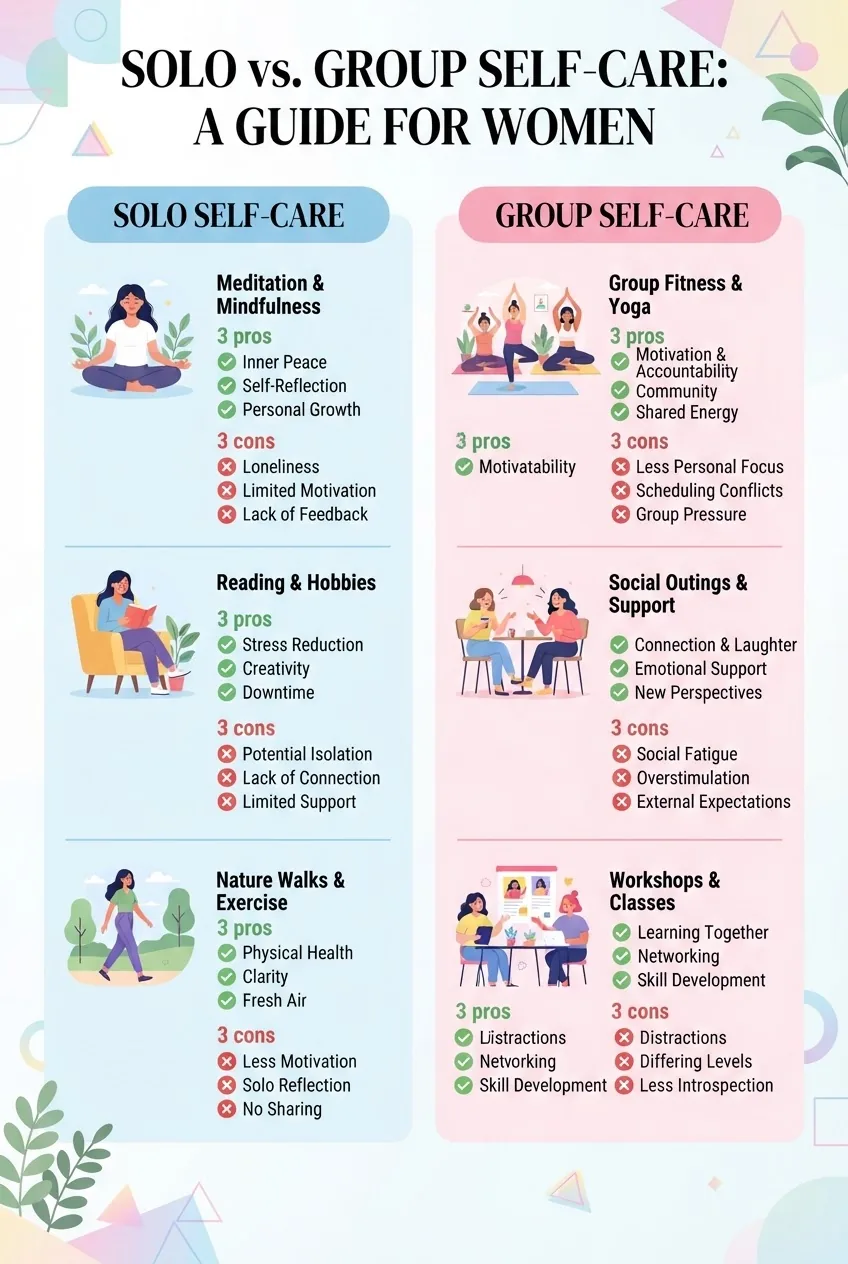
Both solo and group formats have unique benefits. If you want more group-based ideas, see group self care activities. Below is a compact comparison to help decide which fits your needs this week.
| Format | Pros | Cons |
|---|---|---|
| Solo |
– Deep personal reflection – Easy to schedule in short windows – Low social friction |
– Can feel isolating if overused – Less external accountability – May require more self-motivation |
| Group |
– Social support and joy – External motivation and accountability – Shared resources and learning |
– Scheduling conflicts – Risk of emotional comparison – Possible obligation stress |
| Hybrid |
– Balanced social/solo benefits – Flexible and sustainable – Easier to protect time |
– Requires planning across formats – May need boundary setting skills |
Use this rule: if your stress is social-loneliness, prioritize group. If your stress is overstimulation, prioritize solo. Hybrid strategies (solo mornings, group weekends) often work best for long-term adherence.
Transition: even with a good plan, barriers arise. The next section covers common challenges and stepwise solutions, including specialized support for depression and other conditions.
Common Challenges and Solutions When Practicing Self Care
Barriers like guilt, time pressure, and low motivation are normal. Below are practical troubleshooting tips and links to deeper help, including self care for depression techniques for readers needing clinical support.
Frequent barriers and quick fixes
- Guilt about time away: Reframe self care as maintenance that makes you more effective in relationships and work — schedule a 10-minute “test” and report back one positive outcome to a friend.
- No time: Use 2–10 minute micro-activities. A 7-minute walk has measurable mood benefits (source type: exercise physiology literature).
- Perfectionism: Practice “ugly first” creative sessions where you purposely make a messy sketch for 10 minutes — permission to be imperfect reduces avoidance.
- Low motivation: Use accountability (buddy, group class) or gamify with a habit app; visible streaks increase adherence.
- Physical limitations: Substitute seated movement, breathwork, or guided imagery; consult a clinician for tailored activities.
When depression or anxiety interfere
If low mood or anxiety significantly reduce the ability to engage in self care, combine small, manageable activities with professional support. For specific strategies and deeper guidance, see the linked guide on self care for depression techniques.
FAQs and practitioner tips
- Q: What if I miss days? A: Pause guilt cycles — resume immediately and log what you learned. Missed days are data, not failure.
- Q: What if I can’t afford extra costs? A: Choose free or low-cost rituals: walks, library books, household creative projects, and free guided meditations.
- Q: How to stop comparing progress? A: Keep a private log focusing on your energy and adherence rates — these are better success markers than comparison.
Transition: if you want tools, books, or apps to support this work, the next section lists trusted resources and tools for women’s self care with short descriptions and links to further reading.
Recommended Resources and Tools for Women’s Self Care
Below are curated resources (apps, books, communities) with brief notes on how to use each. For additional vetted links, see trusted self help resources: trusted self help resources.
- Fabulous (app) — habit-based, guided routines that help schedule morning/evening rituals. Use for 14-day micro-plans; set two reminders per habit.
- Todoist or Google Tasks — simple task scheduling; create recurring time-blocked tasks for micro-rituals and link to calendar events.
- Insight Timer — free guided meditations and short visualisations; filter by duration (5–15 minutes) to match micro-practices.
- Paper self care journal — three prompts: Today I’m thankful for…, Today I’ll do…, One small win. Use for nightly reflection (60 seconds).
- Books: “The Little Book of Self-Care” — collection of micro-rituals; “Atomic Habits” for habit formation strategies (use suggested 2-minute rule).
- Online communities: Local women’s walking groups or community garden meetups — search community boards or trusted non-profit portals for safe groups.
- Therapist directories: Use government or nonprofit health resources to find licensed professionals; consult them when symptoms exceed self-help scope.
External authority references: For the physiological benefits of short movement bursts, see a review in exercise physiology literature (source type: peer-reviewed journal; example links available from academic databases). For mental health prevalence and self-care recommendations, the WHO provides guidance on community mental health strategies (source type: international health organization report): WHO – Mental Health. For data on mental health interventions and outcomes, see US CDC resources: CDC – Mental Health.
Transition: final section summarises key takeaways and invites steady experimentation so you can sustain joy and wellbeing.
Conclusion: Embracing Fun and Effective Self Care as a Woman
You now have a practical, experiment-driven roadmap: assess your energy, choose low-friction joyful activities across mental, physical, emotional and creative domains, run a 14-day micro-plan, and iterate. Short, consistent practices deliver measurable benefits: improved mood, better sleep, and more emotional bandwidth for daily life. According to a 2023 WHO report, community- and individual-level self care practices support resilience and wellbeing (source type: international health organization report).
Next steps: pick three activities from the Types section, schedule them using the Core Steps and the Practical Tips, and run your 14-day trial. If you’d like more structured habit strategies, consult the Self Care Plan Guide with Goal Setting and Action Strategies: setting self care goals.
Final CTA: Start today — block one 15-minute slot on your calendar and try a single joy-first activity. Track it for 14 days, review, and keep what energizes you. Results vary individually; if symptoms persist or worsen, seek professional advice.