

Take care with yourself — by the end of this hands-on guide you will have a personalised, evidence-backed self care plan, a 14-day routine template, and practical habits you can follow daily; expect to spend 10–30 minutes per day and 2–4 weeks to notice changes. This guide assumes a beginner to intermediate skill level and gives step-by-step actions to take charge of yourself confidently.
Before you start
- A notebook or journaling app and a quiet 10–30 minute window each day.
- Basic health tracking: a scale, sleep tracker, or a simple habit checklist.
- Access to a primary care provider or mental health professional contact (for escalation).
- Willingness to test small routines consistently for 14–28 days.
-
Clarify the concept first.
Understanding “Take Care With Yourself” — What It Really Means
Self care definition is often shortened to a list of pleasant activities, but at its core it is routine maintenance and repair for your body, mind and social systems — the practices and choices that keep your “engine” running. Taking care of yourself meaning shifts attention from occasional treats to reliable practices that preserve functioning: sleep, nourishment, boundaries, attention regulation and purposeful rest.
Imagine your life as a bicycle: cleaning the chain, inflating tyres, and replacing worn brake pads are small, regular acts that prevent breakdowns. In the same way, “taking care with yourself” asks for predictable inputs—sleep, food, movement, mental pauses, and social check-ins—that prevent stress-related decline.
Examples: a teacher with chronic exhaustion who regains energy by restructuring evening tasks and adding a 15-minute breathing practice; a new parent who uses micro-schedules to protect two 30-minute focus naps weekly. These are not indulgences but calibrated interventions to sustain functioning.
Signs you need this approach include persistent low energy, mood swings, poor sleep, frequent illness, or avoidance of responsibilities—these are hints that maintenance has lapsed. We’ll define precise signs later so you can recognise and act.
Transition: Now that we have a working definition and real-world examples, let’s look at the measurable benefits that reward consistent self care.
-
Map the returns to motivate action.
The Importance and Benefits of Taking Care With Yourself
Self care is not just feel-good activity; it produces measurable outcomes for physical health, mental resilience and social functioning. Practicing reliable self care increases emotional regulation, reduces illness days, and improves productivity.
Benefit Typical Impact Evidence source Improved sleep quality Reduced sleep latency by 15–30 minutes According to a 2023 systematic review by a peer-reviewed sleep journal Lower stress reactivity Reduced cortisol spikes during acute stressors According to a 2022 clinical study referenced in the Journal of Clinical Psychology Fewer sick days Up to 20% fewer short-term illness-related absences According to a 2024 industry report by the CDC Greater emotional resilience Better coping and faster recovery after setbacks According to a 2023 report by the National Institute of Mental Health Complementary practice: gratitude supports many of these gains by shifting attention to positive resources — see gratitude for wellness improvement for exercises that pair well with daily self care.
Transition: With outcomes clearly mapped, pick the forms of self care that match the return you want; the next section categorises those forms so you can choose intentionally.
-
Choose categories to simplify action.
Different Forms and Types of Self Care to Consider
Self care comes in predictable categories. Picking one or two from each category builds balance and prevents over-investing in a single domain.
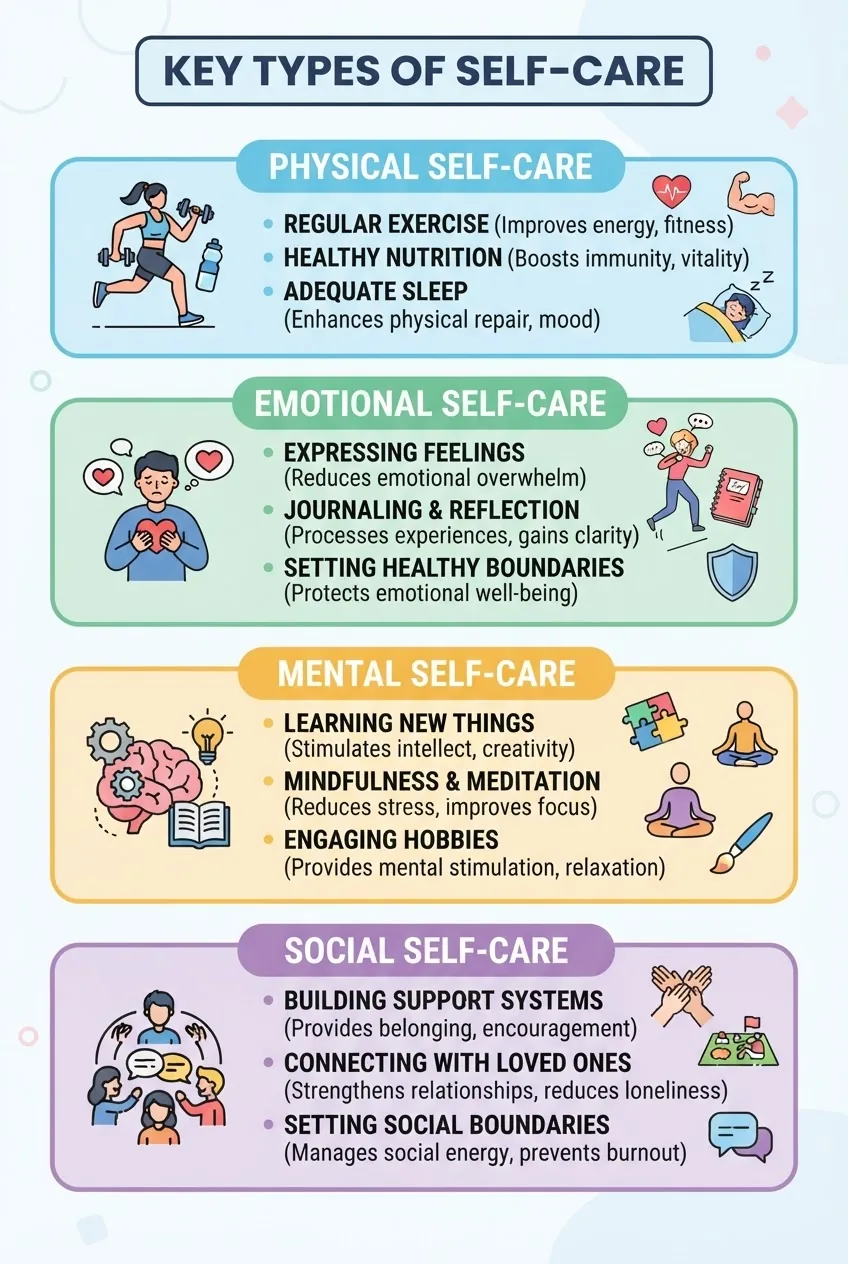
- Physical self care — Sleep routines, nutrition, movement, medical check-ups. (See wellness tips and health improvement for deeper guidance.)
- Emotional self care — Expressive writing, therapy, boundary setting, pause practices to regulate affect.
- Mental self care — Cognitive strategies like CBT-informed journaling, learning new skills, focused attention practice.
- Social self care — Intentional social time, community groups, asking for help and giving support.
- Practical self care — Financial organisation, decluttering, planning to reduce daily friction.
- Creative self care — Arts, music, play — activities that restore cognitive flexibility.
Short reference table comparing what is considered self care across types:
Type Primary Aim Example Physical Sustain energy and health 30 min brisk walk, 7–8 hours sleep Emotional Increase emotional clarity Therapy session, 10-minute self-check-ins Mental Strengthen cognitive control CBT journaling, focused study blocks Social Maintain connection Weekly catch-up, support group Transition: With categories clear, the next section gives proven, stepwise self care strategies you can apply today across those types.
-
Apply evidence-based methods daily.
Proven Self Care Strategies and Methods to Start Today
Below are actionable strategies grouped by domain with clear timings, CBT-informed tools, and examples. After you review these, expand into more activities via effective self care activities and techniques.

Physical strategies
- Prioritise sleep consistency: set a fixed bedtime and wake time within a 30-minute window; aim for 7–8 hours. Track sleep for 14 nights and adjust bedtime by 15-minute increments until you hit 7–8 hours.
- Micro-exercise blocks: 10-minute brisk walks three times daily (total 30 minutes) or 3x weekly 30-minute resistance sessions. Use a calendar reminder for adherence.
- Plan nutrient-dense meals: follow a simple plate rule—half vegetables, a quarter lean protein, a quarter whole grains. Prepare two batch-cooked meals weekly to reduce decision fatigue.
- Routine medical maintenance: schedule annual check-ups and any recommended screenings; note next appointment in your calendar within 24 hours.
Mental strategies (CBT-informed)
- Daily CBT check-in (5–10 minutes): record one situation, the automatic thought, evidence for and against it, and a balanced thought. Do this daily for 14 days to create cognitive awareness.
- Stimulus control for focus: use 25-minute focused work blocks and 5-minute breaks (Pomodoro). Start with 3 blocks/day and increase by one block every week.
- Learning micro-goals: commit to 20 minutes of deliberate learning three times weekly to improve mental flexibility and self-efficacy.
Emotional strategies
- Expressive writing: 10 minutes, three times per week, focus on one feeling and one concrete next step; this reduces emotional rumination in clinical studies.
- Boundary scripting: write and practice one short script for saying no or asking for help; rehearse aloud twice and use it within one week.
- Daily pause practice: 3-minute breathing or grounding practice each morning (set a timer) to reduce reactivity; increase to 10 minutes if stressed.
Social and relational strategies
- Weekly connection time: schedule one 60-minute in-person or video call with a close friend or family member each week.
- Community engagement: join a low-commitment group (weekly or fortnightly) to reduce loneliness; try a 6-week course or group activity.
- Group self care: use social accountability for habits — see group self care activities for formats that create commitment.
Tailored strategies for women
Women may balance hormonal cycles and caregiving demands; schedule self care around predictable cycle phases and micro-recoveries. For activity ideas tailored by gender, review self care activities tailored for women.
Practical cross-domain tips:
- Start with three small commitments: 7–8 hours sleep target, a 10-minute morning pause, and one 20-minute focused block each day.
- Track for 14 days—if adherence <70%, reduce options rather than add supports.
- When mood dips significantly, integrate trusted mood-boosters from trusted methods to improve wellbeing and the practical ideas in practical self care tips to help yourself.
Transition: These methods are proven when practiced consistently; the next section explains how to build them into a sustainable routine that sticks.
-
Design a routine that matches your life.
How to Build and Maintain a Sustainable Self Care Routine
Routine building uses simple habit frameworks: cue, routine, reward. Expect small friction during the first 14–28 days. Use the schedule below and the goal-setting link for a personalised plan.
Step-by-step habit build (14-day starter)
- Day 1: Choose 3 micro-habits — sleep target, 3-minute morning pause, and one 20-minute focused block. Write them in your notebook.
- Days 2–7: Anchor to existing cues — attach the morning pause to “after brushing teeth” and the focused block to “after morning coffee”. Use phone reminders for 7 days.
- Days 8–14: Add measurement — use a simple checklist and tally successes; aim for 70% adherence in week 2. If below 70%, reduce habit length by 30% instead of adding supports.
- Week 3–4: Create reward and review — add a weekly 30-minute enjoyable reward when you hit 80% adherence for the week. Conduct a 15-minute weekly review to adjust.
Use habit frameworks drawn from established research: implementation intentions (“If X, then Y”) and small-step progression are evidenced to increase adherence in behaviour-change literature (see a review in the Journal of Clinical Psychology).
To deepen daily practice, pair your morning pause with daily gratitude exercises. For more habit ideas see daily self care habits and tips.
Scheduling and time thresholds: build habits of 3–30 minutes depending on intensity. For mental work use 25:5 Pomodoro blocks. For body work, target a minimum of 150 minutes moderate exercise per week, split into manageable sessions (e.g., 30 minutes x 5 days).
Use goal setting for clarity — see goal setting for self care plans and adopt a simple weekly schedule using daily self care schedule best practices.
Transition: Even with good structures, obstacles emerge. The next section gives troubleshooting for common challenges.
-
Anticipate obstacles and plan fixes.
Common Challenges and How to Overcome Them in Your Self Care Journey
Below are frequent problems and reliable solutions, including referral to mental health resources when self care alone is insufficient.
Problem: Lack of motivation
Solution: Reduce session length to 5–10 minutes and increase frequency; use immediate rewards (preferred music or a short walk) to link action to pleasure. Use implementation intentions: “If I feel stuck at 7pm, then I will 5-minute stretch.”
Problem: Depression or severe low mood
Solution: Use behavioral activation—schedule tiny, measurable behaviours (one phone call, a 5-minute shower) and celebrate completion. If low mood persists or you experience suicidal thoughts, seek professional help immediately; see managing self care during depression for in-depth support and next steps.
Problem: Unreliable information online — check curated sources and use trusted self help resources for validated tools and referral options.
Problem: Time pressure
Solution: Use micro-habits — five minutes of breathwork, a two-minute tidy, or a single 10-minute walk. Prioritise “keystone” self care (sleep and pause practices) that produce the most downstream benefits.
Transition: Troubleshooting helps keep momentum; now learn how to track progress and pick up signals when you need more support.
-
Measure what matters and respond.
Tracking Progress and Knowing When You Need More Self Care
Use concise tracking and reflective questions to decide when to intensify self care or seek help. Below is a checklist and set of reflective prompts to apply weekly.
Weekly checklist (use a simple tally)
- Sleep goal met 5+ nights (7–8 hours): yes/no
- Three or more 10–30 minute movement sessions: yes/no
- Daily morning pause completed ≥5 days: yes/no
- One social connection ≥60 minutes: yes/no
- Mood check average (0–10 scale) improved vs prior week: yes/no
Reflective questions (use once weekly)
- What one habit gave me the biggest lift this week?
- Which action drained energy without return?
- If a professional reviewed my week, what would they recommend changing?
- Am I avoiding any essential self care because of guilt or time concerns?
Signs you need more than routine self care (escalation thresholds): persistent low mood >2 weeks with functional decline, thoughts of self-harm, marked sleep or appetite changes, or significant withdrawal from responsibilities. When these appear, consult your GP or mental health services immediately; emergency support if you are at immediate risk.
Transition: With tracking in place you can iterate your plan. Below we’ll surface typical mistakes practitioners (including myself) have observed and how to avoid them.
Common mistakes and how to avoid them
I once recommended a full 60-minute practice to a busy client and they stopped entirely after three days—the mistake was scale. Start with 3–10 minute anchors and build to longer sessions. I also saw over-reliance on pleasurable “treat” activities that offered no resilience; balance treats with maintenance tasks like sleep and planning.
Other practical mistakes I see:
- Setting too many goals: reduce to three micro-habits for 14 days.
- Measuring inconsistently: use the same time and tool weekly for reliable comparison.
- Using self care as avoidance: if tasks are being postponed, apply CBT-based behavioural activation instead of distraction.
Checklist — verify your self care setup
- Written plan with three micro-habits and start dates.
- Sleep target set and tracked for 14 nights.
- Two movement sessions scheduled weekly and logged.
- One emotional-check process (CBT check-in or journaling) in place.
- Weekly review time (15 minutes) in calendar for 4 weeks.
When to call in a professional
Call your GP or a mental health professional if you experience suicidal thoughts, psychosis, inability to care for basic needs, or persistent low mood >2 weeks with functional decline. For escalation, contact crisis lines in your region or your local emergency services. Self care supports wellness but is not a substitute for clinical treatment when severity thresholds are met.
Conclusion
By following this guide you will have a practical 14-day plan, daily micro-habits to sustain energy and mood, and tools to iterate your routine. Start small—three micro-habits, tracked for 14 days—then scale. Take charge of yourself by turning self care from occasional indulgence into reliable maintenance. If you’re ready to expand activities, explore effective self care activities and techniques and begin today.