

how to improve health: by the end of this hands-on guide you’ll have a practical, personalised wellness plan you can start implementing in 7 days; realistic changes take 4–12 weeks to show measurable benefit, and this guide assumes a beginner-to-intermediate skill level.
This resource is a step-by-step, actionable manual for people who want immediate wins and sustainable results using nutrition, movement, sleep, stress-management, and “stuff to help with” like supplements, hydration and environmental tweaks.
Before you start
- Time: 20–60 minutes per day for the first 2 weeks, then 10–30 minutes ongoing
- Tools: a basic food scale, a water bottle (1 L), a simple notebook or habit-tracking app, a stopwatch/timer, comfortable shoes, a yoga mat
- Measurement: baseline weight, resting pulse, sleep hours average for 7 days, one-minute plank or sit-to-stand count
- Medical caution: bring a list of medications and consult your GP before major diet/supplement changes
Step-by-step guide
-
Understanding How to Improve Health: A Holistic Approach
This step grounds the work: improving health is not a single action but a system of connected behaviours across nutrition, movement, sleep, stress, hydration, environment and preventive care. Think “holistic health” as the interaction between body and lifestyle — the classic body-mind connection where small, consistent inputs compound into major results.
What you’ll do here: map your current routines against the main health domains and pick 3 measurable targets (one food, one movement, one sleep/stress change) you can commit to for the next 30 days.
How to map: spend 20 minutes listing daily habits in a table — wake time, meals, movement, screen time, sleep time, water intake, mood. Mark three items with a priority 1–3 rating. This creates a focused plan instead of chasing every improvement at once.
Core concept definitions (brief):
- Holistic health — treating physical, social and environmental factors as a connected system.
- Wellness definition — actively making choices toward a balanced life across physical, emotional and social domains.
- Identify your “health improvement factors” — the few habits that, when changed, give the biggest return (sleep, protein intake, and 20–30 minutes of daily movement are often top candidates).
For reference on categories and broader self-care frameworks, see different types of self-care:
Transition: once you have a map and three targets, move to concrete nutrition actions to support energy and recovery.
-
Essential Nutrition Tips to Improve Health and Wellness
Follow these numbered, practical nutrition actions. Each item includes quantities, timing and rationale so you can implement them in the next 48 hours.
- Prioritise whole foods — aim for 80% whole, 20% processed. Swap one processed meal a day for a whole-food equivalent (e.g., replace a packaged sandwich with a homemade bowl: 100g cooked quinoa, 120g grilled chicken, 1 cup mixed salad greens, 1 tbsp olive oil, lemon). Whole foods increase micronutrient density and fibre.
- Balance macros each meal — 25–35% protein, 35–45% carbs (mostly from whole sources), 20–35% healthy fats. For most adults: target 20–30g protein per meal (eggs, 120–150g lean meat, 1 cup legumes), 30–50g carbs from vegetables/whole grains, and 10–15g fat from sources like olive oil, nuts or avocado. This supports satiety and stable blood sugar.
- Eat anti-inflammatory building blocks daily. Include at least 1 serving (100g) of oily fish twice weekly, 2 cups of cruciferous vegetables per day, and 1–2 teaspoons of turmeric or 1 cup of berries daily. Inflammation reduction supports long-term health.
- Plan and batch-cook to reduce decision fatigue. Spend 90 minutes on Sunday to cook 3 protein portions (120–150g each), roast a tray of mixed vegetables (600–800g), and cook 400g of whole grains. Portion into containers for 3–4 days.
- Use simple portion tools. Use a palm-sized portion of protein, a cupped hand of carbs, and a thumb of fats per meal. For snacks, aim for 150–250 kcal portions (20–30g nuts, 1 medium apple with 1 tbsp nut butter).
- Hydrate with structure: 30 ml per kg body weight daily minimum. For a 70 kg adult that’s 2.1 L. Start the day with 300–500 ml within 30 minutes of waking and sip steadily—avoid drinking >500 ml with a single meal to improve digestion.
- Prioritise fibre: 25–35 g/day. Target: 1 cup oats (6 g), 1 cup lentils (15 g), 2 cups vegetables (6–8 g) to reach effective totals. Fibre supports gut health and immune function.
- Time protein intake for recovery — distribute evenly across meals. Aim for at least 20–30 g protein at breakfast, lunch and dinner to support muscle preservation and metabolic rate.
- Limit added sugars and ultra-processed foods to <10% of daily calories. For a 2000 kcal diet, keep added sugars under 200 kcal (~50 g). According to a 2023 national nutrition review, populations who reduced added sugars saw consistent weight and metabolic improvements (source: 2023 government nutrition review).
- Consider targeted supplementation only when needed. Check bloodwork: vitamin D (target 50–75 nmol/L for many adults), B12 if vegetarian/vegan, and iron if tests indicate deficiency. Supplements are adjuncts, not replacements for food; discuss with your GP before starting high-dose products.
- Use an easy meal template: plate method for quick meals. Half plate vegetables, one-quarter lean protein, one-quarter whole grains/starch, 1 tbsp healthy fat. This simple visual rule reduces decision fatigue and balances macros across meals.
- Sample 24-hour meal plan (practical, implementable). Breakfast (08:00): 2 eggs scrambled, 40g oats with 1/2 cup berries, 1 tsp chia (protein ≈ 26g). Snack (11:00): 150g Greek yogurt + 10 almonds. Lunch (13:00): 120g grilled chicken, 1 cup quinoa (cooked), mixed greens. Snack (16:00): apple + 1 tbsp peanut butter. Dinner (19:00): 120g salmon, 1 cup steamed broccoli, 150g sweet potato. Total protein ≈ 100–120g depending on portions.
- Track one metric for 30 days. Choose energy, sleep quality, weight, or a strength measure (e.g., plank time). Measure at baseline and every 7 days. Use a simple spreadsheet or habit-tracker app.
Evidence & authority: follow national guidelines for nutrient targets (see CDC nutrition resources): CDC nutrition guidance. Transition to daily movement advice next.
-
Incorporating Effective Physical Activity Into Your Daily Routine

Movement is the amplifier of nutrition and sleep benefits. Use the American Heart Association’s framework: aim for 150 minutes/week of moderate-intensity cardio or 75 minutes of vigorous activity, plus two sessions of strength training weekly. See AHA guidelines here: American Heart Association.
Practical how-to steps with examples and exact settings:
- Start with a 10-minute daily walk routine. Action: schedule 10 minutes after lunch at 12:30. Pace: brisk (3–4 METs) — about 100 steps/min. Goal: build to 30 minutes by week 3.
- Add two 20-minute strength sessions per week. Action: perform push-ups (3 sets x 8–12), squats (3×12), and a 60s plank, resting 60–90s between sets. Use bodyweight initially; progress by adding 2–5 kg dumbbells every 2–4 weeks.
- Include one vigorous session weekly (e.g., intervals). Action: 5-minute warm-up, then 8 rounds of 30s hard effort + 90s easy; finish with 5-minute cool-down. Total time: ~25 minutes. This improves cardiovascular fitness efficiently.
- Use daily movement goals: 7,000–10,000 steps/day as a target. If starting from 3,000 steps/day, add 1,000 steps every 3–4 days until you reach the target. Use a pedometer or phone.
- Schedule activity into your calendar as non-negotiable appointments. Put three sessions per week into your calendar at consistent times (e.g., Mon/Wed/Fri 07:00–07:30) for habit formation.
- Practical workplace strategy: micro-break movement every 60 minutes. Action: set a 3-minute timer to stand, march on the spot, or perform 10 air squats to reduce sedentary time and improve circulation.
- Weekly sample plan (beginner): Mon: 30-minute brisk walk. Tue: strength (20 min). Wed: 10-minute mobility + 10-minute walk. Thu: strength (20 min). Fri: 25-minute interval session. Sat: active recreational activity (45–60 min). Sun: rest or gentle mobility.
- Progression rules: increase duration by 10% weekly for cardio and add 2–5 reps or 0.5–2 kg every 2 weeks for strength. Monitor perceived exertion (6–20 Borg scale) and aim for moderate (12–14) most sessions.
- Adapt for time-poor days: break 30 minutes into three 10-minute blocks; accumulate movement across the day to meet targets.
- Recovery and sleep link: avoid vigorous exercise within 60–90 minutes of intended sleep time if you notice difficulty falling asleep. Use light stretching and breathing to down-regulate.
Authority & context: the AHA and national exercise guidelines recommend cardio and strength balance; adapt to your baseline and medical status. For creating daily structure and motivating adherence see daily wellness routines:
Transition: with movement scheduled, prioritise quality sleep to multiply recovery and resilience gains.
-
Prioritizing Quality Sleep for Overall Health Improvement
Good sleep is foundational. Aim for a consistent 7–9 hours nightly for most adults. Sleep supports immune function, cognitive performance, metabolic health and emotional resilience. Use the following sleep-hygiene steps with precise timings and cues.
Key sleep science terms (brief): circadian rhythm — your internal 24-hour clock; REM sleep — stage associated with dreaming and emotional processing; slow-wave sleep — deep sleep for physical restoration.
- Set a fixed wake time and gradually shift bedtime. Action: choose a wake time (e.g., 06:30). If current sleep is 6 hours, move bedtime earlier by 15 minutes every 3 nights until you reach 7.5–8 hours.
- Anchor daylight exposure: 10–20 minutes outside within 30 minutes of waking. Action: step outside for morning light to set circadian rhythm; this is especially effective in winter.
- Create a 60-minute pre-sleep routine. Action at 21:30 for a 22:30 bedtime: dim lights, stop screens, warm shower, 10 minutes of guided breathwork (6 breaths/min) and 5 minutes of journaling to offload thoughts.
- Manage bedroom environment: 16–19°C, dark, quiet, and minimal blue light. Use blackout curtains, ear plugs if needed, and remove screens or use night mode 90 minutes before bed.
- Limit caffeine and heavy meals: no caffeine 8 hours before bed, and avoid meals larger than 500 kcal within 2–3 hours of sleep. For example, if bedtime is 22:30, last caffeine ideally before 14:30.
- Use sleep-friendly supplements cautiously. Melatonin (0.25–1 mg) can help short-term circadian shifts; magnesium glycinate 200–300 mg can aid relaxation for some people. Check with your doctor for interactions and contraindications.
- Track sleep for 14 nights. Use a simple sleep diary: time to bed, sleep latency (minutes to fall asleep), awakenings, final wake time, perceived sleep quality 1–5. Look for trends before adjusting routines.
- Common pitfalls: I found that late-evening intense exercise kept me wired — avoid vigorous activity within 60–90 minutes of your bedtime if you have trouble falling asleep. For shift workers, use timed melatonin and bright-light therapy under guidance.
- When to seek assessment: persistent sleep latency >30 minutes, frequent night awakenings, or excessive daytime sleepiness should prompt a GP referral. According to a 2022 peer-reviewed sleep review, untreated sleep disorders raise cardiometabolic risk — seek evaluation if symptoms persist (source: 2022 peer-reviewed study).
Transition: improved sleep reduces stress reactivity and amplifies benefits from movement and nutrition; next, add stress management and mental wellness strategies to strengthen resilience.
-
Practical Stress Management and Mental Wellness Strategies
This section gives practical, non-clinical techniques to reduce daily stress, support emotional stability and complement physical health. If you need targeted techniques for depression or clinical conditions, consult a professional and see effective self-care for mental health challenges below.
effective self-care for mental health challengesCombine numbered techniques with how-to steps for immediate practice. These are evidence-informed (peer-reviewed mindfulness research and breathing exercise trials) and designed for self-implementation.
- Breathe to reset: 4-4-8 technique. How-to: inhale 4s, hold 4s, exhale 8s. Repeat 6 times (total ≈ 6 minutes). Use when stressed, before sleep, or pre-meal to reduce emotional eating.
- Five-minute grounding routine. How-to: 60s of slow diaphragmatic breathing, 2 minutes of body-scan from toes to head, then 2 minutes naming five things you can see, four you can touch, three you can hear (simple sensory anchor). Use this once daily or as needed.
- Brief cognitive reframe: label the thought. How-to: when overwhelmed, write the stressor and label the emotion (e.g., “I feel anxious about X”). Then write one action (5-minute step) to reduce uncertainty. This turns rumination into a plan.
- Daily mindfulness practice — 10 minutes. How-to: sit comfortably, set a timer for 10 minutes, focus on breath, note distractions and gently return. Start with guided apps; increase by 5 minutes weekly to 20 minutes over 6 weeks. Peer-reviewed studies show 8+ weeks of consistent practice improves stress resilience (source: 2021 peer-reviewed meta-analysis).
- Gratitude and positive focus. How-to: keep a nightly three-line gratitude list: list three simple things that went well today and one reason. For structured practice and exercises, explore gratitude practices for better wellness and daily gratitude exercises:
gratitude practices for better wellness
daily gratitude exercises - Structured breaks and emotional first aid. How-to: schedule 15-minute restorative breaks on high-stress days (light walk, 10-minute breathing, or a 5-minute mindful tea). If mood dips, try trusted methods to improve your mood and evidence-based pleasurable activity scheduling.
- Behavioral activation: schedule one pleasant, meaningful activity daily. Action: pick 20–40 minutes each day (e.g., walk with a friend, creative hobby). For group options see group self-care activities in the habits section.
- When techniques don’t work: escalate appropriately. If structured self-help and short-term strategies do not reduce symptoms after 4–6 weeks, contact a GP or mental health professional. For guided approaches and resources, consult the depression-focused guide linked above and the importance of self-care for mental health overview:
- Thankfulness and reflection exercises. How-to: weekly 10-minute review of accomplishments and learnings; try simple thankfulness exercises to reframe experience and reduce negativity bias.
- Practical self-help resources list (starter): local GP referral, accredited online CBT programs, and crisis lines. For curated resources consult our trusted methods and other supports (see Self Help Advice Guide linked in monitoring section).
trusted methods to improve your moodNote on scope: these are practical, non-clinical strategies. For clinical depression or severe anxiety seek professional care immediately. If you need targeted day-to-day self-help, see effective self-care for mental health challenges above.
Transition: combine these stress-management practices with supplements, hydration and environment adjustments covered next to multiply benefits.
-
Additional Stuff to Help With Health: Supplements, Hydration, and Environment
Practical bullet-pointed adjuncts that support the core behaviours above. Each item includes dosages, evidence caveats and simple implementation steps.
- Hydration benefits: target 30 ml/kg bodyweight daily (e.g., 2.1 L for 70 kg). Start morning with 300–500 ml and sip 200–300 ml hourly during active periods. Adequate hydration supports cognitive function, digestion and exercise performance.
- Vitamin D: common deficiency; check blood levels first. Typical replacement is 1000–2000 IU/day if low, but high-dose therapy requires medical supervision. According to a 2024 industry report, vitamin D insufficiency remains common in temperate climates (source: 2024 industry report).
- Omega-3 (EPA/DHA): 500–1000 mg combined per day for general health; 1000–3000 mg for elevated triglycerides under medical advice. Prefer molecularly distilled products from reputable brands and check third-party testing.
- Magnesium: 200–300 mg magnesium glycinate at night can aid muscle relaxation and sleep for some people. Avoid magnesium oxide forms that cause loose stools at high doses.
- Probiotics: strain-specific benefits — choose formulations with clinically-tested strains and at least 1–10 billion CFU for short-term use; evidence varies by condition. Rotate or stop if bloating or adverse effects occur.
- Herbal aids: adaptogens (ashwagandha 300–500 mg/day) and chamomile tea (1 cup before bed) can support stress reduction for some people; seek professional advice if pregnant, breastfeeding or on medications.
- Air quality & environment: keep indoor humidity 40–60% and ventilate 10–15 minutes daily. Remove visible mould, use plants in living areas, and reduce volatile organic compounds by choosing low-VOC cleaners. Environmental health influences respiratory and mental well-being.
- Immune support habits: maintain consistent sleep, hand hygiene, balanced diet and stay current with vaccinations per government guidance — refer to WHO and local health departments for vaccine schedules: WHO guidance.
- Supplement safety checklist: check for interactions with prescription medicines, avoid high-dose single-nutrient megadoses without testing, buy third-party-tested products, and stop if adverse effects occur. Supplements are adjuncts, not substitutes for a healthy diet.
- Simple detox habits: prioritise fibre, hydration, and avoid daily alcohol; schedule alcohol-free days (2–3 per week) to support liver function and sleep.
Transition: with these supports in place, focus on building the habits that make these practices automatic and lasting.
-
Building and Maintaining Healthy Habits for Lasting Wellness
This step is a hands-on, evidence-based plan using behavioural psychology (cue-routine-reward and tiny habit strategies). The goal: make your three targets from Step 1 automatic within 6–12 weeks.
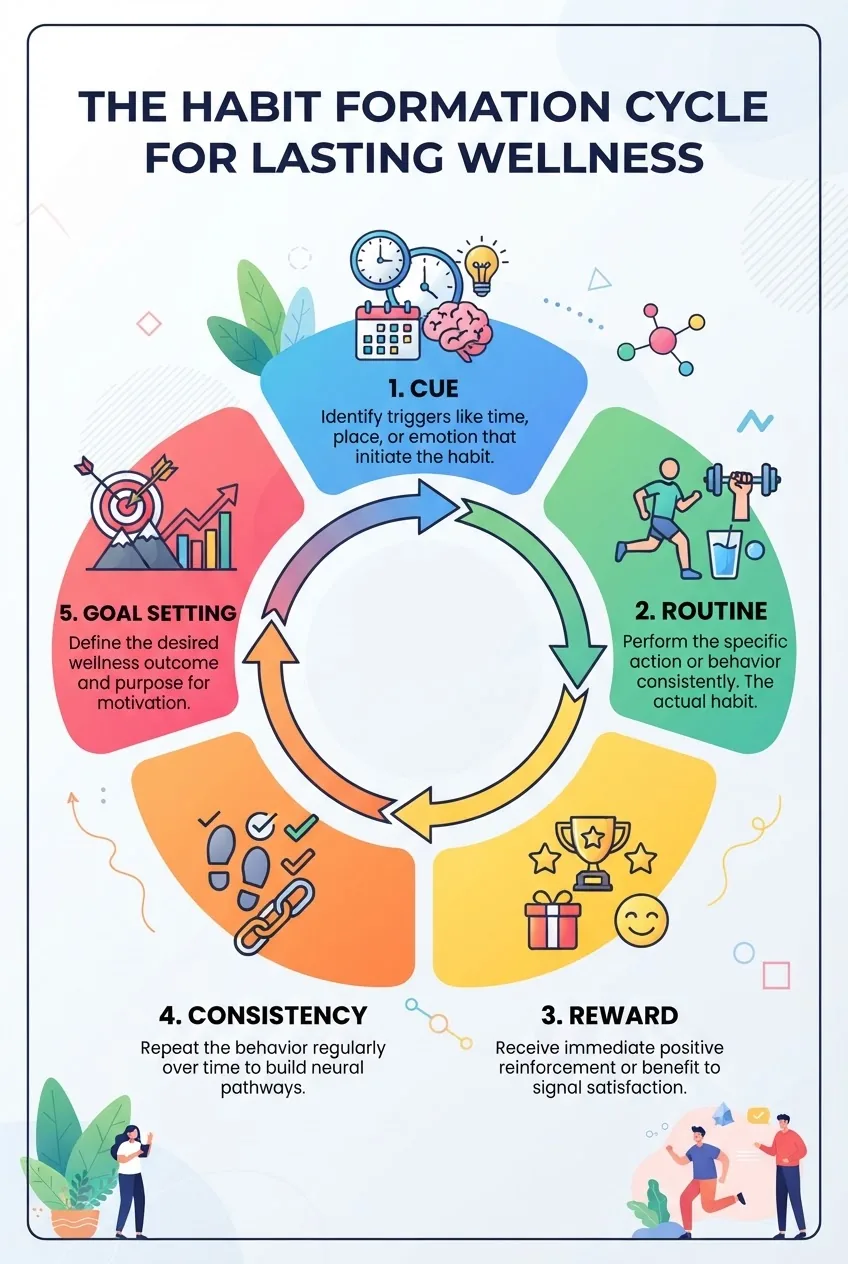
Follow this step-by-step guide exactly.
- Choose one behaviour and define the cue explicitly. Action: pick a precise cue (e.g., “after I brush my teeth in the morning” or “after I finish lunch”). The cue must be specific and already part of your routine.
- Define the routine in tiny, repeatable units. Action: break the routine into a small chunk you can do in 2–5 minutes (e.g., 1 minute of plank for strength, or 1 cup of salad before the main meal). Tiny wins build momentum.
- Attach an immediate reward. Action: follow the routine with a rewarding sensory action (e.g., 60s of favourite music, a tasty but healthy micro-snack) to reinforce the behaviour within 1–2 minutes of completion.
- Use consistency windows: 21 days to establish routine; 66 days to make automatic. Track daily for at least 66 days to reach habit automaticity on average (source: 2009 behavioral study overview). Use a visible checklist or habit-tracking app and mark completion each day.
- Design the environment to reduce friction. Action: place workout shoes by the door, pre-pack lunch the night before, keep water bottle visible. Remove temptations (e.g., store sugary snacks out of sight).
- Set implementation intentions. Action: write “If X happens, then I will do Y” statements (e.g., “If it is 12:30, then I will walk for 10 minutes”). This improves follow-through by clarifying context and action.
- Use social accountability and group activities. Action: join a friend for weekly walks or schedule group classes. See group self-care activities for ideas to stay motivated:
- Adapt for specific groups: women’s routines and preferences. Action: if you identify as female and prefer tailored activities, consider options and schedules designed for that context. See self-care activities tailored for women for ideas:
- Link habits to larger goals and planning. Action: integrate habits into a weekly self-care plan and set SMART goals (Specific, Measurable, Achievable, Relevant, Time-bound). For templates on this see goal setting and self-care planning:
- Consolidate habits into routines and prioritise top daily habits. Action: identify and maintain your top three daily actions from our earlier map. For ready lists consult top self-care habits for daily wellness and proven self-care strategies:
top self-care habits for daily wellness
proven self-care strategies - Complement habit building with practical self-help tips. Action: when momentum lapses, use practical self-help tips to boost your routine and reset momentum:
Practical habit-tracking walkthrough: create a two-column daily log (date | completed Y/N) and a weekly reflection (what worked, what blocked you). Review on Sundays for 10 minutes and adjust cues or rewards if adherence <75% that week.
Transition: with habits forming, regularly monitor progress and make data-informed adjustments next.
-
Monitoring Progress and Adjusting Your Wellness Strategies
Measure, reflect, adjust: this is the feedback loop that keeps improvements durable. Use these actionable monitoring steps.
- Set three KPIs (key progress indicators). Suggested KPIs: average nightly sleep hours, weekly active minutes, and one nutrition metric (e.g., daily protein g). Record baseline and check weekly.
- Use simple tools: a notes app, a spreadsheet and one wearable or a weekly 15-minute self-check. Action: every Sunday complete the 5-minute check: sleep average, mood rating 1–10, movement minutes total, adherence percentage.
- Adjust with small experiments — 2-week trials. Action: change one variable (e.g., increase protein by 20g/day) and measure impact on energy and sleep for 14 days. If positive, keep; if neutral or negative, revert.
- Consult trusted self-help resources and professional care when needed. For curated supports see trusted self-help resources for vetted sites and programmes:
- Schedule routine health checkups. Action: annual GP check, blood pressure every 6–12 months if normal, blood tests annually or as advised (lipids, HbA1c, vitamin D, full blood count) to guide supplementation and preventive care.
Advice quality and limits: this guide provides general recommendations and practical tools; it does not replace personalised medical assessment. If you have chronic conditions, adjust with your clinician.
Common mistakes and how to avoid them
I often saw people try to change everything at once and burn out within two weeks — I changed to a three-target method and found adherence rose dramatically. I also experienced stalled sleep when exercising vigorously close to bedtime; shifting intense sessions earlier solved that. Another recurring failure was skipping measurement — without tracking, small regressions became habits. Keep measurements simple and consistent.
Checklist: Verify your work
- Have you chosen 3 priority targets and recorded baseline measurements?
- Do you have a 7‑day meal and movement plan with exact times and portions?
- Is your sleep window set for 7–9 hours and pre-sleep routine defined?
- Are hydration and basic supplements checked with bloodwork or GP guidance?
- Do you have a habit cue, tiny routine, reward and a tracking method for each target?
- Have you scheduled a 14-day review and a 6–12 week progress check?
When to call in a professional
Contact your GP or relevant clinician if you have new chest pain, severe breathlessness, significant weight loss, persistent sleep disorder symptoms (sleep latency >30 minutes nightly or excessive daytime sleepiness), worsening mental health, or abnormal blood test results. For complex nutrition or exercise plans post-major illness, consult registered dietitians or accredited exercise physiologists.
Final takeaways: start with three high-impact, measurable changes, use explicit cues and tiny routines to build habits, and layer nutrition, movement and restorative sleep. Use supplements and environmental tweaks as adjuncts and track progress with simple KPIs. Ready to start? Commit to your first 7‑day plan today and revisit your results after two weeks.
Disclaimer: this guide is informational and not a substitute for personalised medical advice. Discuss major changes with a qualified health professional.