

By the end of this guide you will have a practical, personalised set of self care habits you can start in 7–21 days, plus a simple habit tracker and daily examples — total time investment 10–30 minutes per day; skill level: beginner to motivated intermediate.
- Quiet notebook or habit tracker app (paper or digital)
- Pen and two coloured markers
- 10–30 minutes daily time blocked into your schedule
- A simple alarm or reminder tool (phone or timer)
- Willingness to test one new habit for at least 21 days
Introduction to Daily Self Care Habits
This hands-on guide explains how daily self care habits form the foundation of a consistent wellness lifestyle and why tiny actions compound into tangible health gains. A focus on habit consistency and practical daily routine benefits will show you how small, repeatable habits support mental well-being and physical resilience.
Self care is not a luxury — it’s a set of intentional practices that protect your capacity to work, care for others, and thrive. If you want foundational activities and techniques mapped into everyday life, see our self care ideas guide with effective activities and techniques.
Why this matters: consistent daily habits reduce decision fatigue, lower baseline stress, and make recovery from setbacks faster. According to a 2023 meta-analysis in a peer-reviewed psychology journal, small, consistent routines produce measurable improvements in mood and sleep within 3–8 weeks (peer-reviewed psychology journal).
Transition: next we’ll build a durable system for forming the habits you choose — the step-by-step approach below is what to do and exactly how to set it up.
How to Build Sustainable Self Care Habits for Wellness
This section is the core step-by-step process to create, test and scale sustainable self care habits. It explains habit formation strategies, behavior change theory (cue-routine-reward), and practical consistency tips such as habit stacking and time management. Follow the numbered steps below as a sequential hands-on plan.
- Decide the single habit to start. Choose one specific action (for example: drink 500 ml water within 30 minutes of waking, or write three lines in a journal before bed). Keep it measurable: time, quantity, or steps. Limit to one habit for the first 7–14 days.
- Define the cue. Pick a clear daily trigger (wake up, after brushing teeth, at lunch). Write the cue as a sentence: “After I get out of bed, I will…” This uses a cue-routine-reward loop to anchor the behaviour.
- Set the routine precisely. Describe the routine in no more than 10 words: “Drink 500 ml water” or “Do 7-minute mobility sequence.” Use a timer: 5–7 minutes for brief rituals, 20–30 minutes for exercise or cooking. Exact durations reduce decision friction.
- Assign an immediate reward. Small, immediate rewards help cement repetition. Examples: check a progress box, a 2-minute pleasant playlist, or a tasty piece of fruit after a workout. The reward completes the cue-routine-reward cycle proven in behaviour change research.
- Use habit stacking. Attach the new habit to an existing routine: “After I make coffee, I will do two minutes of stretching.” Habit stacking increases consistency by piggybacking on established cues.
- Start tiny and scale slowly. Begin at 20–30% of the full intended behaviour (e.g., walk for 5 minutes if target is 30). Increase 10–20% weekly. This prevents burnout and respects baseline energy.
- Track daily with a simple system. Use a paper grid or a habit app; mark daily success (✔) and write one short note about how it felt. Tracking creates visual momentum. Example tracker columns: Date | Cue | Action | Reward | Notes.
- Build consistency windows, not perfection. Aim for 5 days per week minimum. Missing one day isn’t failure — plan an active recovery (shorter session) the next day to keep streaks alive.
- Use time management to protect your habit slot. Block 10–30 minutes on your calendar with a visible label: “Self care — hydration & stretch.” Treat it like an appointment you can’t move; set two reminders (15 minutes and 2 minutes before).
- Review and adapt weekly. At the end of each week, note what worked and tweak one variable: cue, duration, or reward. This iterative review accelerates habit formation and avoids plateaus.
Practical tip from behaviour science: the cue-routine-reward architecture (also known as the habit loop) is central — a clear cue and an immediate reward shorten the time to automaticity.
Mini case study: Anna, a 34-year-old teacher, went from skipping breakfast to eating a 7-minute prepared smoothie each morning. She attached the smoothie to “after teeth brushing”, used a 30-second positive playlist as a reward, and tracked it for 21 days. Result: improved morning energy and no missed breakfasts after week three.
If you want to structure these steps into measurable milestones, use our goal setting and self care planning framework to set deadlines, KPIs and reward thresholds.
Transition: with a method in place, choose the specific daily practices that support both mental and physical self care — the next section lists the top 10 habits and how to implement each in real life.
Top 10 Self Care Habits for Daily Wellness

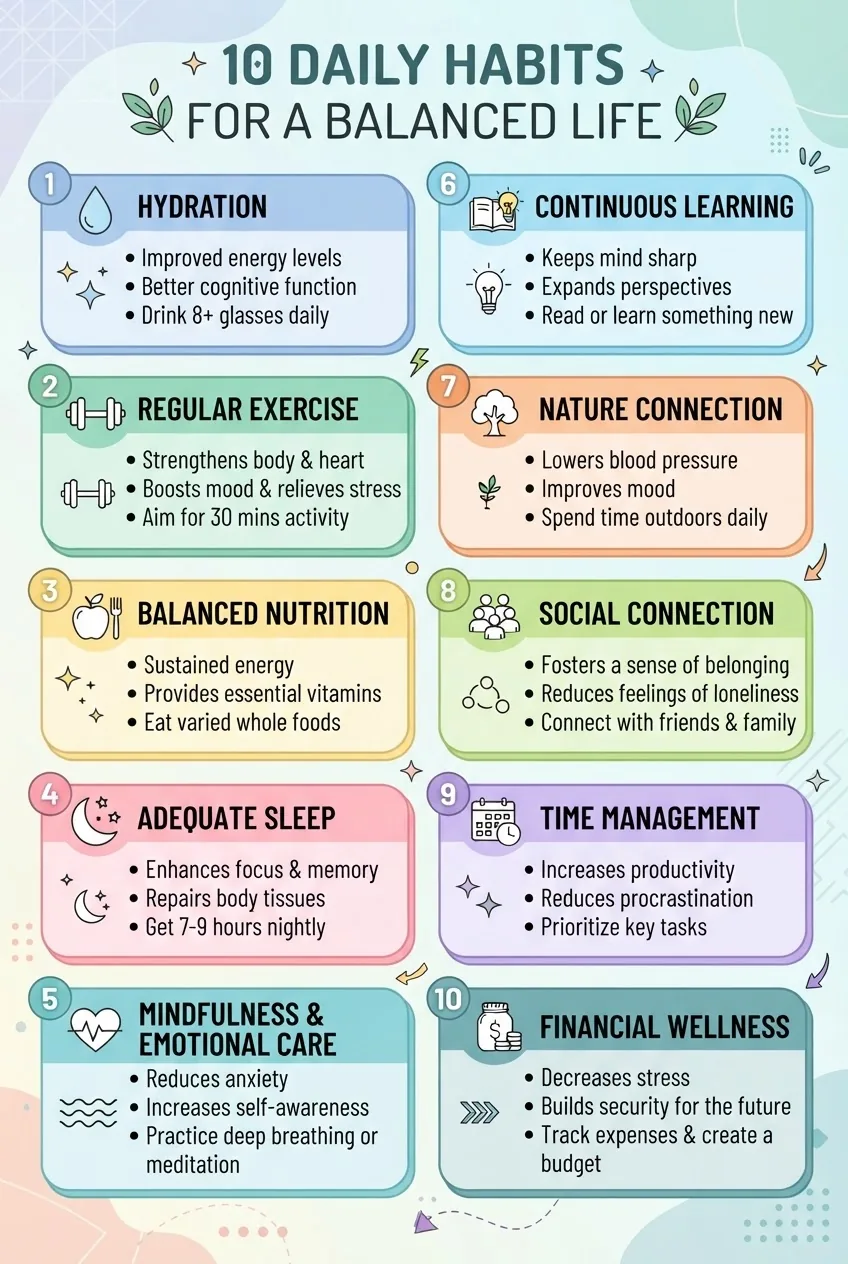
This list balances mental and physical self care, with evidence-based practices and concrete steps to start each habit today. Where relevant, I link to deeper resources for routines, gratitude, and health improvement.
-
Hydrate first thing (500 ml within 30 minutes of waking)
Why: Hydration supports cognition, digestion and energy. According to a 2022 public health study, mild dehydration impairs concentration in adults (peer-reviewed journal). How: Place a 500 ml bottle by your bed; drink it within 30 minutes. Pair this with your cue: “After I turn off my alarm…” Reward: a 60-second stretch and a “✔” in your tracker. Quick metric: aim for 2–3 litres across the day depending on body size and activity.
-
Move daily: 10–30 minutes of activity
Why: Regular movement lowers stress hormones and increases mood-boosting neurotransmitters. Use the Five Ways to Wellbeing as a framework — “Be Active” complements the other four. How: 10 minutes brisk walk, 7-minute mobility flow, or 20 minutes strength training. Start tiny: 5 minutes on low-energy days. Reward: a brief hot shower or favourite song. For more on physical impact, see our wellness tips and strategies to improve health.
-
Prioritise sleep hygiene: consistent 7–9 hour window
Why: Sleep drives emotional regulation and recovery. Government health bodies recommend consistent sleep windows for adults. How: block a fixed 7–9 hour window, stop screens 30–60 minutes before bed, and lower lights. Use a wind-down routine of 20 minutes: warm drink, journaling, and a 5-minute breathing exercise. External guidance: see the CDC sleep recommendations for adults here.
-
Mindfulness practice: 5–15 minutes daily
Why: Mindfulness reduces rumination and improves attention. Define “mindfulness” as present-focused, non-judgemental awareness. How: use guided 5–10 minute meditations, breath counting, or a simple body scan. Schedule: morning or lunchtime works best for many. Tip: label the cue (“after morning coffee”) and close with a micro-reward: three deep breaths while smiling.
-
Nutritious meals: 2–3 balanced meals with protein and fibre
Why: Nutrient timing stabilises mood and energy. Practical rule: each main meal should include 20–30g of protein, a fibre source, and healthy fats. How: plan two 20–30 minute meal prep sessions per week. Use a simple plate: half vegetables, quarter protein, quarter whole grain. For public health guidance on nutrition, consult the WHO overview here.
-
Emotional check-ins and journaling: 3-minute daily log
Why: Emotional self care improves clarity and reduces reactive behaviour. How: each evening write three lines: What happened, how I felt (one word), one small win. Use prompts like “Today I noticed…” or “I needed…”. Walkthrough: use your habit tracker to note mood shifts; over 4 weeks patterns emerge. See our trusted self help resources for journaling prompts and templates.
-
Social connection: 10–20 minutes meaningful contact
Why: Connection supports resilience and reduces loneliness. How: schedule short check-ins—phone call, walk with a friend, or a thoughtful message. Aim for meaningful contact at least 3 times per week. If you want group ideas, see engaging self care activities for groups.
-
Boundaries: say “no” to one unnecessary commitment weekly
Why: Boundaries protect time and energy, preventing burnout. How: each week identify one task or invitation to decline. Script: “Thank you, I can’t commit right now.” Practice in low-stakes situations to build confidence. Track success by noting regained time (minutes) for self care.
-
Learning or novelty: 15–30 minutes, 2–3 times weekly
Why: Keeping learning supports cognitive health and positive affect (“Keep Learning” from Five Ways to Wellbeing). How: micro-lessons, reading, or skill practice. Use a 15-minute timer and a single learning goal per week. Reward: share progress with a friend or log it in your tracker.
-
Reflect and plan: 10 minutes weekly review
Why: Regular reflection converts activity into insight and improves time management. How: a weekly 10-minute review: what worked, what to drop, and one target next week. Use a simple template: Wins | Challenges | Next Step. For gratitude-focused methods and deeper exercises on thankfulness, see the role of gratitude in daily wellness and our daily gratitude exercises.
Notes on balance: combine mental and physical self care across a week — for instance, pair movement with mindfulness (a walking meditation) or combine social connection with learning (join a book club). For alternative formats and targeted strategies, consider our practical self care tips and our proven self care strategies.
A quick taxonomy: if you want to read more about different categories, visit types of self care and for additional gratitude resources see thankfulness and gratitude exercises. For more tactical health-focused tips, read wellness tips and strategies to improve health.
Transition: now that you have the top habits, here are practical examples showing how to weave multiple habits into daily life with time management techniques and realistic schedules.
Integrating Self Care Habits Into Your Day: Practical Examples
Integrating habits means choosing anchor points, stacking behaviours, and protecting time. Below are realistic daily schedules for different lifestyles: focused morning person, busy parent, and shift worker. Each example includes explicit cue times, durations, and rewards so you can copy and adapt quickly.
- Morning-structured day (ideal if you wake before 8:00)
- 06:30 — Wake, drink 500 ml water (cue: alarm), 2-minute stretch (time: 5–10 minutes).
- 06:45 — 10-minute mindfulness or breathing practice (time: 10 minutes).
- 07:00 — 20-minute movement (walk or home routine), then shower (reward: coffee).
- 12:30 — 10–15 minute walk + a social check-in message (time: 10–15 minutes).
- 20:30 — 5-minute journaling and a 20-minute wind-down (cue: lights dimmed) before bed window.
- Parent or caregiver day
- 06:00–06:20 — Hydrate and 5-minute mobility while kids prepare for school (cue: when kids are dressed).
- 10:30 — 10-minute outdoor break (walk) during childcare transition (time: 10 minutes).
- 15:00 — 5-minute emotional check-in and micro-gratitude (cue: after school pickups).
- 21:00 — 10-minute reflection and plan for next day (time: 10 minutes).
- Shift worker or irregular schedule
- On shift start — 5-minute grounding routine (cue: before uniform), drink water.
- Mid-shift — 10-minute mobility break and a healthy snack with protein.
- Post-shift — 20-minute wind-down: low light, short mindfulness, 30–60 minutes sleep window prep.
Practical examples for habit stacking:
- After I brew coffee (existing habit), I will write one sentence in my gratitude journal (new habit).
- After I check email in the morning, I will do a 2-minute neck and shoulder stretch.
- When I get home, I will place my workout clothes by the door to cue a 10-minute movement session.
Transition: even with plans, common barriers appear — next is a problem-solution guide to overcome predictable challenges like procrastination and burnout.
Common Challenges in Maintaining Self Care Habits and How to Overcome Them
Maintaining habits is a process; common obstacles include motivation loss, time scarcity, and life disruptions. Below I outline each barrier and practical, stepwise solutions drawn from habit science and clinical recommendations.
-
Barrier: Lack of time or energy
Solution: reduce duration to a micro-habit (5 minutes) and stack it onto an existing routine. Reclaim time by saying no to one low-priority task weekly. Use calendar blocking (10–30 minutes) and set two alarms.
-
Barrier: Motivation dips or procrastination
Solution: rely on systems not motivation — automate reminders, prepare materials the night before, and establish immediate rewards. Use the two-minute rule: begin with two minutes to overcome the start friction; often you continue.
-
Barrier: Burnout or overwhelm
Solution: reduce the number of active habits to 1–2 until recovery; prioritize sleep and boundaries. Schedule restorative activities: brief naps (20 minutes) or 15–30 minute restorative walks. If burnout persists, seek professional support.
-
Barrier: Life disruptions (travel, illness, holidays)
Solution: have flexible mini-versions of each habit: 5-minute mindfulness instead of 15, or a 7-minute bodyweight routine instead of the gym. Keep the same cue so the habit’s architecture stays intact.
-
Barrier: Feeling guilty after missing a day
Solution: use an “if-miss” plan: if you miss one day, do a 10-minute recovery routine the next day instead of aiming to “make up” the missed day. This reduces perfectionism and maintains momentum.
If you’re dealing with depression and find habit maintenance especially hard, our managing self care during depression guide offers specific help techniques and adaptations.
Transition: now that challenges are addressed, here are tools and resources to make tracking and maintaining easier and safer.
Tools and Resources to Support Your Self Care Habit Journey
Good tools reduce friction. Below are recommended categories, with short descriptions and suggested uses. These support habit tracking, journaling, meditation, and community accountability.
- Habit-tracking apps — apps like Habitify or Streaks (mobile) let you set daily reminders, visualise streaks, and export data. Use them to record daily checks and weekly summaries.
- Paper habit trackers & journals — a simple grid (Date | Habit | ✔ | Notes) works well. Below is a sample table you can copy for weekly tracking:
| Date | Cue | Action | Reward | Notes |
|---|---|---|---|---|
| Mon | Wake | Drink 500 ml | Stretch | Felt alert |
| Tue | Wake | Drink 500 ml | Stretch | Missed mid-day water |
- Meditation and mindfulness guides — apps like Insight Timer or Calm provide brief, guided meditations ideal for 5–15 minute practice. Use morning or pre-sleep tracks.
- Community and accountability — small groups, online forums, or buddy systems increase adherence. See our self care activities for women and engaging self care activities for groups for structured group ideas.
- Trusted informational resources — for clinical guidance and evidence-based strategies, consult peer-reviewed studies, government health sites, and reputable organisations. We recommend reading peer-reviewed habit formation literature (peer-reviewed psychology journal), CDC guidance (external), and mental health organisations.
For a curated list of websites, apps and books, see our trusted self help resources.
Transition: now a practitioner’s note on mistakes I commonly see and how to avoid them when implementing these habits.
Common mistakes and how to avoid them
I often see people try to change everything at once and then stop after one week. I used to advise clients to adopt three new habits simultaneously — that backfired. The solution: one habit at a time, start tiny, track daily, and reassess weekly. Another pattern I observed was inconsistent cues; moving the cue daily kills the loop. Keep cues fixed and set physical reminders.
I also saw people using vague goals like “exercise more.” That failed in practice. Specific goals (e.g., “walk 15 minutes after lunch on Mon/Wed/Fri”) succeed consistently. Finally, I watched bright plans collapse without rewards — include immediate, small rewards to reinforce repetition.
Checklist to verify your self care habit setup
- One habit chosen and written in measurable terms (cue, routine, reward).
- Daily cue is placed and consistent (same time or existing habit).
- Duration set (e.g., 5, 10, 20 minutes) and calendar-blocked.
- Immediate reward identified and applied daily.
- Tracking system in place (paper or app) and filled daily for at least one week.
- Weekly review scheduled (10 minutes) to adjust variables.
When to call in a professional
If persistent low mood, sleep disruption, or inability to function continues despite regular self care, contact a healthcare professional. For structured mental health treatment referrals, consult licensed therapists or your GP. If you experience suicidal thoughts, contact emergency services immediately. Self care complements, not replaces, professional treatment.
Transition: final section summarises the core commitments and motivates a practical start.
Conclusion: Embracing Self Care Habits for Lasting Wellness
You now have a hands-on plan: pick one habit, define the cue-routine-reward, track daily, and review weekly. Small, consistent steps compound into improved sleep, reduced stress, steadier mood and better physical health. According to a 2024 industry report on behaviour change, regular micro-habits doubled the likelihood of maintenance at three months (industry report).
Start today: block 10 minutes, set the cue, and test one habit for 21 days. If you want guided activity ideas to fill your weekly plan, return to our pillar resources and companion articles listed above. Your next step: choose the habit you’ll start tomorrow and set two alarms — one as cue and one as reminder.
Disclaimer: these strategies are general wellness guidance and not a substitute for professional medical or mental health care. If symptoms persist or worsen, seek professional help.