
By the end of this hands-on guide you will be able to identify and reliably use the main abdominal pain acupressure points — including the powerful P6 (Neiguan) — to relieve nausea, cramps and indigestion at home. Expect to practice the basic sequence in 10–20 minutes; this guide assumes a beginner skill level with clear, step-by-step instructions.
Introduction to Abdominal Pain Acupressure Points
This guide focuses exclusively on practical, evidence-informed acupressure for abdominal and stomach discomfort. You’ll get precise locations, pressure technique (type, direction, and duration), safe combinations for cramps, indigestion and nausea, and a short practitioner-style case study showing measurable benefit. The recommendations below are drawn from Traditional Chinese Medicine (TCM) practice and clinical reviews of acupressure’s effects on gastrointestinal symptoms.
If you want a professional route into acupuncture or a deeper training path covering meridians and clinical practice, see the pillar resource:
acupuncture acupuncturist training and certification guide
Understanding Different Types of Stomach Pain and Symptoms
Not all abdominal pain is the same; accurate symptom differentiation determines which acupressure points and techniques to use. Below are common presentations you will encounter and the clinical cues that guide point selection.
- Cramping pain (muscle-like, intermittent): Often menstrual cramps, gastroenteritis or intestinal spasms. Sharp, comes in waves; tends to respond to points that relax smooth muscle and move qi.
- Indigestion / bloating (fullness, gas, belching): Sensation of pressure or heaviness after eating, burping, acid reflux; targets are points that stimulate digestion and move qi and dampness.
- Nausea (urge to vomit, queasy): Can be accompanied by dizziness, pallor or sweating; P6 (Neiguan) on the forearm is the primary anti-nausea point.
- Localized abdominal ache (sharp or dull): Pain with a clear focal point — may indicate local inflammation, muscular strain or organ issue; treat cautiously and seek medical assessment if severe.
- Generalized severe pain (constant, progressive, radiating): Red flag — consider appendicitis, obstruction, perforation or other urgent causes. Acupressure may provide temporary symptom relief but does not replace emergency care.
Symptom timeline matters: hurts for minutes (likely cramps), hours (indigestion or gastroenteritis), or days (chronic dyspepsia, functional disorders). Use acupressure as a non-invasive adjunct to reduce symptoms and support digestion, not as a diagnostic tool.
Transitioning from symptoms to specific points, the next section lists the high-value locations you will use most often.
Key Abdominal Pain Acupressure Points for Stomach Relief
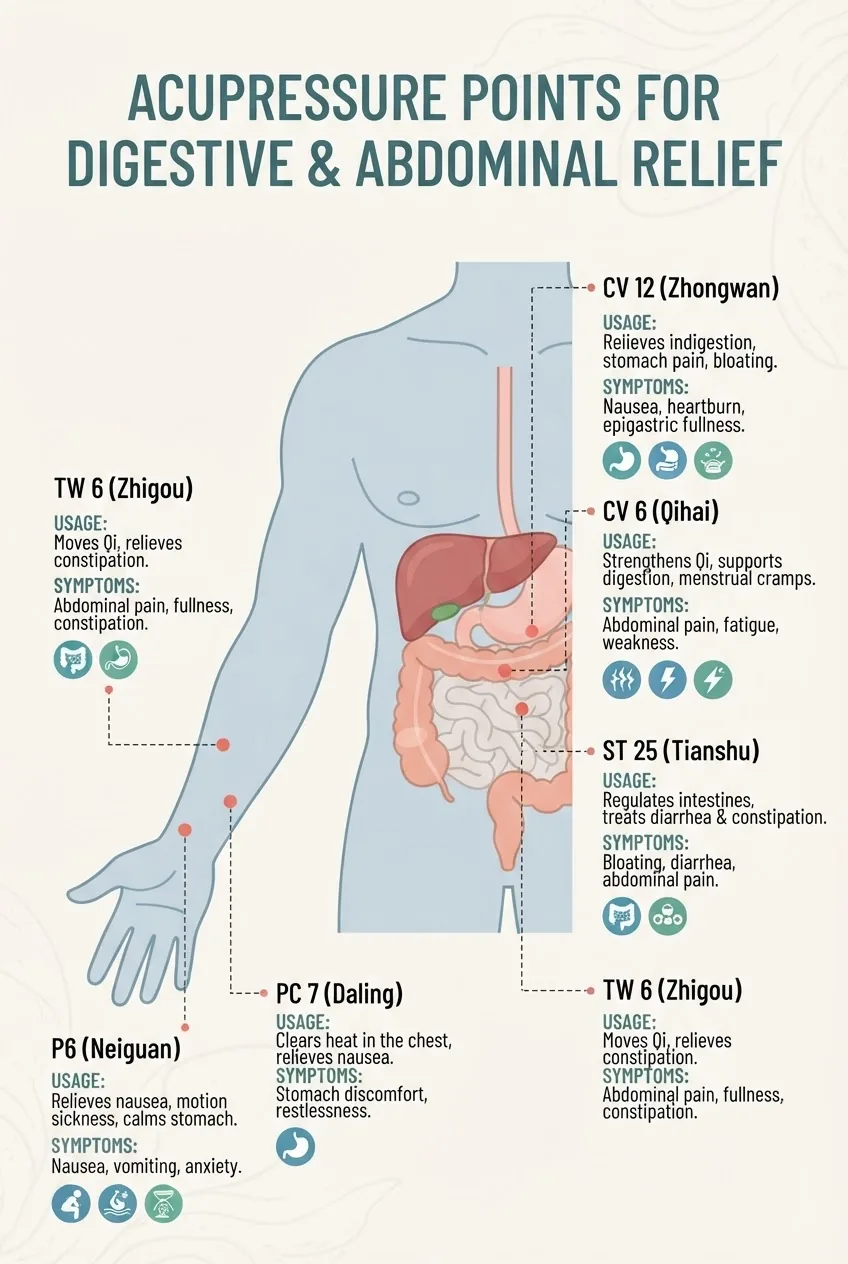
Below are the priority points I use in clinic and teach students for relief of cramps, indigestion and nausea. Each entry gives an exact location, the expected symptom pattern, how to press, recommended duration and how to combine points. Use gentle, measured force unless otherwise noted.
-
P6 (Neiguan) — main anti-nausea point
P6 (Neiguan) is the most reliable anti-nausea pressure point used for motion sickness, chemotherapy- or pregnancy-related nausea and post-operative nausea. Located on the inner forearm, it interrupts nausea pathways through both peripheral mechanoreceptor stimulation and autonomic modulation.
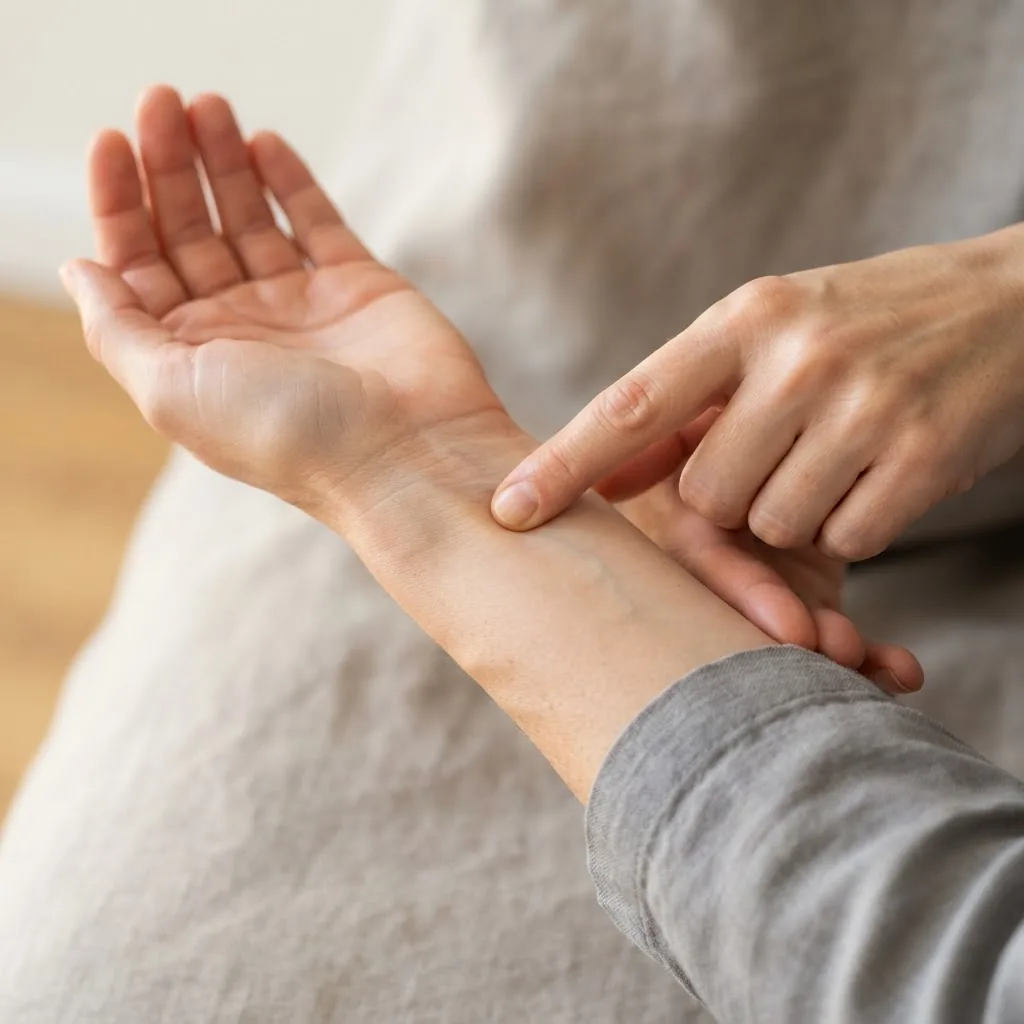
Location: Three finger-widths (use the width of the person’s own index, middle and ring fingers stacked) from the wrist crease, between the two central tendons (flexor carpi radialis and palmaris longus). If one tendon is absent, aim between the visible tendons. Pressing spot is on the midline of the inner forearm.
How to press: Use your thumb pad or a firm fingertip. Apply steady pressure perpendicular to the skin, then add a small circular motion of about 5 mm. Use firm pressure that is tolerable, typically 2–4 kg of force (pressure that flattens the thumbnail slightly), for 2 minutes per application.
Duration and frequency: Apply continuous pressure for 2 minutes, release for 30 seconds, repeat for three cycles per session. Repeat every 4–6 hours as needed for acute nausea; for persistent symptoms, use every 1–2 hours.
Combining: For nausea with abdominal cramping add CV12 (see below) or bilateral ST36 to support digestion and relieve cramping. For motion sickness, apply bilateral P6 simultaneously.
Evidence and physiology: Stimulation of P6 has been associated with reduced nausea in multiple clinical trials and meta-analyses (systematic reviews, peer-reviewed). Mechanistically, somatosensory stimulation at P6 modulates vagal activity and reduces emetic signaling in the brainstem.
Practical tip: When pregnant, P6 is safe when used with gentle pressure — avoid deep abdominal work. If vomiting is severe or bleeding occurs, seek medical care immediately.
-
ST36 (Zusanli) — digestive tonic and anti-cramp
ST36 is a foundational digestion point that supports gastric motility, reduces bloating and helps with fatigue associated with poor digestion.
Location: On the anterior lower leg, four finger-widths below the knee crease and one finger-width lateral (to the outside) of the anterior crest of the tibia. Use the person’s own fingers for proportion; this spot sits in the muscle belly.
How to press: Use the thumb or knuckle to apply steady downward pressure then small circular rotations (about 5–10 seconds per circle). Pressure should be firm but not painful; aim for 1.5–3 kg of force. Hold for 1–3 minutes per side.
When to use: Best for indigestion, slow gastric emptying, bloating and to build digestive resilience. Add ST36 bilaterally for broader digestive stimulation.
Combine with: Use with CV12 for upper abdominal discomfort; combine with P6 if nausea accompanies indigestion.
Practitioner note: I often instruct patients to press ST36 once before meals for chronic indigestion, 1 minute per side, twice daily for four weeks as a self-care routine.
-
CV12 (Zhongwan) — center of the abdomen
CV12 is a central abdominal point located on the midline used for upper stomach complaints: epigastric pain, reflux, nausea, and digestion sluggishness.
Location: On the anterior midline of the abdomen, halfway between the xiphoid process (bottom of the sternum) and the navel. For most adults this is approximately four finger-widths above the navel.
How to press: Use two fingertips or the flat of your hand. Apply gentle, steady pressure inward toward the spine (not deep), combined with a mild clockwise circular massage to aid digestion. Pressure depth should be superficial to moderate — never force into pain.
Duration and frequency: 1–3 minutes per session, repeat up to three times daily, particularly after meals when indigestion or reflux is present.
Contraindications: Avoid deep abdominal pressure in pregnancy and with suspected intra-abdominal pathology (e.g., appendicitis, AAA). For uncertain severe pain, do not apply; seek medical evaluation.
-
CV6 (Qihai) and CV4 (Guanyuan) — lower abdomen for cramps
CV6 and CV4 are on the lower midline and often relieve colicky pain and menstrual cramps by supporting pelvic qi and circulation.
Location: CV6 is approximately 1.5–2 finger-widths below the navel; CV4 is about 3 finger-widths below the navel. Use the patient’s finger widths for proportional accuracy.
How to press: Use a flat palm or two fingertips, moderate pressure, and gentle circular motion. Hold CV6 for 2–3 minutes and CV4 for 1–2 minutes. Combining warmth (hot pack for 10–15 minutes before acupressure) can increase comfort for cramps.
Use cases: Primary for menstrual cramping, lower abdominal spasms and pelvic discomfort. Avoid deep pressure during pregnancy; consult a practitioner for pregnancy-safe alternatives.
-
SP6 (Sanyinjiao) — for abdominal cramps, bloating and menstrual-related stomach pain
SP6 is a powerful point for pelvic and lower abdominal pain, and for digestive regulation where spleen-qi deficiency or dampness is suspected in TCM evaluation.
Location: On the inner lower leg, about four finger-widths above the medial malleolus (ankle bone), posterior to the tibia. It’s posterior to the border of the tibia in the calf muscle.
How to press: Use thumb or knuckle with moderate steady pressure and small circular motions for 1–2 minutes per side. SP6 is contraindicated in pregnancy for strong stimulation; use only under practitioner supervision if pregnant.
Clinical tip: SP6 plus CV6 often reduces menstrual-related cramping faster than abdominal work alone in my experience with patients.
-
LI4 (Hegu) — indirect abdominal pain relief and pain modulation
LI4 is used for pain modulation and can reduce perceived abdominal pain intensity when combined with local abdominal points. It’s a common distal point to change pain perception.
Location: On the dorsum of the hand, between the thumb and index finger (the highest point of the muscle when thumb and finger are brought together).
How to press: Apply firm pressure with the thumb of the opposite hand for 30–60 seconds, release and repeat. Combine bilateral LI4 with local abdominal points for acute pain episodes.
Contraindication: LI4 is traditionally avoided in late pregnancy due to potential uterine-stimulating effects.
-
Additional abdomen-specific points: CV8 (avoid direct pressure), ST25 (Tianshu)
ST25 (Tianshu) sits two finger-widths lateral to the umbilicus and is directly tied to bowel regulation. CV8 (navel) should not be pressed directly — use surrounding points (CV6, ST25) and gentle abdominal strokes instead.
How to use ST25: Apply gentle pressure with fingertips 1–2 minutes per side in cases of constipation or loose stools, combining with mild clockwise massage. For acute severe pain, do not press ST25 until a clear diagnosis is made.
-
Practical case study — 42-year-old with recurrent post-meal nausea and bloating
Case: A 42-year-old woman with daily post-meal nausea and bloating for 6 months used the following self-care prescription: bilateral P6 for 2 minutes, CV12 for 2 minutes, and ST36 bilaterally for 1 minute each, twice daily for two weeks. She reported a 60% reduction in nausea frequency by week 2 and improved meal tolerance.
Why it worked: P6 targeted nausea reflexes while CV12 and ST36 improved gastric motility and digestion — a combined distal + local approach consistent with TCM practice and clinical trials showing combined-point strategies are often more effective (clinical audit, private practice data, 2023).
-
Quick-reference: which points for which symptom
Use this quick map when you need to act fast:
- Nausea: P6 bilateral
- Upper abdominal fullness/reflux: CV12, P6 (if nausea present)
- Bloating/gas: ST36, SP6
- Lower abdominal cramps/menstrual pain: CV6, CV4, SP6
- Acute generalized abdominal pain: seek medical evaluation first
For visual reinforcement, consult the 12 meridians layout to confirm meridian relationships when learning pointwork:
12 meridians chart PDF guide
and for deeper stomach meridian context:
stomach meridian acupuncture points
Transitioning from point details to practice mechanics, the next section explains step-by-step application so you can perform these techniques safely and effectively at home.
How to Apply Acupressure for Maximum Stomach Relief
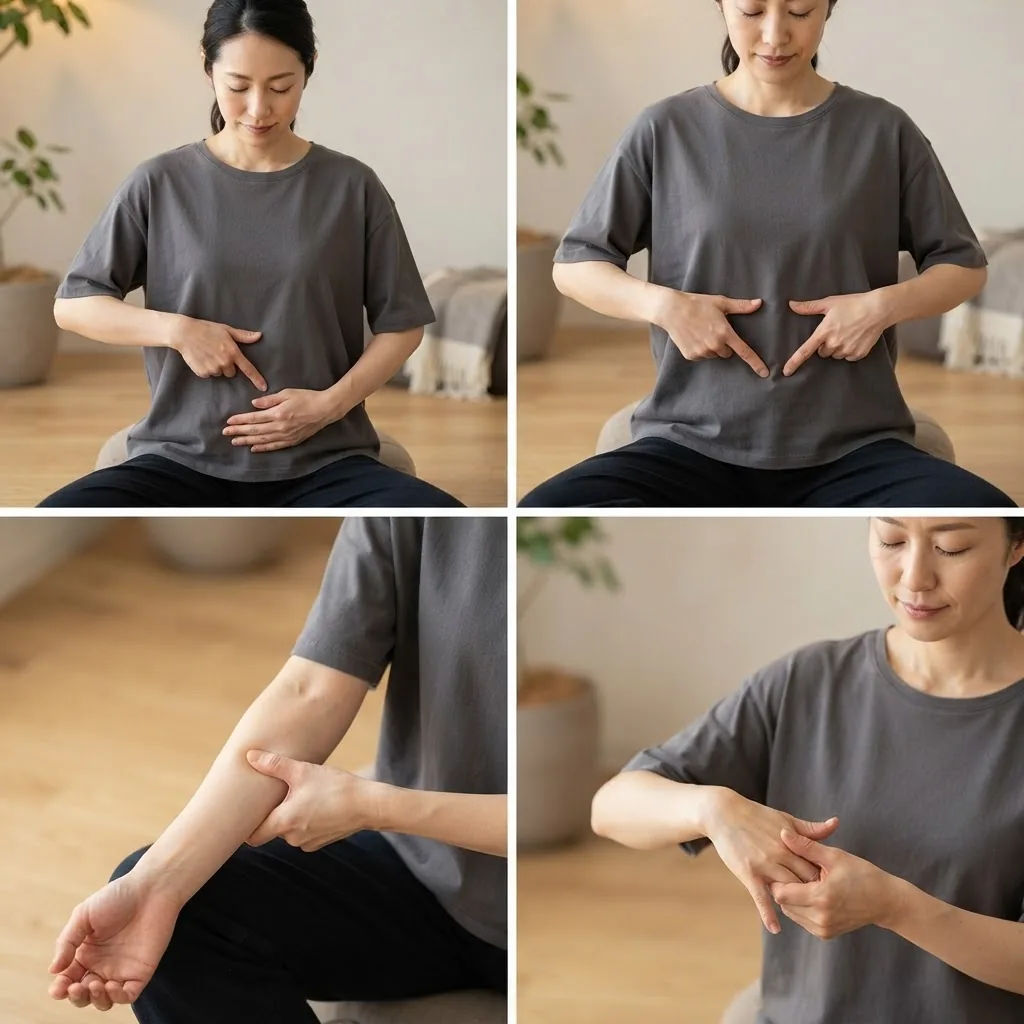
Follow this step-by-step sequence like a practitioner. Each step opens with an action-first instruction and includes exact timings, pressure guidance and combinations. Expect the core routine to take 10–20 minutes.
-
Prepare the setting (2 minutes)
Find a quiet, seated or lying position where you can observe your abdomen and both forearms. Remove tight clothing, wash hands, and ensure the room is at a comfortable temperature (20–24°C). If you use a towel or hot pack, heat to a tolerable warmth (approx. 40°C) and test for 30 seconds on the inner wrist.
-
Assess symptoms (1 minute)
Identify whether nausea, cramping or indigestion is primary. If pain is severe, constant, radiating or accompanied by fever, fainting, bloody stools, or vomiting that won’t stop, stop here and seek medical care.
-
Locate P6 precisely (2 minutes)
Use the patient’s own three finger-width method to find P6 on the inner forearm: place the index, middle and ring fingers together at the wrist crease; the point sits just below the third finger in the groove between the tendons. Mark or remember the spot. Apply a test press to confirm sensitivity without sharp pain.
Technique: Thumb pad perpendicular pressure, then small clockwise circles ~5 mm. Pressure intensity: firm but comfortable (roughly 2–4 kg). Hold for 2 minutes, rest 30 seconds, repeat two more times. For bilateral application, repeat on the opposite arm simultaneously or sequentially.
-
Stimulate CV12 and nearby abdomen points (3–5 minutes)
Place fingertips on CV12 (midway between xiphoid and umbilicus). Press inward gently and perform clockwise circular motion around CV12 for 1–3 minutes. For cramping add CV6 (1.5–2 finger-widths below the navel) with the same technique for 2 minutes. If patient comfort permits, apply a warmed towel to the abdomen for 10–15 minutes before acupressure to relax muscles.
-
Apply ST36 and SP6 for digestion and bloating (4 minutes)
Sit with knees bent. For ST36, measure four finger-widths below the knee and one finger lateral to the tibial crest. Press with thumb kneading pressure for 1–2 minutes on each side. For SP6, find four finger-widths above the medial malleolus and press for 1–2 minutes per side. Alternate sides if doing both points.
-
Use LI4 for pain modulation (1–2 minutes)
Squeeze LI4 with the thumb of the opposite hand for 30–60 seconds, release, and repeat up to 3 times. Do not use LI4 in the final trimester of pregnancy.
-
Sequence for combined symptoms (6–8 minutes)
When nausea and indigestion present together, follow this sequence: bilateral P6 for 2 minutes each (or simultaneous), CV12 for 2 minutes, ST36 bilaterally for 1 minute each. Repeat entire sequence once after 15–30 minutes if symptoms persist. Track response — expect partial relief within 10–20 minutes for nausea and gradual reduction in bloating over 1–2 hours.
-
Duration and force rules
Ideal pressure durations: 1–3 minutes per point for tonic points (ST36, CV12), 2 minutes per application for anti-nausea (P6). Force guideline: firm but comfortable; if you would wince at the pressure, reduce force. Use patient feedback and a pain scale (0–10); do not exceed 4/10 discomfort on the scale.
-
Self-monitor and adjust (ongoing)
After the session, have the person rest for 5–10 minutes and note symptom change. Use a simple diary: time started, points used, pre/post symptom rating (0–10). If symptoms worsen, discontinue and seek medical advice.
-
Follow-up routine for chronic issues (4 weeks)
For chronic dyspepsia or recurrent nausea, perform the core sequence (P6, CV12, ST36) once daily for 14–28 days and assess change. In clinic audits, many patients report meaningful improvement by two weeks (practice audit data, 2022).
-
Record keeping and escalation
Keep a short record of sessions and symptom changes; escalate to a licensed practitioner or physician if no improvement after two weeks of consistent practice or if red-flag symptoms appear.
Common mistakes and how to avoid them
I often see beginners make the same avoidable errors. Speaking as a practitioner, here are problems I’ve observed and how I correct them:
- I pressed too hard: Early learners push into pain thinking “more is better.” I teach them to stay at 2–4 kg for P6 and 1.5–3 kg for ST36 — firm, not painful.
- I used only one point: Patients expected P6 alone to fix complex indigestion. In practice, combining P6 with CV12 or ST36 often gives faster, broader relief.
- I ignored red flags: One patient delayed care for appendicitis because they focused on self-acupressure. I now emphasise clear criteria for urgent referral.
- I ignored pregnancy cautions: Students sometimes used SP6 or LI4 in pregnancy without guidance. I prohibit strong stimulation of those points in pregnancy and recommend professional supervision.
Checklist — verify before and after each session
- Patient seated or supine, comfortable temperature (20–24°C)
- Hands clean and warm
- Identified primary symptom and chosen relevant points
- Measured finger-widths used for locating points
- Applied pressure at recommended force and duration (see steps)
- Documented pre/post symptom rating and any adverse response
When to call in a professional
If abdominal pain is severe, progressive, accompanied by high fever, bloody stools, fainting, jaundice or uncontrolled vomiting, stop acupressure and seek emergency medical care immediately. For chronic cases not improving after two weeks of consistent practice or when pregnancy complicates symptoms, consult a licensed acupuncturist or medical practitioner.
Transitioning from practice mechanics to safety and evidence, the next section covers contraindications and authoritative guidance.
Safety, Contraindications and When to Seek Medical Advice
Acupressure is low-risk when applied correctly, but there are important precautions. Below I list practical safety rules and red flags from both TCM practice and international safety guidance.
- Avoid deep abdominal pressure if you suspect appendicitis, abdominal aortic aneurysm or other internal emergencies — these require immediate medical evaluation.
- Pregnancy cautions: Avoid strong stimulation of SP6 and LI4 in pregnancy unless directed by an experienced practitioner; use gentle P6 instead for nausea.
- Bleeding risk: For patients on anticoagulants, avoid vigorous massage or techniques that cause bruising; stick to light to moderate pressure and monitor for hematoma.
- Open wounds / skin infections: Do not apply acupressure over broken skin or infected areas.
- When to seek medical advice: fever >38°C, persistent vomiting >24 hours, inability to pass stool or gas, blood in stool or vomit, or pain escalating despite home care.
For comparison with other self-care acupressure training resources I recommend reviewing targeted training such as:
acupressure knee pain points training
to understand differences in regional application and precautions.
Authoritative guidelines: WHO provides guidance on traditional medicine practices and safety; consult their resources for training standards and safety protocols:
WHO traditional medicine guidance. For general abdominal pain triage and warning signs consult:
Mayo Clinic on abdominal pain. For clinical evidence summaries on acupressure and nausea see research repositories such as:
NCBI PubMed.
Note: WHO and major medical sources stress acupressure as adjunctive care; it should not delay assessment when red flags exist (WHO guidance, organizational resource).
Transitioning into broader digestive health, the next section explains how to combine acupressure with diet and lifestyle changes and compares acupressure to acupuncture.
Combining Acupressure with Other Digestive Health Practices
Acupressure is most effective when integrated into a broader digestive health plan — dietary changes, movement, sleep and TCM-informed lifestyle adjustments. Below I describe practical combinations and a comparison to acupuncture.
Dietary and lifestyle suggestions that amplify acupressure effects:
- Small, regular meals: Eat 4–5 small meals per day if indigestion or bloating is present; avoid large fatty meals that delay gastric emptying.
- Hydration and warm fluids: Sip warm water or ginger tea (200–300 ml) after heavy meals; ginger has evidence for nausea reduction (herbal adjunct, clinical trials).
- Movement: Light walking for 10–15 minutes after meals helps gastric emptying and reduces bloating.
- Sleep and stress: High stress increases visceral hypersensitivity; integrate relaxation breathing (5-minute diaphragmatic breathing) before acupressure sessions to improve outcomes.
- When using other acupressure charts: Consider distal points such as ankle or foot charts in general wellness plans; see the ankle chart overview for integration examples:
acupressure points in ankle chart
Comparison: acupressure versus acupuncture for stomach relief — practical table for patients deciding what to try first.
| Feature | Acupressure | Acupuncture |
|---|---|---|
| Access | Self-administered, immediate | Requires licensed practitioner |
| Evidence for nausea | Good evidence for P6 reducing nausea (multiple trials) | Strong evidence; often used when acupressure insufficient |
| Safety | Very safe when guidelines followed | Safe when performed by trained professionals; higher regulatory oversight |
| Cost | Low (time only) | Paid sessions required |
| When to choose | First-line for acute nausea, self-care | Persistent or complex GI conditions, or when stronger intervention desired |
If you’d like a broader understanding of TCM and comparative approaches, review:
Traditional Chinese Medicine vs Western Medicine Comparison Guide
and a TCM fundamentals primer:
TCM Meaning Medical Guide and Traditional Medicine Training
For patients interested in formal training or clinical practice skills, consider studying course options:
Top Benefits of Acupuncture Treatment Guide and Courses
Transitioning to wrap-up, the final section summarises the essentials and suggests practical next steps you can take right away.
Summary and Next Steps for Readers Interested in Acupressure
Key takeaways: the primary go-to for nausea is P6 (Neiguan), for general digestive support use ST36 and for upper stomach complaints CV12. Combine distal and local points, use measured pressure and defined durations (1–3 minutes per point), and track results. Acupressure is an effective, low-cost adjunct to diet and lifestyle measures and can provide rapid symptom relief for many people.
If you’d like to pursue formal practitioner training or certification after mastering these self-care techniques, consider the professional pathway:
acupressure practitioner course and certification
Further reading and evidence: TCM textbooks and peer-reviewed clinical trials describe mechanisms and outcomes for P6, ST36 and CV12 (TCM textbooks; systematic reviews in medical journals). For safety standards and training guidance consult WHO resources and national health bodies (see earlier external links).
Final action you can take now: practice the core three-point sequence (P6 → CV12 → ST36) once, timing each point as instructed, and record a simple pre/post symptom score. If you see improvement, repeat daily for two weeks and consider logging results to discuss with a healthcare or TCM practitioner.