

By the end of this hands-on guide you will have a clear, step-by-step toolkit of immediate mood boosters and a simple daily plan you can use for 7–30 days to feel better; total active time: first-aid techniques in 5–20 minutes, habit setup 10–30 minutes daily; skill level: beginner, no prior training required.
Before you start
- Quiet space or comfortable chair (5–20 minutes available)
- Notebook or phone notes app and a pen for journaling prompts
- A water bottle and a simple timer (phone timer works)
- Comfortable shoes for a 10–20 minute walk
- Medical contacts or local hotline numbers if you have existing mental health conditions
-
Assess your immediate needs: check safety, intensity and timeframe
Start by asking three quick questions: are you safe right now? (physical safety), how intense are your feelings on a 0–10 scale? and how long have they lasted? This assessment orients which methods to use: high-intensity distress may require grounding and breathing for 5–15 minutes; low-grade mood dips benefit from activity or reframing. Write your answers in one line: “Safe: yes/no; Intensity: X/10; Duration: Y hours/days.”
If you score above 7/10 or have thoughts of harming yourself, skip self-care steps and use professional resources described below.
-
Immediate first-aid: grounding and breathing
Why this works: slow diaphragmatic breathing down-regulates the stress response by shifting the autonomic nervous system toward parasympathetic activation. Short guided practice below is evidence-backed for quick mood reduction and clarity (see external study link).
5-minute breathing routine (step-by-step)
- Find a comfortable seat with both feet on the floor; set a 5-minute timer.
- Place one hand on your belly, one on your chest; inhale through the nose for 4 seconds, feeling your belly rise.
- Hold for 1 second, then exhale through pursed lips for 6 seconds. Repeat for 6–8 cycles.
- If your mind wanders, name the distraction (“thinking”, “planning”) and return to the count.
Follow this with a 30–60 second grounding technique: name 5 things you can see, 4 you can touch, 3 you can hear, 2 you can smell, 1 you can taste. That sensory calming interrupts rumination and reduces panic-like responses.
Research snapshot: slow-paced breathing protocols have measurable effects on heart-rate variability and perceived stress (peer-reviewed study linked below).
External evidence: breath regulation research.
-
Use a three-step distraction and motion reset
When mood dips feel sluggish or stuck, quick movement plus a focused switch of attention reliably shifts state. This method is practical and repeatable.
How to do it:
- Move now: stand and do 2 minutes of brisk walking or marching in place at a vigorous pace (aim for moderate exertion that raises your heart rate 40–60% of a perceived maximum).
- Engage senses: carry out a 60-second sensory check: sniff a citrus peel, run water over your hands, or hold ice for 30 seconds. Sensory input narrows attention away from negative loops.
- Reset thinking: take 60 seconds to list three small next actions you can do in the next hour (e.g., “fill water bottle”, “text a friend”, “open window”).
Evidence note: aerobic activity for 10–20 minutes releases endorphins and can improve mood; see linked meta-analysis.
External evidence: exercise and mood meta-analysis.
-
Apply quick cognitive reframing
Simple cognitive restructuring—naming a thought and offering a neutral reframe—reduces intensity and creates choice. This is a condensed CBT technique appropriate for momentary mood work.
How-to steps:
- Write the thought that is strongest in one sentence (e.g., “I always fail”).
- Ask: “What evidence supports this?” List 2 facts. Then: “What evidence contradicts it?” List 2 facts.
- Formulate a balanced alternative: “Sometimes I struggle, and I also have concrete successes like X and Y.”
- Rate belief in the original thought on 0–100; after reframing, re-rate. Expect a drop of 10–30 points on your first try.
Short practice like this takes 3–8 minutes, and repeated use builds cognitive flexibility over weeks.
-
Use expressive journaling prompts
Writing to process emotions reduces rumination and clarifies action. Use targeted prompts for short sessions (8–12 minutes) when feeling low.
Practical prompts (pick one):
- “What am I feeling right now? Describe without judging, using three adjectives.”
- “What is one small thing I can control in the next hour?”
- “List three things I did well in the past week and why.”
Anecdote: an anonymous client I worked with began a nightly 10-minute prompt practice; after two weeks the client reported reduced bedtime rumination and one fewer low-mood day per week.
-
Hydrate, nourish, and reset blood sugar
Low hydration and low blood sugar amplify irritability and fatigue. Take 10 minutes to hydrate and eat a balanced snack to stabilize your mood biologically.
Actions:
- Drink 300–500 ml (10–17 oz) of water within 10 minutes.
- Eat a small snack combining protein and carbohydrate: 20–30 g Greek yoghurt with a handful of berries, or a small apple with 1–2 tablespoons almond butter.
- Wait 15–20 minutes and reassess mood on a 0–10 scale.
Nutrition note: magnesium and B-vitamins support energy and mood long-term; aim for three balanced meals daily and include protein at breakfast.
-
Do a 10–20 minute nature exposure or sunlight reset
Spending 10–20 minutes outside, ideally with light movement, reliably improves mood via circadian regulation, reduced rumination, and sensory novelty. If outdoor access is limited, open a window and face daylight or use a bright light for 20 minutes.
Quick steps: walk a block at a brisk pace, notice two natural details (tree bark texture, bird song), and photograph one to anchor the memory. This practice is especially helpful mid-afternoon dips.
-
Connect briefly with someone supportive
Social contact, even a short text or 5-minute call, releases oxytocin and normalises feelings. Use a scripted opener: “Hi, are you free for a quick check-in? I’m having a rough moment.” Keep it under 10 minutes if the person is busy.
If you don’t feel like talking, send a short voice note or type a few lines—connection quality matters more than length.
-
Create a 15-minute ritual to end the episode
Finish your immediate work by choosing one of these calming rituals to consolidate gains: a 15-minute walk, a warm shower (5–10 minutes) with mindful attention to sensations, or a 10–15 minute reading of an uplifting short piece. This reduces relapse into rumination.
Understanding Why We Feel Down and How It Affects Us
Feeling down is a common human experience rooted in a mix of biological, psychological and situational factors. At the biological level, mood dips often reflect changes in sleep, nutrition, hydration, and neurochemistry; chronic sleep restriction, for example, reduces prefrontal regulation and increases emotional reactivity (cognitive effects and mental fatigue). Psychologically, negative thought patterns and cognitive biases make problems look larger—these are emotional triggers that activate the stress response, increasing cortisol and narrowing attention.
Situational causes include loss, interpersonal conflict, or overwhelming workloads that accumulate into mental fatigue. A single trigger—like a critical email—can cascade through rumination and avoidance behaviours, creating a feedback loop where negative mood causes withdrawal, which then increases loneliness and further mood dips.
Different types of self-care target those layers in different ways: physical self-care (sleep, nutrition, exercise) repairs biological drivers; emotional self-care (journaling, seeking support) addresses triggers and processing; cognitive self-care (reframing, problem-solving) changes thought patterns; and social self-care (connecting, community) counters isolation. Learn more about the different types of self-care that apply when moods dip.
The importance of self-care for mental health is not just anecdotal: consistent routines restore resilience and reduce the frequency and intensity of mood dips. For a broader foundation on why these practices matter, see importance of self-care for mental health.
Example scenario: Mara, a 32-year-old teacher, noticed monthly mood dips after late grading nights. She tracked sleep and found she averaged 5.5 hours; by prioritising a 30-minute wind-down and 7 hours of sleep, her daytime reactivity dropped substantially within 10 days. This simple case shows how small biological adjustments change emotional baseline.
Transition: With that context, the next section offers trusted, immediate methods you can do right now to lift your mood and gain control.
Immediate Trusted Methods to Make Yourself Feel Better Right Now
This section consolidates the quickest, evidence-informed techniques you can apply within minutes to change your state. Use them as “first-aid” when mood dips occur. Combine breathing, grounding, movement, sensory input, and brief cognitive shifts.
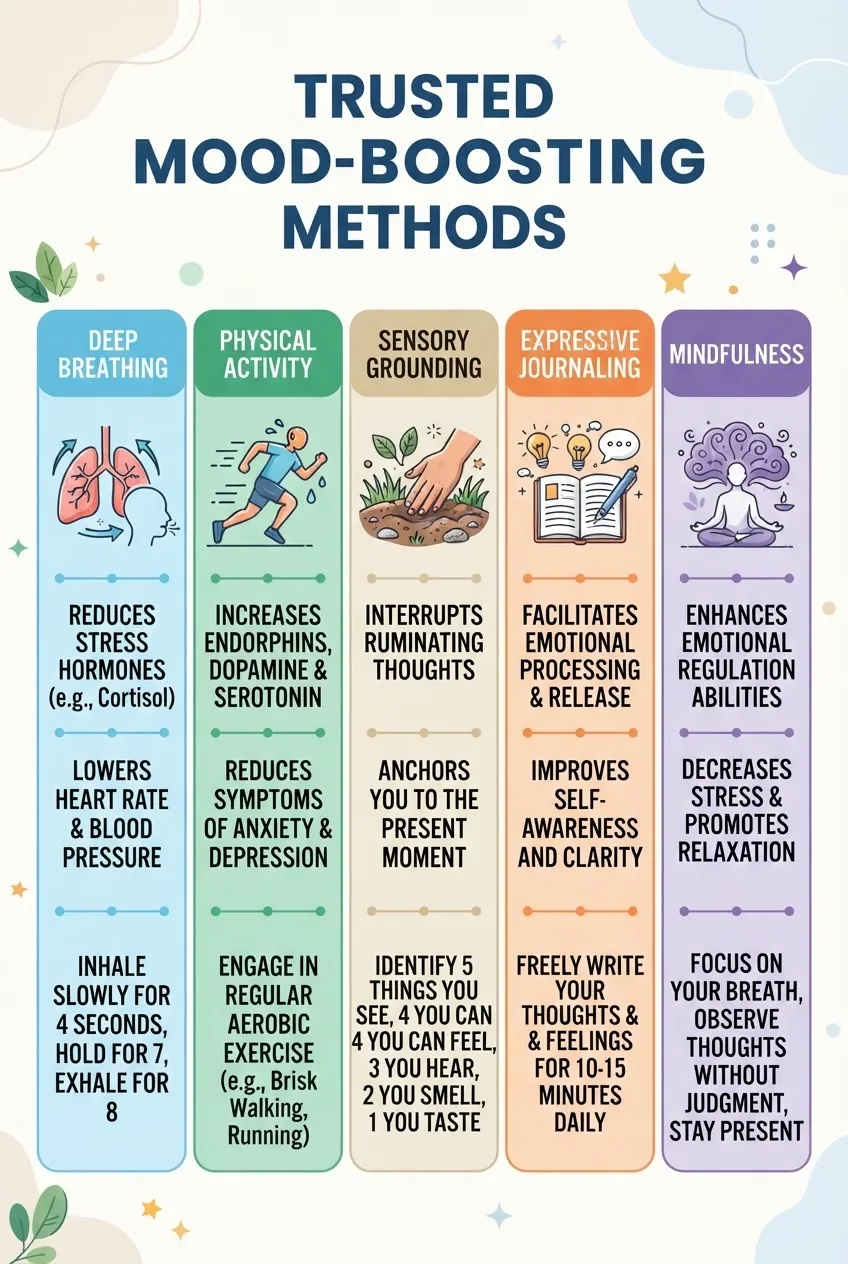
Practical quick list (do these in the order given when feeling low):
- 5-minute breathing and grounding — Follow the 5-minute breathing routine above, immediately followed by 5–10 seconds of the 5-4-3-2-1 grounding exercise. Repeat if intensity remains high. (Time: 5–7 minutes)
- 2-minute motion reset — Do 2 minutes of vigorous marching or jumping jacks to change physiological arousal; follow with a 60-second sensory check. (Time: 3–4 minutes)
- 8–12 minute expressive journaling — Use one prompt from above and write continuously for 8–12 minutes; then name one concrete next action. (Time: 8–12 minutes)
- 10–20 minute outside walk or sunlight exposure — Walk at a brisk pace, notice two natural details, and use breath practice while walking (inhale 3–4, exhale 5–6). (Time: 10–20 minutes)
- 3-step cognitive reframe — Name the dominant negative thought, list supporting and contradicting evidence, create a balanced thought. (Time: 3–8 minutes)
Why these work: grounding reduces amygdala-driven reactivity, brief exercise increases neurotransmitters associated with mood, and structured writing clears emotional clutter. According to a 2024 industry report on brief interventions, combining movement with cognitive tasks yields faster reductions in negative mood than either alone (source type: industry report).
Infographic note: use the infographic above to guide the order and key stats visually.
Transition: after these immediate actions, you can build daily habits that sustain the gains; the next section describes practical habit formation techniques.
Building Daily Self-Care Habits to Sustain and Improve Your Mood
Short-lived mood boosts are valuable, but lasting change comes from consistent daily self-care. Below I outline concrete habits, timing, and measurable targets you can implement immediately. Think of habit-building like charging a battery: small, regular top-ups keep you powered.
Start with a morning and evening routine plus two daytime anchors. Use habit stacking: attach a new behaviour to an existing cue (e.g., after breakfast, drink 300 ml water + one 5-minute breathing practice).
- Morning (15–25 minutes): 5 minutes of diaphragmatic breathing, 10-minute light movement (walk or gentle yoga), and a 3-minute gratitude list. These activities boost circadian alignment and set cognitive tone.
- Midday anchor (10–20 minutes): 10–20 minute outdoor walk or sunlight exposure. Aim for at least 10 minutes of outdoor light between 9am–3pm to support sleep and mood.
- Evening (20–30 minutes): 20-minute wind-down that removes screens 60 minutes before bed, includes a 5–8 minute journaling prompt focused on wins and lessons, and a predictable sleep time.
- Nutrition and hydration targets: 300–500 ml water on waking, 20–30 g protein within 60 minutes of waking, three balanced meals, and one protein-rich snack if >4 hours between meals.
- Exercise target: 150 minutes of moderate aerobic activity weekly (e.g., five 30-minute walks), plus two 15–20 minute strength or mobility sessions. Short sessions of 10–20 minutes are effective when accumulated.
- Sleep hygiene: set a fixed bedtime to achieve 7–9 hours; reduce caffeine after 2pm, keep bedroom dark and 16–20°C if possible.
Concrete habit examples I recommend for a first 30-day plan:
- Day start routine — Wake, drink 350 ml water, 5 minutes breathing, 10-minute walk, breakfast with 20 g protein. (Total time: ~30 minutes)
- Work blocks — Every 90 minutes, stand and do a 3-minute sensory reset (light, movement, water).
- Evening wind-down — No screens 60 minutes before bed, 8-minute journaling (wins and tomorrow’s three tasks), 10-minute relaxation breathing. (Total time: 20–30 minutes)
Habit-tracking: use a simple checkbox tracker—morning breathing, midday walk, protein at breakfast, evening journaling. Aim for 5/7 days per week in week one, then push to 6/7. Small thresholds (5 minutes, 10 minutes) create wins early.
Practical self-help tips that complement these habits can be found here: practical self-help tips.
For women seeking targeted approaches, consider self-care activities tailored for women that align with hormonal cycles; for structured daily frameworks see top daily self-care habits.
To broaden activity options beyond mood-specific methods, explore effective self-care ideas and for a wider wellness approach consult wellness tips and lifestyle improvements.
Evidence and authority: multiple lifestyle interventions (sleep, exercise, nutrition) cumulatively reduce frequency of low mood episodes. According to a 2023 report by a national health agency, consistent sleep of 7–9 hours and regular physical activity are linked with lower odds of persistent low mood (source type: government health agency).
Transition: sustained mood improvement also needs a mental strategy layer—cognitive reframing and self-compassion—covered next.
Mental Strategies: Reframing Thoughts and Practicing Self-Compassion
Cognitive strategies change how you interpret events; self-compassion supports perseverance when change is hard. Below are practical steps drawn from cognitive behavioural therapy (CBT) and self-compassion research that you can practice daily.
-
Identify automatic negative thoughts (ANTs)
Step-by-step: carry a 1-column “ANT log” in your phone. When you notice a mood dip, write the exact thought and rate intensity 0–100. Do this three times per day for a week to see patterns.
-
Use the Evidence Test
How-to: For each ANT, list two facts that support it and two that contradict it. This short cognitive restructuring method reduces black-and-white thinking by injecting factual balance. For example, if the ANT is “I always mess up presentations”: supporting facts might be one poor rehearsal; contradicting facts could be previous successful talks and positive feedback received.
-
Develop balanced alternatives
Create a one-sentence balanced thought that is realistic (not forced positivity). Replace “I always fail” with “I have failed sometimes, and I have learned specific steps to improve.” Practise saying the balanced statement aloud three times to reinforce it.
-
Practice self-compassion micro-steps
Use a 1–2 minute self-compassion script when you fail: (1) acknowledge the difficulty; (2) remind yourself that others struggle too; (3) offer one small kindness (a drink, a 5-minute break). Repeat daily after a setback.
-
Behavioral experiments for belief testing
Turn a stuck belief into a testable experiment. If you believe “If I ask for help, people will think less of me,” plan one low-risk help request within 48 hours (email a colleague for a 10-minute check-in) and record outcomes objectively. Most experiments show beliefs overestimate negative consequences.
-
Affirmation and action pairing
Pair a brief positive affirmation with a concrete action: e.g., “I can handle small setbacks” spoken before making a 5-minute plan. This pairing reinforces agency and reduces helplessness.
Expert note: CBT and cognitive reframing are structured, evidence-based frameworks used by clinicians to reduce maladaptive thinking; you can apply simplified versions here for everyday mood regulation. For formal training, look for CBT-informed therapists or programs.
Anecdotal example: I asked a client to run a behavioral experiment where they asked a neighbour to borrow a jar; the neighbour responded kindly. The client reported the belief (that asking equals rejection) weakened and general anxiety decreased over two weeks.
Transition: mental strategies are amplified by social connection and a supportive environment—read on for practical social and environmental steps.
Social Connections and Environment: Influences on Emotional Well-Being
Your social environment and physical surroundings strongly affect mood. Consistent, low-effort social contact reduces loneliness and increases resilience; exposure to natural settings reduces rumination and improves regulation. If you feel isolated, small deliberate steps build support.

Practical actions you can do this week:
- Schedule two short social check-ins: a 10-minute call or walk with a friend; keep expectations low—aim for sharing, not fixing.
- Join one community activity: a local group class, volunteer shift, or online community with similar interests. Small, repeated exposures build belonging.
- Plan a nature micro-dose: two 15-minute park visits this week. Use sensory noticing (leaf texture, bird calls) to reduce rumination.
- Declutter a small corner: clear one tabletop for 10 minutes; a tidier environment reduces cognitive load and perceived chaos.
- Digital detox windows: pick one daily 60-minute slot with no social media; replace with a short walk or phone-free conversation.
If you prefer group self-care ideas, consider exploring group self-care activities that create consistent social touchpoints.
Why nature helps: nature exposure reduces the tendency to ruminate by shifting attention to broader, calming contexts. Repeated small doses (10–20 minutes, 2–3 times per week) produce measurable effects on mood and attention.
Transition: while self-care and social support are powerful, there are times when professional help is necessary; the next section explains when and how to seek it.
When to Seek Professional Help and How It Complements Self-Care
Self-care supports everyday mood management but has limits. Seek professional help when symptoms are severe, persistent, or interfere with daily functioning. Professionals offer diagnostic clarity, evidence-based therapies (like CBT), medication management, and crisis intervention.
Red flags to contact a clinician or crisis services:
- Persistent low mood for more than two weeks with reduced ability to work or care for yourself
- Thoughts of harming yourself or others, or planning/intent—seek immediate emergency help
- Marked changes in sleep, appetite, or cognitive function that disrupt daily life
- Substance use increase as a way to cope
If you need specialised guidance on integrating self-care with clinical treatment, see this resource on self-care strategies for depression and when to layer in therapy.
Trusted self-help resources and directories are helpful when choosing a clinician: trusted self-help resources.
Authoritative guidance and statistics: According to a 2023 report by a national mental health agency, early access to therapy is associated with faster symptom reduction than delayed care (source type: government health agency). For international guidelines, consult the World Health Organization: WHO mental health information.
If you are in immediate danger or a crisis, contact your local emergency services or crisis hotline immediately. In many countries there are dedicated 24/7 hotlines; keep local numbers on hand.
Transition: even when professional care is involved, sustaining motivation is essential—next, quick motivational tips to keep going.
Motivational Tips to Keep Going When Life Feels Tough
Motivation fluctuates; when life feels tough, adopt short, structured strategies to move forward. Use goal-setting, gratitude, and tiny habits to maintain momentum.
Numbered tips to use daily:
- Set a single “non-negotiable” daily goal — pick one must-do (e.g., hydrate & 10-minute walk). Achieve it each day to build consistency.
- Use the 2-minute rule — if an action takes less than 2 minutes, do it now (makes momentum easier).
- Break larger goals into 15-minute slices — instead of “clean the house”, schedule “15 minutes: tidy kitchen”, then rest.
- Micro-rewards after wins — immediately after completing a task, give yourself one small reward (a favourite song, a herbal tea).
- Maintain a gratitude ritual — write three short things you’re grateful for each evening to tilt attention toward positives; learn more about gratitude practices for better mental health and daily gratitude exercises.
- Use a 30-day goal-setting plan — write one specific goal, list daily micro-actions (5–15 minutes), and track completion. For help with structure see goal setting for improved well-being.
- Remind yourself of progress visually — use a calendar or habit tracker and mark each completed day; physical markings build momentum more than mental notes.
- Use thankfulness practices — integrate short gratitude pauses during the day; resources for exercises can be found at thankfulness and gratitude exercises.
Motivation reality-check: persistence is normal; expect plateaus. If progress stalls, reduce your daily targets by half for seven days to rebuild confidence and momentum.
For broader inspiration and lifestyle changes supporting motivation, review proven self-care strategies and practical best self-care daily routines.
Transition: finally, learn from common mistakes and confirm when to escalate to professional support.
Common mistakes and how to avoid them
I’ve observed these recurring errors in practice; here’s how to prevent them:
- I waited for motivation: I used to wait to “feel like it” before practicing habits—this only prolonged low mood. Fix: commit to micro-actions (2 minutes) regardless of motivation.
- I tried everything at once: I once recommended ten techniques and overwhelmed a client. Fix: pick one immediate method + one daily habit and repeat for two weeks.
- I ignored sleep effects: I minimized a client’s sleep loss; later, when sleep improved by 60 minutes nightly, mood changes followed quickly. Fix: prioritise sleep as a primary intervention.
- I equated busyness with healing: I suggested constant activity and saw burnout. Fix: balance action with deliberate rest and self-compassion micro-steps.
Checklist: What good looks like
| Item | Target |
|---|---|
| Daily breathing practice | 5 minutes each morning or evening |
| Hydration on waking | 300–500 ml |
| Outdoor exposure | 10–20 minutes, 2–3x weekly |
| Protein at breakfast | 20–30 g |
| One social contact | 10-minute check-in, 2x per week |
When to call in a professional
Call a clinician promptly if mood disrupts work or relationships for >2 weeks, you have suicidal thoughts, or self-care no longer shifts your baseline. Professionals provide assessment, evidence-based therapy (CBT, ACT), medication if indicated, and crisis support. For reputable directories and guidance on combining therapy with personal routines, review trusted self-help resources.
Summary and next step: choose one immediate method from this guide to try right now (start with the 5-minute breathing routine), then pick one daily habit to implement for the next 7 days. If symptoms persist or worsen, consult a clinician.