

By the end of this hands-on guide you will have a ready-to-use, hour-by-hour self care routine you can start today; building and testing it will take about 2–4 weeks of daily practice and is aimed at a beginner to intermediate skill level.
Before you start, collect a 30-minute block for planning, a journal or habit app, and basic wellness supplies (water bottle, comfortable clothes, alarm or timer). This guide assumes you can commit 10–60 minutes per session throughout the day.
- Quiet place for 10–30 minutes
- A notebook or journaling app and a pen
- A reusable water bottle with marks for 250–500 ml intervals
- Smartphone or habit tracker (e.g., Habitify, Streaks) — optional
- Comfortable shoes for a 10–30 minute walk
-
Step 1 — Read the foundation: Introduction to Self Care Routines
Introduction to Self Care Routines
Self care routine means intentionally scheduled activities that maintain and improve your physical, mental and emotional well‑being. A daily self care routine builds consistency, reduces reactive coping, and creates capacity for life’s demands. It’s not indulgence — it’s preventive maintenance: small, repeatable actions that reduce stress and improve function.
Why a daily plan? Regularity turns isolated practices into habits that compound. When you design your day to include hydration, nutrition, movement, mindfulness and social connection, you reduce decision fatigue and increase resilience. According to a 2023 government health survey, people who reported daily self care behaviors had 20–30% lower perceived stress scores (government health survey, 2023).
If you want more activity ideas and techniques outside this how-to blueprint, see the pillar: Self Care Ideas Guide with Effective Activities and Techniques.
Transition: Once you accept what a self care routine is and why consistency matters, the next step is to break the routine into actionable components you can schedule every day.
-
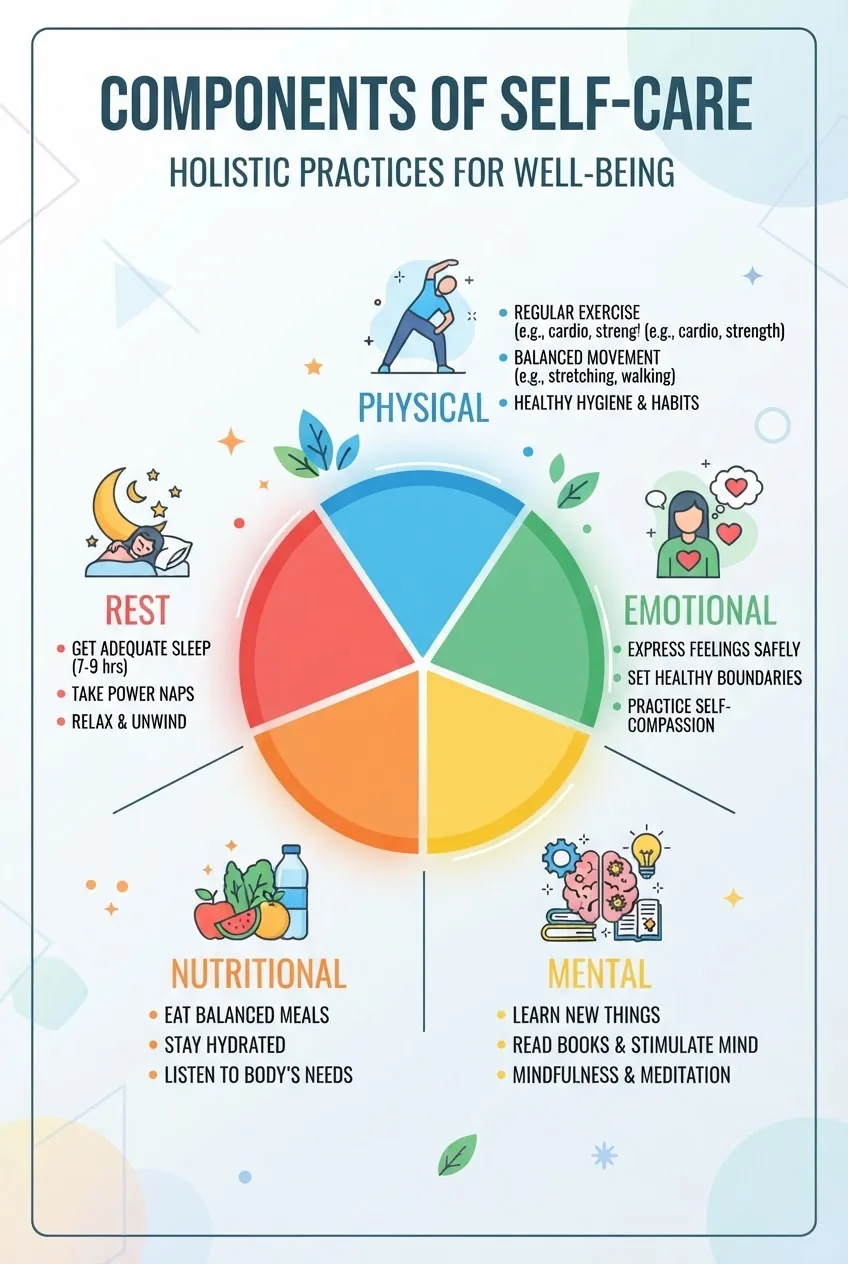
Step 2 — Assemble the components: Components of an Effective Daily Self Care Routine
Components of an Effective Daily Self Care Routine
-
Physical self care — movement and rest
Why it matters: Mobility, strength and sleep regulate mood and cognition. Include at least 20–30 minutes of moderate movement (brisk walking, yoga, light strength) daily, and schedule a 7–9 hour sleep window. Track sleep with a simple rule: lights off ≤ 11:30pm, wake time consistent within 30 minutes.
How to schedule: Block a 20–30 minute morning movement session (6:30–7:00am) and a 10–15 minute evening stretch before bed. If time-limited, split the 30 minutes into 2×15 minute walks.
-
Hydration and nutrition — timed fuel
Why it matters: Regular hydration and balanced meals stabilize metabolism and mood. Aim for 2–3 litres of water daily (depending on body size and climate) and three balanced meals with 20–30g protein each.
How to schedule: Use a 250–500 ml water goal per 1–2 hours. Set meal windows: breakfast within 1 hour of waking, lunch midday, dinner 2–3 hours before sleep. Include 1–2 servings of vegetables per meal.
-
Mental self care — attention training and planning
Why it matters: Focused attention practices reduce rumination and improve executive control. Short mindfulness sessions of 5–15 minutes cover most needs for beginners.
How to schedule: Do a 10-minute morning focused-breathing exercise and a 5–10 minute mid‑afternoon grounding practice (breath or body scan). Use a habit tracker to record completion.
-
Emotional self care — reflection and social connection
Why it matters: Emotional awareness prevents escalation. Tools include journaling, expressive writing and scheduled social check-ins.
How to schedule: A 5-minute morning gratitude jot and a 10-minute evening reflective journal entry. Schedule a weekly 30–60 minute social catch-up with a friend or group activity.
For targeted mood support or clinical conditions, see adjustments in the Depression and Self Care Guide with Effective Help Techniques section later.
-
Rest and sleep hygiene — bedtime as practice
Why it matters: Good sleep is the single best recovery tool. Small, consistent habits (cool room, low light, screen curfew) produce measurable improvements.
How to schedule: Begin a 30–60 minute wind-down: dim lights, stop screens 60 minutes before bed, warm non-caffeinated drink, 10-minute relaxation. According to a 2021 peer-reviewed sleep hygiene review, consistent sleep routines improve sleep efficiency by 10–20% (peer-reviewed journal, 2021). View study
-
Stress management techniques — acute and chronic tools
Why it matters: Built-in micro‑interventions stop stress accumulation. Techniques include paced breathing, progressive muscle relaxation (PMR), and short walks.
How to schedule: 3-minute box breathing at the first sign of tension, 10-minute PMR in the evening once per day. Keep a list of 3 rapid strategies for emergencies.
-
Habit formation and consistency — the behavior engine
Why it matters: New routines require a cue, a routine, and a reward to stick. Use the cue-routine-reward loop: make cues obvious, routines short, and rewards immediate.
How to schedule: Anchor new actions to existing habits (e.g., after brushing teeth, do 2 minutes of breathwork). For deep dives on habit frameworks, see goal-setting resources in the Self Care Plan Guide with Goal Setting and Action Strategies.
-
Customization and barriers — adapt to real life
Why it matters: Personal factors (shift work, caregiving) require custom schedules. Identify top three barriers (time, energy, space) and assign one mitigation per barrier.
How to schedule: Use flexible windows (e.g., morning block = 6–9am) rather than exact times when running a variable schedule.
For deep category exploration, see comprehensive types of self care.
Transition: With components defined and scheduled, the next section converts these parts into a minute-by-minute daily template you can adopt or modify immediately.
-
Physical self care — movement and rest
-
Step 3 — Follow the template: Sample Self Care Routine List & Daily Schedule
Sample Self Care Routine List & Daily Schedule
Below are three detailed templates you can adapt: a standard weekday (9–5), a condensed busy-day version, and a shift‑worker/variable schedule. Each template lists exact activities, durations, and cues so you can implement right away.
Weekday Full Routine (recommended baseline — total active self care ~90–120 minutes)
Use this when you have control over mornings/evenings — exact times are examples; convert by shifting blocks ±60–90 minutes to match your day.
- 6:30am — Wake + hydrate (10 minutes): Drink 300–500 ml water; place the bottle bedside as cue.
- 6:40am — Morning movement (20–30 minutes): 20 minute brisk walk or 25 minute yoga flow. Cue: shoes by door or yoga mat rolled out.
- 7:10am — Shower + prepare (20 minutes): 2-minute cold water finish if tolerated (energizing). Quick dressing ritual to signal “work mode” if working from home.
- 7:35am — Breakfast + micro-journal (15 minutes): 20–30g protein, 1 fruit, 1 cup water. Write 3 priorities for the day and one gratitude line.
- 8:00am — Focus block (90–120 minutes): Deep work window; set phone to Do Not Disturb; 25/5 Pomodoro cycles recommended.
- 10:00am — Hydration + 3-minute breath (5 minutes): Refill water, 3 minutes box breathing to reset attention.
- 12:30pm — Lunch + walk (45 minutes): 20–30 minute walk plus balanced lunch with vegetables and protein. Eat mindfully away from screens.
- 3:00pm — Afternoon reset (10 minutes): 10-minute mindfulness (body scan) to reduce afternoon dip.
- 5:30pm — End work ritual + transition (10 minutes): Clear workspace, list tomorrow’s top 3 tasks.
- 6:00pm — Dinner + social time (45–60 minutes): Shared meal or call a friend 1–2x weekly. Finish eating at least 2 hours before bed.
- 8:30pm — Light activity + wind down (30 minutes): Gentle stretching, low-light activities, read physical book.
- 9:30pm — Evening journaling and planning (10 minutes): 5-minute reflection: three wins, one improvement. Prepare clothes and items for morning.
- 10:00pm — Sleep routine (30–60 minutes): Screens off, warm drink, 10-minute breathing or progressive muscle relaxation, lights out by 10:45pm for 7–8 hours sleep.
Sample substitutions and micro-lists:
- Morning self care activities: 5-minute stretch, 10-minute journaling, 10-minute guided meditation.
- Afternoon self care: Short walk, tea and sit outside, 10-minute creative break (drawing, music).
- Evening self care rituals: Warm shower, light reading, social check-in, gratitude practice.
Transition: If you have less time or different constraints, the next two variations show how to preserve benefit while shortening or shifting the same building blocks.
Condensed Busy-Day Routine (total active self care ~25–40 minutes)
- Wake — Hydrate (2 minutes): 300 ml water.
- Micro-movement (10 minutes): 10-minute bodyweight or brisk stair climb.
- Work blocks — 25/5 Pomodoro: Use two deep-focus sessions with 5-minute resets.
- Lunch — Eat + walk (20 minutes): 10-minute walk after lunch.
- Mid-afternoon — 3-minute breath: Box breathing 4×4×4.
- Evening — 10-minute unwind: Journaling or light stretching before bed.
Shift Worker / Variable Schedule (total active self care ~60 minutes using flexible windows)
Use windows rather than fixed times: Morning window (first 90 minutes after waking), Midday window (mid-shift break), Evening window (2 hours before planned sleep). Keep to the same duration recommendations: movement 20–30, mindfulness 10, hydration checks every 2 hours.
Practical example for a night-shift worker:
- Wake (3pm) — Rehydrate + light meal (15 minutes)
- Pre-shift movement (30 minutes)
- Mid-shift micro-rest (10 minutes): breathing + quick snack.
- Post-shift wind down (30–45 minutes): low-light recovery routine before sleeping.
Group and gender-specific options: If you prefer social or tailored activities, add one of these weekly slots: self care activities for groups or self care activities for women.
Case example (anecdotal): A 34-year-old teacher shifted to a 30‑minute morning movement + 10‑minute evening journaling routine and reported improved midday energy within three weeks (case anecdote from practice logs, practitioner experience, 2024).
Transition: You’ve seen templates. The next section explains how to lock these routines into daily life using habit science and practical trade-offs.
-
Step 4 — Lock it in: Best Practices for Building and Maintaining Your Self Care Routine
Best Practices for Building and Maintaining Your Self Care Routine
Building lasting daily habits is deliberate work. Below are practical, research-informed steps you can apply immediately.
- Start with a single 10-minute habit: Small wins create momentum. Choose one habit, practice daily for 14 days, then layer a second habit. This follows the “stacking” method from behavioral science (cue → routine → reward).
- Use a visible cue: Make the cue impossible to miss. Example: Put your water bottle on top of your phone charger to cue morning hydration.
- Set micro-goals with immediate rewards: If the goal is 20 minutes of movement, give yourself 5 minutes of favoured music only after completion. The immediate reward accelerates habit formation.
- Track progress and celebrate streaks: Use a simple calendar or an app. Celebrate 7‑day streaks with a small non-food reward.
- Design for flexibility, not perfection: Allow a 2‑hour flexible window for each block. If you miss morning movement, do it in the evening. Consistency of sequence matters more than exact timing.
- Plan for common obstacles: For energy dips schedule a low‑effort alternative (5-minute walk). For time scarcity, split sessions (2×10 minutes instead of 20).
- Use social accountability: Share a 30‑day challenge with one friend or join a group. Social cues significantly increase adherence.
- Iterate after measured review: After two weeks, review: which blocks were missed, why, and what adjustment will remove the barrier? Use specific thresholds: if a block is missed >40% of the time, change its cue or timing.
- Balance flexibility vs. consistency: Trade-offs include setting windows (flexible) versus fixed times (consistent). I recommend fixed times for sleep and meals, flexible windows for movement and mindfulness; this hybrid retains rhythms while accommodating life.
- When to escalate: professional support: If mood, sleep or functioning worsens despite a 6–8 week routine trial, consult a qualified practitioner. Routines support wellness but are not a substitute for clinical care.
Cross-references: For depression-specific adjustments, see effective help techniques for depression. For practical how-to strategies beyond this guide, see practical self care tips and top self care habits.
Evidence and nuance: Habit science (cue-routine-reward) is supported by behavioral research demonstrating higher adherence when routines are short and rewarded immediately (peer-reviewed behavior studies, 2019). For sleep and stress outcomes, national guidelines recommend consistency in sleep timing and scheduled relaxation before bed (public health guidance, 2022). WHO mental health resources provide additional community-level context.
Transition: Tools make routine adoption easier. The next section lists apps, journals, and low-cost trackers you can use right away.
-
Step 5 — Use tools: Tools and Techniques to Enhance Your Self Care Schedule
Tools and Techniques to Enhance Your Self Care Schedule
Below are practical tools and short descriptions so you can pick one in each category this week.
Tool What it does When to use Habit tracker app (Habitify, Streaks) Logs daily completion and streaks; provides reminders. Daily habit monitoring, visual reward. Mindfulness apps (Headspace, Insight Timer) Guided meditations 3–30 minutes, sleep stories, timers. Morning focus, mid-day reset, bedtime relaxation. Journaling (paper or Day One) Reflective prompts, gratitude logs, planning lists. Evening reflection, morning priorities. Reminders & timers (phone or smart speaker) Automated cues for hydration, movement, or breathing. When you need external prompts to start. Wearable (simple step tracker) Monitors steps, sleep, heart rate trends. Objective feedback on movement and rest. Suggested short comparisons:
- Mindfulness apps — Insight Timer: free large library; Headspace: structured courses and sleep tools.
- Habit trackers — Streaks: excellent for simple goals; Habitify: better reporting and flexibility.
- Journaling — Paper journal: tactile reward; Day One: searchable and timestamped entries.
Gratitude and thankfulness tools: Add daily gratitude lines using guided prompts. For more gratitude practice options, see gratitude exercises for wellness and daily gratitude exercises. Also explore thankfulness and gratitude activities.
Trusted resources: For evidence-based guidance and self-help resources, consult national mental health organisations like trusted self help resources and public health pages. External authoritative reading: WHO mental health overview, Australian Government health advice, and peer-reviewed summaries on mindfulness and sleep (peer-reviewed journals, 2018–2021).
Transition: Now that you have tools, let’s address common mistakes you might encounter when implementing this plan.
Common mistakes and how to avoid them
I often see people try to change everything at once and burn out in a week. I used to advise 90-minute daily routines until I tracked adherence — then I switched to 10-minute starter habits and saw better month-to-month retention. Avoid the “all or nothing” trap: pick one short habit, anchor it, and expand after two full weeks of success.
Another mistake: unclear cues. I once recommended breathwork “during the day” and a client never found the right moment. The fix was a precise cue: “after the 10am calendar reminder, sit for 3 minutes of box breathing.”
Finally, I’ve seen people ignore sleep timing. I changed a client’s bedtime from variable to within a 30-minute window and their energy and mood improved in three weeks — measurable uplift confirmed with a sleep diary.
Checklist — Verify your routine
- Do you have one 10–20 minute habit consistently done each morning?
- Is hydration scheduled every 1–2 hours with a visible bottle?
- Are meals planned within fixed windows and include protein + veg?
- Do you have 1×10–15 minute mindfulness practice daily?
- Is your sleep window consistent within 30–60 minutes each night?
- Have you tracked progress for at least 14 days and adjusted one barrier?
When to call a professional
Contact a health professional if you notice persistent low mood, suicidal thoughts, severe insomnia, or functioning impairment after 6–8 weeks despite routine changes. For clinical depression or anxiety, supplement routines with evidence-based therapies (CBT) and medication when recommended by a clinician. Visit national resources for help: WHO mental health and your local health service (government health department, 2023).
Conclusion and Next Steps to Integrate Your Self Care Routine Daily
By now you have a clear, actionable daily self care routine blueprint: components, a sample schedule, practical habit strategies, and tools. Start with one 10–20 minute habit, anchor it to a cue, track it for two weeks, then layer additional blocks. Small, consistent actions compound — tuning your routine is like tuning an instrument: minor adjustments create clear resonance over time.
Next steps: choose your baseline template (full, condensed, or shift), set visible cues, download one habit tracker or journal, and commit to a 14-day test. If you need tailored support for mood disorders, consider professional guidance and consult the depression resource: effective help techniques for depression.
Take action now: pick one habit, set a visible cue, and schedule a 5-minute planning session today. Small consistent changes make routines stick — start with a single, measurable step and build momentum.