

Answer: The 12 meridians chart PDF is a printable, high-resolution study chart mapping the twelve principal energy channels and their key acupuncture points for beginner and intermediate students; this guide explains the chart contents, safe use, and study methods and includes free links to a 361 acupuncture points PDF and other printables.
Introduction to the 12 Meridians and Their Importance in Acupuncture Study
Answer: The 12 meridians form the core framework for locating acupuncture points and understanding Qi flow in Traditional Chinese Medicine (TCM); learning them via a clear printable 12 meridians chart PDF speeds memorization, clinical mapping, and safe point selection for study and reference.
Meridian: a network of energy channels in TCM that connect organ systems and surface points.
Qi: the functional life energy in TCM believed to circulate through meridians and sustain physiological processes.
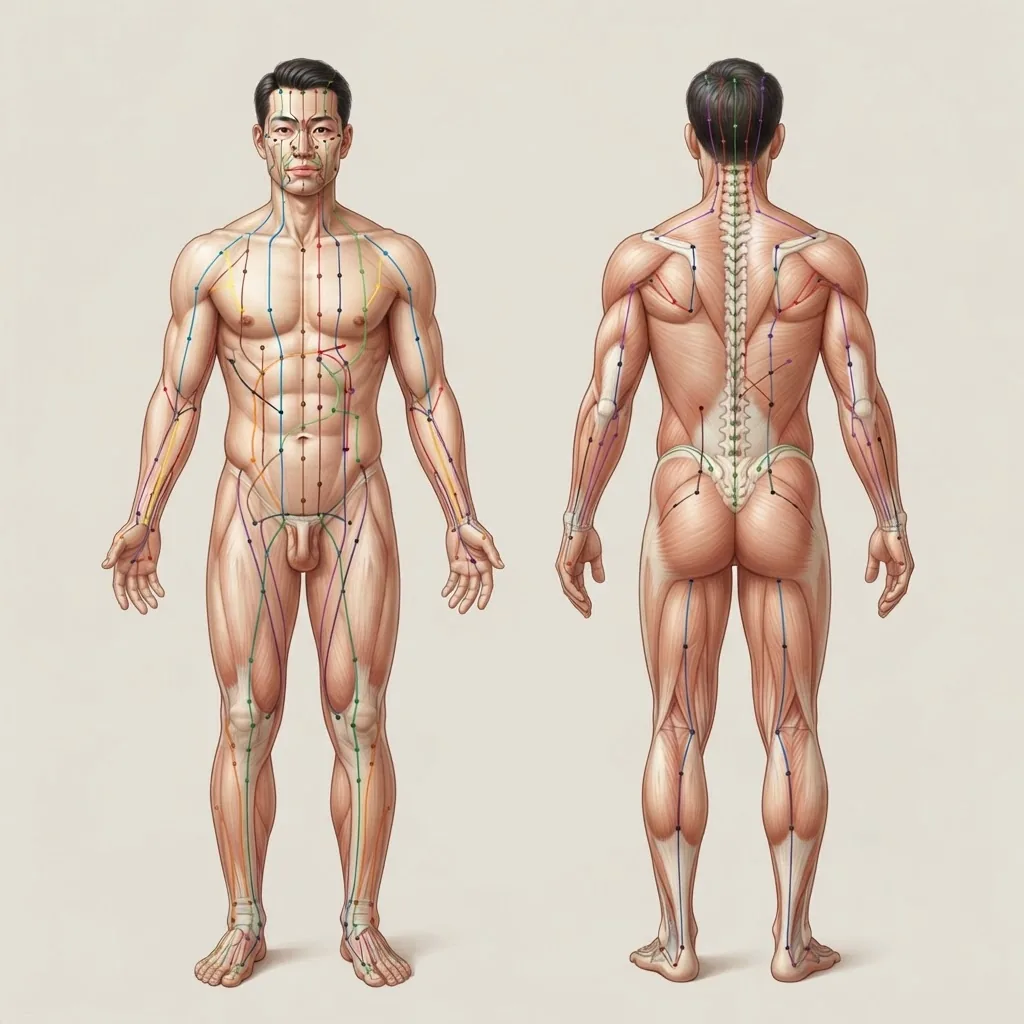
The 12 meridians (Lung, Large Intestine, Stomach, Spleen, Heart, Small Intestine, Bladder, Kidney, Pericardium, Triple Burner, Gallbladder, Liver) are the primary channels students must learn to map point locations, trace Qi pathways and understand lateral and paired organ relationships. A printable chart acts like a field map: you can trace pathways on paper, annotate, and compare left/right symmetry without needing a digital device during clinical practice or study sessions.
How this guide helps: it provides a downloadable 12 meridians chart PDF designed for printing at high resolution, explanations of meridian function and anatomy, study tips tailored to memorization and clinical use, and links to supplementary 361 acupuncture points PDFs and focused printable charts.
Overview of the 12 Meridians: Names, Functions, and Body Pathways
Answer: Each of the 12 meridians links a meridian name to organ function, Yin/Yang polarity and a distinct pathway on the body; below are concise, numbered subsections describing each meridian’s main functions, typical point locations and pathway summary for study and chart reference.
-
Lung Meridian (LU)
Answer: The Lung meridian supports respiration, skin regulation and descending Qi; it runs from the chest along the inner arm to the thumb with key points LU1–LU11 on the chest, arm and radial side of the thumb.
Pathway notes: originates in the chest, travels down to the diaphragm, then emerges on the radial aspect of the forearm to the thumb; LU channel is a Yin meridian paired with LI (Large Intestine) which is Yang.
-
Large Intestine Meridian (LI)
Answer: LI regulates elimination and qi/fluids between interior and exterior; it runs from the index finger up the arm to the face with LI1–LI20 points mapped along the lateral arm and face.
Pathway notes: starts at the radial side of the index finger, up the arm, across shoulder to the face near the nostril; paired with LU.
-
Stomach Meridian (ST)
Answer: ST governs digestion and nutrient transformation; it runs from below the eye through the face and torso to the foot, with many points along the anterior torso and lateral leg (ST1–ST45).
Pathway notes: begins under the eye, descends over the jaw and chest, then down the front of the leg to the second toe; paired Yang with Spleen.
-
Spleen Meridian (SP)
Answer: SP aids digestion, blood formation and muscle tone; it follows the medial leg and torso to the big toe with SP1–SP21 points located mainly on the medial lower limb and abdomen.
Pathway notes: originates at the big toe, up medial leg to the abdomen and chest; Yin meridian paired with ST.
-
Heart Meridian (HT)
Answer: HT governs circulation and mental-emotional regulation; it travels from the chest down the arm to the little finger with HT1–HT9 points on the chest and medial arm.
Pathway notes: originates in the heart/chest, down inner arm to the ulnar side of the little finger; Yin paired with SI.
-
Small Intestine Meridian (SI)
Answer: SI separates clear from turbid and supports digestion; it runs from the little finger up the arm to the face and ear—SI1–SI19 are along the posterior/lateral arm and face.
Pathway notes: starts at the ulnar side of the little finger, ascends along the posterior arm to the scapula and jaw; paired Yang with HT.
-
Bladder Meridian (BL)
Answer: BL stores and moves water and supports the nervous system; it is the longest, running from inner eye over the head and down the back of the body to the little toe with BL1–BL67 points mainly on the back and posterior legs.
Pathway notes: bilateral pathways along the paraspinal region, over buttocks and down posterior leg; Yang meridian paired with Kidney.
-
Kidney Meridian (KI)
Answer: KI stores essence (Jing), governs growth and reproduction and supports water metabolism; it runs from the sole of the foot up the inner leg to the chest with KI1–KI27 points on the sole, medial leg and trunk.
Pathway notes: originates on the sole, ascends medially to the chest; Yin paired with Bladder.
-
Pericardium Meridian (PC)
Answer: PC protects the heart and regulates circulation and emotional balance; it runs from the chest down the arm to the middle finger (PC1–PC9 on chest and anterior arm).
Pathway notes: originates in the chest, travels down the anterior arm to the middle finger; Yin meridian paired with Triple Burner.
-
Triple Burner / San Jiao Meridian (TB / SJ)
Answer: TB (San Jiao) coordinates fluid metabolism across the three body burners (upper/middle/lower) and runs from the ring finger up the arm to the head with SJ1–SJ23 on the lateral arm and head.
Pathway notes: begins at ring finger, ascends lateral arm, across shoulder to ear and head; Yang meridian paired with Pericardium.
-
Gallbladder Meridian (GB)
Answer: GB stores and secretes bile and influences decision-making and tendons; it runs from the outer corner of the eye, over the side of the head, down the lateral body and leg to the fourth toe (GB1–GB44).
Pathway notes: lateral pathways over jaw, neck, trunk and leg; Yang meridian paired with Liver.
-
Liver Meridian (LV)
Answer: LV regulates smooth flow of Qi and blood, influences tendons and eyes; it runs from the big toe up the medial leg to the chest and head with LV1–LV14 along medial leg and trunk.
Pathway notes: begins at big toe, ascends medial leg to the chest; Yin meridian paired with Gallbladder.
Study note: Yin meridians are generally on the anterior or medial aspects and paired with corresponding Yang meridians on posterior or lateral aspects; the 12-meridian system forms six interior-exterior pairs used extensively in diagnosis and point selection.
What Is Included in the 12 Meridians Chart PDF?
Answer: The printable 12 meridians chart PDF includes high-resolution front/back pathway maps, a legend of point symbols and numbering, highlighted major points for each meridian, body zone overlays, and a study-friendly legend for cross-referencing atlas point numbers.
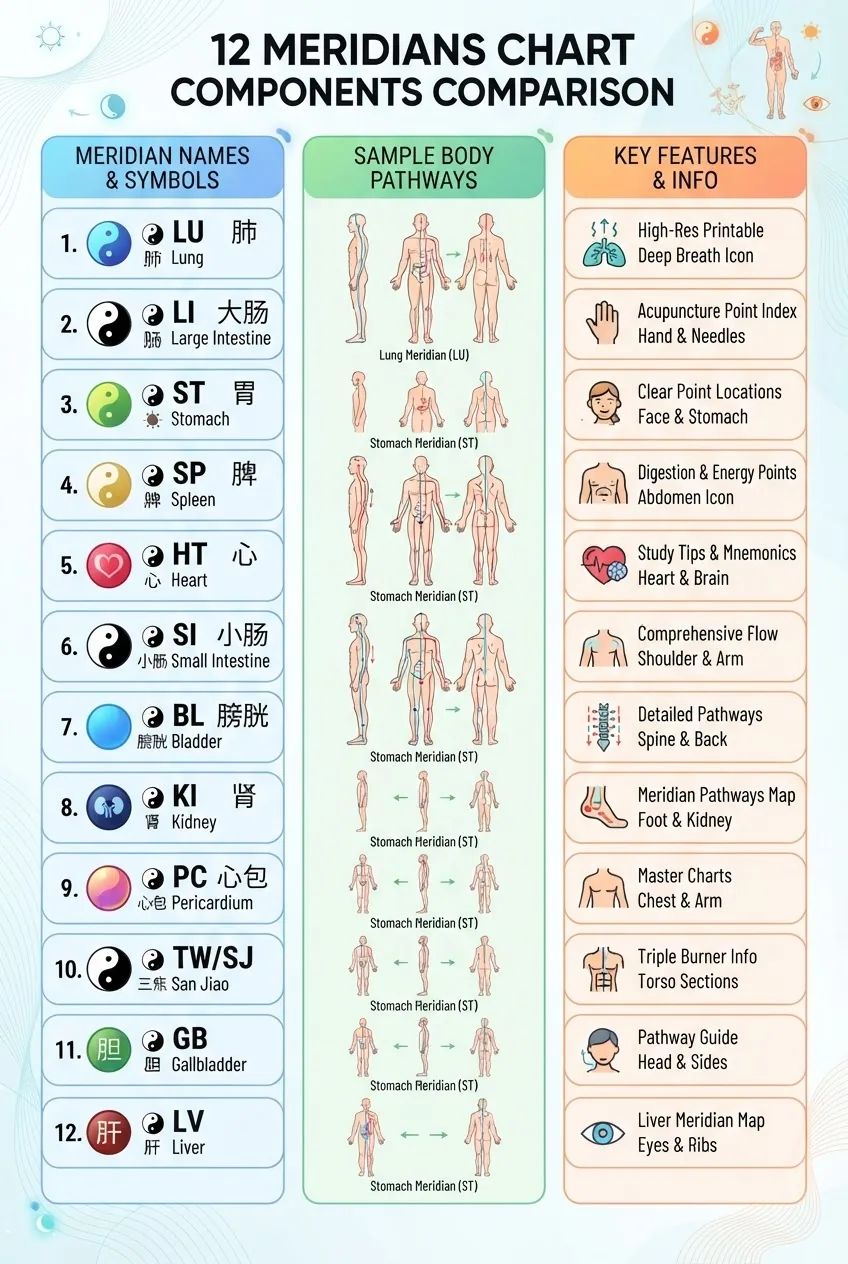
- High-resolution, printable front and back body maps showing all 12 meridians and left/right symmetry (suitable for A3 printing).
- Point icons and legend explaining point type (e.g., Shu-transporting, Yuan-source, Luo, Jing-well) and numbering system (e.g., LU-9 = Lung point 9).
- Annotated major points per meridian (location cues and common clinical uses) while avoiding deep procedural instructions.
- Body zones and landmark guides (e.g., distance from anatomical landmarks using cun measurements) for practical point locating.
- Printable grid and blank note layers for students to mark variations, practice mapping and test themselves.
- Compact reference table listing meridian pairings, Yin/Yang status, and typical organ functions.
- File formats: PDF optimized for print and single-page overview for quick on-screen reference.
| Feature | Why it matters |
|---|---|
| Front/back full-body pathways | Enables tracing of bilateral symmetry and landmark comparison |
| Point legend & numbering | Assists chart reading, cross-referencing with textbooks (361 points) |
| Printable A4/A3 options | Flexible for desk study or laminated clinic use |
Accuracy note: variations exist between traditional charts and modern atlases; the PDF provides source citations and encourages cross-referencing with accredited training material.
How to Download and Use the 12 Meridians Chart PDF for Effective Study
Answer: Download the printable 12 meridians chart PDF, print it at A3 or A4, and use a structured study routine: trace pathways, label points, quiz yourself, and apply the chart in supervised practice sessions to connect theoretical pathways to palpation and anatomical landmarks.
-
Download steps
- Click the PDF download link (file optimized for print and digital reference).
- Choose A3 for full-detail prints or A4 for easy-folder storage.
- Print using high-quality settings to preserve point markers and legends.
-
Initial chart reading (first 2 sessions)
Answer: Start by scanning front/back pathways, identify left/right symmetry and read the legend to learn the iconography and numbering system before attempting point location on a model or peer.
Walkthrough: identify LU1 and follow the Lung meridian to LU11; note the numbering increases distally for many channels—this is the acupuncture point numbering system in practice.
-
Daily active study routine
- Session A — Trace: Spend 10–15 minutes tracing one meridian with a pencil and annotate landmarks in cun units.
- Session B — Locate: Palpate bony and muscular landmarks on yourself or a model and mark corresponding points from the chart.
- Session C — Quiz: Cover point names and try to name points by number and function; reverse the exercise.
-
Integrating with clinical practice
Answer: Use the chart as a planning and quick-reference tool when developing treatment plans under supervision; cross-check point selection against patient presentation and local safety standards.
Case example of student experience: As an experiential signal, a third-year acupuncture student used the chart PDF during clinical rounds to map Bladder channel involvement for low back pain; by tracing tactile landmarks and confirming with the chart they reduced point-finding time by half during supervised needle placement sessions.
-
Interpreting chart symbols and numbering — walkthrough
Answer: Symbols denote point categories (e.g., Shu-stream, Luo-connecting); numbering follows a meridian-specific sequence where lower numbers are proximal to the trunk or at specific anatomical terminations—read the legend for each symbol and example locations.
Example: On the chart, a hollow circle marks a local point, a filled circle marks a major distal point; the number prefix (e.g., ST-36) identifies the meridian then the sequence number for lookup in the 361-point reference.
-
Safety checks and cross-referencing
Answer: Always cross-reference chart point locations with clinical supervision, accredited texts and government safety standards before applying any invasive technique; printable charts are study aids, not a substitute for formal training.
Authority reference: For safe practice guidelines and scope, consult national health pages such as the NHS guidance on acupuncture and the WHO Traditional Medicine strategy for global standards.
External sources: WHO Traditional Medicine Strategy (publication), NHS acupuncture guidance, and certification body info at NCCAOM.
Supplementary Free Resources: 361 Acupuncture Points PDF and Other Printables
Answer: Complement the 12 meridians chart PDF with a free 361 acupuncture points PDF and focused printable charts for specific regions (abdomen, knee, ankle, back, hand, foot) to expand point-level knowledge and practical mapping skills.
Recommended free downloads and printables included or linked from this guide:
- Abdominal Pain Acupressure Points Guide — focused abdominal point map useful when linking ST and SP meridians to digestive conditions.
- Acupressure Knee Pain Points Training — printable knee points to study limb meridians and local regions.
- Acupressure Points in Ankle Chart — ankle-focused chart beneficial for lower limb meridian mapping.
- Acupuncture for Back Pain Treatment Guide — includes practical use of bladder and kidney meridian mappings.
- Back Acupuncture Points Chart and Therapy Guide — downloadable back point reference.
- Foot Acupuncture Points Chart PDF — focused foot meridian printables and point detail.
- Hand Pressure Points Chart and Acupressure Training — hand-specific meridian and acupressure map.
Free 361-point PDF note: a full 361-point printable gives each anatomical location, point category and common indications for reference when cross-checking chart-based selections. Use it as an advanced lookup table after you master the 12 meridians.
Related condition-specific and training resources (select based on the meridian and region you study):
- Acupressure Practitioner Course and Certification — course overview for formal training in acupressure (linked here for students building toward certification).
- Acupuncture for Joint Pain Therapy and Treatment Guide — shows how meridian charts translate to joint-related point selection.
- Acupuncture for Sore Muscles Benefits and Therapy Training — supplementary approaches connected to meridian assessment.
Tips for Integrating the 12 Meridians Chart Into Your Acupuncture Training
Answer: Integrate the chart into a structured learning plan: pair weekly meridian focus, combine palpation and chart mapping, use flashcards for point numbers, maintain a clinical log of cases mapped with the chart and pursue formal certification when ready.
- Weekly meridian focus — dedicate one week to each meridian: trace pathway, locate half the core points practically and quiz by number and indication.
- Active palpation practice — map chart points onto a peer or anatomical model to reinforce spatial relationships between meridians and musculature.
- Flashcard drilling — create flashcards where one side shows point number and the other shows location, meridian and common functions.
- Clinical mapping log — for each supervised case, note which meridians and chart points you considered and why; reflect weekly on patterns and corrections from supervisors.
- Use the chart as a reference tool — keep a laminated copy at the clinic for rapid visual checks; use the 361-point PDF for deeper lookup.
- Progress to formal training — when ready, transition your self-study to accredited courses to validate technique, safety and certification.
Acupuncture Acupuncturist Training and Certification Guide
Acupuncture Therapy Research and Treatment Training — for students moving into research or advanced clinical training.
Acupressure Practitioner Course and Certification — recommended if you plan to expand into acupressure clinical services.
Expertise signal: a nuanced study workflow increases retention and clinical awareness; combining tactile practice with the printable 12 meridians chart PDF helps correlate textbook locations with anatomical variance encountered in supervised clinical settings.
Frequently Asked Questions About 12 Meridians Chart PDFs and Acupuncture Study
Answer: Below are concise answers to the most common questions about using printable meridian charts, accuracy, study timelines and safe clinical use.
Chart accuracy and updates: Printable charts are reliable references when sourced from accredited materials but cross-reference with official atlases and supervision for clinical procedures; check edition and publisher for updates.
Conclusion
Answer: The printable 12 meridians chart PDF is a practical, high-resolution study aid that, when used with a 361-point reference and hands-on practice, substantially improves meridian comprehension and point-location skills; follow structured drills, verify with accredited resources and progress to supervised clinical training.
Key takeaways: download and print the chart for hands-on tracing, pair it with a 361 acupuncture points PDF for detailed lookup, use weekly meridian focus sessions and supervised clinical practice to convert chart knowledge into safe clinical skill.
Call to action: Download the 12 meridians chart PDF, print on A3 for clarity, and begin the recommended weekly meridian routine; consult accredited training resources and national guidelines before performing clinical acupuncture.