

Self care plan — by the end of this hands-on guide you’ll have a customised, trackable self care plan with 3 SMART goals, a 30–90 day action schedule, and backup strategies for common obstacles. Expect to spend 60–120 minutes creating the first draft; skill level required: beginner to motivated intermediate.
Before you start
- Quiet 60–120 minutes, a notebook or tablet and a pen (or a Notion/Google Docs template).
- Access to a habit-tracking app (recommended: Daylio or Streaks) or a paper worksheet; install and create an account if using an app.
- Print or open a simple self assessment worksheet (30 questions covering physical, emotional, social, and practical needs).
- A calendar (digital or paper) and a weekly time audit of 7 days (track 30-minute blocks).
- Willingness to test actions for 30–90 days and to revise based on real-world feedback.
Introduction to a Self Care Plan
A focused self care plan organises activities, sets measurable targets, and maps actions into time — turning good intentions into a sustainable routine. A goal-oriented plan reduces decision fatigue, improves follow-through, and helps you measure progress over weeks rather than hoping things “feel better”. The main benefits include clearer priorities, better time management for well-being, and measurable gains in mood, sleep, and energy.
Start by understanding the difference between activities and plan: activities are options you might do; a plan explicitly sets which actions you will do, when, and how you’ll measure their effect. If you want a quick primer on broader activities to use while planning, see this self care ideas guide.
Why goal-oriented planning matters: measurable targets increase the chance of behaviour change. For example, instead of “meditate more”, a SMART goal would be “meditate for 6 minutes, five days a week for four weeks.” That clarity lets you track, test, and adjust.
According to a 2023 CDC report on adult mental health, about 1 in 5 adults experienced mental illness in the past year — that underlines the scale of need for practical daily routines and preventive self care (source: 2023 CDC report on adult mental health). For research-based benefits of structured self care, the American Psychological Association outlines how routines and goal-setting improve resilience and stress management (source: APA resource on self care).
Before we move on to assessment and goals, review a short list of practical starter actions for beginners: breathing practice (6/6 breaths for 3 minutes), 10-minute walk, 7 hours of sleep target, and a one-item daily gratitude note. If you want foundational action suggestions, see these practical self care tips.
Transition: now that you know what a plan is and why goals matter, we’ll assess needs and build clear, achievable goals using proven frameworks.
Understanding Your Self Care Needs and Setting Goals
This section walks you through a practical wellness assessment, prioritising needs, and converting them into clear self care goals using SMART language. Expect to spend 45–90 minutes on the assessment plus follow-up reflections each week for 4 weeks.
- Run a 30-question personal wellness assessment (30–45 minutes). Score each item 0–4 (0 = never, 4 = always). Categories: sleep quality, nutrition regularity, movement, stress levels, emotional processing, social connection, time management, purpose and leisure. Example items: “I fall asleep within 30 minutes” and “I connect with a friend weekly.” Total and sub-scores highlight gaps.
- Identify 3 priority domains (10 minutes). Convert your lowest-scoring categories into domains to focus on for 30–90 days. Limited focus yields higher adherence. Example: if Sleep = 9/20, Stress = 8/20, Social = 6/20, pick Sleep and Social first.
- Write one outcome goal per domain (15 minutes). Outcome goals describe the effect you want: “Improve sleep efficiency to 80%,” “Reduce daily stress to manageable levels,” “Have one meaningful social contact per week.”
- Apply SMART to each outcome. SMART = Specific, Measurable, Achievable, Relevant, Time-bound. Nuances matter: ‘Achievable’ should reflect current constraints; ‘Measurable’ should use objective metrics where possible (minutes meditated, sleep hours, step counts). For example, convert “sleep better” into “Increase average nightly sleep from 6:20 to 7:15 over 8 weeks, measured by phone sleep tracking app.”
- Set process goals as daily/weekly actions. Process goals are the backbone of a self care action plan. Example: “Practice 6-minute breathing each morning, 5 days/week” or “Walk 20 minutes after lunch, 4 days/week.” Process goals are controllable; outcome goals depend partly on them.
- Prioritise using the 2×2 Impact/Ease grid (10 minutes). For each proposed action, rate Impact (1–5) and Ease (1–5). Pick the two actions with highest combined score for the first 30 days.
- Allocate time using a weekly time audit (20 minutes setup, ongoing 7-day tracking). Use 30-minute blocks. Reserve a minimum of 90 minutes/week for self care in Week 1, increasing to 180 minutes by Week 4 if feasible. Block them into your calendar now: e.g., breathing practice M–F 07:15–07:21; lunch walk T/Th 12:30–12:50; journaling Sun 18:00–18:20.
- Document success metrics and measurement methods (10 minutes). Pick tools: wearable sleep tracker, phone step count, mood scale 1–10 in a simple daily log, or the Daylio app. Example: “Sleep score tracked via phone app; mood logged nightly at 21:00 on a 1–10 scale.”
- Create a 30/60/90-day milestone plan (15 minutes). Milestones are coarse checks: 30 days = consistent habits 60%+ of planned sessions; 60 days = tangible outcome shift (e.g., +30 minutes average sleep); 90 days = stable habit with maintenance plan.
- Write a commitment statement and schedule a 15-minute weekly review. The statement is a short paragraph: why this matters, what you’ll do, and how you’ll know it’s working. Block calendar time for an 8–15 minute weekly review on Sundays.
Example: converting needs into SMART goals
- Need: Low energy during afternoon. SMART Goal: “Increase afternoon energy by walking 15 minutes at 14:00 on workdays, five days/week for 8 weeks, measured by afternoon mood rating rising by 2 points on a 1–10 scale.”
- Need: Loneliness. SMART Goal: “Schedule and attend one 60-minute social activity biweekly for 12 weeks, confirmed in calendar, and record satisfaction after each meeting.”
Resources: for an explanation of goal-setting frameworks and learning materials, see this external SMART goals primer SMART goals guide (source: educational resource). For clinical context on mental health and self care, refer to the APA guidance on self-care strategies (external) APA self-care resources.
Transition: with clear SMART goals and a 30/60/90 plan, the next step is designing an actionable schedule and daily routines that embed those goals into your life.
Creating an Effective Self Care Action Plan
This section gives a numbered step-by-step to convert goals into daily routines, time-managed actions, and habit triggers. Use the steps below to produce a plan you can follow for 30–90 days.
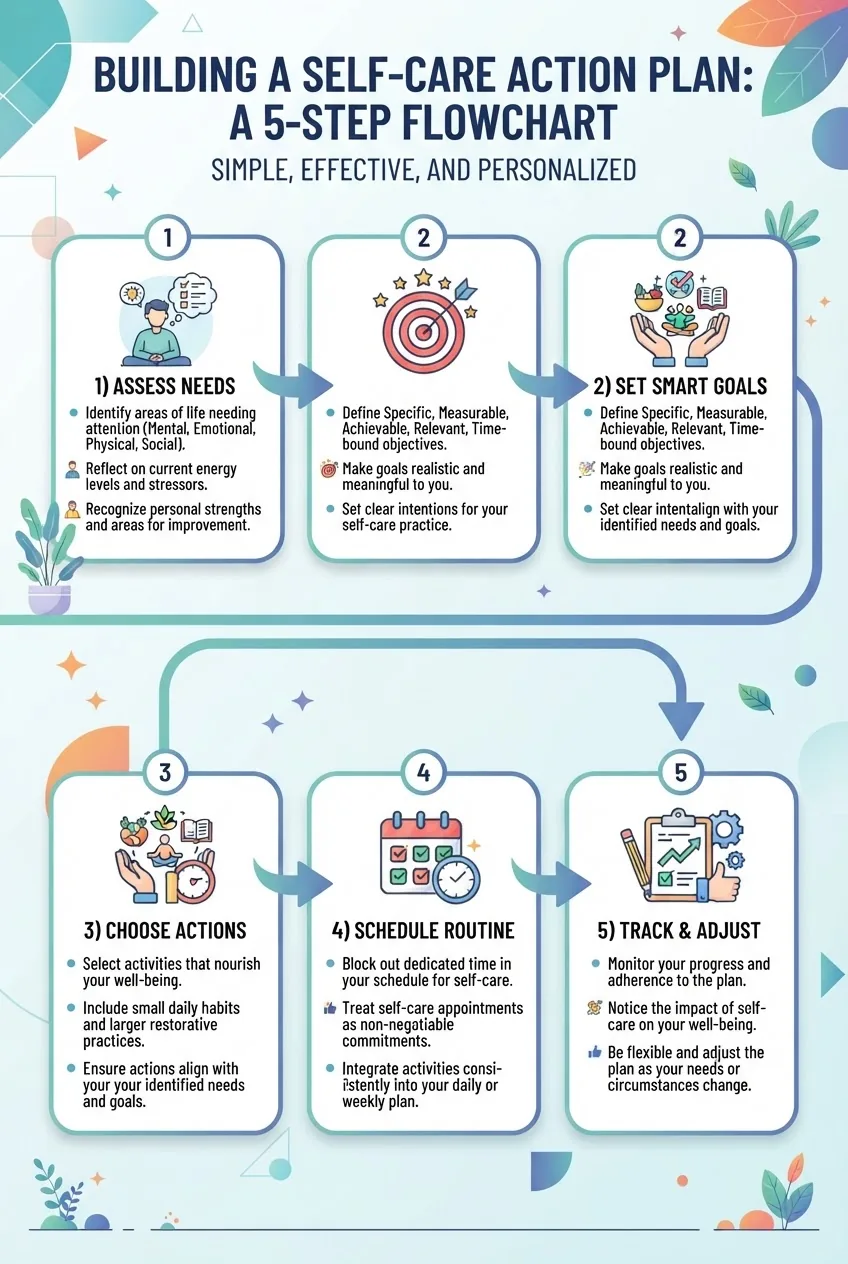
- Map your day and anchor one habit to an existing routine (10–20 minutes). Choose a reliable daily anchor (e.g., making coffee, brushing teeth). Attach a small habit: after I make coffee, I will do 3 minutes of deep breathing. Anchoring increases cue-response reliability. Example anchor: “After I switch on my laptop at 09:00, I will stand and stretch for 2 minutes.”
- Schedule 90–180 minutes of self care weekly and block it now (10 minutes). Use your calendar and treat these slots like appointments. Start small: 90 minutes/week in Week 1 (five 18-minute micro-sessions or three 30-minute longer sessions). Increase by 30-minute increments every two weeks as your schedule allows.
- Design a simple daily routine template (5–10 minutes to create; 5 minutes to execute each day). Format: Morning (6–15 min), Midday (10–25 min), Evening (10–20 min). Example: Morning 6-minute breath, Midday 20-minute walk, Evening 10-minute reflection/journal.
- Choose 2–3 concrete action strategies per goal (15–30 minutes). Strategies should include frequency, duration and measurement. Example for sleep: 1) No screens 30 minutes before bed; 2) Fixed bedtime 22:30; 3) 6-minute breathing at 22:20. For stress: 1) 3-minute diaphragmatic breathing twice daily; 2) Weekly 60-minute hobby slot; 3) Cognitive restructuring practice twice weekly using a worksheet.
- Set specific thresholds and feedback loops (10 minutes). Define success thresholds: e.g., “If sleep falls under 6 hours on three nights in a week, reduce evening activity and extend wind-down to 45 minutes.” Build automatic feedback: evening mood score below 4 triggers a shorter relaxation practice the next morning.
- Choose tracking tools and input frequency (10 minutes). Options: paper journal nightly, Daylio app entries twice daily, or Google Sheets with daily checkboxes. If you prefer wearables, set sleep tracking to auto-log and sync weekly. For most people, daily brief logging (20–45 seconds) yields enough data without burnout.
- Plan weekly reviews and monthly adjustments (10 minutes/week; 30 minutes/month). Weekly: 8–15 minutes to check adherence and mood trends. Monthly: 30–45 minutes to evaluate milestones and adjust difficulty. Add these reviews to your calendar now.
- Create a backup and flexibility policy (5–10 minutes). Define what to do when life interrupts: if you miss two sessions in a row, reduce session length by 50% for one week rather than stopping. Build one micro-action that you can always do (2-minute breathing) to avoid stopping entirely.
- Include motivational reminders and habit rewards (5–10 minutes). Use immediate micro-rewards (a favourite tea after a practice) and longer rewards for milestones (a cinema trip after 30 consecutive days of action adherence). Tie rewards to values, not indulgence that undermines goals.
- Integrate gratitude and reflection intentionally (5–10 minutes/day or 2–3 times/week). Intentional gratitude improves resilience; include short exercises. For ideas on how to incorporate this, consider adding selected gratitude practices to include in your plan and these daily gratitude exercises.
- Use proven methods for immediate relief where appropriate (3–10 minutes actions). Keep a short toolkit (3 breathing techniques, a 7-minute physical routine, a grounding checklist). For reliable quick techniques, see trusted self care methods.
- Document everything in one place and create a simple visual weekly dashboard (30–60 minutes setup). Use a Notion template, printed worksheet, or Google Sheet. Include columns: date, action, completed Y/N, mood 1–10, notes. A dashboard helps you see trends and keeps decisions simple.
- Deploy one supportive app or worksheet now (15 minutes). Example: install Daylio, set three moods and the three actions you want to track, add a weekly reminder at 20:45. Or import a Notion self care template and map your SMART goals into it.
Practical tip—start with 10–15 minute daily commitments for the first two weeks to build habit confidence. If you want scheduling templates and daily routine examples, the daily self care routines resource offers ready-to-use patterns. To blend longer-term habit design, read about daily self care habits.
Transition: with an action plan scheduled and tools installed, you need tracking systems and review practices to ensure steady progress—covered next.
Implementing and Tracking Your Self Care Plan
Tracking turns intentions into measurable data. This section explains journaling, app tracking, simple metrics, and when to choose each method. Expect to spend 5–10 minutes daily logging and 8–15 minutes weekly reviewing.
Choose one primary tracker and one backup. The primary should be the method you will consistently use: a paper journal for tactile people or an app for those who prefer automation. For many users, a hybrid approach works best: automated sleep/step data plus a one-line daily mood entry.
Comparison of tracking methods
| Method | Best for | Pros / Cons |
|---|---|---|
| Paper journal | Reflection & emotional processing | + Low tech, high ownership. − Hard to aggregate data. |
| Habit app (Daylio/Streaks) | Simple checkboxes, streak motivation | + Automates reminders & streaks. − Limited nuance in notes. |
| Wearable + dashboard | Sleep, steps, biometrics | + Objective data. − Can be noisy and lead to over-reliance. |
| Spreadsheet / Notion | Custom metrics & trends | + Highly customisable. − Requires setup & review time. |
Choose metrics: keep them simple. Examples: session completion (Y/N), daily mood 1–10, sleep hours, minutes of activity, number of social contacts. Store weekly averages and plot them monthly to identify trends.
How to run a weekly review (8–15 minutes)
- Check completion percentage for each action (target: ≥60% in Week 1, ≥75% in Weeks 3–4).
- Compare average mood and sleep against last week; note any >1-point change.
- If completion <50% for two consecutive weeks, reduce frequency or duration by 50% rather than quitting.
- Record one insight and one adjustment for the coming week (e.g., change walk time from 12:30 to 18:00 for weather reasons).
Tool walkthrough (example): Daylio app (15 minutes to set up)
- Download and open Daylio; create an account and set your three mood levels and three custom activities (e.g., “Breathing”, “Walk”, “Journal”).
- Enable daily reminders at times matching your scheduled actions (e.g., 07:20, 12:30, 21:00).
- Log activities daily and export data weekly as CSV to a spreadsheet for trend analysis. Benefit: quick logging, streaks, and mood correlation without heavy note-taking.
Mini case study (realistic example)
Sara, a 34-year-old office worker, created a self care plan to improve sleep and reduce afternoon fatigue. She used a 30-question assessment, set two SMART goals (sleep 7–7.5 hours; 15-minute walk five days/week), and used a wearable plus Daylio for tracking. Over 8 weeks she increased average sleep by 35 minutes and moved from 3 afternoon slumps/week to 1. She achieved this by anchoring her walk to lunch and setting a 22:15 digital sunset. Key success factors: small, measurable steps and weekly reviews.
Transition: once you have tracking and reviews in place, you’ll face inevitable barriers. The next section offers troubleshooting strategies and motivation techniques to maintain momentum.
Overcoming Barriers to Maintaining Your Self Care Plan
Common challenges include motivation loss, time constraints, mental blocks, and life disruptions. Below are specific troubleshooting tactics and when to escalate support.
Barrier: Motivation loss
- Fix: Reduce daily targets to micro-actions for 7 days (e.g., 2-minute breathing). Use immediate rewards and public commitment (tell one friend).
- Motivational technique: visualize the 30-day improvement and log small wins; set one non-negotiable micro-routine to maintain identity (“I am someone who takes a 3-minute pause after lunch”).
Barrier: Time constraints
- Fix: Time-audit and swap passive activities for active self care (e.g., 15-minute phone commute listening to a guided breathing exercise). Use the 2-for-1 rule: combine social and physical goals (walk with a friend).
Barrier: Mental health symptoms (depression, anxiety)
If symptoms of depression or anxiety make action difficult, apply graded tasks: break tasks into the smallest possible steps (get out of bed, sit by the window, make a cup of water). For targeted strategies when depressive symptoms interfere, see this specialised resource self care for depression support. If you notice persistent or worsening symptoms, seek professional help (see ‘When to call a professional’ below).
Barrier: Perfectionism and all-or-nothing thinking
- Fix: Adopt a “minimum effective dose” rule — the smallest consistent action that preserves momentum (e.g., one 2-minute breathing session counts as a win on busy days).
Barrier: Unexpected life events
When disruptions occur (illness, family crisis), follow your flexibility policy: reduce duration to 50% and focus on micro-actions. Use your backup micro-action to maintain identity and routine continuity.
Trusted support and resources: when self-help isn’t enough, reputable websites and organisations provide guidance. For evidence-based mental health information consult the CDC on mental health (external) CDC mental health resources (source: government public health website). For curated self-help tools, see trusted self help resources.
Real-life troubleshooting scenario
Case: Mark had a 60% completion rate for his planned walks. Two weeks in, his workload doubled. He adjusted by moving walks to 10-minute micro-walks after every 90 minutes of work and tracked steps instead of full walks. He maintained a 50% completion rate during the peak and returned to full sessions after three weeks. Lesson: plan for dose reduction and alternative forms of the same goal.
Transition: to show how goals and actions look in practice across domains, the next large section offers annotated examples you can adapt.
Examples of Self Care Goals and Action Strategies
Below are annotated examples across mental, physical, and emotional categories. Use them as templates: copy the SMART goal, choose matching process actions, and plug into your calendar. For additional activity ideas, including group options and women-focused activities, consider these resources: group self care activities, self care activities for women, and physical goal inspiration via health improvement strategies.

| Category | SMART Goal (example) | Action Strategy (concrete steps) |
|---|---|---|
| Mental Health | Improve daily mood from 4 to 6/10 within 8 weeks as measured by nightly mood log. | Daily: 6-minute morning breathing (after coffee). Weekly: 30-minute walk Tue/Thu. Tools: Daylio mood tracking. Thresholds: If mood <4 three nights, add daily 3-minute midday grounding. |
| Sleep | Increase average nightly sleep to 7:15 within 8 weeks, measured by sleep tracker. | Wind-down routine: 30-minute no-screens, 10-minute breathing at 22:15, fixed bedtime 22:30. Track nightly and adjust light exposure. If <6 hours three nights, reduce evening intensity for one week. |
| Physical | Walk 10,000 steps on at least 5 days/week for 12 weeks. | Daily: walk 20 minutes after lunch (counts ~2,500 steps). Add 3×10-minute walking bursts. Tools: phone steps tracker; weekly step summary. If busy week, switch to 15-minute high-intensity intervals to maintain exertion. |
| Emotional Regulation | Reduce peak anxiety episodes from weekly to fortnightly in 12 weeks, measured by journaling frequency and intensity. | Practice naming emotions for 5 minutes nightly, use CBT worksheet twice weekly, and apply a 4-4-8 breathing technique during spikes. Keep a short ‘calm kit’ checklist. |
| Social / Relational | Attend two social events per month for 3 months and report satisfaction 1–5 after each. | Plan events at start of month in calendar, invite one contact per week, and use brief phone calls (15 minutes) when time is limited. If turnout low, try small-group options from the group self care activities. |
| Work-Life Balance | Reduce evening work from average 90 minutes to 30 minutes, 80% of weekdays, over 6 weeks. | Enforce digital sunset at 20:30, set an auto-away calendar rule after 17:30, and move one work task to 10:00–11:00 slot. Track via calendar logs weekly. |
Notes on tailoring: each example includes a measurement method (mood log, tracker, attendance). Adjust thresholds to your starting baseline and life demands. For more structured lists of activities tailored to women, groups, and daily formats, see these targeted guides: self care activities for women, group self care activities.
Transition: now verify your work with a final set of implementation checks and know when to escalate to a professional.
Conclusion and Encouragement for Personalised Self Care Planning
You now have a structured path: assess needs, convert priorities into SMART self care goals, build a concrete self care action plan, and use simple tracking + weekly reviews to iterate. Personalisation and flexibility matter: treat the plan as a living document you update every 30–90 days.
Remember: results vary and professional consultation is advised for clinical mental or physical health issues. Use small wins to build momentum, keep a micro-action for crisis days, and apply compassion to setbacks. For proven approaches and deeper strategy libraries, consider reviewing these proven self care strategies.
Common mistakes and how to avoid them
I’ve seen many people try to change everything at once and then stop after a week. That happened to me early on — I scheduled daily 60-minute routines and burnt out within 10 days. The fix: start with a 10–15 minute daily commitment and a clear 30-day minimum. Another mistake I observed is tracking too many metrics; it creates analysis paralysis. Choose 2–3 simple indicators and focus on trends. Finally, I’ve noticed people drop routine when travel or illness strikes; set a clear flexibility rule (50% dose for disruptions) to maintain identity and continuity.
Final checklist
- Completed 30-question wellness assessment and identified 3 priority domains.
- Defined 1 SMART outcome goal per domain and 2–3 process goals for each.
- Scheduled 90–180 minutes weekly of self care in calendar and set weekly review time.
- Selected primary tracking method (app/journal/wearable) and set reminders.
- Created a flexibility rule for missed sessions and one micro-action for crisis days.
- Installed at least one app or worksheet and completed initial 7-day logging.
When to call a professional
If you experience persistent worsening of mood, suicidal thoughts, severe anxiety, or physical symptoms that don’t improve with self care, contact a mental health professional or GP. If you have a diagnosed medical condition, consult your treating clinician before changing exercise or sleep medications. Self care complements but does not replace professional treatment.