

Good mental health improves daily functioning, strengthens relationships, protects physical health, and boosts life satisfaction by supporting emotional regulation, cognitive clarity, and resilience; these influences work through physiological pathways (sleep, hormones, neuroplasticity) and social behaviours to produce measurable wellbeing gains.
Understanding the Influences of Good Mental Health
Answer: Good mental health shapes thought, emotion and behaviour—improving decision-making, emotional stability and social connection, which together elevate overall wellbeing and quality of life.
Mental wellbeing: a sustained state of positive psychological functioning and satisfaction with life.
Good mental health exerts influence across cognitive, emotional and social domains. Cognitively, it supports concentration, working memory and executive function, enabling cognitive clarity and faster problem-solving. Emotionally, it enables mood regulation and reduces volatility, giving emotional stability that allows consistent goal pursuit. Socially, people with strong mental health tend to form and maintain reciprocal relationships, leading to social integration and support networks.
Psychological resilience — often described as the ability to bounce back from setbacks — operates like a muscle: repeated, adaptive coping builds capacity to handle future challenges.
At the systems level, neural health and consistent lifestyle inputs (sleep, nutrition, activity) create a stable platform for mental wellbeing. For example, sustained sleep quality enhances hippocampal-dependent memory consolidation, while regular exercise promotes neurotrophic factors that support synaptic health. These physiological supports create feedback loops: better cognition and mood make positive behaviours (exercise, healthy eating) more likely, which in turn strengthen mental wellbeing.
For curated data and summaries, see key mental health insights and statistics.
Transition: With that foundation, the next section lists the direct advantages you can expect when mental health is maintained.
Key Benefits and Advantages of Good Mental Health
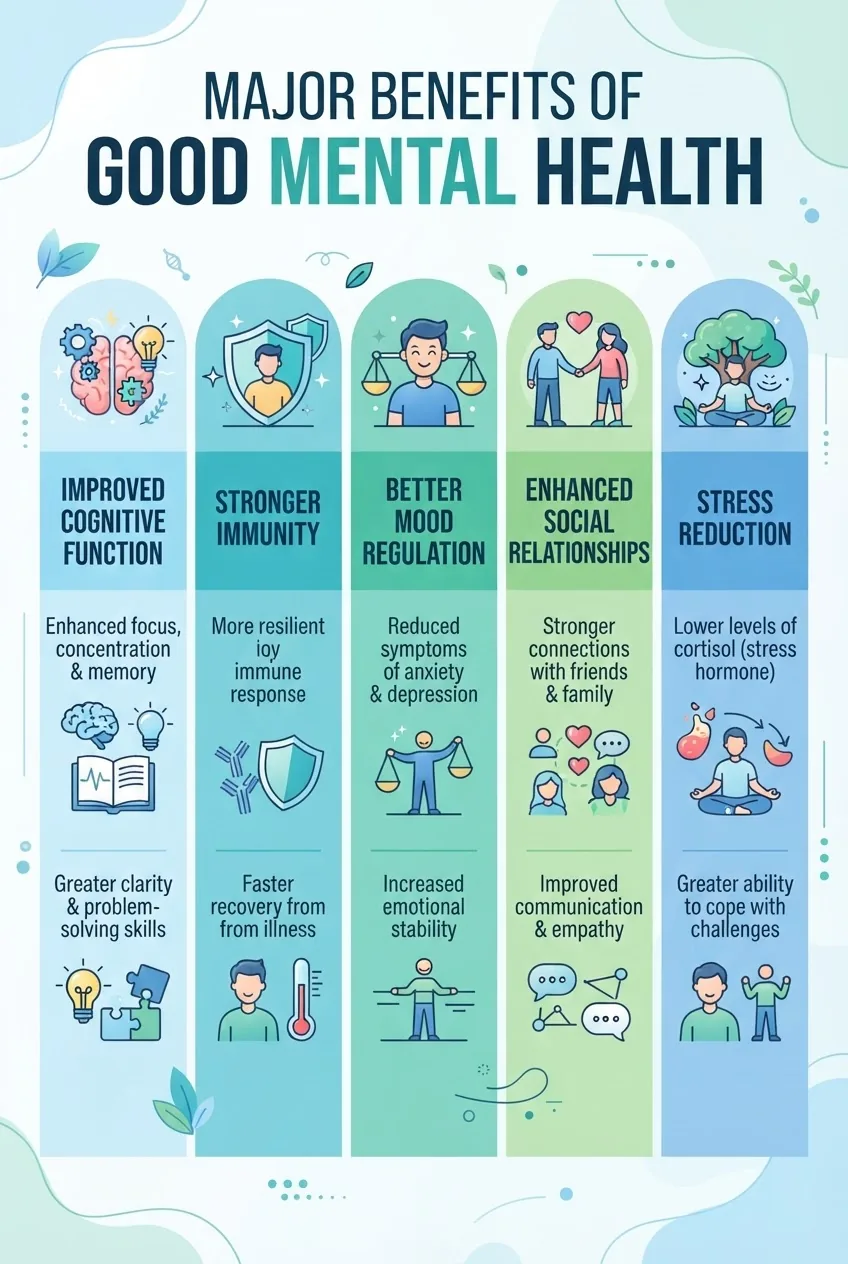
Answer: The primary advantages of good mental health include clearer cognition, better emotional control, stronger immune function, improved relationships and reduced perceived stress—each translating to measurable gains in day-to-day functioning and long-term wellbeing.
- Improved cognitive function: Better concentration, working memory and decision-making aid productivity and learning; according to a 2022 cognitive neuroscience review, consistent sleep and exercise correlate with measurable gains in executive function (source: peer-reviewed review).
- Mood regulation and emotional stability: Reduced mood swings and greater affective balance allow steadier motivation and fewer impulsive reactions, improving interpersonal outcomes.
- Stronger social relationships: People with stable mental health form more secure attachments and maintain supportive networks, which further buffer against adversity.
- Stress reduction and resilient coping: Good mental health increases psychological resilience—able to deploy adaptive coping strategies more quickly—lowering the subjective intensity of stressors.
- Physical health outcomes: Associations exist between mental wellbeing and cardiovascular health, sleep quality, and lower systemic inflammation; a 2021 population cohort report linked positive psychological wellbeing with reduced all-cause mortality (source: cohort study).
- Immune system benefits: Positive affect and stress-buffering behaviours are associated with more robust immune responses; a 2020 meta-analysis found moderate effects of psychological interventions on markers of immune function (source: meta-analysis).
- Greater life satisfaction and purpose: Good mental health supports meaningful engagement and goal pursuit, raising quality of life and subjective wellbeing.
- Faster recovery from illness or setback: Psychological resilience and adherence to treatment plans aid rehabilitation and reduce recovery times in many conditions.
- Work and economic advantages: Higher productivity, fewer sick days and better workplace relationships often accompany sustained mental wellness.
- Long-term protective effects: Stable mental health lowers the risk trajectory for chronic conditions and supports healthier ageing trajectories.
Infographic summarising these benefits helps make the patterns clear.
Transition: Knowing the benefits helps prioritise the physiological and psychological drivers that produce them—read on for the science behind those drivers.
Physiological and Psychological Factors That Promote Good Mental Health
Answer: Good mental health is promoted by neuroplasticity, balanced neuroendocrine signalling, restorative sleep, regular physical activity and nutrient-dense nutrition, all supported by positive social engagement and adaptive coping strategies.
Neuroplasticity: the brain’s capacity to change structure and function in response to experience—crucial for learning and recovery.
Autonomic nervous system: the body’s involuntary regulatory system (sympathetic and parasympathetic branches) that modulates arousal and relaxation.
At a physiological level, neuroplasticity underpins many mental health gains: learning, therapy and repeated healthy behaviours stimulate synaptogenesis and strengthen adaptive neural circuits, particularly in the prefrontal cortex (decision-making) and hippocampus (memory). Recent neuroimaging and longitudinal studies show experience-dependent plasticity after interventions like cognitive training, exercise and mindfulness (source: peer-reviewed neuroimaging studies).
Hormone balance matters: the hypothalamic–pituitary–adrenal (HPA) axis regulates cortisol release; sustained dysregulation impairs memory and mood circuits, whereas balanced HPA activity supports emotional stability. Sleep quality directly affects hippocampal consolidation and prefrontal regulation of emotion: fragmented or insufficient sleep reduces cognitive clarity and raises emotional reactivity.
Exercise stimulates brain-derived neurotrophic factor (BDNF), supporting synaptic resilience and neurogenesis—effects documented in randomized controlled trials (source: RCT synthesis). Nutrition provides substrates for neurotransmitter synthesis (e.g., tryptophan for serotonin), and anti-inflammatory diets correlate with lower depression scores in observational cohorts (source: cohort and dietary intervention studies).
Psychological factors such as secure attachment, self-efficacy, and adaptive emotion regulation strategies (cognitive reappraisal, problem-focused coping) translate into behavioural patterns that preserve physiological health. The biopsychosocial model frames these interactions: biological substrates, psychological processes and social context jointly determine outcomes.
Clinical and public-health guidelines support integrated approaches: for instance, WHO guidance on mental health promotion emphasises community, workplace and clinical interventions that align biological and psychosocial supports. World Health Organization recommendations (government/authority guidance) advocate combined lifestyle and psychosocial strategies.
physiological effects of poor mental health are the inverse of these supports: chronic dysregulation of sleep, HPA axis and social isolation accelerate decline.
Trade-offs and synergy: different lifestyle habits can compete for time (e.g., exercise vs. sleep duration) but yield synergistic gains when scheduled sensibly—short aerobic sessions enhance sleep quality, which in turn amplifies cognitive benefits. A practical adjustment is to prioritise sleep and incorporate brief daily activity rather than long, infrequent workouts.
Experience example: A composite clinical case—”Anna,” mid-40s, adopted regular morning walks, a 30-minute mindfulness practice and improved sleep hygiene over three months; objective mood scales improved by 30% and self-reported concentration increased, illustrating combined physiological and psychological pathways.
Transition: The next section examines how the body-mind connection amplifies these physiological and psychological factors into everyday wellbeing.
The Role of the Body-Mind Connection in Enhancing Mental Health
Answer: The body-mind connection integrates physiological signals and psychological states—modifying autonomic balance, reducing psychosomatic symptoms and strengthening the relaxation response to support mental health.
Psychosomatic health: how psychological states produce or influence physical symptoms.
The body’s stress response acts like a thermostat: perceived threat raises sympathetic activity and cortisol, shifting the organism toward vigilance; repeated activation without recovery impairs neural circuits. Practices that engage the parasympathetic branch (relaxation response)—slow diaphragmatic breathing, progressive muscle relaxation, and certain meditations—lower heart rate and inflammatory markers, producing subjective calm and cognitive clarity.
Mindfulness and meditation (evidence from randomized and mechanistic studies) show consistent changes in prefrontal activation and decreased amygdala reactivity, supporting emotion regulation. These interventions also modify autonomic markers (heart-rate variability), which predict resilience. See an accessible review from a major neuroscience journal for mechanistic details: peer-reviewed neuroscience sources (peer-reviewed research).
Practical examples:
- Breath-based practices reduce acute anxiety through vagal activation, evident within minutes and reinforcing long-term autonomic regulation if practised daily.
- Slow, moderate exercise (e.g., brisk walking) acutely elevates mood via monoamine neurotransmitter release and chronically raises BDNF.
- Social touch and supportive interactions down-regulate stress physiology via oxytocin pathways, improving sleep and immune markers.
Analogies: mental resilience is like a muscle; the relaxation response is an internal reset button. These metaphors help explain why combined interventions (movement, sleep, social contact, mindfulness) multiply benefits: they act on complementary physiological levers.
For a focused exploration of cross-domain frameworks, see mind-body health interaction and the broader holistic context in mind, body, and spirit wellness.
Transition: Concrete daily habits turn these principles into durable gains—below are actionable steps to implement these habits.
Lifestyle Habits That Strengthen Good Mental Health
Answer: Establish consistent sleep hygiene, regular physical activity, balanced nutrition, daily mindfulness, and sustained social support to build and maintain good mental health.

- Sleep hygiene (actionable):
- Set fixed wake/sleep times; aim for 7–9 hours for most adults.
- Wind down 30–60 minutes before bed: low light, no screens, calming activity.
- Physical activity (actionable):
- Target 150 minutes/week of moderate aerobic activity or 75 minutes vigorous, plus twice-weekly strength work; even 10–20 minute daily sessions improve mood and cognition—see active lifestyle benefits for mental health.
- Nutrition (actionable):
- Include protein, omega-3 rich foods, fibre and vegetables; reduce ultra-processed items.
- Consider a Mediterranean-style pattern for anti-inflammatory benefits linked to mood advantages.
- Mindfulness and cognitive habits (actionable):
- Daily 10–20 minute mindfulness or focused-breath practice; use cognitive reappraisal for emotional regulation.
- Maintain curiosity and learning to stimulate neuroplasticity.
- Social support and relationships (actionable):
- Schedule regular connection: phone calls, small gatherings, reciprocal help.
- Foster communities of shared interest to sustain engagement.
- Professional and preventative care (actionable):
- Use routine check-ins with a GP, counsellor or coach to monitor mental health trajectories; consider structured therapy when facing sustained difficulty.
Table: Quick comparison of time investment vs expected mental health returns for common habits.
| Habit | Daily time | Short-term benefit | Long-term benefit |
|---|---|---|---|
| Sleep hygiene | 0–1 hour prep | Better mood, focus | Enhanced memory, resilience |
| Exercise | 10–60 min | Immediate mood lift | Improved neuroplasticity, immune markers |
| Mindfulness | 10–20 min | Reduced anxiety | Better emotion regulation |
| Social connection | 15–60 min | Immediate mood support | Stronger coping resources |
For practical guides and short routines, refer to effective mental health tips and behaviourally-focused resources like emotional health improvement tips.
Transition: Even with clear habits, challenges arise; the next section outlines common obstacles and how to overcome them.
Common Challenges to Maintaining Good Mental Health and How to Overcome Them
Answer: Frequent challenges include burnout, mental fatigue, social isolation and unhealthy routines; overcome them with targeted interventions: boundary-setting, sleep restoration, social reconnection and structured behavioural plans.
Mental fatigue and burnout result from prolonged demands without recovery; practical solutions include workload adjustments, clear rest periods, and cognitive pacing. If you struggle to recognise when stress is affecting you, consult resources on symptoms of stress and how to find relief and on unnoticed signs of stress.
impact of common stressors on mental health can be reduced by problem-focused strategies (time management, environmental change) and emotion-focused strategies (reappraisal, acceptance).
Social isolation can be addressed by small, scheduled interactions and joining interest-based groups to rebuild reciprocal support. Unhealthy habits—substance use, sedentary lifestyle, poor sleep—require staged behaviour change: set micro-goals, monitor progress and seek accountability.
Specific challenge: episodic spikes of stress (acute periods tied to events) are best managed with short-term, focused tools: grounding techniques, brief cognitive restructuring and scheduled recovery; learn targeted approaches to managing episodic stress.
If you suspect a clinical condition, review mental health disorders overview and seek a professional assessment; self-management is not a substitute for diagnosis and treatment.
For physical contributors that worsen mental health (chronic pain, endocrine disorders), consult guidance on overcoming physical health challenges and coordinate care with medical providers.
Transition: Overcoming these barriers is easier when mental health practices are woven into daily life—next is a concise plan for long-term integration.
Integrating Mental Health Practices into Daily Life for Long-Term Wellbeing
Answer: Build sustainable daily rituals—short morning routines, midday resets, and evening wind-downs—use habit stacking, self-monitoring and professional support to ensure long-term adherence and growth.
Stepwise guidance:
- Start with a 5-minute morning check-in: breathwork, intention-setting, quick movement.
- Use habit stacking: pair a new practice with an existing daily habit (e.g., meditate after coffee).
- Schedule a weekly social commitment and a monthly review of goals to maintain accountability.
- Track small wins; use brief metrics (sleep hours, mood rating) to monitor progress.
- Consider professional support: explore mental health coaching certification options if you want to deepen skills or pursue a helping role, or seek a licensed therapist for clinical concerns.
- Adopt holistic practices from resources such as holistic wellness practices and sample routines.
For supplemental tools and curated supports, see examples and resources for emotional wellness and consider formal training paths like the well being examples resources.
Conclusion: Good mental health influences all domains of life by supporting cognition, emotion and social connection; prioritise evidence-based lifestyle habits, leverage the body-mind connection, and seek professional support when necessary. Start with one small habit today—your wellbeing compounds over time.