
A holistic doctor is a licensed medical practitioner who treats the whole person—physical, mental, and social factors—using a patient-centered, integrative approach that combines evidence-informed conventional medicine with complementary therapies to promote prevention, long-term healing, and mind-body-spirit wellness.
Understanding What a Holistic Doctor Is
Answer: A holistic doctor is a medically trained clinician who prioritises whole-person assessment and combines conventional medicine with validated complementary approaches to support long-term wellness and prevention.
Term: Holistic medicine is an approach to healthcare that considers physical, emotional, social, environmental, and spiritual influences on health.
Holistic doctor meaning centers on treating people, not just diseases. Unlike some alternative providers who focus mainly on non-medical modalities, a holistic medicine practitioner with an MD, DO or comparable qualification integrates diagnostic testing, pharmaceuticals or surgery when appropriate with supportive therapies such as nutrition, mind‑body techniques and lifestyle medicine.
Authoritative definitions: The World Health Organization recognises traditional and complementary approaches within national health systems as part of broader health strategies — see WHO resources for context:
WHO on traditional, complementary and integrative medicine.
The U.S. National Center for Complementary and Integrative Health explains integrative health and how it complements conventional care:
NCCIH: Integrative Health.
Practical distinction: holistically trained medical doctors focus on evidence-informed integration—balancing safety, conventional treatments and selected natural/holistic remedies—to enhance outcomes while retaining medical oversight and continuity of care.
Transition: With that definition in place, the next section summarises the core principles that guide holistic health care and a holistic approach to health.
Core Principles of Holistic Medicine and Care
Answer: Core principles of holistic care include whole-person focus, patient-centered care, mind-body-spirit wellness, integrative care and prevention — applied through collaborative, individualized treatment plans.
Term: Holistic care meaning refers to healthcare that addresses the full range of factors affecting health rather than treating a single symptom or organ.
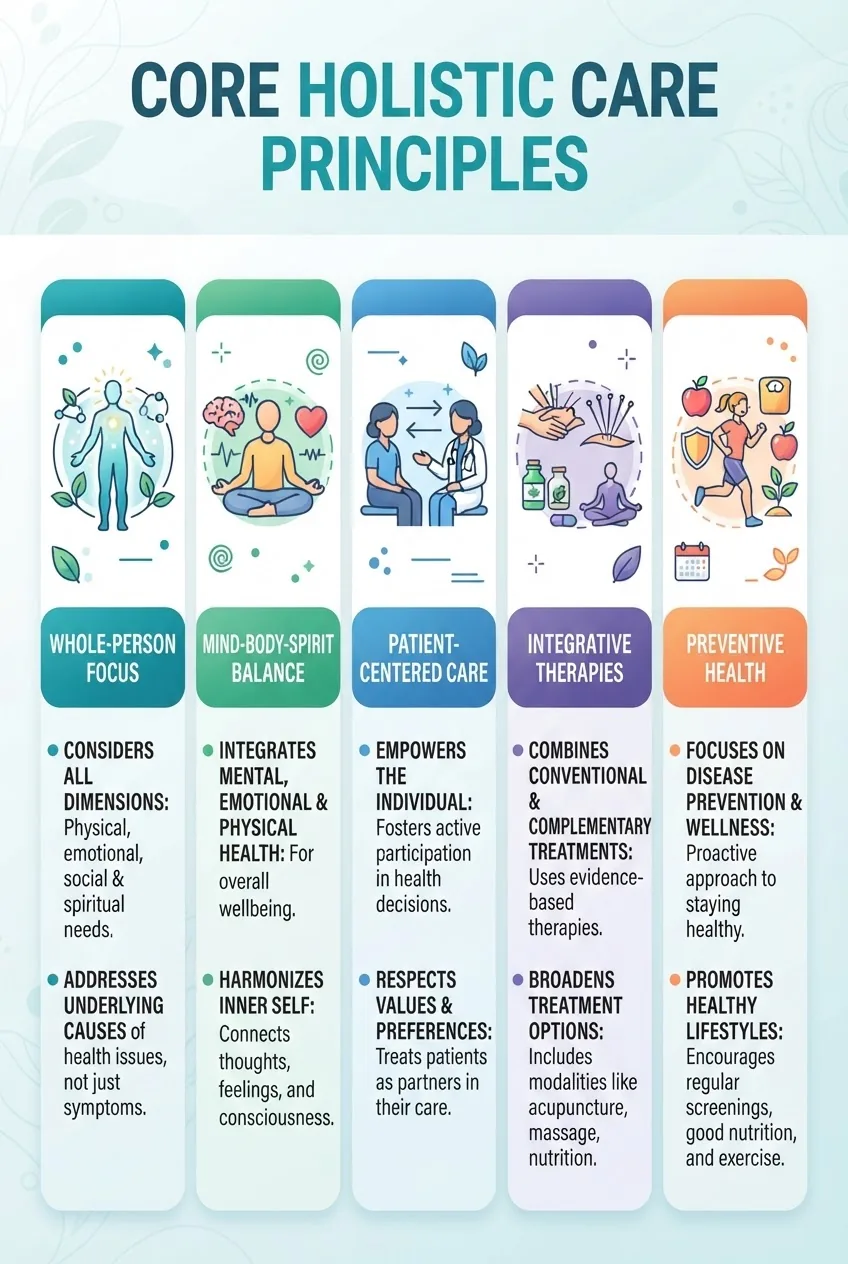
- Whole-person focus: evaluates biological, psychological, social, spiritual, and environmental factors together.
- Mind-body-spirit wellness: acknowledges mental health, stress regulation, sleep, and spiritual meaning as clinical variables.
- Patient-centered care: decisions built with the patient’s values, goals and lived experience at the centre.
- Integrated care: combines conventional treatments with validated complementary modalities when evidence and safety support it.
- Preventive and lifestyle emphasis: prioritises nutrition, physical activity, sleep, social connection, and risk reduction.
Further reading on how a holistic perspective defines health and wellbeing is available in our guide on the holistic view:
holistic view definition.
A holistic approach to health often uses the biopsychosocial model — a well-established framework that links biological disease processes with psychological state and social context — while extending to spiritual or existential factors where relevant. This combination helps clinicians plan interventions that address root causes and resilience, not just immediate symptoms.
Core principles, distilled:
- Comprehensive assessment (medical history, lifestyle, environment, mental health)
- Collaborative goal setting (patient values & measurable outcomes)
- Layered interventions (pharmacology, therapy, nutrition, movement, mind‑body work)
- Evidence-informed selection of natural/holistic remedies alongside conventional care
- Ongoing monitoring and preventive maintenance
Transition: Knowing the principles, next we examine the practical scope — what holistic doctors actually do day-to-day.
What Does a Holistic Doctor Do? Scope and Practices
Answer: A holistic doctor assesses whole-person health, diagnoses using conventional medicine, prescribes evidence-informed treatments, and layers complementary therapies—such as nutrition, mind‑body interventions, and targeted natural remedies—into individualized care plans focused on prevention and functional recovery.
Term: Holistic health care describes clinical services that intentionally integrate multiple modalities to address full-spectrum health needs.

Daily activities and scope:
- Comprehensive intake and diagnosis: extended appointments to capture medical history, lifestyle, social determinants, sleep, stressors, and spiritual or cultural factors.
- Functional assessment: uses lab testing, imaging and validated screening tools to identify metabolic, hormonal, inflammatory, or nutritional contributors to symptoms.
- Individualised treatment planning: creates tiered plans combining conventional medical care (medications, procedures) with complementary interventions tailored to the patient’s goals.
- Mind‑body interventions: prescribes evidence-based techniques such as mindfulness-based stress reduction, cognitive-behavioural strategies, biofeedback or guided imagery.
- Nutrition and lifestyle medicine: structured dietary plans, sleep optimization, movement prescriptions, and behaviour-change coaching.
- Targeted use of natural/holistic remedies: botanical medicine, nutraceuticals, and non-pharmacologic modalities where safety and evidence allow.
- Referral and coordination: arranges for allied therapies (acupuncture, physiotherapy, counselling) and communicates with specialists to integrate care.
- Long-term prevention and wellness: ongoing monitoring, risk reduction strategies, and patient education to support resilience.
Examples of typical patient journeys:
- Chronic pain case: A patient with low back pain receives diagnostic imaging and medication as needed, plus a structured plan including physiotherapy, acupuncture, targeted supplements, and a graded exercise program. Progress is tracked with functional outcome scores.
- Mental health and insomnia: Combined CBT-I (cognitive behavioural therapy for insomnia), sleep hygiene coaching, selective herbal support, and review of medications that may disturb sleep, coordinated with a psychiatrist if medication adjustments are needed.
- Metabolic syndrome: comprehensive lab review, personalised nutrition plan, supervised exercise prescription, micronutrient correction, and staged medication initiation if lifestyle measures are insufficient.
What do holistic practitioners focus on that conventional clinics sometimes miss? They explicitly probe lifestyle, relationships, work stress, environmental exposures and meaning in life, and translate that into measurable treatment steps. This is why some patients describe holistic healing meaning as restoring balance across life domains rather than only reducing a symptom.
Scope limitations and integration: holistic doctors do not universally reject conventional treatments. Instead, integrative care weighs the evidence, safety profile and patient preference to combine approaches. For specialised surgeries or oncologic treatments, holistic doctors will coordinate with relevant specialists rather than replace those services.
Specialized focuses within holistic medicine include integrative oncology, functional medicine, integrative cardiology and holistic mental health; for a deeper look at mental health applications see
holistic mental health care.
Transition: To provide that scope of work safely, holistic doctors follow defined education and training pathways—detailed next.
Qualifications and Training of Holistic Doctors
Answer: Holistic doctors usually hold standard medical degrees (MD, DO, MBBS) and then pursue additional training in integrative or holistic medicine through fellowships, continuing medical education, certificate programs and supervised clinical practice.
Term: Training and certification pathways for holistic doctors include formal medical degrees, accredited residencies, plus post‑graduate integrative medicine fellowships and certified continuing education.
Education stages:
| Stage | Typical credential | Purpose |
|---|---|---|
| Undergraduate | Bachelor’s prerequisites | Prepare for medical school |
| Medical school | MD / DO / MBBS | Licensure and core clinical training |
| Residency / Fellowship | Specialty training; optional integrative fellowships | Clinical competence in specialty care and integrative methods |
| Postgraduate certificates | Accredited courses in integrative medicine, nutrition, or lifestyle medicine | Structured competency in complementary therapies |
Common certification pathways and examples:
- Fellowships or certificate programs in integrative medicine (hospital-affiliated or university programs)
- Postgraduate diplomas in lifestyle medicine or functional medicine courses
- Training in specific modalities (e.g., acupuncture certification, herbal medicine courses) that meet local regulatory standards
Accreditation and regulation vary by country and state. Official professional groups and accredited programs provide standards; for example, university-based integrative medicine centres often publish curricula and supervised clinical hours. For professionals exploring complementary career paths, see our review of
health coach certification programs
and information on
holistic wellness coach training.
Ongoing learning: reputable holistic doctors participate in continuing medical education, peer review, and outcome tracking. Many belong to integrative medicine societies that set practice standards; consult these bodies when assessing practitioner qualifications.
Comparison table — what each credential gives you:
| Credential | Clinical scope | Typical patient services |
|---|---|---|
| MD/DO | Full medical practice | Diagnosis, medications, procedures, referrals |
| Integrative medicine fellowship | Enhanced integrative competence | Blended conventional and complementary plans |
| Certificate in nutrition/lifestyle | Specialised counselling | Dietary plans, behaviour change strategies |
For those pursuing complementary careers, see the detailed guide to certification for holistic nutrition and coaching:
holistic nutrition counseling,
and program lists such as
holistic medicine degree programs and accredited schools.
Transition: With training clarified, next is a practical list of common remedies and treatments used by holistic doctors.
Common Holistic Remedies and Treatments Used by Holistic Doctors
Answer: Holistic doctors commonly use a mix of nutritional plans, mind‑body therapies, physical modalities, botanicals, supplements, and evidence-selected procedures to complement conventional care and support recovery and prevention.
Term: Natural/holistic remedies are therapies derived from nutrition, botanicals, physical methods or mind‑body techniques used to support health alongside conventional treatments.
For an extended overview of modalities and how they’re applied in practice, see our pillar guide to
holistic healing methods.
- Nutrition therapy: personalised anti‑inflammatory or metabolic diets, elimination diets for food sensitivities, and micronutrient repletion to address deficiencies.
- Mind‑body techniques: guided meditation, mindfulness, CBT, biofeedback and stress-reduction protocols for pain, anxiety and chronic disease management.
- Acupuncture and manual therapies: for pain, headache and musculoskeletal conditions when evidence and patient preference support use.
- Herbal medicine and botanicals: targeted plant-based extracts for symptom support, used with attention to interactions with prescription drugs.
- Nutraceuticals and supplements: omega‑3s, vitamin D, magnesium, probiotics and other supplements selected based on labs and clinical need.
- Behavioural medicine and lifestyle coaching: sleep optimisation, exercise prescriptions, smoking cessation and stress management plans.
- Detoxification and environmental health measures: exposure reduction, targeted testing and remediation strategies for identified toxins.
- Functional and integrative procedures: IV nutrient therapies, prolotherapy or platelet-rich plasma in select clinics where evidence supports use.
- Spiritual or existential support: counselling, pastoral care or meaning-centred therapies as part of whole-person care.
- Community and social prescribing: linking patients to local resources, group programmes and social supports.
Nutrition is a frequent cornerstone; to explore credentialing in this area, see
holistic nutrition counseling.
Safety note: holistic remedies should be evaluated for interactions with medications, contraindications in pregnancy or organ disease, and quality of sourcing. Holistic doctors typically apply evidence hierarchies when choosing natural remedies and avoid unproven or dangerous practices.
Transition: The next section examines what research and clinical experience say about the benefits and effectiveness of these approaches.
Benefits and Effectiveness of Holistic Health Care
Answer: Holistic health care can improve patient satisfaction, symptom management and certain clinical outcomes when evidence-based complementary therapies are integrated with conventional medicine, though effectiveness varies by condition and intervention.
Term: Evidence and effectiveness of holistic medicine refers to the scientific studies that test outcomes from integrative practices compared to standard care or placebo.
High-level evidence: systematic reviews and meta-analyses show benefit for certain integrative interventions. For example, mindfulness and cognitive-based therapies reduce anxiety and depression symptoms (see peer-reviewed reviews). Acupuncture has supportive evidence for some pain conditions. A range of lifestyle interventions (nutrition, exercise, sleep) show consistent benefit for cardiometabolic risk.
Representative references:
peer-reviewed integrative medicine review (PMC) summarises outcomes across modalities; and the WHO provides global oversight of traditional and complementary approaches:
WHO: traditional/complementary medicine.
Evidence levels and limitations:
- Strong evidence: lifestyle medicine (diet, exercise) for prevention and management of type 2 diabetes and cardiovascular disease (According to a 2023 industry report summarising clinical trials and guideline updates).
- Moderate evidence: mindfulness-based interventions for anxiety, depression and chronic pain (According to a 2021 systematic review published in peer-reviewed journals).
- Variable evidence: herbal medicines and nutraceuticals where high-quality RCTs are fewer and product heterogeneity complicates conclusions.
- Inconclusive or low-quality evidence: some detox or anti-aging claims lack rigorous trials and should be approached cautiously.
Case summary (real-world example): A 52-year-old with chronic migraine saw a holistic doctor who combined guideline-based preventive medication, lifestyle changes (sleep hygiene, trigger management), acupuncture sessions and magnesium supplementation. Over six months the patient reported 60% fewer headache days and improved quality of life scores — outcome tracking supported iterative plan adjustments.
Patient-centred benefits commonly reported:
- Greater patient engagement and empowerment through collaborative goal setting
- Improved symptom control for chronic pain and mood disorders when multimodal strategies are used
- Enhanced preventive care and earlier lifestyle changes
- Higher satisfaction and perceived continuity of care
Critical perspective: does holistic medicine work for every condition? No. Efficacy depends on the condition, intervention quality, practitioner skill and adherence. Holistic care is best understood as complementary and integrative—intended to augment, not replace, evidence-based conventional care. This is why transparent outcome measurement and shared decision-making are central to trustworthy practice.
For a focused review of advantages, see our companion analysis:
benefits of holistic medicine.
Transition: If the approach and benefits align with your goals, the next section explains practical steps to choose and work with a holistic doctor.
How to Choose and Work with a Holistic Doctor
Answer: Choose a holistic doctor by verifying medical credentials, asking about integrative training and outcome tracking, confirming collaborative referrals, and ensuring their care philosophy matches your goals; during care expect comprehensive intake, clear shared goals, and measurable follow-up.
Term: Patient-centered care places the patient’s goals, preferences and context at the centre of clinical decisions.
- Verify credentials: confirm a medical degree (MD/DO/MBBS) and relevant integrative training or society membership.
- Ask about scope: confirm which complementary therapies the doctor personally provides versus those referred to allied practitioners.
- Review outcomes: ask how progress is tracked (symptom scores, labs, functional measures) and how treatment success is defined.
- Discuss safety: request information on interactions, contraindications and emergency plans.
- Confirm collaboration: ensure the doctor will coordinate with your other healthcare providers and specialists.
- Logistics: review appointment length, costs, insurance coverage and follow-up structure.
Practical tips for the first appointment: bring a full medication list, relevant test results, and a concise summary of goals. Expect a longer visit focused on history, lifestyle mapping and co-created goals rather than quick symptom fixes.
To learn more about finding providers and insurance logistics, consult our guide on
finding alternative practitioners,
and read why patient-centered holistic care matters.
Insurance and cost note: coverage varies widely; check insurer lists, itemised bills and whether the clinician bills as a conventional medical specialist for higher reimbursement. Many practices offer blended billing options and package pricing for multi-session programmes.
Conclusion: A holistic doctor combines medical training with whole-person thinking, evidence-informed complementary therapies, and a prevention-focused mindset to support sustained wellness. If you want coordinated care that addresses lifestyle, mental health, environment and medical needs together, a qualified holistic doctor can be a practical option—start by checking credentials, discussing evidence, and agreeing measurable goals. If you’re ready to explore care, book an initial consult and ask for outcome measures and referral pathways to ensure safe, integrated treatment.