By the end of this guide you will have a practical, step-by-step toolkit for how to reduce school stress — routines, mindfulness and yoga moves, breathing drills, and a study-plan you can use in 5–20 minutes per day. Estimated time to implement the basic plan: 2 weeks; skill level required: beginner to motivated intermediate student.
Before you start
- Tools: quiet corner, notebook or planner, smartphone with a timer, a yoga mat or towel.
- Materials: refillable water bottle, simple snacks (nuts, fruit), blue-light filter for evening use.
- Prerequisites: willingness to try 10–20 minutes of new habits daily, commitment to 2-week trial.
Understanding School Stress and Its Impact on Students
School-related stress is the pressure students feel from academic demands, social dynamics and future uncertainty. When we talk about how to reduce school stress, we’re addressing short-term triggers (like an upcoming exam) and chronic loads (ongoing heavy workload). Common causes include overloaded schedules, unclear expectations from teachers, perfectionism, social comparison and lack of sleep — imagine stress as adding weight to a backpack; a single heavy textbook is manageable, but when every book stacks up, movement becomes harder.

Real student scenarios:
- Case A — Year 11 student juggling three advanced subjects and extracurricular sport: stress spikes before assessment windows and mounts when sleep drops below 6 hours.
- Case B — First-year uni student experiencing performance stress after moving away from home; loneliness and poor time management amplify anxious thinking.
Impact on learning and wellbeing: high stress reduces working memory, increases exam anxiety, and raises the likelihood of missed classes or burnout. According to a 2024 government report on youth mental health (Australian Government Department of Health), rising academic pressure is a leading contributor to adolescent mental health problems in many regions; integrating small, consistent coping strategies reduces acute distress and improves academic performance over weeks.
Transition: With that context, the next section gives targeted, student-focused practices you can apply immediately.
Proven Stress Management Techniques for Students
Below are focused, actionable steps and routines — a toolbox of evidence-aligned practices for stress relief. I present them so you can mix-and-match: short micro-practices for in-class use and longer routines for after school. These are the best stress management techniques for students, explained with when to use each.
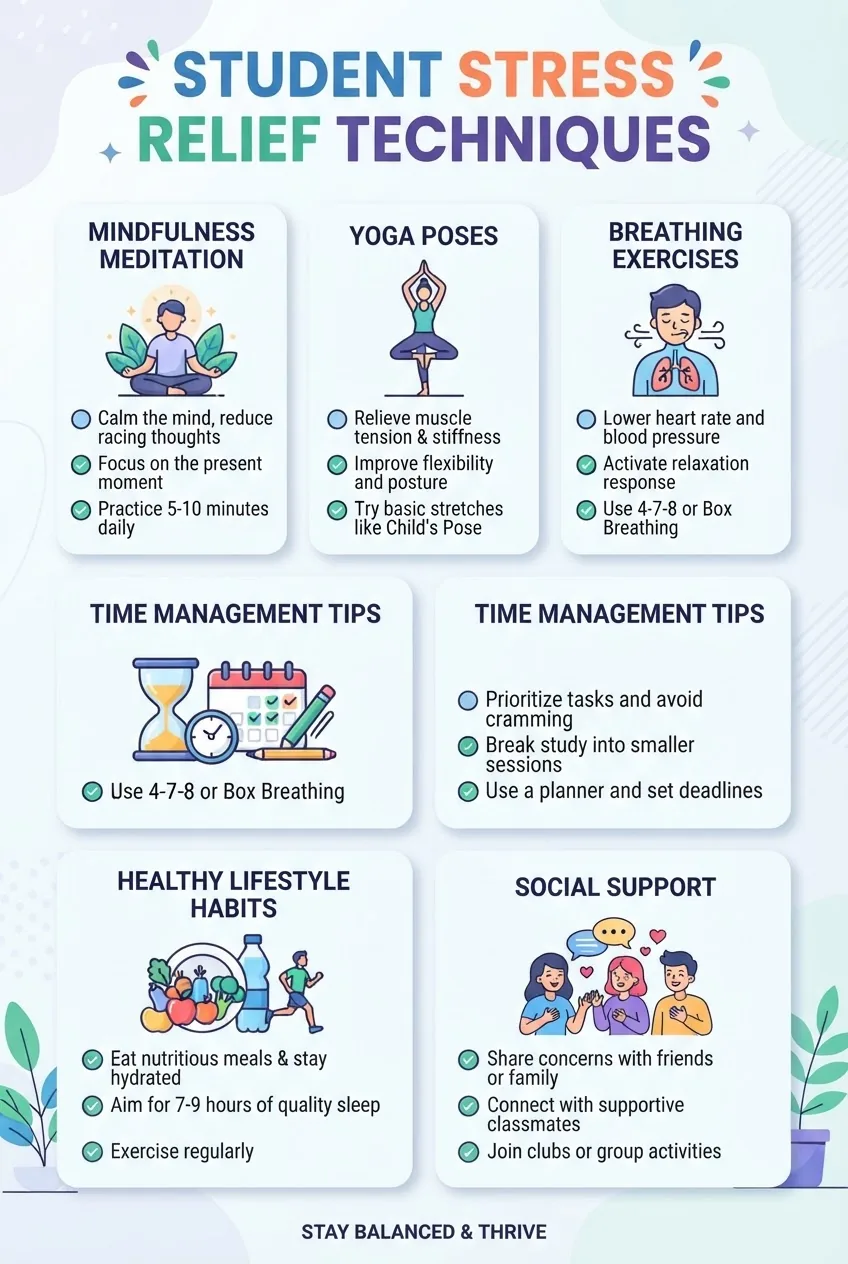
- Identify your top 3 stress triggers — Spend 20 minutes today listing the three situations that make you most anxious (e.g., tests, public speaking, parental expectations). For each trigger write one concrete behaviour to change (e.g., “Start study sessions 48 hours before deadline”). Track these for 7 days; noticing patterns gives control.
- Set up a daily 10–20 minute micro-routine — Pick a morning or evening slot. Use this time for focused breathing, a short yoga sequence, or planning. The goal is consistency: 10 minutes daily equals 70 minutes weekly — enough to build stress resilience in 2–3 weeks.
- Use focused study blocks with planned breaks — Work in 25–50 minute blocks depending on attention span; follow each with a 5–10 minute active break (walk, stretches, hydration). Shorter students: try 25/5; older teens: 50/10. Breaks reduce cognitive fatigue and drop stress hormones linked to prolonged work.
- Apply cognitive reframing for self-talk — When negative thoughts appear, label them (“thinking: I’ll fail”) and reframe (“I have prepared parts of this; I can improve with a focused plan”). This positive self-talk reduces catastrophising and exam anxiety and is most effective when written and rehearsed aloud for 2–3 minutes daily.
- Practice quick grounding and breathing techniques — Use a 60–90 second breathing drill before a test or stressful class to lower heart rate and regain focus. See the Breathing Techniques section below for step-by-step methods proven to reduce immediate physiological arousal.
- Build a simple sleep and nutrition plan — Aim for 8–9 hours for adolescents, 7–9 for older teens. Stop screen use 60 minutes before bed and keep caffeine to mornings only. Small diet changes — protein with breakfast and 250–500ml water every 2–3 hours — stabilise energy and mood.
- Use social support and ask for help — Schedule one check-in per week with a friend, study buddy, or mentor to offload concerns and share strategies. Peer accountability reduces procrastination and perceived stress.
- Choose a weekly longer practice — Once or twice weekly, do a 20–40 minute session combining yoga, stretching, and journaling. This deeper recovery session lowers cumulative stress and resets focus for the coming week.
- Use targeted tech aids — Study timers, mindfulness apps and habit trackers can automate reminders and measure progress. Pair technology with offline checklists to avoid endless scrolling; in the Technology section below I review recommended apps and tools.
- Review and adapt every 2 weeks — Keep a 2-week log: note sleep hours, study blocks completed, and stress level (0–10) each evening. Adjust one variable at a time (e.g., shift study block length) and observe the effect.
Transition: The following three subsections unpack mindfulness, yoga and breathing with school-friendly step-by-step guidance and links to focused resources.
Mindfulness Practices to Reduce School Stress
Mindfulness builds the skill of present moment awareness — catching anxious thoughts before they escalate. Use these steps during a 3–10 minute break between classes or at the start of study sessions.
- Find a 3–5 minute quiet slot — Sit upright, feet on the floor, hands in lap. Set a phone timer for the duration.
- Anchor to your breath — Notice the inhale and exhale at the nostrils or chest; count breaths 1–5 and repeat. If your mind wanders, gently return to 1.
- Do a quick body-scan — Spend 30 seconds scanning from head to toes, releasing tension (jaw, shoulders, belly). This short scan resets physical stress quickly.
- Finish with an intention — State one clear goal for the next study block (e.g., “Complete section A for 25 minutes”).
Examples for school: before a presentation, practice a 3-minute breathing and body scan; before exams, use a 10-minute focused session to reduce rumination. For deeper practice and guided scripts see quick guided meditation scripts and 3-minute meditation technique.
mindfulness exercises for anxiety
meditation benefits for mental health
Why this works: mindfulness calms the default mode network and reduces repetitive negative thinking. Studies show short daily practice lowers anxiety and improves concentration in students (peer-reviewed reviews, 2021–2023). Limitations: it’s a skill that strengthens with repeated, short practice; it’s less useful in acute panic without breathing support.
Yoga Poses for Student Stress Relief
School-friendly yoga focuses on release and grounding — poses you can do in a dorm room, classroom corner or at home before bed. Below are step-by-step instructions and suggested timings.

- Child’s Pose — release and gentle breath (1–3 minutes)
- Kneel, big toes together, knees hip-width. Fold forward, arms extended or alongside body.
- Rest forehead on mat, breathe slowly: 6-second inhale, 6-second exhale for 1–3 minutes.
- Benefit: calms the nervous system and eases shoulder/neck tension common after screen time.
- Seated Forward Fold — calm the mind (30–60 seconds)
- Sit with legs extended, hinge at hips and reach toward feet; keep spine long.
- Breathe into the back body and relax tension in the lower back; pause when you feel a steady stretch.
- Benefit: signals relaxation and can reduce rumination before bed.
- Legs-Up-the-Wall (Viparita Karani) — 5–10 minutes
- Lie on your back with legs vertical against a wall; support hips with a folded blanket if needed.
- Breathe slowly for 5–10 minutes, letting gravity drain tension from legs and pelvis.
- Benefit: promotes parasympathetic activation and reduces leg fatigue after long standing days.
- Cat–Cow flow — 1–2 minutes for focus reset
- On all fours, inhale to arch the spine (Cow), exhale to round (Cat). Coordinate movement with breath for 8–12 cycles.
- Benefit: mobilises the spine, eases tension from slumping during study, and provides a quick alertness reset.
Practice schedule: 5-minute micro-yoga in mid-day breaks, 20–30 minutes twice weekly for deeper recovery. For students wanting a structured build-up, see 30-day yoga challenge for stress reduction.
When to use yoga vs breathing: use yoga sessions for posture, tension release and sleep preparation; use breath drills for immediate calming during acute stress. For more on how yoga helps anxiety, consult the linked review above and practice conservatively if you have physical injuries.
Breathing Techniques for Instant Calm
Breathing is the fastest in-the-moment tool to lower physiological arousal. Below are three effective, school-friendly techniques with exact timings.
- Diaphragmatic breathing — 3–5 minutes
- Sit upright. Place one hand on chest, one on belly. Inhale 4 seconds through the nose so the belly rises, exhale 6 seconds through slightly parted lips. Repeat for 3–5 minutes.
- Effect: increases vagal tone and reduces heart rate; ideal before a presentation or test.
- Box breathing — 60–120 seconds
- Inhale for 4 seconds, hold for 4, exhale 4, hold 4. Repeat 4–6 cycles. Use a silent count or phone timer with vibration.
- Effect: restores balance between sympathetic and parasympathetic systems and calms racing thoughts quickly.
- 4-7-8 calming breath — 2–3 minutes
- Inhale 4 seconds, hold 7 seconds, exhale 8 seconds. Repeat up to 4 cycles. Not recommended if you have respiratory conditions without medical approval.
- Effect: creates stronger parasympathetic response for deep relaxation—use at bedtime or before an exam if nervousness is high.
breathing meditation and relaxation exercises
Methodology note: breathing exercises change carbon dioxide and oxygen levels which directly affect heart rate and brain arousal. For students with asthma or other breathing issues consult a healthcare provider before trying prolonged breath holds.
Transition: The practical lifestyle habits below support these techniques and reduce the number of stress spikes you face each week.
Practical Lifestyle Habits to Lower School Stress
Small, repeatable lifestyle changes reduce baseline stress and make acute techniques more effective. Below are concrete, measurable habits you can adopt immediately.
- Sleep hygiene — Target: 8–9 hours for 13–18 year-olds; 7–9 for 18+. Set a fixed bedtime and wake time, stop screens 60 minutes before bed, and use a dim nightlight if studying late. If sleep latency exceeds 30 minutes over multiple nights, cut evening sugar and bright light exposure.
- Nutrition and hydration — Eat protein within 60 minutes of waking (e.g., 2 eggs or Greek yogurt); include complex carbs and fibre at lunch to avoid afternoon crashes. Hydration target: 1.5–2 litres daily for teens, adjusted by activity. Low blood glucose and dehydration amplify stress responses.
- Exercise — 20–40 minutes of aerobic exercise 3–5 times weekly (brisk walking, cycling, team sports) lowers cortisol and improves executive function. Short 10-minute mobility or walk breaks between study blocks reduce muscle tension.
- Daily structure — Use a planner to block fixed times: study, meals, movement, sleep. Start by scheduling two 50-minute study blocks and a 20-minute relaxation block daily. Stick to them 5 days to measure effect.
- Screen management — Use blue-light filters after sunset and set “do not disturb” during focused study blocks. Limit social media to 30 minutes per day during high-stress weeks.
- Microschedules for big projects — Break assignments into 6 tasks, schedule 2–3 tasks per day across a 2-week window. Example: 14-day essay plan — Day 1 outline, Day 2 research, Days 3–6 drafting, Days 7–9 edits, Day 10 references, Day 11 final check.
- Nutrition timing around exams — Eat a balanced breakfast before exams: wholegrain toast + protein + fruit; avoid heavy meals and large amounts of caffeine right before testing.
- Hydration for concentration — Drink 250–500ml water 30 minutes before exams or study sessions; dehydration as little as 1–2% of body weight can reduce alertness.
- Limit multiscreening — Single-task during study; if distracted, use a 5-minute reset with breathwork.
Evidence and authorities: sleep and exercise recommendations follow guidance from credible health organisations. For background on youth sleep and health recommendations see WHO adolescent health guidance and for broader mental health frameworks see CDC mental health resources. For national statistics on student mental health in 2024 consult a government source such as the Australian Government Department of Health (2024) report on youth mental health: Australian Government health guidance.
Transition: Better daily habits reduce how often you hit high-stress moments; next, concrete time-management and planning methods prevent stress spikes ahead of deadlines.
Time Management and Academic Planning to Prevent Stress
Good planning reduces rush and panic. Below are step-by-step actions, recommended tools and specific settings so students can create a reliable study system.
- Create a rolling 14-day plan — Use a paper planner or digital calendar (Google Calendar with 2-hour blocks visible). On Sunday, list all deadlines and allocate 2–6 discrete tasks per assignment across 14 days. Set reminders 48 and 24 hours before each major milestone.
- Use Pomodoro-style work blocks — Timer settings: 25 minutes focus / 5 minutes break for high distractibility; 50/10 for deeper study. Repeat cycles 3–4 times then take a 20–30 minute longer break. Use simple apps or a kitchen timer.
- Prioritise with the 3-Task Rule — Each day choose 3 high-impact tasks to finish. If you complete those, you can consider the day successful. This limits overcommitment and reduces chronic stress from endless to-do lists.
- Batch similar tasks — Schedule research on two separate afternoons rather than fragmenting reading across many days. Batching lowers cognitive switching costs and saves time.
- Set deadline buffers — Aim to finish drafts 48 hours before submission to allow editing and reduce last-minute anxiety. If a real emergency happens, this buffer protects your grade and stress levels.
- Use technology wisely — Recommended tools:
Tool Use Settings Forest / Focus apps Reduce phone checking during focus 25m timer, disable notifications Digital calendar Schedule study blocks Reminders 48h & 24h Note-taking app Organise research and quotes Tags by subject and deadline - Plan recovery windows — Schedule at least one 60-minute recovery (social or active) in each weekend; this prevents burnout accumulation.
- Cut tasks under 10 minutes now — If a task can be done in 5–10 minutes, do it immediately to reduce backlog; otherwise schedule it for the next 25-minute block.
Tool recommendation: A simple combination — paper weekly planner + Google Calendar blocks + a 25-minute focus app — covers most needs for reducing procrastination and stress.
Transition: Tools and plans are powerful but social and emotional support is the safety net when things still feel heavy.
Social and Emotional Support as a Stress Buffer
Support from friends, family and professionals reduces perceived stress and improves coping. Social connection is a buffer — students who share concerns report lower subjective distress and better study persistence.
Practical actions:
- Weekly check-ins — Arrange a 30-minute weekly call or café study with a peer to share progress and obstacles. If you struggle to speak up, prepare three prompts: “This week I’m proud of…”, “This week I found hard…”, “I need help with…”.
- Use school counselling — Most schools and universities offer free counselling services. Counselors provide structured plans and coping strategies; book an appointment if worry consistently interferes with classes for 2+ weeks.
- Learn basic communication skills — Practice “I” statements (“I feel overloaded when…”) and specific asks (“Can we negotiate deadlines?”). This reduces conflict and clarifies expectations.
- Peer academic groups — Formal study groups with a rotating leader and clear agenda reduce procrastination and spread workload.
- Medication and professional treatment — For severe, persistent anxiety or depression, medication or intensive therapy may be needed. For information on options, see anti-anxiety medication information.
- Therapy options — Cognitive-behavioural therapy (CBT) and brief problem-solving approaches are effective for exam anxiety and chronic stress. If you want to explore therapy access and benefits see counseling and therapy options.
Limitations and signposts: If stress leads to persistent sleep loss, self-harm thoughts, or major changes in appetite or performance, seek professional assessment. Include a safety plan: contact campus services, local emergency lines, or a trusted adult immediately.
Transition: Technology can help manage routines and provide immediate relief when used intentionally — here are recommended apps and tools.
Using Technology and Apps for Stress Reduction
Technology can support focus, track habits and provide guided practices. Use apps as tools, not replacements for offline practice.
- Recommended mindfulness apps — Headspace and Insight Timer offer short guided sessions; use 3–10 minute practices for breaks. (Note: choose the free or student versions to reduce costs.)
- Focus and timer apps — Forest, Pomodone, and Focus Keeper implement the Pomodoro method and reduce phone-checking. Set 25-minute focus / 5-minute breaks as default.
- Habit trackers — Streaks or Habitica help build consistency for sleep, exercise and practice. Aim for a 14-day streak target for each new habit.
- Relaxation and sound apps — Apps like Calm provide sleep stories and guided imagery; use these for 15–20 minute evening sessions.
- Advanced tools — For biofeedback, heart-rate variability (HRV) trainers and wearable-guided breathing exist. If interested in sophisticated approaches, consult advanced stress relief tools.
Are apps safe? Most are safe but watch for in-app purchases and privacy policies. For research about app effectiveness, consult peer-reviewed studies and institutional reviews before relying solely on an app for severe anxiety.
Transition: The next section gives focused strategies specifically for exams — the moments that spike stress for many students.
Managing Exam and Test Anxiety Specifically
Test anxiety is a predictable, manageable reaction. Use the following numbered strategies immediately before and during exam season.
- Start prep 14 days early — Break the syllabus into daily tasks; aim to finish core revision 48 hours before the exam to allow consolidation and light review.
- Do a simulated timed practice — Take one full past paper under exam conditions 7–10 days prior. Time settings: same as the true exam. Review errors and focus the following week on those topics.
- Use a 3-point pre-exam routine — 30 minutes before: light protein snack and water; 10 minutes: breathing drill (box breathing 4×); 5 minutes: positive self-talk and a quick visualisation of success.
- During the exam — triage method — Spend the first 5 minutes scanning the paper, mark easy questions, allocate time per question, and start with high-value, high-confidence items to build momentum.
- If panic rises during the exam — Stop, place pen down, do 60–90 seconds diaphragmatic breathing (inhale 4, exhale 6) while keeping eyes closed if allowed. Return to the last completed question and proceed.
- Post-exam recovery — Avoid replaying every doubt; instead schedule a 30-minute reflection where you list two things you did well and one improvement for next time.
- When exam anxiety persists — If worry prevents you from starting an exam or causes repeated panic attacks, seek campus counselling or a medical review for targeted support and possible treatment plans.
Evidence: Brief exposure and simulated practice lower physiological anxiety and improve performance (peer-reviewed educational psychology studies, 2019–2023). The practical routine above reduces panic and supports steady performance.
Transition: Keeping these techniques consistent is the key to lasting change — the final section summarises practice tips and encouragement.
Summary and Encouragement for Consistent Stress Management Practice
Consistent practice of small habits builds stress resilience — 10 minutes of daily mindfulness, 2–3 focused study blocks per day, a weekly 20–40 minute recovery session, and basic sleep and nutrition habits will reduce stress noticeably in 2–4 weeks. Think of this plan as gradually lightening your backpack: each small change removes weight.
- Practice consistency — Track your daily 10-minute practice for 14 days before changing variables.
- Combine strategies — Use breathwork for immediate calm, yoga for tension release, and planning to prevent future stressors.
- Review and adapt — Re-evaluate every two weeks using simple logs: sleep, study minutes, stress score (0–10).
Final encouragement: start with one micro-habit (e.g., 3-minute breathing before study) and add one more every week. If you want deeper resources, explore the linked guides throughout this article for scripts, yoga programs and therapy options. Start today and track your first 14-day streak.
Common mistakes and how to avoid them
I often saw students try a single long session and give up — short daily practices win. I also observed too much app-hopping; I recommend picking one focus app and one mindfulness guide for a 2-week trial. Finally, skipping sleep to study produced worse results; I learned to prioritize 7–9 hours for better recall.
Checklist: What to verify before you finish
- Have you recorded the top 3 stress triggers and one behaviour to change for each?
- Do you have a daily 10–20 minute slot scheduled and a 14-day plan in your calendar?
- Can you perform diaphragmatic breathing for 3–5 minutes and box breathing for 60–120 seconds?
- Have you practised at least three yoga poses (Child’s Pose, Cat–Cow, Legs-Up-Wall) once this week?
- Is your sleep set to a consistent time and are you drinking 1.5–2 L water daily?
When to call in a professional
Contact a school counsellor, GP or mental health professional if: stress disrupts daily functioning for more than 2 weeks, you experience panic attacks, have suicidal thoughts, or if sleep drops below 5 hours nightly despite interventions. For immediate advice use campus services or emergency contacts.
Next step (CTA): start a 14-day trial of one breathing technique + one 25-minute focus block and record daily stress scores; revisit this guide to progress to the yoga and planning steps.