
Integrated health meaning: Integrated health is coordinated, whole-person care that intentionally combines conventional medicine, complementary therapies, lifestyle interventions and preventive care to improve outcomes, manage chronic disease, and support long-term wellness through care coordination and patient-centered decision-making.
What Is Integrated Health? Meaning and Core Concepts
Answer: Integrated health is a care model focused on whole-person health that coordinates multiple providers, treatments and wellness factors into a single plan to address physical, mental, social and lifestyle contributors to health.
Integrated health: a coordinated approach to health services that aligns conventional medicine, complementary therapies and wellness strategies into cohesive care.
Holistic healing modalities: therapies and practices that consider the whole person—body, mind and lifestyle—rather than isolated symptoms.
At its core, integrated health means organizing care so that all relevant influences on a person’s well-being—medical diagnoses, mental health, nutrition, physical activity, social supports and preventive actions—are considered and managed together. Imagine integrated health as an orchestra: conventional medicine may be the strings, complementary therapies the woodwinds, and lifestyle factors the percussion—when they are directed together, the result is coherent, patient-centered care.
Practical examples:
- Primary care physicians coordinating with a nutritionist and physiotherapist to reduce medication use for chronic pain by combining exercise, diet changes and targeted analgesics.
- Oncology clinics offering acupuncture and mindfulness programs alongside chemotherapy to manage symptoms, fatigue and emotional distress.
Key components of integrated health include:
- Care coordination: shared care plans, cross-disciplinary case conferences and synchronized follow-ups.
- Whole-person approach: assessment of physical, emotional, social and lifestyle factors.
- Patient-centered care: shared decision-making and individualized goals.
- Multi-disciplinary teams: clinicians, allied health, and complementary therapy providers working together.
Clinical frameworks often referenced in integrated health include the WHO Integrated People-Centred Health Services framework, which emphasizes service continuity and coordination across providers.
For authoritative definition and health systems guidance, see the WHO guidelines on integrated care.
Example case scenario 1 — coordinated diabetes management:
- Patient with poorly controlled type 2 diabetes receives a shared care plan from primary care linking an endocrinologist, dietitian, exercise physiologist and mental health counselor.
- Team uses a common electronic health record (EHR) and schedules monthly multidisciplinary reviews to adjust medication, nutrition and activity goals, reducing hospital admissions over 12 months.
Example case scenario 2 — chronic low back pain:
- Primary care refers patient to physical therapy and offers acupuncture; team integrates pain education, graded exercise, sleep hygiene and medication review into a single plan.
- Care coordination reduces redundant imaging and supports return-to-work planning through a social worker.
Transition: Having defined integrated health, next we clarify what “integrative care” covers and how it differs in scope and principles.
Defining Integrative Care: Scope and Principles
Answer: Integrative care is a clinical approach that intentionally combines conventional medical treatments with evidence-based complementary therapies to treat the whole person, emphasizing collaboration, safety and the best available evidence.
Integrative care: the practice-level application of combining standard medical care and complementary therapies under collaborative clinical governance to support patient goals.

Integrative care sits where clinical medicine and complementary therapies meet, and it is usually delivered by multi-disciplinary care teams that collaborate on diagnosis, treatment planning and follow-up. The scope ranges from outpatient programs that integrate mindfulness training with chronic disease management to hospital-based integrative oncology clinics.
Core principles of integrative care (concise list):
- Patient-centeredness: care tailored to the individual’s values, preferences and health goals.
- Evidence-based integrative medicine: prioritizing therapies with demonstrated benefit while transparently communicating evidence gaps.
- Safety and coordination: screening for interactions (e.g., herbal‑drug interactions) and ensuring therapies are compatible with medical treatments.
- Multi-disciplinary collaboration: formal processes for communication across clinicians and therapists.
- Whole-person focus: addressing mind-body, nutrition, physical activity, sleep and social determinants.
- Preventive orientation: integrating lifestyle and wellness strategies to reduce disease risk.
Operational features commonly used in integrative care models:
- Shared care plans and treatment summaries accessible via EHR.
- Multidisciplinary case conferences and referral pathways.
- Clinical governance structures that define scope of practice, referral criteria and quality metrics.
- Screening tools for complementary therapy appropriateness and safety (e.g., drug-herb interaction checklists).
Step-by-step walkthrough of provider collaboration in integrative care:
- Initial assessment: primary clinician completes whole-person assessment including lifestyle, social supports and CAM (complementary and alternative medicine) use.
- Goal setting: patient and team agree on short- and long-term goals (symptom reduction, function, quality of life).
- Team convening: relevant providers (e.g., physician, physiotherapist, nutritionist, psychotherapist, acupuncturist) review the case and propose a coordinated plan.
- Care plan documentation: a shared care plan is entered into the EHR with roles, timelines and outcome measures.
- Delivery and monitoring: providers implement interventions and use standardized outcome tools (e.g., PHQ-9 for mood, pain scales) to monitor progress.
- Review and adapt: regular team reviews adjust therapies based on response and new evidence.
Clinical tools and frameworks often referenced include SBAR (Situation-Background-Assessment-Recommendation) for communication, validated patient-reported outcome measures (PROMs) for tracking progress, and local clinical pathways that specify when to integrate particular complementary therapies.
Authority signals: For evidence summaries and research on complementary approaches, see NCCIH and selected peer-reviewed studies on integrative medicine outcomes.
Transition: With integrative care principles clarified, the next section compares these two concepts directly so you can distinguish their roles.
Key Differences Between Integrated Health and Integrative Care
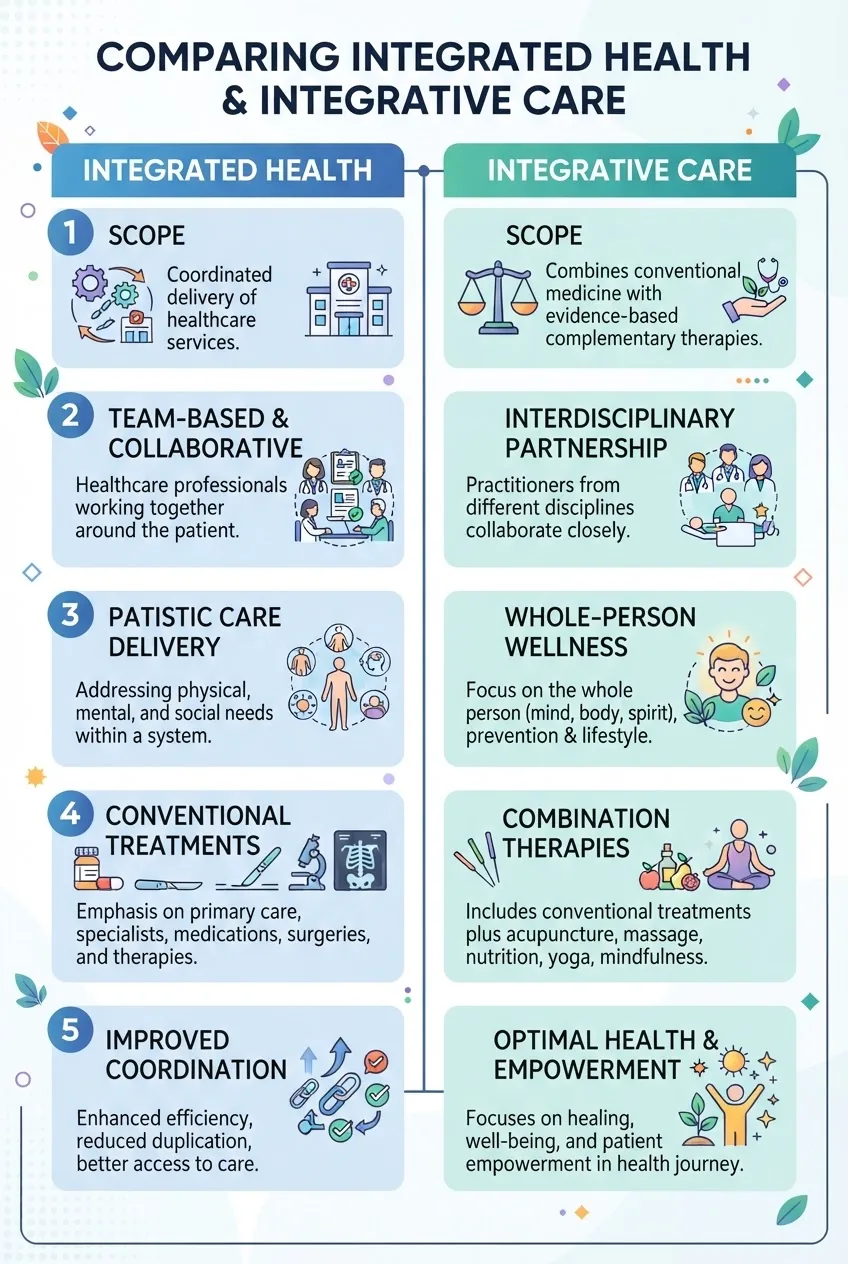
Answer: Integrated health is a systems-level whole-person model emphasizing coordination across services, while integrative care is a clinical approach combining conventional and complementary therapies within patient care.
| Feature | Integrated health | Integrative care |
|---|---|---|
| Primary scope | System-wide coordination across services, public health and clinical settings | Clinic- or program-level combination of therapies delivered to an individual patient |
| Typical team structure | Multi-sector teams including primary care, specialists, allied health and community services | Multi-disciplinary clinical teams—physicians, therapists, nutritionists, complementary providers |
| Patient focus | Whole-person population health and individual care coordination | Individualized clinical treatment plans integrating complementary therapies |
| Modalities included | Range across prevention, lifestyle, chronic disease management and medical services | Specific complementary therapies selected based on evidence and patient preference |
| Primary outcomes targeted | Improved system efficiency, access, population outcomes and continuity of care | Symptom relief, function, quality of life and reduced treatment side effects |
Elaboration: The difference is analogous to city planning versus interior design—integrated health shapes the system and routes people into coordinated services, while integrative care arranges the treatment elements inside a clinical encounter to meet the patient’s needs.
Clinical nuance: Integrated health initiatives often require governance, financing changes and population health strategies, while integrative care programs are typically established within clinics or hospitals and focus on safe incorporation of complementary therapies into clinical pathways.
Transition: Understanding distinctions helps place both concepts within holistic healing modalities and illustrates how they complement each other in practice.
How Integrated Health and Integrative Care Fit into Holistic Healing Modalities
Answer: Both integrated health and integrative care bring holistic healing modalities into coordinated, whole-person care by combining mind-body practices, nutritional and lifestyle strategies and conventional treatments to support wellness and preventive care.
Holistic healing modalities: a spectrum of therapeutic approaches that attend to physical, mental, social and spiritual dimensions of health.
Integrated health systems and integrative care programs incorporate modalities such as:
- Mind-body practices (mindfulness, meditation, biofeedback) supporting the mind-body connection.
- Movement therapies (physical therapy, yoga, tai chi) for function and prevention.
- Nutrition and lifestyle counseling addressing wellness and chronic disease risk.
- Manual therapies (massage, osteopathy) for pain and mobility.
- Complementary therapies like acupuncture where evidence supports symptom relief.
Examples of integration in practice:
- Primary care clinics embedding a health coach to support lifestyle change and preventive care, improving adherence and outcomes.
- Cardiac rehabilitation programs that add mindfulness and nutrition counseling to exercise and medication management to reduce recurrence risk.
- Oncology centers offering supervised yoga and acupuncture to complement symptom management during chemotherapy.
How wellness and lifestyle factors are woven into integrated models:
- Screening for lifestyle risks during routine visits and automated referrals to nutritionists or movement therapists.
- Preventive care pathways that combine vaccination, smoking cessation support and stress reduction programs.
- Community partnerships linking clinical teams to local exercise, food security and social support services.
Internal resources and further reading can help contextualize modality choices for different conditions. See the holistic healing modalities for a broader overview.
Integration with chronic disease management and preventive care:
- Chronic disease management programs commonly add behavioral medicine and nutrition to medication regimens to improve long-term outcomes.
- Preventive care is extended to include lifestyle interventions, stress reduction and social determinant screening as standard practice elements.
Practical implementation vignette — coordinated heart health program:
- Patient enters program after myocardial infarction; cardiologist prescribes standard therapies.
- Care coordinator assigns a dietitian, an exercise physiologist and a behavioral health specialist to create a single rehabilitative plan.
- Patient receives mindfulness training to manage anxiety, a tailored exercise plan and ongoing nutritional support—outcomes tracked via PROMs and EHR reminders.
Transition: With modalities contextualized, the next section outlines the measurable benefits of these approaches for patients and systems.
Benefits of Integrated Health and Integrative Care Approaches
Answer: Integrated health and integrative care can improve patient outcomes, enhance chronic disease management, increase patient satisfaction and support preventive care by aligning treatments and addressing lifestyle and psychosocial factors.
Key benefits (numbered with concise explanations):
- Improved patient outcomes: Combining therapies that target symptoms and underlying lifestyle drivers can reduce symptom burden and improve function; according to a 2022 systematic review in peer-reviewed journals, integrated programs often show better symptom control versus usual care.
- Enhanced chronic disease management: Multi-disciplinary plans improve medication adherence, self-management and reduce hospital readmissions for conditions like diabetes and heart failure (According to a 2023 NCCIH evidence summary).
- Better quality of life: Addressing pain, mood and sleep together often yields greater overall quality-of-life improvements than isolated treatments; clinical trials in integrative oncology report improved fatigue and emotional well-being.
- Patient satisfaction and engagement: Patient-centered, whole-person plans increase perceived support and participation in care decisions, which correlates with higher satisfaction scores in clinic surveys (According to a 2024 industry report on patient experience).
- Prevention and risk reduction: Embedding lifestyle and wellness advice in routine care supports risk factor modification and long-term disease prevention.
- Reduced fragmentation and duplication: Care coordination reduces redundant testing and conflicting treatment plans, improving system efficiency and lowering avoidable costs.
- Safer use of complementary therapies: Integrative models screen for interactions and contraindications, reducing risks associated with unsupervised alternative therapy use.
Evidence caveat: While many integrated programs report positive outcomes, the strength of evidence varies by modality and condition; some complementary therapies have strong randomized trial support while others rely on observational or limited data (According to a 2023 NCCIH research summary).
For more on broader advantages of whole-person approaches and their health effects, see extended discussion on the benefits of holistic medicine.
Transition: After benefits, practitioners and patients often ask which specific practices are used—so the next section lists common modalities and how they are applied.
Common Practices and Modalities Used in Integrated Health Frameworks
Answer: Integrated health frameworks commonly combine conventional medicine with modalities such as acupuncture, nutrition counseling, mindfulness, physical therapy, manual therapies and health coaching, selected by evidence and patient goals.
Complementary therapies: non-mainstream practices used together with conventional medicine to support health outcomes.
Overview of frequently used modalities with brief descriptions:
- Acupuncture: needle-based therapy often used for pain and nausea management; many studies show benefit for chronic pain syndromes.
- Nutrition counseling / holistic nutrition counseling: individualized dietary guidance targeting chronic disease prevention and management; works alongside medications and other treatments.
- Mindfulness and meditation: mind-body interventions that reduce stress, improve mood and support pain self-management.
- Physical therapy: evidence-based movement and rehabilitation approaches for function, injury recovery and chronic pain.
- Massage and manual therapies: short-term relief for musculoskeletal symptoms and stress reduction.
- Health coaching and holistic wellness coaching: behavior-change support that helps patients translate medical advice into daily habits.
- Herbal medicine and supplements: used selectively where evidence supports benefit but always screened for drug interactions.
- Psychotherapy and behavioral health: integrated mental health care addressing mood, trauma and stress-related contributors to physical symptoms.
Brief modality notes and practical considerations:
- Acupuncture: often integrated into pain clinics and oncology centers to manage symptoms and reduce medication needs.
- Nutrition counseling: central to chronic disease management—refer to registered dietitians for medical conditions.
- Mindfulness: scalable through group classes, digital programs and individual therapy; commonly used in stress-related conditions.
- Physical therapy: essential for musculoskeletal integration and return-to-function plans.
Resources for finding support or pursuing practitioner training:
- finding alternative practitioners with insurance
- health coach certification programs
- holistic nutrition counseling
- holistic wellness coaching
- holistic mental health treatments
- integrative health coach certification
Practical tip: When evaluating modalities, ask providers about the evidence base for your condition, how they coordinate with your medical team, and whether they document care in the shared medical record.
Transition: Despite benefits and practical tools, implementing integrated models faces several common barriers discussed next.
Challenges and Considerations in Implementing Integrative Care
Answer: Implementing integrative care faces barriers including inconsistent insurance coverage, variable evidence quality, provider communication gaps and patient acceptance, but many solutions (care pathways, documentation standards, and patient education) can mitigate these challenges.
Major barriers and practical caveats:
- Insurance coverage and cost: many complementary therapies are not uniformly covered by insurers; patients may face out‑of‑pocket expenses. Solution: develop referral networks that accept insurance and document medical necessity to support claims.
- Provider communication: fragmented communication can lead to conflicting advice. Solution: standardized shared care plans in the EHR and regular multidisciplinary meetings.
- Evidence challenges: strength of evidence varies across modalities; some rely on observational studies. Solution: prioritize evidence‑based integrative medicine and transparently discuss uncertainties with patients.
- Scope of practice and regulation: different licensing and credentialing rules affect which providers can deliver certain therapies. Solution: clear clinical governance and defined referral criteria.
- Patient acceptance and expectations: some patients expect quick cures or may distrust conventional care integration; solution: shared decision-making and realistic goal setting.
- Measurement and outcomes: standardizing outcomes across diverse modalities is complex. Solution: adopt PROMs and agreed clinical metrics for regular evaluation.
Implementation strategies and solutions:
- Establish clinical pathways and referral criteria that specify when to use each modality.
- Integrate documentation templates into the EHR to record complementary therapy use and monitor for interactions.
- Create internal training and credential checks to ensure provider competence and patient safety.
- Negotiate bundled care packages or partial coverage with payers where possible to lower patient cost barriers.
- Use pilot programs to collect local outcome data and refine models before wider rollout.
Regional and provider variation: Implementation will differ by health system, regulatory environment and payer mix—disclose these limitations when comparing programs and engaging patients. According to a 2024 industry report, variability in coverage and governance remains the leading barrier to scaling integrative models.
Transition: Having covered challenges and solutions, the final takeaway section summarizes the most important points and suggests next steps for readers.
Conclusion — Key takeaways: Integrated health refers to system- and person-level coordination of whole-person care; integrative care is the clinic-level mixing of conventional and evidence-based complementary therapies. Both aim to improve chronic disease management, preventive care and patient wellness through multi-disciplinary collaboration and care coordination. If you want to learn more about practical modalities, explore our holistic healing methods guide.
Call to action: Review your current care plan with your provider and ask how integrative approaches or care coordination might address lifestyle, mental health and preventive needs in your treatment.