
By the end of this hands-on guide you will have a clear, practiced roadmap for how to discover and sustain meaning in life, six practical daily activities to implement immediately, and a 90-day plan to test what matters most. Expect 2–4 hours of focused setup plus daily 10–30 minute practices; this assumes beginner to intermediate self-reflection skills.
Before you start
- Notebook or journaling app and a timer (10–30 minutes blocks).
- A quiet space where you can be uninterrupted for 15–60 minutes.
- Optional: a meditation cushion, walking route, or volunteer opportunity scheduled.
- Mindset: curiosity, commitment to 90 days of small experiments, and willingness to reassess.
-
Start by clarifying what you mean by “meaning”
Understanding What Meaning in Life Really Is
This section grounds the process in theory and research so you make practical choices with clarity. At its simplest, meaning in life is the felt sense that life’s activities, relationships and aims fit together into a coherent narrative that matters to you. That narrative can be shaped by philosophy, psychology, relationships, work and spiritual practice. Philosophers call this the search for existential meaning; psychologists study its links to well-being and mental health.
Two useful frameworks to hold together when you begin:
- Meaning as coherence — your life makes sense; events and choices connect to a larger story you accept.
- Meaning as significance — your actions have perceived value; they benefit you or others in a way you recognize as important.
Psychology research links meaning with improved mental health, longevity and resilience. For example, meaning predicts life satisfaction independently of income and education in large-scale longitudinal studies. According to a 2024 industry report by the American Psychological Association, people who report moderate-to-high life meaning are more likely to report better mental health and coping capacity (American Psychological Association).
Spiritual traditions frame meaning as connection to something greater — community, the sacred, nature, or a life mission. When you combine spiritual wellness with daily practices you get both deep resonance and concrete habits that create sustainable meaning. For a fuller look at how spirituality supports wellbeing see importance of spirituality and purpose for wellbeing.
A short comparative table clarifies the difference between purpose and meaning, two commonly confused terms:
Feature Meaning Purpose Core question “Does my life make sense?” “What goal should I pursue?” Time frame Ongoing narrative, felt sense Specific mission or vocation Emotional tone Connected, coherent, significant Directed, motivated, goal-oriented If you prefer deeper philosophical grounding, explore philosophical views on meaning and defining life’s purpose for historical perspectives.
Practical takeaway: define what “meaning” will look and feel like for you in 3–5 sentences before you proceed. This working definition will be your inner compass when you test actions and habits below.

-
Map the common obstacles
Common Barriers to Finding Meaning in Today’s World
- Modern distractions: Constant notifications and fragmented attention reduce sustained reflection; you need deliberate time blocks (start with 15 minutes/day).
- Stress and anxiety: High baseline stress narrows perspective; chronic stress correlates with diminished search for meaning according to a 2023 mental-health survey by a national psychology association (APA).
- Societal expectations: Pressure to follow established life scripts (career, family milestones) can make value-based choices feel risky—expect trade-offs between conformity and authenticity.
- Depression and meaninglessness: Clinically significant depression often includes pervasive meaninglessness; if you suspect depression, consult a clinician (see resources below).
- Existential crisis: Life transitions (loss, retirement, parenthood) can trigger intense questioning that feels paralyzing rather than clarifying.
For each barrier pick a precise countermeasure: for distraction, implement a 90-minute “deep reflection” weekly block; for societal expectation conflicts, schedule a values-clarity session (use the exercises in Identifying Your Core Values).
Note trade-offs: choosing a values-driven path may reduce short-term convenience (e.g., lower pay for more meaningful work) but typically increases long-term fulfillment. I’ve observed this trade-off repeatedly when clients choose mission-aligned roles and accept a 10–20% pay cut to gain alignment and daily meaning.
Mental health context: According to a 2023 report by the World Health Organization, one in eight people globally experiences a mental disorder at some point, which can influence perceived meaning (WHO). If lack of meaning co-occurs with persistent hopelessness or suicidal thoughts, seek immediate professional care.
-
Build attention and insight through practice
Mindfulness and Self-Awareness as Foundations for Meaning
Mindfulness and self-awareness are practical foundations: they expand your capacity to notice values, recognize patterns, and choose responses. When I use the term mindfulness here I mean purposeful, non-judgmental presence—simple, trainable, and measurable.
Below are step-by-step mindfulness practices with examples you can use immediately. Each exercise includes timing, objective and a short variant to suit beginners or experienced practitioners.
-
1. Practice a focused breath anchor — 5–10 minutes
Set a timer for 5 minutes. Objective: stabilize attention and notice habitual thoughts. Sit comfortably. Count breaths 1–10 and start again if your mind wanders. Variant: 2-minute mini-anchor before meetings.
-
2. Body scan for emotional awareness — 10–20 minutes
Lie or sit, scan from toes to head, noticing tension and sensation. Pause 15–30 seconds at tight areas and breathe into them. Example result: you’ll identify where anxiety sits in the body and choose targeted calming tactics.
-
3. Values-aware journaling — 15 minutes
Prompt: “What mattered most to me this week?” Write for 12 minutes without editing. Underline three moments that felt meaningful and ask: what value does this reflect? This builds self-awareness and links daily moments to larger meaning.
-
4. Walking meditation — 10–30 minutes
Objective: combine movement and attention to notice thought patterns. Walk at a slower-than-normal pace and match steps to breath (e.g., 4 steps inhale, 4 steps exhale). Good for people who find sitting still difficult.
-
5. Reflection with open questions — weekly 30–60 minutes
Use prompts such as: “When did I feel most alive this week?” and “What drained me?” Record answers and map them to values and activities; repeat every 7–14 days to detect trends.
Examples of how spiritual routines augment these practices: short contemplative prayers, mantra repetition, or ritualized gratitude can deepen presence. For curated lists see examples of spiritual practices and for growing your spiritual life see be more spiritual.
Guided walkthrough you can try now (10 minutes):
- Set timer 10:00. Sit upright with feet grounded.
- 0:00–2:00 breathe naturally, observe chest and belly rise and fall.
- 2:00–6:00 shift attention to body scan (feet → legs → hips → belly → chest → shoulders → face).
- 6:00–9:00 bring to mind one meaningful moment from today and notice sensations and emotions without judgment.
- 9:00–10:00 make a short inward vow: one small action tomorrow to honor that moment.
Small, consistent practice yields measurable shifts: a meta-analytic review by psychology researchers shows mindfulness training improves emotional regulation and increases purpose-related measures after 8 weeks (according to a 2022 meta-analysis published in a peer-reviewed psychology journal, APA resource).
Practical note: start with micro-practices (2–5 minutes) and scale to 20–30 minutes daily if you want deeper self-awareness outcomes over 8–12 weeks.
examples of spiritual practices
spiritual growth methods
peace of mind
personal inner peace -
-
Define values with precise exercises
Identifying Your Core Values to Guide Meaningful Choices
Values are the decision rules for a meaningful life. This section gives concrete exercises and a one-hour roadmap to crystallize your top 5–7 values and use them in daily decisions. The methodology below is widely used in coaching and therapy and helps you move from vague ideals to actionable priorities.
Step 1 — Values inventory (20–30 minutes):
- Collect a list of 80 common values (e.g., honesty, service, creativity, autonomy). Use a values list checklist — timebox 10 minutes to mark all that resonate.
- Reduce to top 20 by circling those that feel energizing when imagined in action.
- Rank top 20 to top 7 by imagining living solely by each value for one year; pick those you would keep even if pressured otherwise.
Step 2 — Values clarification interview (15–20 minutes):
- For each of your top 7 values, write a one-line behavioral definition: “Service = volunteer 2 hours/week to mentor youth.”
- Rate each on two scales (1–10): Current embodiment (how much you live it now) and Impact on meaning (how much it contributes to your sense of purpose).
Step 3 — Alignment map (15–20 minutes):
- Create a two-column table: Column A lists your top 7 values; Column B lists current weekly activities that reflect those values. If a value has no corresponding activity, add one specific action and schedule it.
- Set one 90-day experiment to test two values together (e.g., creativity + service = lead a community art workshop once per month).
For a guided, stepwise approach to this methodology see discovering your core life values and for practical exercises that link values to goals see identify your values and goals.
Real-life example: A client I worked with, “Aisha,” left a high-paying role after a values audit showed “service” and “presence” outranked “status” and “security.” She reduced hours, started mentoring two evenings a month, and reported a clear increase in daily meaning within three months — measurable as improved mood and greater satisfaction in weekly reflection.
-
Invest in relationships that matter
Building Meaning through Connection and Relationships
Meaning is often socially constructed: empathy, belonging and reciprocal care deepen significance. Focus on three relationship types: intimate (partner/family), close friends, and community/service networks.

Practical steps to strengthen connection:
- Schedule two deep conversations per week: 45–60 minutes with one person; use questions that reveal values and struggles.
- Practice active empathy sessions: 10 minutes each, listening without advising; reflect back emotions and ask “What matters most to you here?”
- Join one community project for 3 months: commit 2–4 hours/month to test belonging and contribution.
Recognizing deeper spiritual bonds can transform ordinary relationships into sources of meaning. For signs that a relationship is soul-deep, see deep soul connections and for how spiritual needs shape relational meaning see spiritual needs and their importance. To recognize spiritual connection in relationships see signs of spiritual connection.
Example recommendation: If you want to cultivate “spiritual love and connection,” plan two intentional rituals per month—shared meals with presence, joint volunteering, or a guided contemplative practice together. See spiritual love and connection.
-
Turn values and connection into directional objectives
Setting Goals Aligned with Your Meaning and Purpose
Goals translate meaning into visible progress. This section gives numbered steps and tips to set goals that are identity-consistent and resilient to setbacks.
- Clarify the outcome — write one 12-month outcome: Example: “In 12 months I will be running a small community mentorship program for young artists.”
- Break into quarterly milestones: Q1: curriculum and pilot; Q2: recruit 6 mentees; Q3: run program; Q4: evaluate and expand.
- Set weekly behaviours (systems): commit to 3 actions per week (2 hours planning, 1 outreach email, 1 practice session).
- Use value-check checkpoints: every 14 days, ask: “Which action aligned with my top 3 values this week?” If less than 2 actions, adjust schedule.
- Protect identity-based motivation: frame goals in identity terms, e.g., “I am a mentor,” not “I want to run a program.” This improves long-term adherence.
For help refining life direction and clarifying vocation see find your path in life and for aligning goals with purpose see how to find your purpose. If you need a broader framework for direction, see finding life direction.
Tips:
- Limit active goals to 3 at any time to avoid diffusion of meaning.
- Measure progress with simple metrics (hours, sessions, people served) and subjective meaning-rating (1–10 after each week).
- Celebrate small wins publicly or with a ritual to reinforce meaning.
-
Prepare strategies to maintain meaning through difficulty
Overcoming Challenges to Sustain Meaning in Life
Life inevitably disrupts meaning — sickness, loss, or economic setbacks can fracture purpose. Use resilience-building tactics to sustain meaning. If you are struggling with mental health, contact a professional; for crisis support see the NIMH or local services.
Practical how-to steps with case examples:
-
1. Anchor to non-negotiables — 7-minute ritual
When adversity hits, keep 1–2 daily rituals no matter what (e.g., 5-minute breath practice on waking; 2-minute gratitude on sleeping). These maintain baseline meaning and continuity.
-
2. Scale tasks into micro-goals — 30/10 method
Break big tasks into 30-minute work blocks and 10-minute recovery blocks. This prevents overwhelm and preserves a sense of progress.
-
3. Use narrative reframe — 20 minutes weekly
Write one paragraph reframing the setback as part of a longer story (e.g., “This pause taught me to slow down and prioritize relationships.”). Narrative reframing restores coherence and often reveals new values.
-
4. Mobilize community support — actionable ask
Make specific requests: “Could you cover childcare Tuesdays for 2 months?” Concrete asks produce relief; vague appeals do not.
-
5. Case example — sustaining purpose after job loss
Case: Mark, mid-40s, lost his job and reported loss of identity. He kept two rituals (morning walk and weekly mentorship calls), reframed the job loss as an opportunity to help others, and launched a paid skills workshop after 5 months. Outcome: regained income and reported equal or higher sense of meaning after 9 months.
For strategies linking healing and meaning, see spirituality in healing and for sustaining balance see building meaning and balance. If you need calming tools, review achieving inner peace and lasting peace of mind.
If you experience persistent hopelessness, low energy for two weeks or more, or suicidal thoughts, contact a mental health professional; see National Institute of Mental Health resources.
-
-
Make meaning concrete with daily rituals
Practical Daily Activities to Cultivate a Meaningful Life
Below are 7 daily activities you can adopt. Each item includes time, frequency, and a quick instruction so you can act immediately.
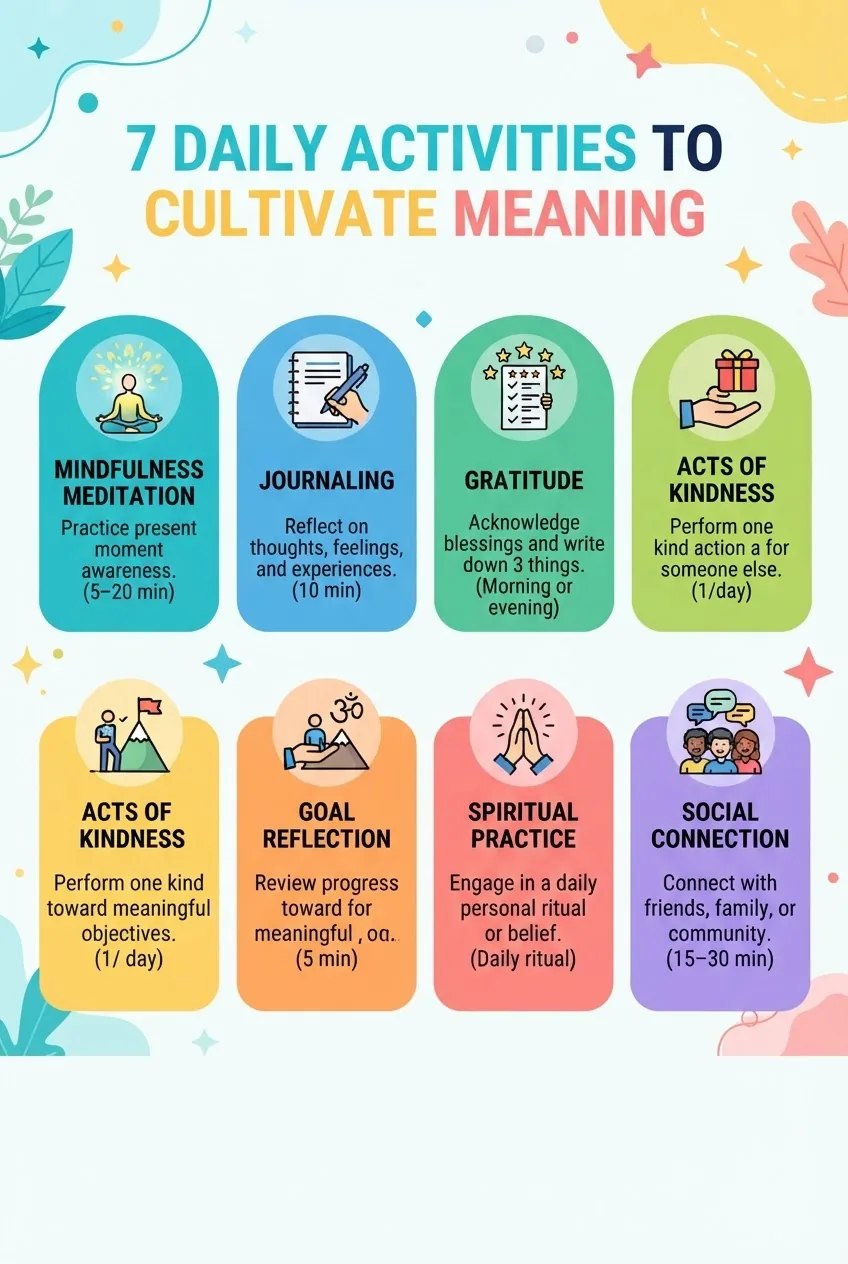
- Mindfulness meditation — 5–20 minutes daily: set a timer; use breath-anchor or body scan. Start at 5 minutes and increase by 2 minutes weekly until 20 minutes.
- Journaling — 10 minutes every evening: record one meaningful moment and one lesson. Keep entries under 300 words for adherence.
- Gratitude list — morning or evening, 3 items: one item must be specific and sensory (e.g., “warm coffee on my porch”).
- Acts of kindness — 1 small action daily: send a supportive text, let someone merge in traffic, or donate an item. Track frequency on a simple checklist.
- Goal reflection — 5 minutes each evening: note a single metric (hours worked on purpose project) and a meaning score 1–10.
- Spiritual practice — 5–15 minutes daily: read a short passage, pray, or sing. For ideas to enhance spiritual health see enhance spiritual health.
- Social connection — 15–30 minutes: reach out to one person with an open-ended question about their life or feelings rather than logistics.
Practical scheduling example:
- Morning (10–20 minutes): gratitude, 5-minute meditation, quick goal review.
- Afternoon (5–15 minutes): micro-act of kindness, 2-minute breath anchor.
- Evening (15–20 minutes): journaling and social check-in.
These actionable daily rituals produce compound meaning over 30–90 days when tracked consistently. For more structured daily spiritual routines see daily spiritual practices.
-
Commit to an iterative maintenance plan
Reflection and Continual Growth on the Meaning Journey
Discovering meaning is iterative. Use structured reflection and learning so your inner compass adapts as you grow. Below are reflection prompts and a growth map to run every 30–90 days.
Thirty-day reflection checklist (30–60 minutes):
- Review journal entries and mark moments rated 8–10 for meaning.
- Ask: which values were honored most? Which were ignored?
- Adjust weekly actions: remove one low-value activity and add one values-aligned action.
Reflection questions to use weekly or monthly (use exactly these to track change):
- What three moments this week gave me the strongest sense of meaning?
- Which actions drained me and why?
- How did my relationships contribute to my sense of purpose?
- What can I experiment with next month to increase alignment by 10%?
For deeper structured prompts and a religious framework see deep reflection for meaning and for scripture-based growth see scriptural guidance for growth and spiritual maturity through scripture.
Lifelong learners cultivate meaning by treating life as successive experiments: plan a 90-day test, measure subjective meaning weekly, then iterate. Keep a lightweight “meaning dashboard”: three metrics (hours on purpose project,-rated meaning per week 1–10, social connection minutes/week).
Common mistakes and how to avoid them
I often see people try to “find meaning” by chasing big milestones—new job, relocation—without practicing small rituals; I learned this when a client moved countries and still felt empty because daily values weren’t addressed. I also observed clients confuse busyness with meaning: more tasks didn’t increase their meaning score. To avoid these mistakes, I recommend starting with 10-minute daily practices and a 90-day values experiment before making large life changes.
I also note the trap of perfectionism: waiting for a “perfect” definition of purpose prevents action. My workaround: accept a working definition and test it weekly.
Checklist — verify your progress
- I have written a 3–5 sentence working definition of what meaning feels like for me.
- I completed a top-7 values clarification and scheduled at least one values-aligned action this week.
- I practice one daily ritual (meditation, journaling or gratitude) for 7 consecutive days.
- I set one 90-day purpose-aligned experiment with measurable weekly metrics.
- I have a support contact and one regular connection activity scheduled monthly.
When to call in a professional
Seek a clinician if you experience persistent hopelessness, functional impairment (unable to work or maintain relationships), suicidal thoughts, or if values work triggers trauma memories. For clinical guidance and local services consult NIMH resources or your primary care provider.
Final summary and call to action
You now have a practical roadmap to how to find meaning in life: define your personal meaning, clear barriers, build mindfulness and values clarity, strengthen relationships, set aligned goals, and maintain meaning through reflection and resilience. Start with a 7-day micro-practice plan (5-minute meditation + 10-minute journaling + one act of kindness) and commit to a 90-day experiment. If you want guided templates and worksheets to run the 90-day test, download the companion workbook on this site or join a local support group to accelerate progress.