

By the end of this hands-on guide you will be able to design and run a full week of adult-focused thankfulness activities—solo and in groups—deployable at home, in workplaces, or in community settings. Expect to spend 90–120 minutes preparing and then 5–45 minutes per activity; this assumes no specialist qualifications, just basic facilitation and empathy skills.
Before you start
- Materials: notebooks or lined paper (A5 or A4), pens, a timer, and optional printed worksheets or a projector for groups.
- Tools/apps: a guided gratitude app (e.g., journaling app), simple PDF printouts, and a whiteboard or sticky notes for group lists.
- Space and time: a quiet 10–40 minute window for solo practices; a 30–90 minute room booking for group sessions.
- Permissions: consent from participants for sharing and an agreed confidentiality guideline for group activities.
If you want complementary self-care practices to pair with gratitude, see the self care ideas guide with effective activities and techniques.
Introduction to Thankfulness Activities for Adults
This guide focuses on practical, adult-centered thankfulness activities you can use to support emotional wellbeing, social connection, and everyday self-care. I explain proven exercises—from solo journaling and gratitude meditation to facilitated group circles—and give step-by-step instructions so you can run them without needing specialist training. Throughout I’ll reference research showing how gratitude supports mood and resilience; for example, positive psychology research consistently connects gratitude practice to improved subjective well-being and better sleep.

According to a 2023 psychology study (peer-reviewed journal), structured gratitude interventions produce small-to-moderate increases in reported well-being and reductions in depressive symptoms when practiced consistently for at least 4 weeks. Recent public health guidance (government health body) also highlights social connectedness and emotion regulation as key wellness outcomes supported by gratitude activities.
Gratitude sits inside broader categories of self-care—the emotional and social aspects in particular. For context on other categories of self-care, see the types of self care and for scientific wellness evidence see our piece on the health benefits of gratitude.
Transition: the following sections move from individual activities to group facilitation, then to context-specific adaptations and daily integration—each with clear steps you can follow.
Individual Thankfulness Activities and Gratitude Exercises for Adults
This section lists solo practices with practical steps. Each item includes time, materials, the psychological purpose (brief), and trade-offs versus group methods (time, vulnerability, emotional intensity).
- Daily gratitude journaling — 5–15 minutes per day.
How: write three items you are grateful for each morning or evening in a notebook. Be specific: name people, events, or sensory details. Set a timer for 7 minutes and write freely.
Purpose: builds attentional bias toward positive experiences (a positive psychology technique). Trade-offs: low social risk, easy to sustain; may feel repetitive without prompts.
For more structured routines try our daily gratitude exercises.
- Gratitude letter writing — one 20–40 minute session.
How: choose one person (alive or deceased). Write a one-page letter describing what you appreciate and why. If comfortable, read it aloud in person or record a voice message.
Purpose: strengthens social gratitude and relational repair. Trade-offs: high emotional intensity and time; can open unresolved feelings—use only when you feel stable.
- Gratitude meditation — 8–15 minutes.
How: sit comfortably. Breathe 4-6 deep breaths, then focus on one thing you are grateful for. Expand from object→sensation→person→broader system (e.g., community). Use an app or guided audio if new to meditation.
Purpose: integrates mindfulness with gratitude to reduce rumination. Trade-offs: requires focus training; can be less socially reinforcing than group sharing.
- Gratitude photograph or visual diary — 5–20 minutes daily.
How: take one photo each day that captures something you appreciate (a meal, a view, a pet). At week’s end, assemble into a slideshow and reflect for 10 minutes.
Purpose: creates visual cues and memory anchors; helpful for those who struggle with verbal expression. Trade-offs: requires device storage and time to review photos.
- Three good things — 10 minutes nightly.
How: each night list three good things that happened, why they happened, and your role in them. Focus on causes to strengthen agency.
Purpose: promotes attributional shifts and optimism. Trade-offs: may feel forced initially; best combined with journaling.
- Gratitude walks — 10–30 minutes.
How: walk at a comfortable pace and name five things you notice that you’re grateful for. Use senses—what you see, hear, smell. Set a 20-minute timer for a balanced session.
Purpose: couples movement and gratitude to reduce stress. Trade-offs: weather-dependent and less private in busy areas.
- Gratitude scripting — 15–30 minutes weekly.
How: script a short gratitude speech (2–4 minutes) you could say to someone. Practice aloud once. Keep the script in a folder for future use.
Purpose: builds confidence for verbal appreciation. Trade-offs: requires rehearsal time; may feel performative to some.
- Gratitude rituals for self-care — 5–25 minutes.
How: pair gratitude with a self-care action: after a shower, list two things you appreciate; before bed, name one bodily sensation you’re grateful for. Make it a micro-ritual (1–3 minutes).
Purpose: anchors gratitude into daily self-care routines. Trade-offs: minimal time but consistent repetition required for habit formation.
See related self-help techniques for well-being to combine gratitude with broader coping strategies.
- Reflective gratitude prompts (worksheets) — 10–30 minutes.
How: use a printable worksheet or PDF with prompts: “Who helped me this week?”, “What surprised me with goodness?” Complete one worksheet weekly.
Purpose: structured reflection for deeper processing. Trade-offs: requires a printable or digital worksheet; higher insight potential but more time-consuming.
Search for “gratitude activities for students pdf” and adapt prompts for adults; the structure works across ages with language changes.
- Comparison: personal journaling vs group sharing — quick table.
Method Time Emotional intensity Best for Journaling 5–20 min/day Low–moderate Daily habit, privacy Group sharing 30–90 min/session Moderate–high Social bonding, accountability
Transition: next we’ll shift to group exercises and facilitation guidance—practical for team-building, therapy-adjacent groups, and social clubs.
Group Gratitude Activities and Exercises for Adults
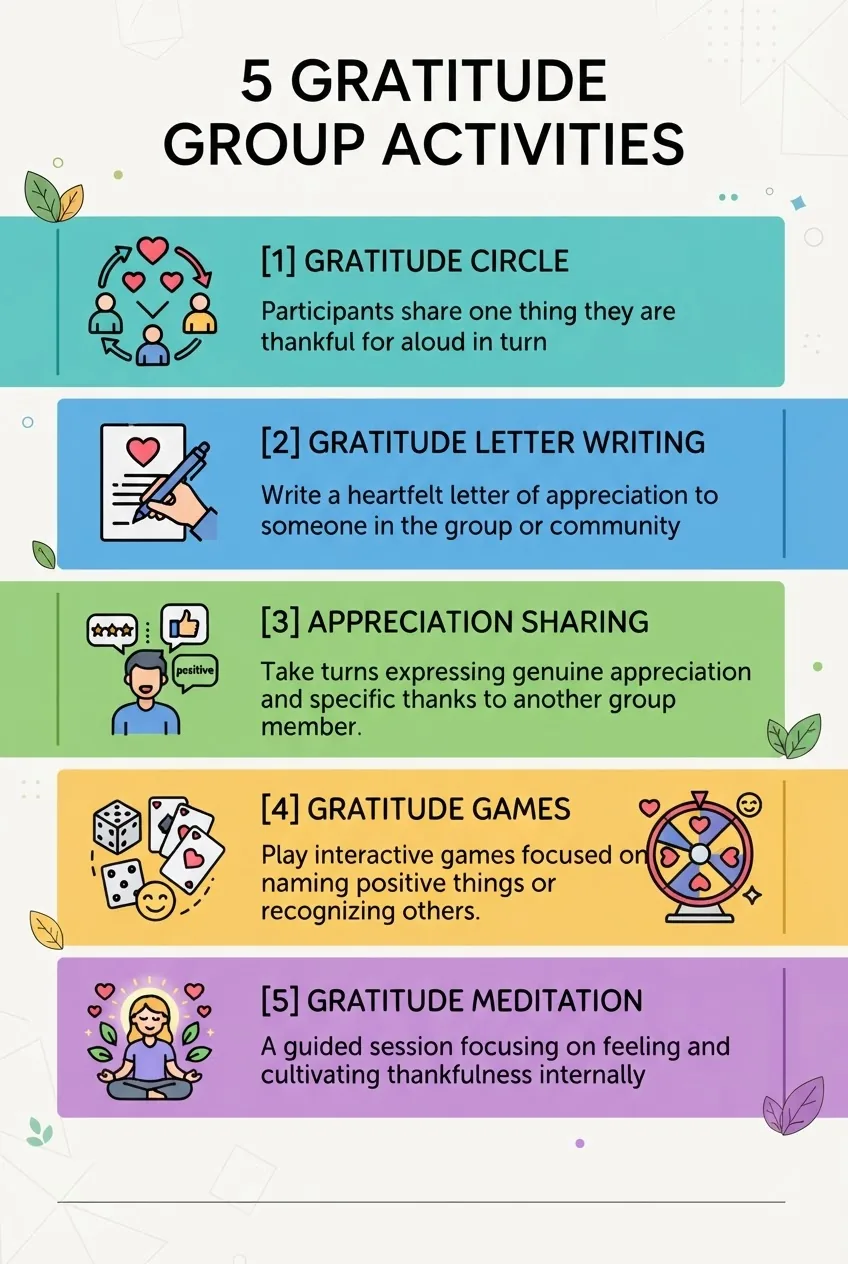
Well-designed group gratitude sessions combine structure and psychological safety. Below are 12 ready-to-run activities with facilitation tips, timings, and adaptations for group size (4–8 small groups, 9–20 medium, 20+ large).
- Gratitude circle — 20–45 minutes.
How to run: arrange chairs in a circle. Ask each person to share one specific gratitude for 1–3 minutes. Use a timer and a “talking object” to ensure one voice at a time. End with a group reflection (5 minutes) on themes.
Facilitation tips: for large groups, break into circles of 6–8 with a facilitator per circle. If participants are reluctant, start with an icebreaker (see #4).
Group facilitators can integrate these into broader group self-care activities.
- Appreciation cards — 15–30 minutes.
How: provide blank cards. Each participant writes a short appreciation note to another member, slips it into a box, and the facilitator redistributes randomly. Allow private reading time (3–5 minutes).
Facilitation tips: great for teams and workplaces; keep messages short and specific to avoid awkwardness.
- Gratitude letter workshop — 45–90 minutes.
How: give 20 minutes of silent writing, then invite volunteers to read their letters (3–5 minutes each). Offer an opt-out: participants may redact names or read a short excerpt.
Facilitation tips: set clear support resources: a private area, 1:1 check-in option, and a time limit per reader to keep energy balanced.
- Gratitude icebreakers / games — 10–25 minutes.
How: use quick activities like “Two Truths, One Gratitude” (each person names two facts and one gratitude) or “Gratitude Bingo” (a bingo card of experiences—someone shares if they check a box).
Facilitation tips: ideal for mixed groups and to ease reluctance toward deeper sharing. Keep rules simple and encourage laughter and lightness.
- Guided group gratitude meditation — 10–20 minutes.
How: produce a short script: settle (2 min), direct attention to breath (2 min), then imagine someone or something you’re grateful for and send them goodwill (6–10 min). End with a silent minute.
Facilitation tips: use a calm moderator voice or recorded guide. Use soft lighting and comfortable seating.
- Strengths & gratitude pairing — 30–45 minutes.
How: pair participants. Each tells a story of a moment when the other showed a strength they appreciate. Rotate so everyone receives specific feedback.
Facilitation tips: useful for teams; requires psychological safety and clear timekeeping.
- Gratitude timeline — 30–60 minutes.
How: on a large sheet, draw a timeline and invite participants to place sticky notes on points of life they feel grateful for. Discuss themes emerging from the map.
Facilitation tips: visual and narrative; good for recovery and community groups. Prepare large post-its and markers.
- Thank-you circle with action commitments — 30 minutes.
How: after sharing appreciations, ask each person to name one small action they will take this week to express gratitude (e.g., text someone, volunteer 30 minutes). Record commitments publicly to boost accountability.
Facilitation tips: tie commitments to measurable timeframes (e.g., “send the message by Friday midday”).
- Silent gratitude wall — 15–30 minutes.
How: set up a wall or flipchart where participants post anonymous notes of thanks. Leave the wall up for 24–72 hours to let people revisit it.
Facilitation tips: lowers barrier for those who avoid speaking; monitor for inappropriate content and remove if necessary.
- Intergenerational storytelling — 45–75 minutes.
How: pair adults across age groups to share stories of gratitude and life lessons. Limit to 15 minutes per pair then rotate. This is ideal for community centers or family gatherings.
Facilitation tips: prepare conversation prompts and ensure respectful tone; watch for power imbalances.
- Gratitude role-play — 30–60 minutes.
How: participants role-play delivering gratitude to a challenging relationship (e.g., boss, ex-colleague) to practice tone-setting and boundaries.
Facilitation tips: use with small groups only and include debrief to process emotions.
- Thankfulness-focused team retrospective — 30–90 minutes.
How: in work teams, run a project retrospective focusing on appreciations: what went well, who helped, what lessons to carry forward. End with action items tied to individuals and deadlines.
Facilitation tips: helps shift from purely problem-focused retros to recognition, improving morale. Keep the session timed and outcomes documented.
For gender-specific adaptations, see self-care activities for women.
Real-life example: A community mental health group I facilitated used a monthly gratitude circle combined with a “gratitude wall” for three months; attendance rose 35% and qualitative feedback showed improved group cohesion. We tracked session attendance and self-reported mood using a simple pre/post 5-point scale.
Transition: now adapt these activities for specific adult contexts—workplaces, families, community groups—so they fit real schedules and constraints.
Gratitude Activities Adapted for Different Adult Contexts
Below are short, context-specific lists with quick scripts, timing, and risk considerations for workplace, community groups, and family settings.
Workplace gratitude activities
- 15-minute “shout-out” standups: each person names one colleague and one specific action they appreciated that week. Keep contributions to 60 seconds.
- Monthly appreciation emails: one manager compiles 3–5 positive notes and posts them to the team. Confidentiality: ask permission before sharing names widely.
- Recognition board: a digital or physical board where employees add quick thank-yous. Keep moderation to avoid misuse.
- Facilitation note: avoid mandatory emotional disclosure; participation should be voluntary to respect privacy.
Community group gratitude exercises
- Gratitude potluck: participants bring a dish and a short story of gratitude to share (3–5 minutes). Time: 60–90 minutes.
- Skill-exchange appreciation: everyone lists one skill they appreciate in others and one they’d like to learn; pair up accordingly.
- Facilitation note: ensure accessibility—provide seating, clear audio, and captioned materials if needed.
Family and household gratitude practice
- Meal-time gratitude round: one sentence per person—limit to 30 seconds each—after dinner, 3–10 minutes total.
- Weekly “thanks jar”: family members add notes; read them together on Sunday (10–20 minutes).
- Adaptations for teens: shorter turn-taking, playful prompts, and integrations with social media to increase engagement—contrast with deeper adult reflection to respect developmental differences.
- For a quick teen-specific comparison, see our brief mention of group self-care activities—many group formats scale down to teen attention spans.
Transition: next, we map gratitude into daily adult routines with practical habit steps, linking to relevant help guides for depression and routine formation.
Incorporating Thankfulness Activities into Daily Adult Routines
This section gives step-by-step habit-formation guidance so gratitude becomes sustainable. These are concrete daily routines with timing, frequency, and goals you can test over a 4-week trial.
- Set a clear, time-bound plan.
Step 1: choose a start date and commit to 4 weeks. Time commitment: 5–10 minutes daily for journaling or a 15–20 minute group weekly session.
For integration with clinical self-care, review self-care strategies for depression and pair gratitude with behavioral activation.
- Anchor gratitude to an existing habit.
Step 2: attach a gratitude micro-routine to an established habit (e.g., after making coffee each morning). Execute for 7 consecutive days to strengthen cue-response learning. Use a sticker on your calendar as visual tracking.
- Create measurable prompts and reminders.
Step 3: set one phone reminder labeled “3 grateful things” at 8:30 AM and 9:00 PM. If using a journaling app, enable the daily push notification. Track completion as a binary checkmark each day.
Pair with other daily self-care habits for compounding benefits.
- Use accountability and social sharing.
Step 4: share your 4-week plan with one person, join a weekly gratitude group, or post a weekly gratitude summary to a trusted group. Public commitments increase adherence; length: 1 minute to post, 30–60 minutes weekly reflection with a group.
- Measure outcomes with simple metrics.
Step 5: choose two metrics: (A) days practiced per week (goal: 5+) and (B) a 1–5 mood rating each evening. Record in a notebook or spreadsheet. After 4 weeks, evaluate changes in average mood and days practiced.
For evidence-based mood strategies, reference trusted self-care methods.
- Combine gratitude with goal-setting.
Step 6: at the end of each week, write one small self-care goal tied to gratitude (e.g., “Send one thank-you message by Friday”). Use our goal setting for self-care template to structure targets and timelines.
- Adapt for busy adults: micro-sessions.
Step 7: when pressed for time, use 60-second gratitude pauses: inhale-count-4, think of one thing you appreciate, exhale-count-4. Repeat 3 times. This can be done at transit stops or before meetings.
- Integrate into sleep hygiene.
Step 8: put gratitude reflection into your evening routine: 5 minutes of listing one positive event and why it mattered. Improved sleep has been associated with gratitude in several observational studies; pairing with regular sleep habits increases effect sizes.
See examples in our daily self-care routine.
- When gratitude feels hard, use structured prompts.
Step 9: use prompts like: “Name one person who improved your day,” or “Name one resource that helped you this week.” Structured prompts reduce cognitive load and are especially useful during low-mood periods.
To integrate with depression support, consult our self-care strategies for depression for complementary techniques.
Transition: if you want tools, worksheets, or apps to support the work above, the next section provides vetted resources and short reviews so you can pick what fits your schedule and budget.
Resources and Tools for Gratitude Activities
Below are recommended worksheets, journals, apps, and printable resources, followed by usage notes and links to trusted self-help resources.
- Guided gratitude journals (paper) — e.g., 90-day gratitude journals with daily prompts. Use for structured 3-month programs; buy one with dated pages to encourage consistency.
- Printable worksheets / PDFs — weekly reflection templates labeled “Week 1–4” with three prompts per page. Search for “gratitude activities for students pdf” and adapt language for adult professionals; print A4, double-sided to save paper.
- Apps — journaling apps with reminders and mood-tracking. Choose apps that export data (CSV) if you want to track adherence. Recommended: look for apps with a 4+ star rating and privacy policies that don’t sell data.
- Whiteboard / sticky notes — for group walls and timelines; use 3×3″ post-its and a flipchart. Provide spare pens and a few marker colours to encourage visual diversity.
- Audio guides — short 8–12 minute guided gratitude meditations you can record for your group. Host on a private file share or play through a meeting platform.
- Facilitation checklist PDF — one-page guide listing timing, safety reminders, and debrief prompts. Keep printed copies at facilitator table.
- For additional materials and vetted guidance see trusted self-help resources.
External authoritative resources:
- American Psychological Association—gratitude overview
- Australian Government Department of Health—mental wellbeing guidance
- Peer-reviewed research on gratitude interventions (PubMed Central)
Transition: effective group facilitation is key—below are practical tips and communication techniques to make sessions safe and productive.
Tips for Facilitating Gratitude Exercises in Groups
These facilitation techniques draw on group dynamics frameworks and adult learning principles to support participation and emotional safety.
- Set clear agreements and boundaries.
Say: “What is shared in this circle stays here, and sharing is voluntary.” State time limits and opt-out options at the outset.
- Create a welcoming opening ritual.
Begin with a 2-minute breathing exercise to center the group and lower reactivity.
- Use structured turn-taking.
Apply a timer (60–180 seconds per speaker) and a talking object for respect. This prevents dominating voices and helps reluctant participants prepare.
- Offer multiple participation modes.
Allow speaking, writing, or anonymous posts to the gratitude wall. This increases inclusion for neurodiverse participants or those with social anxiety.
- Be prepared for emotional escalation.
Have a private area and contact info for local mental health services. Remind participants that gratitude exercises are supportive but not a replacement for therapy.
- Balance light and deep content.
Start with lighter prompts to build comfort before introducing deeper reflection (e.g., gratitude letters).
- Encourage specificity.
Ask participants to name specifics (“What exactly did they do? When?”)—it makes appreciation feel more real and actionable.
- Monitor group energy and adjust timing.
If the group becomes fatigued, switch to a creative activity (photo diary or bingo) to re-engage minds for another 10–15 minutes.
- Close with integration.
End sessions with one practical takeaway or a commitment (e.g., send a thank-you message within 48 hours).
- Debrief and collect feedback.
Use a two-question exit survey: “What helped?” and “What would improve the next session?” Use results to iterate.
Transition: common pitfalls happen; below I share mistakes I’ve seen and how I fixed them in practice.
Common mistakes and how to avoid them
I have seen groups rush into deep gratitude sharing without establishing safety; people shut down or leave. I now always open with a 2-minute grounding and clear opt-out. I’ve also observed facilitators using vague prompts; replacing these with specific “who/what/when” prompts increases engagement markedly.
I once advised a workplace to make gratitude mandatory; morale dipped because employees felt coerced. We corrected this by shifting to voluntary “shout-outs” and an anonymous appreciation board, which restored trust.
Checklist — verify your gratitude activity setup
- Session length chosen and timed (5–90 minutes).
- Materials ready: notebooks, cards, pens, sticky notes.
- Safety plan: private area, opt-out, mental health contacts.
- Clear instructions and time limits prepared.
- Follow-up plan: commitments recorded and a review date set (e.g., 4 weeks).
When to call in a professional
If participants disclose severe symptoms (self-harm, suicidal ideation, uncontrolled mania), immediately refer to local mental health services and pause group activities until a clinician has assessed risk. Gratitude exercises can support well-being but are not a substitute for therapy or crisis care.
Conclusion and Encouragement to Practice Thankfulness Regularly
By following this guide you can create a tailored program of thankfulness activities for adults that fits your schedule and setting. Start small—5 minutes daily or a 30-minute weekly circle—and measure adherence over 4 weeks. According to a 2023 psychology study (peer-reviewed journal), consistent practice over several weeks yields measurable improvements in mood and social connectedness.
For proven, broader approaches to maintaining wellbeing, see proven self-care strategies. Remember: gratitude supports mental health but is not a replacement for clinical treatment; if symptoms persist or worsen, contact a qualified professional.
Final encouragement: design one small, repeatable gratitude practice this week, commit to 4 weeks, track two simple metrics (days practiced; evening mood rating), and compare results. If you want templates, printables, or facilitation scripts, use the resources above and adapt the exercises in this guide to your group’s culture and time constraints.