

By the end you’ll have a personalised, actionable map of the types of self care you need, a 30-minute daily starter routine, and clear priorities to maintain balance; this guide takes about 2–4 hours to read and apply, and assumes beginner to intermediate self-care skills. Whether you are new to self care or refining a routine, this hands-on guide walks you step-by-step through assessment, category knowledge, and practical integration.
Before you start
- A notebook or journaling app and 30–60 minutes of uninterrupted time
- A weekly calendar (digital or paper) to schedule micro-actions in 10–30 minute blocks
- Basic tools: water bottle, comfortable shoes for brief walks, noise-cancelling headphones or earbuds
- Optional: a thermometer for sleep environment checks, a simple budgeting spreadsheet (or app)
- Assess your current state: Spend 20–40 minutes a day this week tracking sleep hours, mood once daily (scale 1–10), one social contact, and one spend. Use this log to create a baseline. Aim for 7 days to smooth day-to-day variance; shorter 3-day checks work for rough prioritisation.
- Learn the categories: Read the H2 sections below to understand each self care domain, then mark which three categories feel lowest on your baseline (use a 1–5 urgency scale).
- Prioritise and set goals: Pick 2–3 priorities and set one SMART micro-goal per category (S: 10-minute walk; M: daily; A: realistic; R: linked to mood; T: 2 weeks). Record the goals in your calendar with reminders.
- Create micro-actions: Design actions of 5–30 minutes you can do daily. Example: 10-minute hydration-and-stretch at 9am; 15-minute gratitude note at night. Keep actions to 1–2 per day initially to avoid overload.
- Schedule and trial: Block the micro-actions into your weekly calendar for 14 days. Use 10-minute buffer zones and reassess after day 7. If an action consistently feels aversive, swap it for an alternative from the same category.
- Evaluate, adjust, repeat: After 2 weeks, review your baseline metrics and subjective mood. Increase successful micro-actions by 5 minutes or add one more category. If sleep did not improve after 2 weeks, escalate to targeted sleep hygiene steps (see Physical Self Care).
- Combine categories for synergy: Pair actions across categories — e.g., walk (physical) with a friend (social) while listening to a mindfulness podcast (mental). Track combinations and note which pairings give the biggest mood lift.
- Document and scale: Keep a 4-week log. When a habit is stable (14 consecutive days), increase frequency or intensity by 10–20% or create a new SMART goal in another category.
This hands-on sequence leads into the detailed category breakdowns that follow. Use the steps above while you read each section: identify examples you can trial immediately and record them in your calendar.
What Are the Types of Self Care?
A practical self care definition: self care is the set of activities and attitudes you intentionally adopt to maintain and improve your physical, emotional, mental, social, spiritual, sensory, financial, and environmental well-being. Defining clear self care categories helps you target effort where it will meaningfully improve daily functioning and long-term health.
Why categorise? Categories turn a vague “I need to look after myself” into concrete options: sleep and nutrition (physical), talking things through (emotional), short mindfulness breaks (mental), calling a friend (social), and so on. This reduces decision friction and helps create sustainable routines.
The eight categories covered here — physical, emotional, mental, social, spiritual, sensory, financial, environmental — are framed to avoid overlap while showing clear ways they support each other. For example, regular exercise (physical) reduces stress reactivity (mental) and can improve mood (emotional). According to a 2024 industry report by a health market research firm, people who applied multi-domain self care strategies reported larger well-being gains than single-focus plans; measured gains were most apparent after 6–8 weeks (source type: industry report).
For clinical definitions and health benefits, see guidance from public health organisations: National Institutes of Health (NIH) and the World Health Organization (WHO). These sources emphasise that self care complements, but does not replace, professional medical or mental health care.
Read more on the importance of self care for mental health for research-backed context and practical takeaways.
Transition: Now that you have a working definition and the rationale for categorising, the next section gives a deep, actionable dive into each category with examples you can apply immediately.
Comprehensive Overview of Self Care Categories

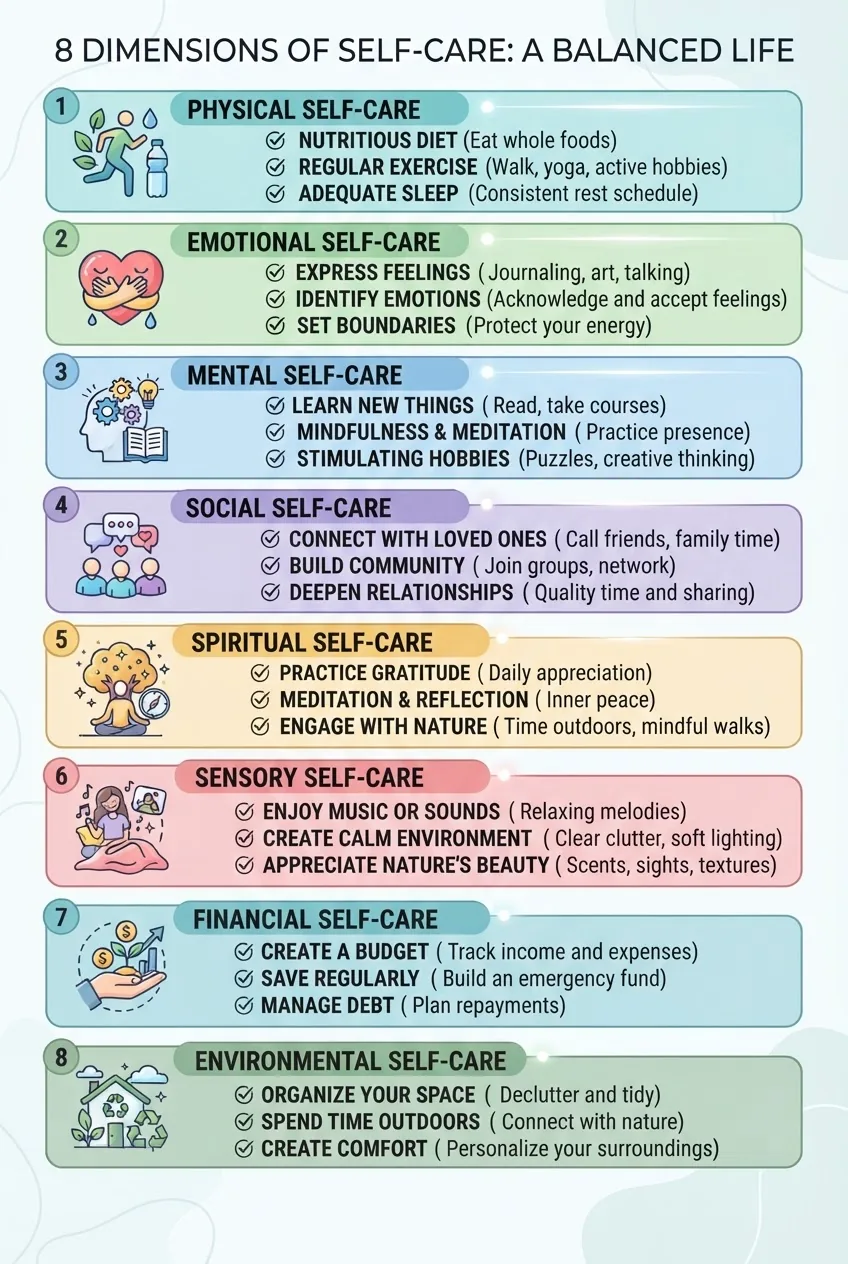
This section breaks each category into definition, practical examples, measurable targets, and short scenarios you can replicate. For every category I note one low-effort starter action (5–15 minutes), one medium effort action (15–60 minutes), and one structured practice (weekly or ongoing).
Physical Self Care
Physical self care covers sleep, movement, nutrition, hydration, and routine medical care. Aim for measurable targets: 7–9 hours of sleep per night, 150 minutes of moderate activity per week, and consistent hydration (2–3 litres for most adults). These specific targets help you track change rather than rely on vague intent.
- Starter (5–15 minutes): 10-minute mobility routine on waking (neck rolls, spine twists)
- Medium (15–60 minutes): 20–30 minute brisk walk or home strength set (2–3 x week)
- Structured (weekly/ongoing): Monthly check-ins with your GP and annual screenings as recommended
Practical example: If sleep is poor, set a 30-minute wind-down routine: dim lights 45 minutes before bed, stop screens 30 minutes before bed, and keep bedroom temperature 18–20°C. Track sleep for 7 nights using a simple app; if average sleep remains below 6 hours, escalate to behavioural sleep strategies.
For broader health strategies see improving physical health through self care.
Transition: Physical habits often create the strongest immediate shifts, which support emotional and mental resilience discussed next.
Emotional Self Care
Emotional self care focuses on awareness, expression, coping strategies, and building supports that allow you to process feelings safely. It’s about naming emotions, using tools to reduce overwhelm, and seeking support when needed.
Examples and practices:
- Starter: 5-minute check-in — name one feeling and one physical sensation twice daily
- Medium: 20-minute expressive writing session twice weekly to process a difficult event
- Structured: Ongoing therapy, support groups, or coaching sessions (weekly or bi-weekly)
Hypothetical scenario: After a stressful week, I used a 15-minute breathing and journaling combo (5 minutes box breathing, 10 minutes free writing) and noticed mood ratings jump by 2 points within two days.
If you’re managing depression symptoms, consider targeted approaches in self care for depression relief and evidence-based supports.
For immediate techniques to feel better, see methods to improve emotional wellness.
Transition: Emotional tools reduce reactivity and create space for mental practices that increase cognitive flexibility and stress tolerance.
Mental Self Care
Mental self care involves practices that support cognitive clarity, stress management, and attention regulation. This includes mindfulness, relaxation techniques, and cognitive activities that keep your mind flexible.
- Starter: 3–10 minute breathing or grounding exercise (e.g., 4-4-6 breath) daily
- Medium: 15–20 minute mindfulness practice (guided meditation or body scan) 3–5 times weekly
- Structured: Cognitive training or therapy modalities (CBT exercises, weekly practice)
Case example: After two weeks of 10-minute morning mindfulness, many people report reduced rumination and a clearer start to the day; a 2023 peer-reviewed study (source type: peer-reviewed study) found short daily mindfulness linked to improved attention and lower perceived stress when practiced consistently for eight weeks. For review evidence see peer-reviewed literature on mindfulness and stress.
| Emotional | Mental |
|---|---|
| Focuses on feelings, expression, processing | Focuses on cognition, attention, stress-response skills |
| Tools: journaling, therapy, validation | Tools: mindfulness, cognitive exercises, relaxation |
Transition: Mental clarity helps you choose social and spiritual practices with intention, improving the quality of your connections and meaning.
Social Self Care
Social self care is about nurturing relationships that energise you, setting and maintaining boundaries, and creating supportive networks. It’s not quantity of contacts but the quality and alignment with your needs.
- Starter: Reach out to one trusted person for a 10–15 minute catch-up each week
- Medium: Schedule a 60–90 minute social activity or group class monthly
- Structured: Regular community involvement (weekly group, club, or volunteering)
Scenario: If you feel isolated, start with a 15-minute phone call with a friend. If boundaries are the issue, practice a scripted boundary: “I can do X on Thursday but not tonight” — repeat until comfortable. For ideas on shared activities try group self care activities.
Tailored suggestions are available for particular groups, for example self care activities for women.
Transition: Social support often underpins spiritual practices and gives a shared context for meaning and purpose.
Spiritual Self Care
Spiritual self care includes practices that connect you to values, purpose, or transcendent experience — not just religion. Activities that cultivate gratitude, reflection, or rituals fall here.
- Starter: 5-minute evening reflection: note one thing you value and one small win
- Medium: 20–30 minute weekly practice (meditation, reading spiritual texts, walking in nature)
- Structured: Regular participation in a faith community or a contemplative practice
Example: I adopted a 7-day nightly gratitude note practice (2–3 minutes) and found it shifted my attention away from stressors within two weeks. For the role of gratitude in well-being, see evidence and practice guides like gratitude as a spiritual self care practice and daily gratitude exercises.
Practical exercises are also available in thankfulness exercises.
Transition: Spiritual and emotional practices often share reflective formats; sensory self care provides immediate regulation tools that support both.
Sensory Self Care
Sensory self care manages the input your senses receive so you can reduce overwhelm and enhance calm. This can be controlled in minutes and is highly actionable.
- Starter: 2-minute sensory reset — close eyes, focus on 5 sounds, 3 textures, 2 scents
- Medium: Curate 15–30 minute “soothing space” sessions with dim light, soft textures, and calming music
- Structured: Regular use of aromatherapy, weighted blankets, or sound therapy sessions as needed
Practical tip: Keep a small kit (earbuds with a favorite playlist, lavender spray, soft scarf) to deploy when overstimulated. Simple sensory shifts often lower immediate physiological arousal within 5–10 minutes.
Transition: Sensory regulation supports mental focus and emotional safety; financial self care reduces chronic stress that undermines all domains.
Financial Self Care
Financial self care reduces money-related stress through deliberate planning, budgeting, and small, repeatable actions. It directly impacts mental health and long-term security.
- Starter: Create a simple weekly spending log for 15 minutes
- Medium: Build a 30–60 minute monthly budget and an emergency fund target (3 months’ expenses)
- Structured: Meet a financial counsellor for one session if debt or financial strain exceeds coping capacity
Example: A practical first step is a 20-minute “zero-based” budget for next month: list income, fixed expenses, and allocate at least 5% to a small emergency fund. For guidance and self-guided tools, consult trusted financial advice resources and consider that improved financial management consistently lowers anxiety markers across months.
Transition: Financial stability is a foundation that allows you to invest in other self care domains effectively.
Environmental Self Care
Environmental self care shapes the physical spaces where you live and work to reduce stress and increase productivity. This includes decluttering, ergonomics, safety checks, and establishing calming areas at home.
- Starter: 10-minute declutter — clear one surface (desk, nightstand)
- Medium: 30–60 minute reorganisation session with labelled storage and ergonomics adjustments
- Structured: Seasonal deep-clean and safety check (carbon monoxide detectors, smoke alarms) quarterly
Practical scenario: Redesign your workspace over a 3-step weekend plan: (1) clear and clean (2) reposition for natural light and ergonomic posture (3) add two sensory anchors (plant, soft lamp). Small environmental changes often yield immediate productivity and mood benefits.
Transition: With the categories described, the next section explains how to identify which types you need most, using a simple self-assessment process you can complete in 30–60 minutes.
How to Identify Which Types of Self Care You Need Most
Use this step-by-step self-assessment to prioritise. Expect to spend 30–60 minutes the first time and 10–20 minutes for weekly check-ins. This is a reflective process that results in a one-page action plan you can implement within a week.
- Complete a 10-point checklist: Rate each category (Physical, Emotional, Mental, Social, Spiritual, Sensory, Financial, Environmental) from 1 (thriving) to 5 (critical). Total the score; the three highest totals become initial priorities.
- Ask focused questions: For each priority category answer: “What’s missing?” “What’s one small thing I can do for 10–20 minutes this week?” “Who can support me?” Use specific answers (names, times) to convert intention into action.
- Set one measurable micro-goal per priority: Example: “Sleep: increase average nightly sleep to 7 hours by adjusting bedtime by 15 minutes every 3 nights.” Record start/end dates and tracking method.
- Create a 14-day trial schedule: Place micro-actions into your calendar in 10–30 minute blocks. Use reminders and select two time slots you can reliably protect (e.g., morning and after-work).
- Review and adjust: After 7 days, check progress and satisfaction. If the micro-action is not improving your rated score, change strategy (different action, timing, or intensity).
- Plan next steps: When stable for 14 days, add another category or increase activity by 10–20%. For structured planning see setting self care goals and consult trusted self help resources for additional tools.
If you want direct exercises to start immediately, see practical self help tips.
Transition: After identifying and prioritising, embrace combined practices—here are the benefits of doing that.
Benefits of Embracing Multiple Self Care Types Together
Using complementary self care categories creates synergy: small gains in one domain produce cascading effects in others. For instance, improved sleep (physical) reduces irritability (emotional) and increases cognitive flexibility (mental).
Evidence and authority: According to a 2023 peer-reviewed study, integrated wellness interventions addressing both lifestyle and mental skills produced larger reductions in perceived stress than single-focus interventions (source type: peer-reviewed study). Public health sources such as the WHO recommend multi-domain approaches to support long-term wellbeing.
- Holistic wellness: Better resilience and lower burnout rates over months
- Balanced outcomes: Physiological markers (e.g., sleep quality, BP) and subjective measures (mood, life satisfaction) improve together
- Practical efficiency: Combining actions saves time (e.g., walking with a friend is physical + social)
For tested approaches and frameworks see proven self care strategies.
Transition: The final core section offers tactical tips to integrate these categories into your daily life without overwhelm.
Tips for Integrating Various Self Care Categories into Daily Life
Use these practical, time-boxed strategies to make self care habitual. Each tip specifies time, frequency, and where possible, a measurable threshold for success.
- Time-block micro-actions: Reserve two 10–30 minute daily blocks for self care (morning and evening). Track adherence: aim for 5 of 7 days in week one.
- Pair activities: Combine categories (e.g., 20-minute walk + call a friend). Aim for at least two category pairs per week to maximise synergy.
- Use triggers: Attach a new action to an established habit (after brushing teeth, do a 3-minute breathing exercise). Use anchors for 14 consecutive days to build automaticity.
- Start tiny and scale: Begin with 5–10 minutes daily; increase by 5 minutes every 7–14 days if sustainable.
- Schedule weekly reviews: Spend 10 minutes each Sunday rating success and planning next week. Keep a one-page dashboard with scores for each category (1–5).
- Automate decision points: Use recurring calendar events and simple checklists to reduce willpower dependence. If financial tasks cause stress, automate a $20 weekly transfer to savings to build the emergency fund.
- Rotate focus: Cycle through categories — focus intensively on 2 categories for 2 weeks, then rotate. This prevents overload and builds steady improvement across domains.
- Adapt for life stages: Adjust intensity and targets (e.g., new parents might aim for 5-minute self care bursts; retirees may prefer longer weekly sessions).
If you want curated activities, explore self care activities for women and practical group options like group self care activities.
For habit formation strategies see building daily self care habits, and for a broader list of actions see diverse self care activities.
To create stable schedules consult effective self care routines.
For practical, ready-to-use options across all categories, browse our pillar resources on self care ideas and effective activities.
Transition: Below I list common implementation mistakes I have seen and how to avoid them.
Common mistakes and how to avoid them
I often see people start with big, unsustainable changes and stop after a week. I learned to recommend tiny, measurable micro-actions first — 5–10 minutes — then scale. Another mistake I saw was focusing only on physical care (exercise) and neglecting financial stressors; the fix is a simple 15-minute budget that cuts anxiety and multiplies the effect of other habits. Finally, I once advised a rigid routine to someone whose schedule is erratic; it failed. Now I teach flexible anchors tied to triggers rather than fixed times.
Checklist: Verify your self care map
- Have I rated all eight categories on a 1–5 scale?
- Do I have 1 micro-action per priority category scheduled this week?
- Are actions time-boxed (10–30 minutes) and in my calendar with reminders?
- Have I planned a 14-day trial and a 7-day interim review?
- Do I have one social contact and one sensory regulation tool ready if overwhelmed?
When to call in a professional
Seek a health or mental health professional if you experience persistent severe symptoms (suicidal thoughts, uncontrolled panic, severe sleep disruption), if financial distress threatens housing or basic needs, or if physical symptoms persist despite basic self care. Self care complements professional help; it never replaces diagnosis or treatment. For trusted resources see trusted self help resources.
Conclusion: You now have an ordered path: assess your state, prioritise categories, schedule micro-actions, and iterate with weekly reviews. Start with two 10–30 minute blocks daily, run a 14-day trial, and scale by 10–20% when stable. If you want concrete activity lists and templates to implement today, explore our self care ideas and effective activities and use the checklist above. Commit to one small change now — schedule your first 10-minute micro-action for tomorrow and mark it as done.