
Holistic vs naturopathic care differ primarily in education, regulation and scope: naturopathic doctors (NDs) complete accredited, medical-style training with licensure in some jurisdictions, while holistic practitioners range from medically trained holistic physicians to coaches and therapists with varied certifications—verify credentials, scope and oversight before care.
Introduction to Holistic and Naturopathic Care
Answer: Holistic and naturopathic care both aim for whole-person wellness, but they represent overlapping philosophies rather than identical practitioner models—holistic is a broad approach used by many professions; naturopathic medicine is a specific licensed profession in many areas with defined training and scope.
Term: holistic medicine refers to care that considers physical, emotional, social and sometimes spiritual factors together; it is a philosophy rather than a single credentialed occupation.
Holistic medicine emphasises integrating body and mind and using conventional and complementary therapies to support wellness. Naturopathic medicine emphasises natural therapies combined with a biomedical foundation and is often taught in dedicated naturopathic doctoral programs. Both appear under the umbrella of natural health approaches but differ in standardisation.
For readers seeking an expanded primer on modalities and how they fit into a whole-person model, see the holistic healing methods guide.
This introduction sets the scene for practitioner-focused distinctions that matter most: who trained them, what they can legally do, and how to verify their legitimacy.
Defining Holistic Care and Holistic Practitioners
Answer: Holistic care is a patient-centred approach delivered by a variety of professionals—holistic physicians (MD/DO who apply whole-person methods), holistic practitioners (therapists, nutritionists, coaches) and holistic primary care doctors each bring different training and oversight.
Term: holistic practitioner describes any health professional who explicitly applies a whole-body, whole-life perspective to care; it is not a single regulated credential.
Holistic practitioners include:
- Medically trained physicians (MD or DO) who specialise or advertise a holistic approach—often labelled holistic physician or holistic medicine doctor.
- Holistic allied professionals—licensed psychologists, physiotherapists, dietitians—who integrate lifestyle, nutrition and mind-body techniques.
- Complementary providers—holistic nutritionists, health coaches, energy healers—whose training and certification can vary widely.
Example profiles (practitioner-focused):
- Dr. A, MD, Holistic Primary Care Doctor: A board-certified family physician who completed an accredited medical degree, holds state registration, and pursues additional integrative medicine training; uses evidence-based supplements, functional testing and counselling alongside conventional care.
- Ella, Certified Holistic Health Coach: Completed an online certification and supervised practicum; focuses on lifestyle, nutrition coaching and behaviour change in non-prescriptive roles.
- Sam, Holistic Nutritionist: Holds a diploma in holistic nutrition; works with clients on diet and supplementation but does not diagnose or prescribe medications.
How to read titles: “holistic doctor” or “holistic gp” can mean an MD/DO using a holistic framework, or a non-medical practitioner using the phrase for branding. The presence of regulated qualifications (medical registration, postgraduate certificates) distinguishes the former from the latter.
If you want to learn more about the health impacts and evidence behind whole-person approaches, see the benefits of holistic medicine.
Defining Naturopathic Care and Naturopathic Doctors
Answer: Naturopathic care is a defined system delivered by naturopathic doctors (NDs or NMDs in some countries) who complete accredited naturopathic doctoral programs combining biomedical sciences with natural therapies and may be licensed with a defined scope of practice.
Term: naturopathic doctor is a title for a practitioner who has completed a naturopathic medical degree (often ND) from an accredited naturopathic college; licensing varies by jurisdiction.
Typical naturopathic doctor profile:
- Four-year doctoral program focused on anatomy, physiology, pathology, clinical diagnosis plus naturopathic modalities (botanical medicine, nutrition, homeopathy, physical medicine).
- Clinical internships and supervised patient care are core components.
- In jurisdictions that license naturopaths (some U.S. states, Canadian provinces, parts of Australia or Europe), NDs have legal registration and regulated scope—this affects prescriptive authority and lab ordering.
Example profiles (practitioner-focused):
- Dr. Lee, ND (licensed): Completed an accredited ND program, passed national board exams where required, and holds registration—works in private practice ordering labs and managing chronic conditions with botanical and nutritional protocols where permitted.
- Clinic-employed ND: Works in an integrative care centre alongside MDs, offering natural therapies as adjuncts to conventional treatment with clear referral pathways.
Naturopathic training is structured to mirror biomedical education while emphasising natural therapeutics; verify a naturopath’s accreditation and licensure with regional regulatory bodies before care.
Key Differences Between Holistic and Naturopathic Practitioners
Answer: Key differences are standardisation of training, legal regulation and typical scope: naturopathic doctors follow accredited ND curricula and may be licensed, while holistic practitioners span regulated medical doctors to unlicensed coaches with variable credentialing.
| Feature | Holistic Practitioner | Naturopathic Doctor (ND) |
|---|---|---|
| Typical training | Varies: from short certifications to postgraduate courses; includes MDs/DOs who add integrative training. | Standardised: 3–4 year accredited doctoral programs with biomedical and naturopathic curricula. |
| Regulation & licensure | Varies widely by title and location; many roles unregulated. | Licensed/registered in some regions with defined legal scope and board exams. |
| Scope of practice | Ranges from health coaching to medical practice if an MD/DO; prescriptive authority depends on license. | Can include lab ordering, diagnosis and natural therapeutics; prescription rights depend on jurisdictional regulation. |
| Typical clinical settings | Private wellness clinics, spas, integrative centres, online practice. | Private ND clinics, integrative medical centres, collaboration with MDs in licensed regions. |
| Credential transparency | Highly variable—requires active verification of certifications and scope. | More standardised when trained at accredited schools and registered with licensing boards. |
Explanation and practice implications:
- Scope matters: a holistic physician who is an MD can prescribe and manage medications; an unregulated holistic practitioner cannot.
- Consistency matters: naturopathic doctors trained at accredited ND programs follow a predictable curriculum; holistically labelled practitioners require case-by-case credential checks.
- Integration matters: in strong integrative models, MDs and NDs collaborate; in other settings, a lack of regulation can create safety gaps.

Practitioner Training and Certification Explained
Answer: Training and certification vary: MD/DO paths are long and regulated; accredited ND programs have standardised doctoral curricula; other holistic certifications range from short workshops to formal postgraduate diplomas—verify accreditation, supervised clinical hours and licensing.
Term: practitioner training and certification refers to formal education, supervised clinical experience and any regulatory exams or certifications that establish scope and competency.
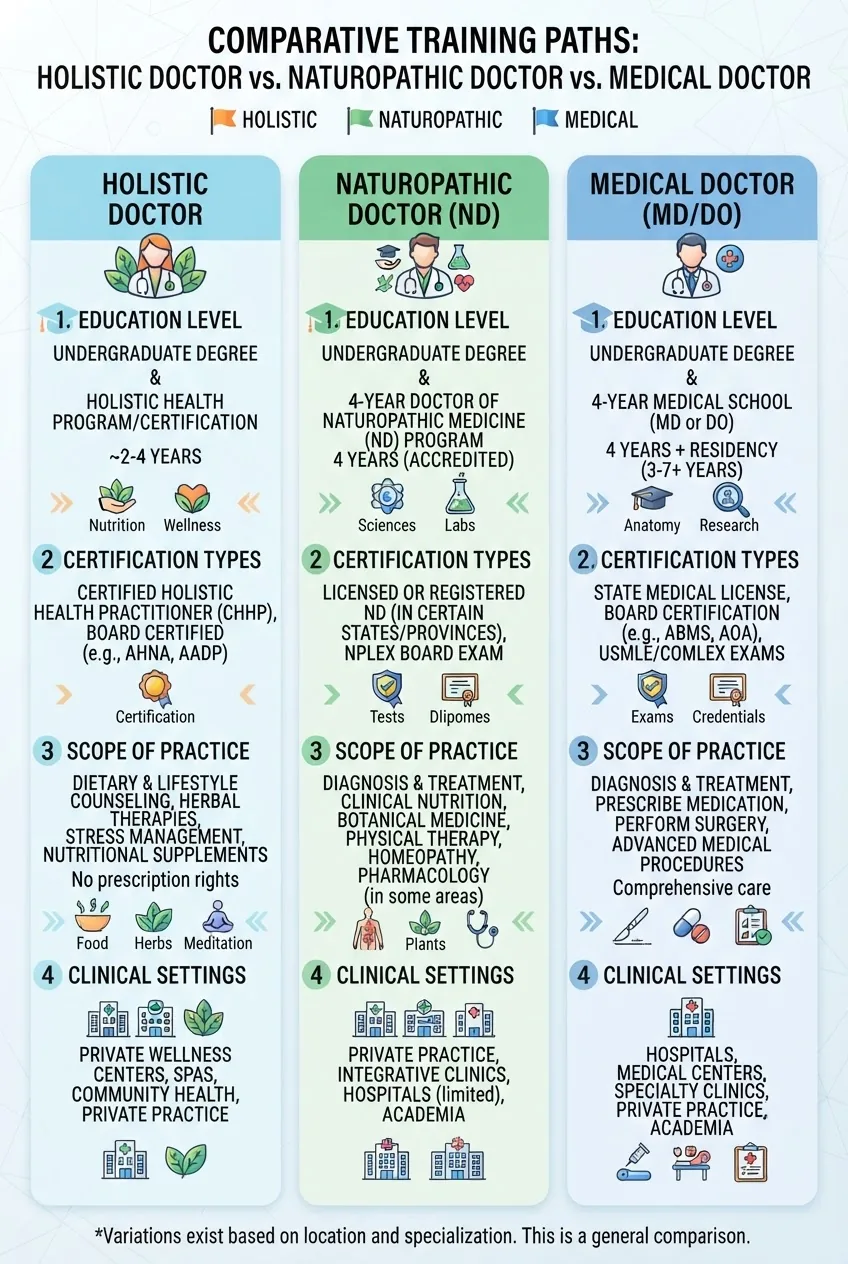
How training paths compare (walkthrough):
- Medical doctor (MD/DO): 6–10 years (medical degree, residency), state or national licensing, full prescriptive authority where licensed.
- Naturopathic doctor (ND): Typically 3–4 year accredited naturopathic doctoral program with biomedical sciences, clinical internships and board examinations where required.
- Holistic allied professions: Varied: registered dietitians, psychologists and nurses have regulated degrees and registration; their “holistic” training may be a short postgraduate course in integrative care.
- Health coaches & holistic nutritionists: Range from 6-week certificate programs to 6–12 month diploma courses; usually non-regulated and non-prescriptive.
Certifications and common credential markers:
- Board or national registration (for MDs/DOs and licensed NDs).
- Accredited degree from recognised institutions (medical schools, accredited naturopathic colleges).
- Postgraduate diplomas or fellowships in integrative/holistic medicine for licensed clinicians.
- Professional association membership (sign of continuing education but not regulation).
- Practical supervised clinical hours and documented internships—especially crucial for naturopathic training.
Practical verification checklist:
- Check school accreditation and program curriculum.
- Confirm supervised clinical hours and internships.
- Verify licensure or registration with state/provincial/national boards where applicable.
- Ask for scope-of-practice documentation and whether the practitioner carries professional indemnity insurance.
For those considering training themselves, review credible courses—see the online health coach certification programs and the holistic nutrition certification.
Authoritative resources and accreditation bodies:
- For naturopathic program recognition and accreditation standards, consult the AANMC (American Association of Naturopathic Medical Colleges).
- For clinical evidence and government perspectives on complementary therapies, consult the NIH National Center for Complementary and Integrative Health (NCCIH).
- For accredited naturopathic and integrative degree programs, review institutional pages such as Bastyr University which lists curricula and clinical training models.
According to AANMC program guidance and accreditation frameworks, students must complete rigorous biomedical coursework and supervised clinical internships—verify these elements when comparing programs and practitioners (According to AANMC program standards, clinical internship and board assessment are core requirements).
Legitimacy and Credentials: Are Holistic Doctors Real Doctors?
Answer: “Holistic doctor” can mean a medically licensed doctor practicing integrative care or a non-medical practitioner using “doctor” as a title; legitimacy depends on the underlying credential—medical registration or accredited naturopathic licensure confers recognised clinical authority.
Term: is a holistic doctor a real doctor asks whether the practitioner holds a recognised medical or doctoral credential—answer depends on whether they are MD/DO, ND or an unregulated title.
Q&A-style clarifications:
- If someone is an MD/DO and calls themselves a holistic doctor: Yes—this denotes a medically qualified doctor applying whole-person approaches; verify board certification and medical registration.
- If someone uses “holistic doctor” without a clear regulated degree: They may hold a non-accredited doctorate or marketing title—ask for degree credentials, registration and scope.
- If they are an ND: In licensed jurisdictions, NDs are recognised clinicians with standardised training; in unlicensed areas, the ND title may not confer legal practice rights.
How to verify legitimacy (experience signals):
- Request the exact degree name and awarding institution; check program accreditation.
- Ask for registration number from the relevant medical or naturopathic licensing board and verify online.
- Confirm insurance and professional indemnity—regulated practitioners normally carry this.
- Check complaints or disciplinary records with local health authorities.
Trust signals and cautions:
- Titles vary internationally; state-by-state or country-specific licensure affects practice rights—always confirm local rules.
- According to a 2024 industry regulatory review, transparency about training and licensure correlates with better patient safety outcomes (According to a 2024 industry report on professional regulation).
- Be cautious of anyone using “doctor” solely as branding without verifiable qualifications.
If you are unsure about a practitioner’s legitimacy, ask for time-stamped education credentials and contact the licensing authority; this protects your care and clarifies whether the provider is a medical-grade practitioner, a licensed ND, or another type of holistic health expert.
How to Find a Qualified Holistic or Naturopathic Practitioner
Answer: Find qualified practitioners by verifying credentials with licensing boards, checking accredited program histories, using professional association directories, and assessing scope, referrals and red flags before booking care.
Term: alternative doctors near me refers to directories and search queries used to find local holistic, naturopathic or integrative practitioners; quality depends on verification methods.
Step-by-step guide:
- Define your needs: primary care, chronic disease support, nutrition or coaching—this determines required credentials (MD/ND vs coach).
- Search trusted directories and association registries for licensed practitioners in your area.
- Verify education and accreditation—ask for school names, program length and supervised clinical hours.
- Confirm licensure or registration online with local boards.
- Request a scope-of-practice statement and referral plan—responsible practitioners will integrate with conventional care when needed.
- Check reviews and ask for a brief pre-consultation to assess fit and safety.
Red flags to avoid:
- Practitioners refusing to share formal credentials or registration details.
- Claims of universal cures, high-cost long-term supplement plans without diagnosis, or discouraging standard medical care for serious conditions.
- Lack of communication about contraindications or interactions with prescription drugs.
Trusted resources:
- Professional associations and licensing boards in your jurisdiction (search for “naturopathic licensing board” or “medical registration” online).
- Specialised referral directories at integrative clinics and hospitals that list collaborating MDs and NDs.
- If you need help finding covered providers, consult the guide to finding alternative practitioners with insurance.
If you want a local wellness coach or practitioner, you can also consult the health coach near me guide to find vetted coaches in your area.
Integration of Holistic and Naturopathic Care in Modern Healthcare
Answer: Holistic and naturopathic care integrate into modern healthcare through collaborative teams and integrative centres where MDs, NDs and allied professionals coordinate care—this model improves continuity, safety and patient-centred treatment options.
Term: integrative care means coordinated healthcare that blends conventional medicine with complementary approaches under multidisciplinary oversight.
Examples of integration:
- Hospital-linked integrative clinics where NDs and integrative MDs consult on chronic pain and supportive oncology.
- Primary care practices where holistic primary care doctors (MDs) incorporate nutritionists and mental health specialists into care plans.
- Community health programs that provide lifestyle, movement and stress-reduction interventions alongside medication management.
For a focused application in mental health, review the collaborative models and evidence described in holistic approach to mental health.
Integrated teams document care plans, share lab results, and use referral pathways—this is the safest model for combining natural therapies with conventional treatment and is increasingly the preferred model in reputable integrative holistic centres.
Conclusion
Holistic vs naturopathic care overlap in philosophy but differ in standardisation, training and legal scope: naturopathic doctors follow accredited, medical-style training and are often licensed where regulated, while holistic practitioners range widely in qualifications. Prioritise verified credentials, clear scope-of-practice and integration with conventional care when choosing a provider. To take the next step, verify credentials, ask for clinical hours and contact local boards or the referral guides linked above to find a trusted practitioner.