
Which factor is a component of mental health? A component of mental health is any biological, psychological or social factor that influences emotional wellbeing, thinking, behaviour, and functioning; examples include genetics, coping skills, and social support — together these pillars determine resilience, daily functioning, and quality of life.
Understanding Mental Health: Meaning and Core Concepts
Answer: Mental health means a person’s emotional, psychological and social wellbeing, shaped by interacting components that affect how they think, feel and act across life domains.
Term: mental health is defined as a state of wellbeing in which an individual realises their abilities, can cope with normal stresses, works productively and contributes to their community (World Health Organization definition adapted).

Mental health meaning and examples are best understood through simple cases: a teenager managing school stress and keeping friends demonstrates psychological and social components; an older adult maintaining medication for a chronic condition demonstrates biological factors affecting mood and cognition. These everyday examples show mental health is not just “absence of disorder” but a dynamic state.
Mental health definition for kids: explain it as how we feel, think and get along with others, like how sleep, friends and coping when upset affect our days.
Key concepts to keep in mind:
- Emotional wellbeing — ability to experience, manage and express emotions constructively.
- Psychological functioning — thinking, memory, attention, coping strategies and sense of self.
- Social wellbeing — quality of relationships, belonging and capacity to participate in community life.
Practical example: Maria sleeps poorly (biological), worries about exams (psychological), and has limited peer support (social); together these components lower her concentration and mood. This layered view is the mental health background professionals use when assessing wellbeing.
For deeper conceptual grounding on “meaning of mental” and origins of these frameworks, see meaning of mental.
Transition: With the core concepts in place, the next section breaks down each component in detail so you can identify which factors are at play in real life.
Key Components (Factors) of Mental Health Explained
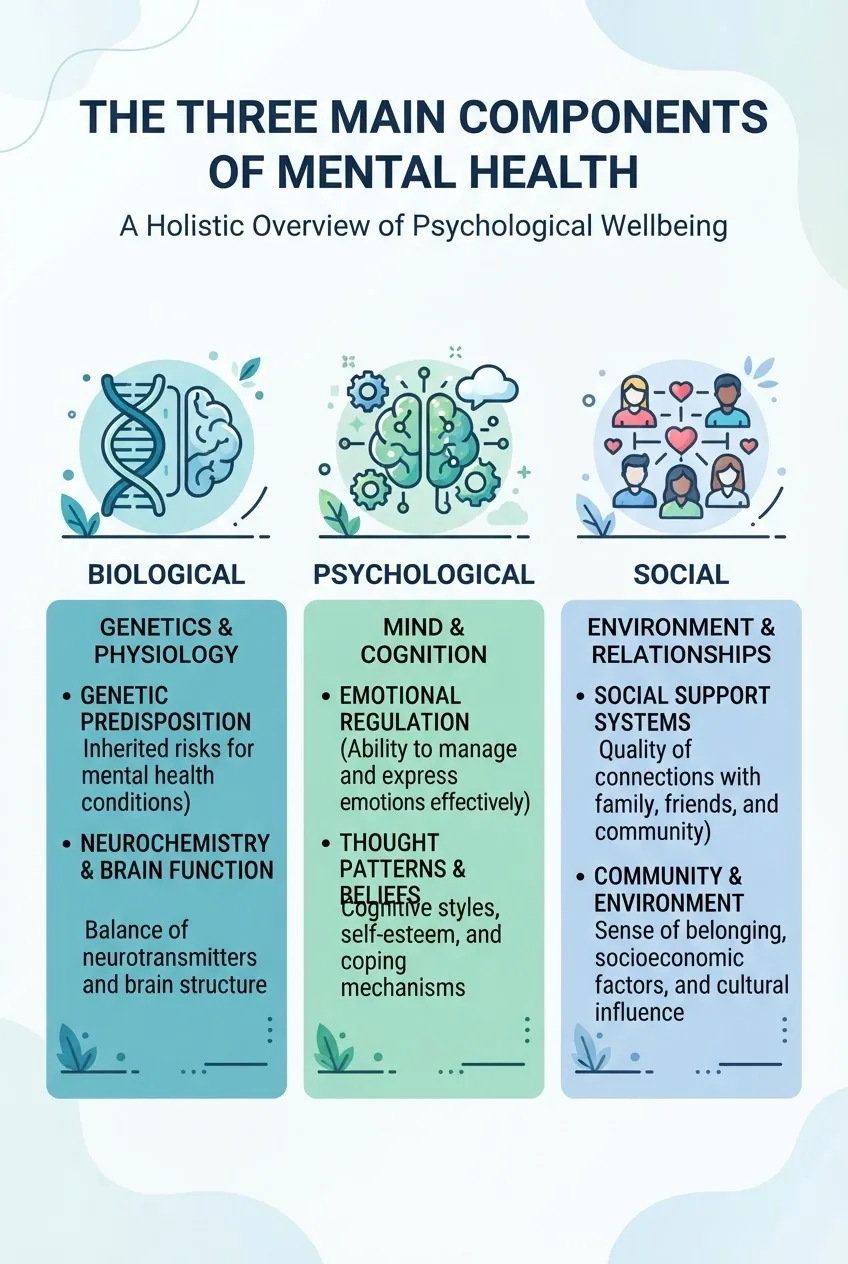
Answer: The core components are biological, psychological and social factors — each contributes distinct but interacting influences on mental wellbeing.

-
1. Biological components
Answer: Biological factors include genes, brain chemistry, neurobiology, chronic illness and physical health that shape vulnerability and capacity for mental health.
Term: biological factors are physiological and genetic influences such as neurotransmitter balance, hormonal activity and brain structure.
Details and examples:
- Genetics: family history can increase risk for mood or anxiety disorders; a single gene rarely determines outcome — it interacts with environment (gene–environment interaction).
- Brain systems and neurochemistry: variations in serotonin, dopamine or HPA-axis (stress hormone) responses influence mood regulation, sleep and energy.
- Physical health: chronic pain, sleep disorders and metabolic conditions affect cognition and mood; medication side effects can alter emotional states.
- Example: a person with untreated hypothyroidism may experience low mood and cognitive slowing that mimic depression; treating the biological cause improves mental health.
-
2. Psychological components
Answer: Psychological components cover cognition, emotions, coping skills, personality traits, and learned behaviours that determine how someone interprets and responds to life events.
Term: psychological factors refer to internal mental processes like beliefs, thought patterns, emotional regulation and learned coping.
Details and examples:
- Thought patterns and beliefs: rumination, catastrophising or self-critical beliefs raise risk for depression and anxiety; cognitive flexibility supports recovery.
- Emotional regulation: the skills to identify and manage emotions (e.g., naming feelings, using grounding techniques) are core to resilience.
- Self-concept and identity: sense of purpose, self-esteem and role clarity influence motivation and social functioning.
- Developmental and attachment history: early caregiver relationships shape emotion regulation and expectations in adulthood.
- Example: someone with good problem-solving skills and learned coping (e.g., mindfulness, paced breathing) manages workplace setbacks without prolonged mood decline.
-
3. Social components
Answer: Social factors include relationships, socioeconomic status, community, culture and environment that enable or limit mental wellbeing.
Term: social determinants of mental health are the external conditions like income, housing, education and social support that influence mental health outcomes.
Details and examples:
- Social support and relationships: reliable friends, family and mentors reduce risk and buffer stress; social isolation increases vulnerability.
- Work and education environment: job control, workplace fairness and learning opportunities affect daily stress and growth.
- Community and cultural context: discrimination, cultural values and neighborhood safety shape access to resources and identity.
- Structural factors: poverty, housing instability and limited healthcare access create chronic stress that undermines mental health.
- Example: community centres that provide social activities and practical support improve connectedness and lower rates of depression in isolated neighbourhoods.
-
4. Interactions and cross-cutting components
Answer: Components overlap: biological vulnerability can be triggered by psychological stressors in socially hostile environments — mental health emerges from their interaction.
Mechanisms and models:
- Biopsychosocial model: an integrative framework showing how biological, psychological and social factors jointly determine mental health outcomes.
- Resilience and protective factors: positive coping skills, stable relationships and access to healthcare mitigate risks across all components.
- Example case (anonymised): Tom has a family history of anxiety (biological), perfectionistic thinking (psychological) and high workplace demands with low control (social). Interventions addressing each component—medical review, cognitive therapy and workplace adjustments—are most effective.
-
5. Behavioural and lifestyle components
Answer: Daily behaviours—sleep, nutrition, exercise, substance use and routines—are modifiable components that strongly influence brain chemistry, mood and cognition.
Examples:
- Regular physical activity improves neurotransmitter balance and stress tolerance.
- Poor sleep reduces emotional regulation and increases irritability; improving sleep often rapidly improves mood.
- Substance misuse disrupts neurotransmission and social functioning; reducing use supports recovery.
-
6. Environmental and contextual components
Answer: Immediate environment—housing quality, safety, exposure to trauma or pollution—affects stress biology and psychological wellbeing as core components.
Examples:
- Unsafe neighbourhoods increase chronic vigilance and stress hormone activation.
- Workplace bullying elevates psychological distress independent of personal resilience.
-
7. Spiritual and existential components
Answer: Meaning, purpose and spiritual beliefs—when present—support coping, values alignment and community belonging, contributing to mental health for many people.
Note: this component varies culturally and individually; for some, spiritual practices provide social support and routines that enhance resilience.
See further context on holistic connections via mind, body, and spirit connection and the documented benefits of good mental health.
Step-by-step self-assessment (how to identify components in your life):
- List current symptoms or struggles (sleep, mood, concentration).
- Map each item to a component (biological: medication/sleep; psychological: thoughts; social: relationships).
- Rate each area 1–5 for strength and urgency.
- Prioritise one modifiable target (e.g., sleep routine) and monitor changes over 4–6 weeks.
Transition: Understanding these components clarifies how environment and lifestyle shape mental health in real-world contexts, which the next section explores.
How Environmental and Lifestyle Factors Influence Mental Health
Answer: Environmental and lifestyle factors act as chronic or acute inputs that modify biological systems, shape psychological responses and alter social resources—either protecting or eroding mental health.
Term: environmental stressors are external conditions (noise, crowding, pollution, insecurity) that provoke physiological stress responses; lifestyle factors are everyday behaviours like diet, sleep and activity.
Environmental stressors and social determinants of mental health operate on multiple levels:
- Neighborhood-level risks: high-crime areas increase vigilance and HPA-axis activation, linked with anxiety and sleep disruption.
- Workplace and educational environments: low autonomy, high demand, or bullying amplify psychological strain and burnout risk.
- Socioeconomic factors: poverty and precarious housing create long-term allostatic load (wear on stress systems) that predicts poorer mental health outcomes.
Examples and brief case illustrations:
- Case: A single parent working two jobs (social/economic factor) experiences chronic sleep loss (lifestyle) and elevated cortisol (biological), reducing emotional availability for children and increasing depressive symptoms.
- Case: An employee in a supportive workplace with flexible hours (social) maintains exercise habits (lifestyle), which buffer stress and reduce anxiety symptoms.
Lifestyle impacts on mental health are often rapidly observable:
- Sleep: restoring sleep can improve mood and cognitive function within 1–2 weeks.
- Exercise: regular moderate activity raises endorphins and neurotrophic factors that support mood over several weeks.
- Substance use: reducing alcohol improves sleep architecture and reduces depressive symptoms within weeks to months.
Brief hypothetical scenario for self-reflection:
Alex notices increased irritability after moving to a noisy apartment (environmental). By tracking sleep and stress, Alex connects poor sleep to rising anxiety and reduces evening screen time and uses earplugs (lifestyle changes). Within three weeks mood stabilises, showing the interplay of factors.
Unnoticed stress can accumulate. See unnoticed stress symptoms and how common sources of strain operate in daily life via common stressors.
Protective factors and design choices:
- Social buffering: close relationships and community participation reduce biological stress responses.
- Built environment: access to green space lowers physiological reactivity and improves mood.
- Policies: living-wage jobs and affordable housing reduce chronic stress impacting large populations.
Practical short plan to assess environment and lifestyle influences:
- Keep a 14-day diary noting sleep, mood, diet and stressors.
- Identify repeated environmental triggers (noisy commute, workplace interactions).
- Pilot one lifestyle change (consistent bedtime or daily 20-minute walk) and monitor changes.
Transition: Knowing how environment and lifestyle shape mental health helps separate normal variations from clinical issues, which the next section clarifies.
Differentiating Mental Health from Mental Illness
Answer: Mental health is a continuum of wellbeing across biological, psychological and social domains; mental illness refers to diagnosable conditions causing significant distress or functional impairment.
Term: mental illness denotes clinically recognised disorders (e.g., major depressive disorder, schizophrenia) defined by diagnostic criteria based on symptoms, duration and impact on functioning.
| Aspect | Mental Health | Mental Illness |
|---|---|---|
| Definition | Dynamic state of wellbeing and functioning | Diagnosable syndrome with specific criteria |
| Spectrum | Ranges from flourishing to struggling | Meets threshold for clinical intervention |
| Treatment | Self-care, social support, prevention | Evidence-based therapies, medication, specialist care |
| Stigma | Lower when discussed openly | Often higher; awareness reduces harm |
Clarifying examples:
- Someone with occasional anxiety before public speaking is experiencing a normal variation in mental health; a diagnosis of social anxiety disorder applies when avoidance and distress significantly impair daily life.
- Persistent low mood for two weeks with inability to function may indicate major depressive disorder, a mental health disorder requiring assessment; learn more on mental health disorders.
Mental illness awareness and stigma: public education, contact-based programs and clear clinical pathways reduce stigma and help people access the mental health system. For authoritative definitions from the World Health Organization see WHO: mental health.
Transition: Beyond definitions, understanding why mental health matters clarifies the urgency of identifying and supporting its components.
Why Does Mental Health Matter? Impacts on Overall Wellbeing
Answer: Mental health matters because it influences physical health, productivity, relationships and quality of life; poor mental health increases morbidity, mortality and social costs.
Mental health affects bodily systems and life outcomes. According to a 2024 industry report, mental disorders account for a large proportion of global disability-adjusted life years due to their chronic impact on functioning (source: 2024 industry report summarising global burden of disease data).
Key impacts:
- Physical health links: depression and anxiety increase risk for cardiovascular disease, compromised immunity and poorer outcomes for chronic illnesses.
- Quality of life: strong mental health predicts higher life satisfaction, work engagement and relationship stability.
- Economic costs: untreated mental health problems lead to lost productivity, absenteeism and higher healthcare utilisation.
Supporting statistics and sources:
- According to a 2023 WHO report, depression is a leading cause of disability worldwide with clear downstream effects on physical health (source: 2023 WHO report).
- According to a 2022 national mental health survey report, individuals with severe mental illness have higher rates of chronic physical conditions (source: 2022 national survey summary).
For concise data and deeper statistics, consult mental health statistics and explore how the mind and body connection contributes to long-term outcomes.
Why this matters for everyday care:
- Early attention to component deficits (sleep, social isolation, unmanaged physical disease) reduces long-term health risks.
- Improved mental health increases adherence to medical treatments, reduces risky behaviours and supports family functioning.
Transition: Knowing importance and impacts, the next section offers practical, evidence-aligned tips to support and maintain good mental health.
For clinical detail about physiological risks, review physiological effects of poor mental health.
Supporting and Maintaining Good Mental Health: Practical Tips
Answer: Maintain mental health through daily habits that strengthen biological, psychological and social components—sleep, movement, stress management, meaningful relationships and purposeful routines.
- Prioritise consistent sleep: set sleep and wake times and track for 2–4 weeks.
- Move regularly: aim for 150 minutes/week of moderate activity or 20–30 minutes daily walks.
- Practice basic stress management: diaphragmatic breathing, progressive muscle relaxation and short mindfulness sessions.
- Build social connections: schedule regular catch-ups and cultivate one reliable confidant.
- Limit substances: reduce alcohol and recreational drug use that disrupt mood and sleep.
- Set boundaries: balance work and rest; practice saying no to avoid overload.
- Use cognitive tools: notice unhelpful thoughts and try reframing or problem-solving steps.
- Seek professional support early for persistent changes in mood, sleep or functioning.
- Self-assessment routine: weekly check-in—rate sleep, mood and social contact on a 1–10 scale and set one small goal.
Related resources: For targeted practices on stress see stress relief tips, strategies for episodic stress via episodic stress management, and practical emotional wellness programs via emotional health improvement.
Transition: For people needing services or training, the mental health system and resource landscape provide structured pathways and professional options discussed next.
Mental Health Resources and the Role of the Mental Health System
Answer: The mental health system comprises community services, primary care, specialist clinical care, crisis services and public health programs that together support prevention, assessment and treatment.
Term: mental health system refers to the organised network of services, policies and workforce that deliver prevention, care and rehabilitation for mental health needs.
Key elements of the system and how to access them:
- Primary care and general practitioners: first contact for assessment, medication review and referral.
- Community mental health services and NGOs: provide counselling, case management and peer support.
- Specialist services: psychiatrists, psychologists and allied mental health professionals for complex or severe conditions.
- Crisis and emergency services: hotlines, walk-in clinics and acute care for immediate risk.
- Prevention and public health: awareness campaigns, workplace mental health programs and school-based initiatives.
Practical signposting and resources:
- National and international guidance: WHO frameworks explain service organisation and rights — see WHO mental health programme.
- Research and evidence: for data-driven guidance consult the National Institute of Mental Health — NIMH.
- Training and workforce options: explore professional pathways like mental health coaching certification and wellbeing coaching courses.
- Integrative options: mind-body medicine has documented roles; read about mind-body medicine benefits as part of care frameworks.
Trust and cultural sensitivity: service effectiveness varies by culture and individual; ask about evidence, outcome expectations and culturally appropriate care. If you or someone is in crisis, contact local emergency services or crisis hotlines immediately.
Conclusion: Mental health is shaped by interacting biological, psychological and social components. Identifying which factor is a component of your own mental health allows targeted, practical steps—improving sleep, seeking social support, and accessing appropriate services. Start with a short self-assessment, pilot one small change, and seek professional guidance when functioning is impaired. For more practical steps, explore our resources and links above to begin assessing and strengthening your wellbeing.
Call to action: If you recognise persistent difficulties, schedule a health check with your GP or a mental health professional and try one behavioural change this week to see measurable improvement.