Ayurveda certification — by the end of this guide you will know exactly which online Ayurveda certification and training courses fit your goals, how to evaluate accreditation, and the practical steps to enroll and apply skills in 4–12 weeks for short certificates or 6–24 months for practitioner-level training. This guide assumes you are a motivated beginner to intermediate learner with basic internet skills and a willingness to apply hands-on practice.
Before you start
- Prerequisites: reliable internet, video-capable device, basic anatomy knowledge recommended for practitioner tracks
- Tools & materials: course platform account (Zoom/Moodle), notebook, basic Ayurvedic texts (see recommended Ayurveda texts), kitchen scale for diet modules
- Time commitment: 3–10 hours/week for short courses, 6–15 hours/week for diploma/practitioner programs
- Budget range: AUD/USD 150–6,000 depending on level, live mentorship, and internship requirements
Follow these hands-on steps to shortlist, evaluate, enroll, complete, and apply an online Ayurveda training course. After the numbered steps you’ll find common mistakes, a verification checklist, and when to call a professional.
- Define your goal and scope — Decide if you want a non-practitioner certificate (wellness coach, hybrid educator) or practitioner-level training (clinical ayurvedic practitioner). Set outcome: e.g., “work as a wellness consultant within 3 months of finishing a 60–80 hour certificate” or “complete a 12-month practitioner diploma with clinical internship.” Write this goal down and assign a hard deadline.
- Map acceptable accreditation and legal limits — Research recognition in your jurisdiction; in the USA many states do not license Ayurveda as a medical practice, so certifications often qualify you for wellness, education, or adjunct clinic roles only. Bookmark professional guidance such as the National Ayurvedic Medical Association. Then compare required accreditation levels for your goal.
- Shortlist courses by format and flexibility — Choose between live interactive classes for clinical skills, recorded modules for self-study, or a blended model. For USA learners, prioritise programs offering clear clinical practicum pathways or supervised internships if you aim to consult professionally.
- Evaluate curriculum and instructor credentials — Check that courses cover core modules: dosha assessment, Ayurvedic diet, pulse/tongue observation basics, herbal materia medica, and lifestyle protocols. Prefer instructors with formal Ayurveda education (e.g., BAMS) or long-term clinical experience and verified student outcomes. Ask for sample lesson plans.
- Compare costs, duration, and deliverables — For each shortlisted program create a simple spreadsheet: price, hours, live vs recorded, certificate vs diploma, internship hours, and refund policy. Aim for a maximum cost-per-hour threshold that suits your budget (e.g., under USD 50/hour for non-practitioner study; practitioner training often USD 100–300/hour with mentorship).
- Check verification and assessment methods — Confirm how competence is assessed: quizzes, case studies, proctored exams, supervised client hours. If you need continuing education credits, verify provider partnerships or CE approval.
- Request alumni outcomes and sample case studies — Ask providers for graduate placement rates, sample case logs, or anonymised clinical case studies demonstrating learning outcomes. Genuine providers will share testimonials and evidence of student work.
- Enroll, schedule, and set milestones — Once selected, book the course, set a weekly study schedule (e.g., Tuesdays/Thursdays 90 minutes, Sunday 2 hours), and create milestone check-ins every 4 weeks. Use a shared calendar for live sessions.
- Practice with supervised case logs — For every client or peer practice session, keep a structured log: intake date, dosha assessment, diet/lifestyle plan, herbs recommended (if allowed), follow-up date, and outcome notes. Aim for 20 practice logs for practitioner-level certificates.
- Complete assessments and convert learning into offerings — Finish all assessments, request a formal certificate with clear wording of scope (e.g., “Ayurvedic Wellness Coach — non-clinical”), and prepare 3 service offerings: group course, one-to-one consultation, and a content piece (e.g., a 6-week diet guide).
Common mistakes and how to avoid them
I’ve seen learners pick a course because it looked “holistic” without checking assessment methods; later they couldn’t demonstrate clinical competency. I now ask for sample assessments before paying. I’ve also watched students underestimate practicum time — schedule 2–4 extra hours weekly for supervised practice if choosing practitioner tracks. Finally, many ignore refund and transfer policies; I always confirm the cancellation window and credit transfer options within the first week.
Post-step checklist
- Goal statement written and dated
- At least three providers compared in spreadsheet
- Accreditation/recognition verified and documented
- Study schedule input into calendar with reminders
- Practicum or peer practice slots booked (if required)
When to call in a professional
Consult an experienced Ayurvedic practitioner or legal advisor if you plan to treat clients for medical conditions, want to open a clinic, or need clarity on state-level scope of practice. For setting up herbal dispensing or clinical records, hire a mentor with an active clinical license or a compliance consultant.
Transition: With practical steps complete, below are the in-depth reference sections that expand on key decisions, program types, top providers, curricula, career outcomes and USA-specific regulatory context.
What Is Ayurveda Certification and Why It Matters
Ayurveda certification is a formal credential issued by a training provider that documents completion of a defined curriculum in Ayurvedic principles and skills. Certification ranges from short certificates (20–100 hours) to diplomas (6–24 months) and academic degrees (BAMS/MD Ayurveda). The credential matters because it clarifies what a graduate is competent to do—educate, coach, or provide non-medical Ayurvedic lifestyle guidance—and it helps employers, clinics, and clients evaluate credibility.
Certification benefits include:
- Structured learning path and measurable outcomes
- Evidence for professional listings or insurance panels (where applicable)
- Access to professional networks and continuing education
- Clearer client communication of scope — e.g., “Ayurvedic Wellness Consultant (non-clinical)”
Scope of certification varies by provider. Many credible online programs include:
- Core theory (doshas, agni, malas), practical skills (pulse observation basics), and lifestyle applications
- Supervised practicums or mentorship for practitioner tracks
- Assessment through case studies, oral exams, and written tests
Professional recognition is nuanced: in the USA, there is no single federal license for Ayurveda. Instead, recognition depends on professional associations and local regulations. According to a 2024 professional body update by the National Ayurvedic Medical Association (professional body), standardized competency frameworks are emerging, but many programs still differ in scope and naming conventions.
Why get certified? If you want to: work as a wellness coach, teach, or integrate Ayurveda into allied health work, a certificate demonstrates knowledge and can increase client trust. If you aim to practice clinically, choose comprehensive practitioner training with supervised case hours and clear post-certification pathways.
Transition: Next, compare the different types of online Ayurveda courses and what each delivers so you can match format to your goal.
Types of Ayurveda Certification and Training Courses Available Online
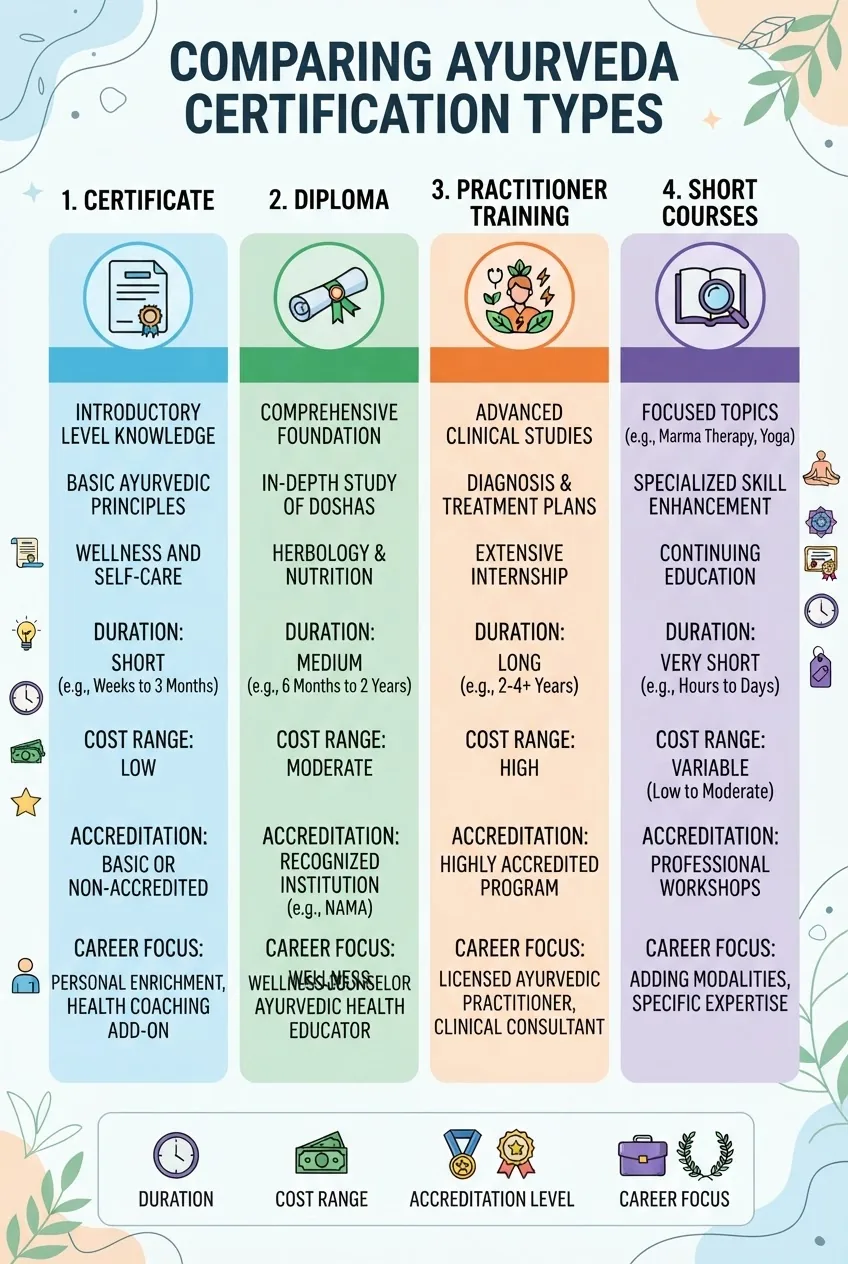
Online Ayurveda training comes in distinct types. Below I list the common formats, what they cover, typical timeframes, and who they suit. Use this numbered list to map your goal to course type.
- Short certificate courses (20–100 hours) — Short courses are usually recorded or mixed live sessions covering introductory topics: dosha basics, simple diet plans, daily routines (dinacharya). Ideal for wellness coaches, yoga teachers, or curious learners. Cost typically USD 150–800. They usually offer a completion certificate but not practitioner licensure.
- Continuing education (CE) modules — These 5–30 hour modules are for health professionals seeking CE credits. Content is narrowly focused (e.g., Ayurveda for digestive health). CE recognition depends on the partner body; check for explicit CE accreditation.
- Professional certificate/diploma (6–24 months) — These are deeper programs with theory, case studies, and supervised practical hours. Expect 300–1,200+ hours including clinical practicum for practitioner-equivalent diplomas. These programs suit those who plan Ayurvedic consulting services or wish to work alongside complementary clinics.
- Practitioner training programs — Designed to mirror clinical training (not a substitute for BAMS), these are immersive, often with mandatory in-person internships or supervised online clinical practicums. They include detailed diagnosis, herbal materia medica study, formulation basics, and treatment planning. Search explicitly for “practitioner training programs” if this is your target.
- Diploma vs Certificate vs Degree — A certificate is short and knowledge-focused; a diploma is longer with assessment and practicals; a degree (BAMS/MD Ayurveda) is an accredited academic qualification typically offered by universities in India and requires full-time study. Online degree options are rare and usually region-bound.
- Live classes — Scheduled Zoom or webinar sessions that allow Q&A and live case reviews. Best for clinical skills and real-time feedback.
- Recorded/self-paced classes — Flexible for learners with time constraints; ensure they include assessment and credible instructor support.
- Blended learning — Combines recorded lessons with live clinics and occasional in-person intensives. Often the best compromise for international learners.
- Short thematic workshops — Topic-focused 1–5 day workshops: herbal formulations, Panchakarma overview, Ayurvedic nutrition. Good for targeted skill-building.
Transition: Now that you’ve seen types, use this decision checklist when choosing your ideal course.
How to Choose the Best Ayurveda Certification Course for You
Choosing the right program is a step-by-step evaluation. Start by listing your outcome (education, career, personal growth), then score providers across key criteria. Use the checklist below and consult foundational readings to cross-validate curricula.
- Course accreditation — Check whether the provider is affiliated with recognized professional bodies or educational institutions. Accreditation varies widely in Ayurveda; demand explicit statements about recognized credentials or CE approvals.
- Curriculum quality — Ensure the curriculum covers both theory and practical application: dosha theory, diagnostics, herbal materia medica, therapeutic diet, and lifestyle protocols. Sample syllabi help compare depth.
- Instructor expertise — Prefer instructors with clinical experience (BAMS, MD Ayurveda, or long-standing clinical practice) and evidence of student mentorship.
- Delivery format — Live clinics for hands-on skills; recorded modules for flexible study. Blended models often provide the best outcomes.
- Assessment & practicum — Look for objective assessments: case-based exams, supervised client hours, and final practical evaluations.
- Duration & scheduling — Match program length to your availability: expect 3–6 months for comprehensive certificates and 12–24 months for practitioner diplomas.
- Cost & refund policy — Confirm full price, instalment plans, scholarship options, and refund windows (e.g., 7–14 day cooling-off period).
- Post-certification support — Check for alumni networks, job boards, clinic referrals, or business setup help.
- Legal & scope clarity — The certificate should state your scope of practice explicitly (e.g., non-medical wellness advice). If you plan to practice clinically in the USA, verify local legal constraints.
- Student outcomes — Request graduate examples: case logs, placements, or testimonials with measurable results.
Suggested supplementary study: review the recommended Ayurveda texts before enrolling to evaluate depth.
Transition: With an evaluation framework in place, here are top online courses to consider in 2024, summarized and compared for USA and global learners.
Top Ayurveda Certification and Training Courses Online in 2024
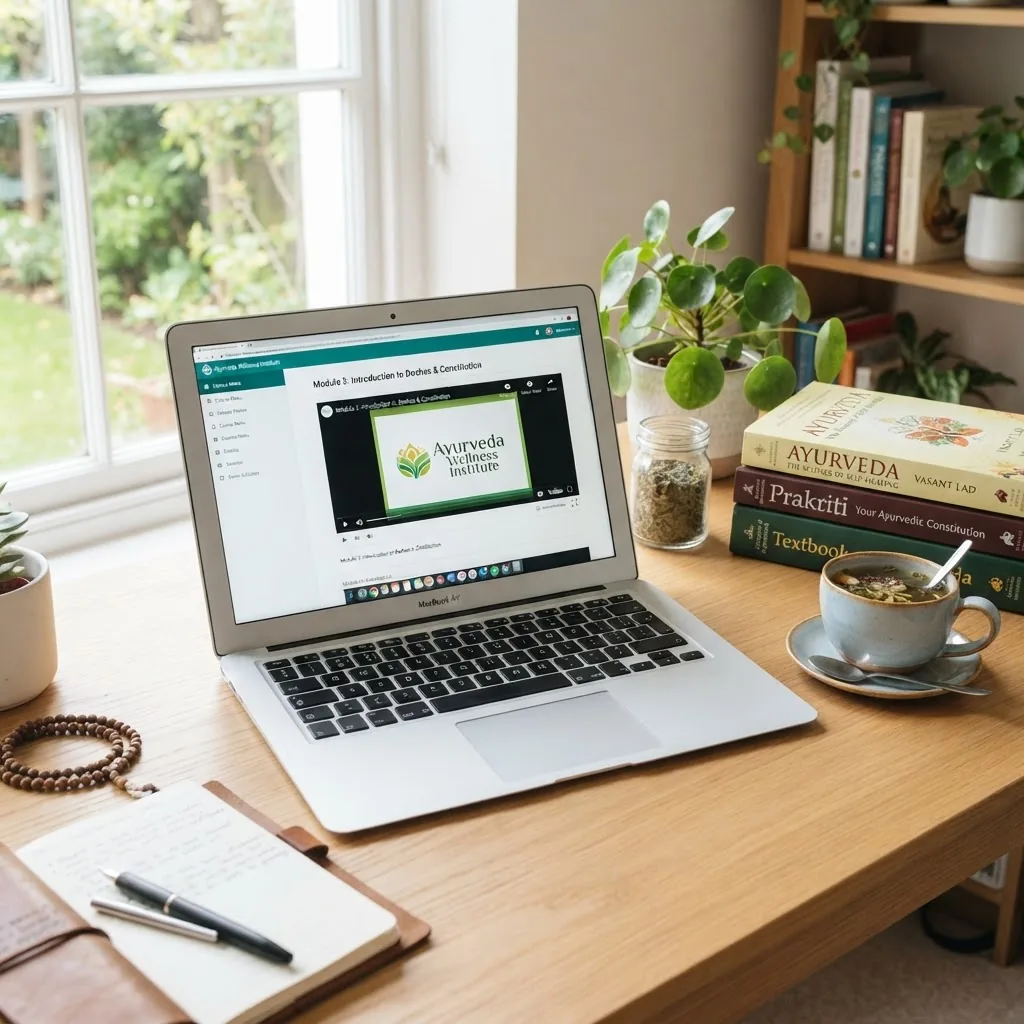
The table below compares selected reputable programs offering online Ayurveda certification and training in 2024, focusing on duration, cost, accreditation, and highlights. Use this as a starting shortlist; verify current pricing and intake dates on each provider site.
| Course & Provider | Duration | Cost (approx.) | Accreditation / Recognition | Highlights |
|---|---|---|---|---|
| The Ayurvedic Institute — Online Practitioner Certificate | 6–12 months | USD 2,000–5,000 | Industry-recognized (clinical mentor-led) | Live clinics, case supervision, strong clinical emphasis |
| Kerala Ayurveda Academy — Professional Ayurvedic Courses | 3–12 months | USD 300–1,800 | International training certificate | Practical herbal workshops, diet modules, USA-accessible |
| American Institute of Vedic Studies — Ayurveda Foundations | 20–80 hours | USD 150–900 | Certificate of completion | Recorded + live seminars, strong textual scholarship |
| Kerala-based University (distance modules) — Diploma options | 12–24 months | USD 800–3,000 | University diploma (region-specific) | Academic rigor, access to classical texts and formulations |
| National Ayurvedic Medical Association (courses) — CE & short courses | 5–40 hours | USD 50–500 | Professional body-recognised modules | CE credits, practice-oriented short workshops |
Course summaries & considerations
The Ayurvedic Institute — Online Practitioner Certificate: An established US-based provider focusing on clinical skills, including supervised case reviews. Best for serious practitioner-track students. Expect synchronous clinic hours and mentorship. Verify intake windows and practicum location requirements.
Kerala Ayurveda Academy — Professional Ayurvedic Courses: Offers practical modules on herbal medicine and lifestyle counselling. Suited to international students seeking affordable course structures with optional intensives.
American Institute of Vedic Studies — Ayurveda Foundations: Strong on textual foundations and philosophy; useful as a complementary academic grounding to applied clinical courses. Good for educators and content creators.
University-based distance diplomas (India): Provide academic diplomas with more rigorous assessments and access to classical formulations. For USA learners, check whether the diploma meets your professional goals and if travel for practicum is needed.
National Ayurvedic Medical Association — CE & short courses: Ideal for allied health professionals seeking CE credits and succinct modules to integrate Ayurveda into existing practice.
Caveat: Accreditation labels in Ayurveda are not universally standardised. Confirm whether a course provides explicit wording on scope of practice and whether it includes supervised clinical hours if you intend to consult professionally. For further credibility checks, consult regulatory guidance from national health agencies.
Transition: Having chosen a program, you’ll want to know exactly what topics are commonly taught. The next section breaks down standard curriculum modules and learning outcomes you should expect.
What You Will Learn in Typical Ayurveda Courses

Typical Ayurveda courses combine theoretical frameworks with practical skills. Below are the major curriculum modules and specific competencies you should be able to demonstrate upon completion.
1. Ayurveda Fundamentals and Theory
Topics: history of Ayurveda, the three dosha concepts (Vata, Pitta, Kapha), prakriti (constitution), vikriti (current imbalance), and basic Sanskrit terms. Outcome: be able to explain dosha types and create baseline lifestyle recommendations.
dosha types and testing — for deeper assessment practice see the linked guide.
2. Diagnostic Techniques and Assessment
Topics: pulse reading introduction, tongue & eye observation, intake interview structure, and basic case-taking templates. Outcome: conduct a structured intake and register findings in a case log for supervisor review.
3. Materia Medica and Herbal Medicine
Topics: common herbs, formulations, safety and sourcing, contraindications, and non-prescriptive advising. Outcome: identify 25–50 common herbs, their dosha actions, and how to recommend over-the-counter herbal products responsibly. For deeper herb and formulation study see the pillar guide.
Ayurvedic supplements and herbal medicine
herbal powders and supplements
4. Nutrition and Therapeutic Diet
Topics: dietary protocols by dosha, seasonal adjustments, and meal planning. Outcome: compose personalized diet plans and meal guides for common imbalances. For focused diet resources see the linked guides.
5. Lifestyle, Daily Routines, and Yoga Integration
Topics: dinacharya (daily routines), ritucharya (seasonal routines), stress management, and safe yoga practices. Outcome: recommend concrete routines with timings, foods, and simple lifestyle prescriptions.
6. Detoxification and Panchakarma Overview
Topics: principles of detoxification, Panchakarma therapies (oil therapies, enemas, and therapeutic steaming), indications, and contraindications. Outcome: refer clients appropriately and understand retreat-based Panchakarma workflows.
detoxification and Panchakarma
7. Formulation Basics and Product Knowledge
Topics: reading labels, sourcing quality herbal products, and simple household formulations. Outcome: guide clients on reputable products and prepare basic decoctions and herbal infusions safely.
8. Ethics, Scope, and Referral Pathways
Topics: boundaries of non-medical practice, referral to medical professionals, record keeping, and informed consent. Outcome: create a client agreement form and a referral checklist for red flags requiring medical attention.
9. Business and Client Management
Topics: creating service offerings, pricing models, digital marketing basics, and telehealth considerations. Outcome: launch one service package and draft three marketing messages tailored to your target audience.
Transition: With curriculum modules clear, read on for practical career and personal growth paths you can pursue post-certification.
Career and Personal Growth Opportunities After Ayurveda Certification
After certification, opportunities depend on your level of training and local regulations. Typical roles:
- Ayurvedic wellness coach/consultant — Provide lifestyle, diet, and herbal guidance within non-clinical scope.
- Clinic assistant or integrative practitioner — Support licensed practitioners in intake, client education, and administering non-invasive therapies.
- Entrepreneurship — Start workshops, online courses, retreats, or sell herbal products (check local regulations).
- Teaching — Lead community classes, corporate wellness sessions, or yoga studio modules.
Examples of practical application:
- Create a 6-week Ayurvedic detox program with clear meal plans, daily routines, and gentle herbal support (non-prescriptive) and price it at USD 200–600 depending on included materials and coaching hours.
- Partner with local wellness centres or yoga studios to offer monthly workshops; most studios expect a 60–90 minute class fee ranging USD 100–250.
- Offer telehealth consultations as a wellness consultant with clear scope statements and referral plans to medical professionals; maintain professional liability insurance if available.
Ayurveda centers near you are useful for internships or clinic collaborations; search local centres for supervised practice opportunities.
Ayurvedic massage therapy and related services are common adjunct careers for certified practitioners.
professional Ayurvedic doctors are essential referral partners for clinical cases beyond your certificate scope.
Transition: If you are in the USA, consider the following regulatory perspective before practicing clinically.
Ayurveda Certification in the USA: Regulations and Recognition
In the USA there is no federal licensure specific to Ayurveda. Regulation happens at the state level and commonly falls under scope-of-practice rules for complementary health. Key considerations:
- Most states do not legally recognise Ayurveda as a licensed medical practice; certified individuals typically operate as wellness consultants, educators, or complementary therapists.
- For clinical practice offering diagnosis or medical treatment, a licensed medical or naturopathic credential may be required depending on state law.
- Professional associations like the National Ayurvedic Medical Association provide competency frameworks and continuing education but are not a substitute for state licensure. For clarity on Ayurveda and health agency positions, consult authoritative resources such as the NIH/NCCIH overview on Ayurvedic medicine.
NCCIH overview of Ayurvedic medicine
Caveats and trust signals: Many certifications explicitly state a non-medical scope. According to a 2024 professional association update (professional body), new voluntary competency frameworks are emerging, but enforcement and legal recognition vary by state (source: professional body statement, 2024). Always confirm your state health department guidance before offering clinical services.
Transition: Final practical tips for getting the most from online learning are below.
Tips for Maximizing Your Online Ayurveda Training Experience
- Set a fixed study routine — 3 sessions/week: two 60–90 minute study blocks and one 2-hour weekend review. Track progress with weekly measurable goals (e.g., “complete Module 3 quiz by Sunday”).
- Create a practice client roster — Recruit 4–8 friends or volunteer clients for supervised practice; schedule 1-hour intake and 30-minute follow-ups over 6 weeks to build 10 practice cases.
- Use case templates — Always use structured case templates with fields: presenting complaint, prakriti, vikriti, diet plan, lifestyle plan, herbal recommendations, follow-up notes. Store securely and anonymise data.
- Engage with cohort and mentors — Join course forums and schedule monthly mentor calls; active engagement increases completion rates. If the course offers a cohort Slack/Discord, spend 30 minutes weekly interacting.
- Practice short, focused micro-habits — Implement one daily dinacharya habit (e.g., warm water on waking) for 21 days and log outcomes to translate learning into lived experience.
- Document learning with video/audio — Record 10-minute case presentations for mentor feedback; aim for at least 5 recorded presentations during the program.
- Verify certificates and wording — Ensure your certificate specifies the course title, hours, assessment types, and scope (non-clinical vs. practitioner). If wording is ambiguous, request clarification before accepting.
- Plan for continuing education — Budget 10% of annual income (or AUD/USD 200–1,000) for ongoing CE to maintain currency in herbal safety and clinical protocols.
Transition: Below are answers to frequently asked practical questions to guide your next steps.